

Friction Hinge vs Torque Hinge: Which One Holds Position Better?

Laptop lid held at 45° by a precision torque hinge — no external support required
Friction Hinge vs. Torque Hinge: The Short Answer
If your panel needs to hold position at any angle — without drifting, without slamming, and without the user holding it — you need either a friction hinge or a torque hinge. Both achieve free-stop functionality, but they do it differently and suit different applications.
Friction hinges work through basic surface contact resistance. They are inexpensive and compact, but torque fades as surfaces wear — typically noticeable after a few thousand cycles. They are the right choice for low-cost, low-frequency applications: toolboxes, makeup mirrors, storage lids.
Scharniere mit Drehmoment (also called precision or constant-torque hinges) use calibrated internal mechanisms — multi-disc friction assemblies, encapsulated spring systems, or polymer friction elements — to deliver consistent, rated torque across tens of thousands of cycles. They cost more upfront but deliver lower total cost of ownership in high-cycle or high-reliability applications.
Quick decision rule: If your product will be opened and closed more than 5,000 times in its lifetime, or if panel drift would be a safety or quality issue, choose a torque hinge. For anything lighter or less critical, a friction hinge is sufficient.
The rest of this article explains the mechanisms, trade-offs, and selection criteria in detail — with real application examples from laptop design, medical equipment, and industrial enclosures. For the full torque calculation method and safety factor guidance, see the Torque Hinge Selection Guide.
Was ist ein Reibungsscharnier?
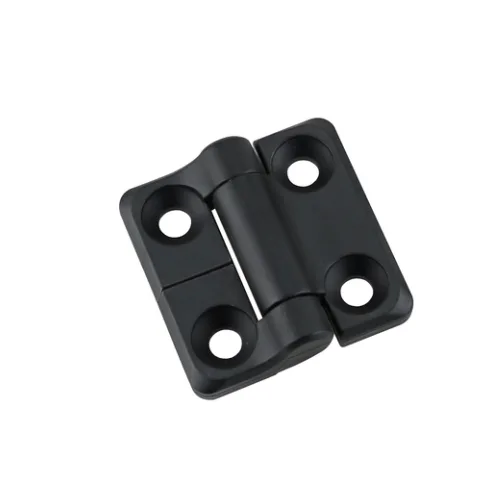
A friction hinge generates holding force through direct surface contact resistance between internal components — spring plates, friction washers, or a tight interference fit between shaft and sleeve. When the panel rotates, this resistance produces damping torque that counteracts the panel’s weight, allowing it to hold at any angle.
Types of Friction Hinges
- Leaf-type: A curved metal leaf clamps around the shaft to create friction. Simple, low-cost, widely used in consumer products.
- Washer-type: Friction is generated by compressing a stack of metal or polymer washers. Slightly more consistent than leaf-type.
- Sleeve-type: A sleeve tightly encircles the rotating shaft, producing controlled resistance. Common in compact electronics.
Strengths and Limitations
- Strengths: Low cost, simple structure, compact footprint, easy to source.
- Torque decay: Friction surfaces wear progressively. In high-cycle applications, noticeable torque loss typically appears within 2,000–5,000 cycles — the panel begins to drift or droop.
- Unit-to-unit variation: Manufacturing tolerances produce significant torque variation between individual units — problematic for products where consistent feel matters.
- Stick-slip effect: Some friction hinge designs exhibit high initial breakaway resistance followed by a sudden drop in running resistance, creating an uneven, jerky feel.
- Environmental sensitivity: Open friction surfaces are vulnerable to dust, moisture, and temperature changes — all of which alter the friction coefficient and therefore the torque output.
Cycle life and durability testing for hinges can be referenced against DIN EN 1935 (Building Hardware – Single-axis Hinges), which covers cyclic and corrosion testing protocols.
Was ist ein Torque-Scharnier?
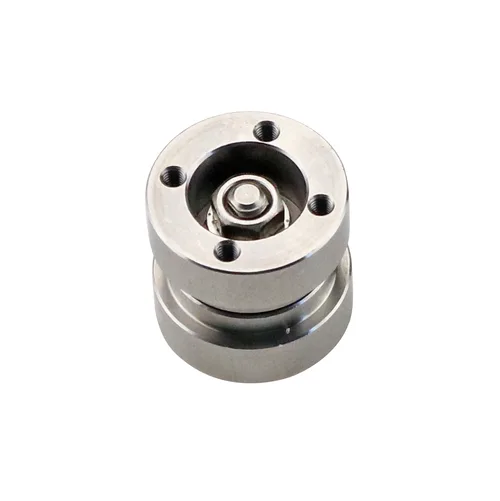
A torque hinge — also called a precision torque hinge or constant-torque hinge — is an engineered evolution of the friction hinge. Where a basic friction hinge relies on surface contact alone, a torque hinge uses a calibrated internal mechanism to deliver a specific, rated torque value that remains stable over the product’s service life.
It is worth clarifying a common source of confusion: most torque hinges also generate holding force through friction — but through precision-controlled friction elements rather than simple surface contact. The key differences are calibration, consistency, and longevity.
Core Technologies
- Multi-disc friction assemblies: Stacked precision discs — similar in concept to automotive clutch packs — distribute wear across multiple surfaces, dramatically extending service life.
- Encapsulated spring systems: Internal springs maintain consistent preload on friction elements throughout the rotation range, reducing torque variation with angle.
- Sealed construction: Factory-filled with specialized grease, sealed against dust and moisture ingress — maintaining consistent performance in harsh environments.
- Factory calibration: Each unit is torque-tested before shipment, ensuring batch-to-batch consistency within ±10–15% of the rated value.
Strengths and Limitations
- Durability: Rated for 10,000–50,000+ cycles with torque decay typically below 15% at end of rated life — validated per ASTM F1574.
- Consistency: Factory-calibrated torque eliminates the unit-to-unit variation that plagues basic friction hinges.
- Premium feel: Smooth, quiet, uniform motion with no stick-slip effect — a measurable contributor to perceived product quality in consumer electronics and medical equipment.
- Environmental resilience: Sealed construction maintains consistent torque output across a wide temperature range (-40°C to +85°C for most industrial grades).
- Beschränkungen: Higher initial cost due to precision manufacturing; slightly larger form factor for equivalent torque output compared to basic friction hinges.
Head-to-Head Comparison
The table below compares friction and torque hinges across the dimensions that matter most for engineering and procurement decisions.
| Dimension | Reibungsscharnier | Präzisions-Drehmomentscharnier |
|---|---|---|
| Torque accuracy | Low — wide tolerance range, varies by unit | High — factory-calibrated to rated value ±10–15% |
| Torque consistency over life | Poor — rapid, unpredictable decay | Excellent — <15% decay over rated cycle life |
| Rated cycle life | Hundreds to low thousands of cycles | 10,000–50,000+ cycles (application dependent) |
| Operating feel | May exhibit stick-slip, noise, or jerky motion | Smooth, uniform, quiet throughout rotation range |
| Environmental resistance | Poor — open to dust, moisture, temperature effects | Excellent — sealed construction, wide temp. range |
| Maintenance requirement | Periodic cleaning or adjustment needed | Maintenance-free (sealed units) |
| Initial unit cost | Low ($2–$15 typical) | Higher ($15–$80+ depending on torque and material) |
| Total cost of ownership | Higher — replacement and downtime costs accumulate | Lower — longer service life reduces lifecycle cost |
| Typical applications | Toolboxes, mirrors, storage lids, toy chests | Laptops, medical monitors, industrial enclosures, EV charging stations |
Decision Guide: Which One Do You Need?
Choose a Friction Hinge When:
- The product is cost-sensitive and low-cycle (under 3,000 lifetime open/close operations)
- Gradual torque decay over time is acceptable — the panel drifting slightly after a year of use is not a functional or safety issue
- The operating environment is clean and temperature-controlled
- Typical products: Toolboxes, makeup mirrors, storage bins, toy chests, low-cost consumer lids
Choose a Precision Torque Hinge When:
- High cycle frequency: The panel is opened and closed multiple times per day — laptops, medical monitors, industrial control panels
- Consistent feel is a quality signal: In premium consumer electronics, medical devices, or automotive interiors, panel feel directly influences perceived product quality
- Harsh environment: Dust, moisture, vibration, wide temperature swings — all conditions that degrade basic friction hinge performance rapidly
- Safety or regulatory requirements: Medical, aerospace, or defense applications where hinge failure or drift is not acceptable
- Typical products: Laptops, medical imaging equipment, industrial enclosures, EV charging stations, copier lids, heavy machinery guards
Real Application Examples
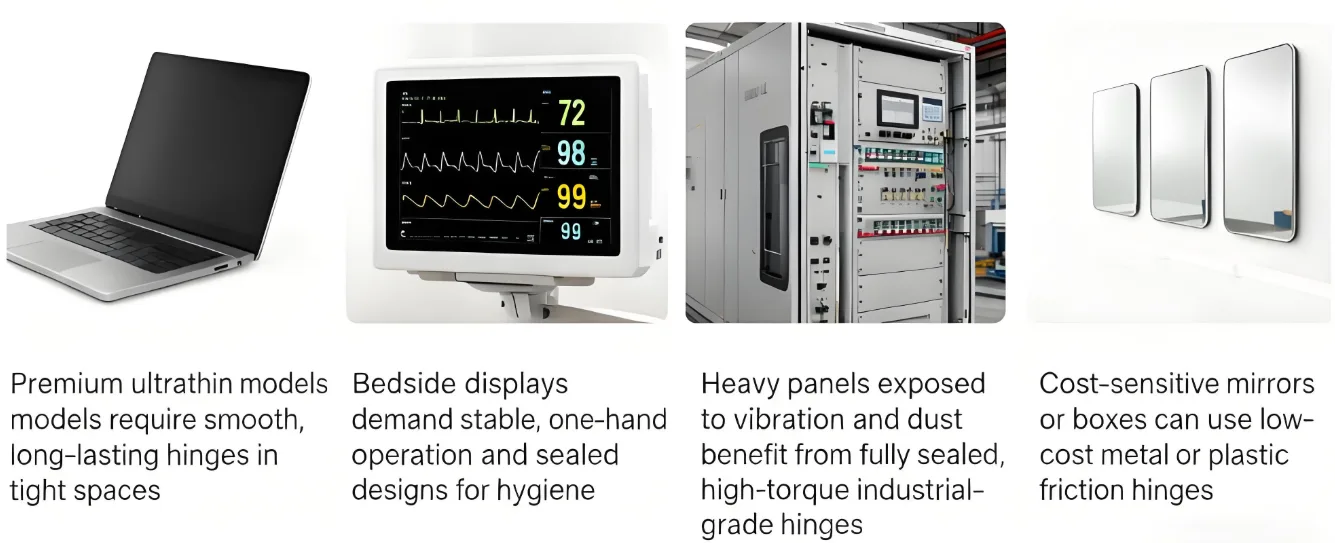
Torque hinges in industrial, medical, and consumer applications
Laptop Displays
Premium ultrabooks require a hinge that holds the display at any angle — including one-hand open — while fitting within a 3–4 mm shaft diameter and surviving 20,000+ open/close cycles. Precision torque hinges with nitrided shafts and flat-wire spring elements meet these requirements. Basic friction hinges lose holding force within the first year of daily use, producing the characteristic “floppy screen” failure common in budget laptops.
Medical Monitors and Display Arms
Bedside and surgical monitors require single-hand repositioning, stable hold at any angle, and surfaces compatible with regular chemical disinfection. Sealed torque hinges with 316L stainless steel construction and PEEK friction elements satisfy both the mechanical and hygiene requirements. A friction hinge in this application typically requires recalibration or replacement within 6–12 months under daily clinical use. For a complete calculation example of a medical display arm application, see Torque Hinge Calculation: Industry Case Studies.
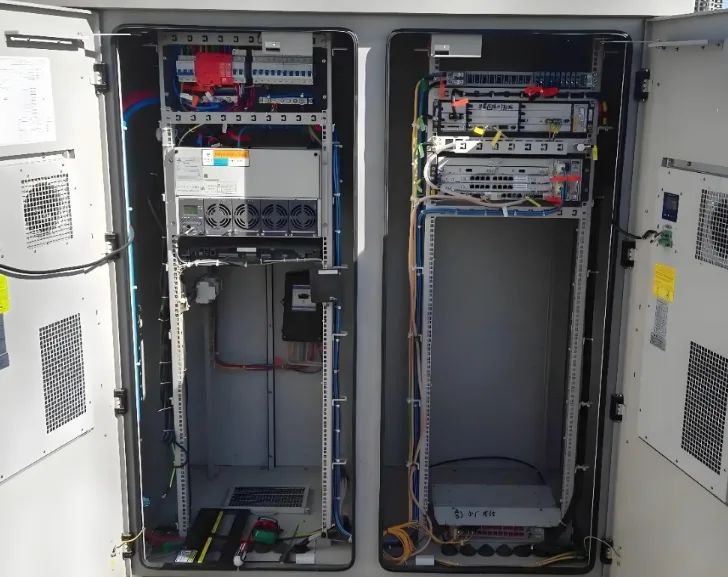
Industrial Control Cabinets
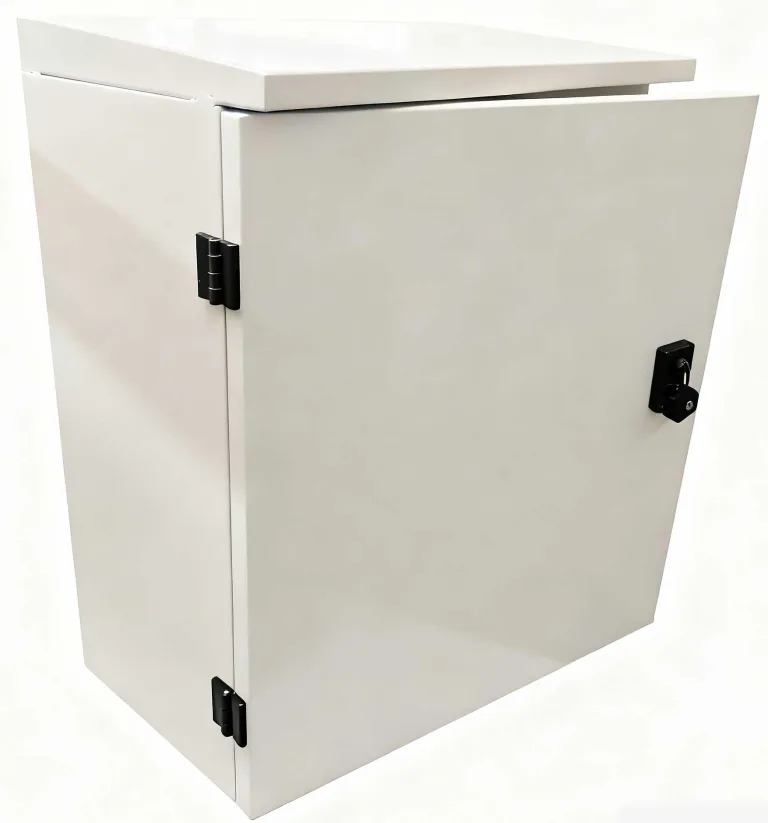
Heavy steel doors on CNC enclosures and electrical cabinets operate in environments with continuous vibration, coolant mist, and wide temperature swings. Fully sealed, high-torque industrial hinges rated for 30,000+ cycles at 20–50 N·m are standard in this sector. An undersized or degraded hinge in this application creates both a safety hazard and a maintenance cost far exceeding the hinge’s original price.
Consumer Storage and Low-Cycle Applications
Cost-sensitive products — makeup mirrors, storage bins, toolboxes — that are opened a few times per day and replaced or discarded within 2–3 years are well-served by basic friction hinges. The lower cost is appropriate because the cycle life requirement is modest and performance drift over time is acceptable to the end user.
How to Calculate Required Torque
Before selecting either hinge type, calculate the torque your application actually requires. The fundamental formula is:
Treq = W × L × sin(θ)
- W = Panel weight in Newtons (kg × 9.81)
- L = Moment arm: distance from hinge axis to panel center of gravity (meters)
- θ = Opening angle — peak torque occurs at 90° (horizontal), where sin θ = 1
Apply a safety factor of 1.2–1.5 for stable indoor use, or 1.5–2.0 for vibrating or outdoor environments. Divide the result by the number of hinges to get the per-hinge specification.
For worked examples with real values — including a laptop display (0.30 N·m per hinge), a medical arm (13.0 N·m), and a heavy industrial door (25.0 N·m per hinge) — see How to Calculate Torque Hinge Requirements: Industry Case Studies.
Installation und Wartung
Installation Best Practices
- Coaxial alignment: All hinge pivot axes must be strictly collinear. Even a 0.5° misalignment creates uneven torque loading and accelerates wear. Reference ISO 1101 geometric tolerance for coaxiality requirements.
- Even load distribution: In a two-hinge configuration, verify that panel weight is shared approximately equally — asymmetric loading overloads the higher-loaded hinge and shortens its service life disproportionately.
- Fastener torque control: Over-tightening mounting screws deforms the hinge housing and permanently alters the torque output. Use a torque-limiting driver — small hinges typically require only 0.6–1.1 N·m (5–10 in·lbf) of fastener torque.
Wartung
- Torque hinges (sealed): Maintenance-free. Do not disassemble or add lubricant — doing so introduces contamination into the precision friction mechanism and typically reduces torque immediately.
- Friction hinges: Keep friction surfaces clean and dry. Compression adjustment may temporarily restore torque, but it does not reverse wear — treat it as a short-term measure before replacement.
FAQ
Q1: Are friction hinges and torque hinges the same thing?
They overlap in function but not in performance. Both achieve free-stop holding through friction, but a precision torque hinge uses a calibrated, sealed mechanism that maintains consistent torque over tens of thousands of cycles. A basic friction hinge uses simple surface contact that wears and drifts relatively quickly. For most engineering applications, “torque hinge” implies the precision variant.
Q2: My panel is only 1.5 kg. Do I really need a torque hinge?
It depends on cycle frequency and environment, not just weight. A 1.5 kg laptop display opened 10 times per day reaches 3,650 cycles per year — well within the range where a basic friction hinge starts to degrade. If the product is used daily, operates in a dusty or humid environment, or needs to feel premium, a torque hinge is the correct choice even at light loads. If it is opened occasionally and performance drift after 2–3 years is acceptable, a friction hinge is fine.
Q3: Can I adjust a friction hinge when it becomes too loose?
Some designs allow compression adjustment — tightening a fastener that increases preload on the friction surfaces. This temporarily restores holding force but does not reverse the underlying wear. In most cases, adjusted friction hinges require re-adjustment within a few months in high-cycle applications. A torque hinge with a rated service life eliminates this maintenance cycle entirely.
Q4: What is the typical cost difference?
Basic friction hinges range from approximately $2–$15 per unit depending on size and material. Precision torque hinges typically range from $15–$80+ per unit. For a product requiring hinge replacement every 1–2 years, the total lifecycle cost of the friction hinge option often exceeds the one-time cost of a properly specified torque hinge — particularly when downtime or labour costs are factored in.
Q5: Which hinge type is used in laptops?
All modern laptops rated at mid-range and above use precision torque hinges — typically bidirectional, non-indexed, with torque values in the 0.25–0.45 N·m per hinge range for a 13–15-inch display. Budget laptops sometimes use friction hinges to reduce BOM cost, and this is the primary mechanical reason they develop “loose screen” issues within 18–24 months of regular use.
Schlussfolgerung
Friction hinges and torque hinges solve the same problem — holding a panel at any angle — but at different performance and cost levels. The decision is straightforward once you know your cycle count, environment, and quality expectations:
- Under 3,000 lifetime cycles, controlled environment, cost-sensitive → Reibscharnier
- High cycle count, harsh environment, premium feel, or safety-critical application → precision torque hinge
For the next step — calculating the specific torque value your application requires — see the Torque Hinge Selection Guide, or contact our engineering team directly for application-specific guidance.

 Deutsch
  English
  한국어
한국어  Русский
  Español
  Italiano
  Français
  Português