

Ball-Joint Torque Hinges: Multi-Direction Positioning
Most positioning hinges answer a one-dimensional question: at what angle around a single axis should the panel stop and stay? But some equipment needs more than that. A camera that has to aim anywhere in a hemisphere, a sensor that must be pointed at a moving target, an inspection light that needs to reach into an awkward cavity — none of these are satisfied by rotation around one fixed line. They need to hold a chosen direction in space, not just a chosen angle. That is the job of a ball-joint torque hinge, and this guide explains how it works, where it earns its place over a single-axis hinge, and how to specify one correctly.
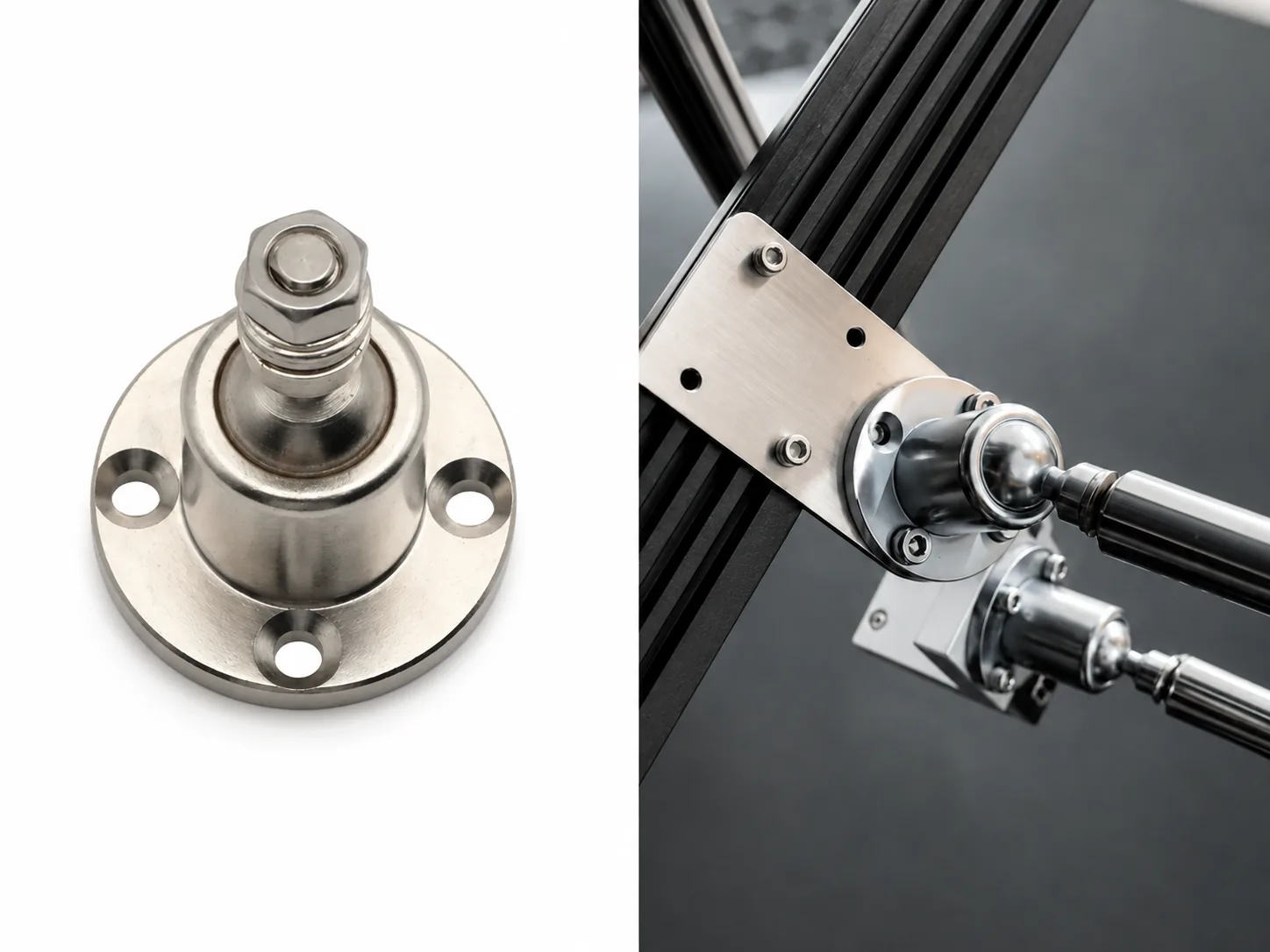
When Should You Use a Ball-Joint Torque Hinge?
Use a ball-joint torque hinge when the mounted part needs to aim in multiple directions and hold that direction without a locking knob, set screw, or separate clamp. It is best for light to moderate components such as cameras, sensors, inspection lights, antennas, and small displays. Use a single-axis torque hinge instead when the part only opens around one line, carries a heavy off-center load, or needs maximum rigidity.
| Требование | Лучший выбор |
|---|---|
| Open and hold around one line | Single-axis torque hinge |
| Tilt and swivel through two linked axes | Двухосевой моментный шарнир |
| Aim freely within a cone or hemisphere | Ball-joint torque hinge |
| Heavy or off-center panel | Single-axis or paired hinge |
| Camera, sensor, light, or small display | Ball-joint torque hinge |
| Exact repeatable stop angle | Detented or single-axis solution |
Single-Axis, Dual-Axis, and Ball-Joint: The Core Difference
The fastest way to understand a ball-joint torque hinge is to compare how many directions of motion each hinge type actually controls. This single distinction drives almost every selection decision, so it is worth being precise about it.
| Тип петли | Degrees of Freedom | What It Can Do | Типичное использование |
|---|---|---|---|
| Single-axis torque hinge | One (rotation about one line) | Holds a lid, screen, or panel at any angle around a fixed pivot | Covers, displays, access doors |
| Двухосевой моментный шарнир | Two (two separate rotation lines) | Holds position on two planes, usually tilt plus swivel through two linked joints | Folding arms, two-plane brackets |
| Ball-joint torque hinge | Multi-direction about one point | Holds an aimed direction anywhere within a cone, combining tilt and rotation at a single ball center | Cameras, sensors, lights, pointing mounts |
A single-axis hinge rotates around one line. A dual-axis design adds a second, separate axis so the load can move on two planes — but each axis is still a distinct hinge with its own pivot. A ball-joint hinge is different in kind, not just in count: it uses a ball held in a socket, so the load can tilt and rotate freely about a single center point and hold any aimed position within its range. Instead of asking “what angle,” it answers “what direction.”
If your application only ever needs to stop at angles around one line, you do not need a ball joint — a standard torque hinge is simpler, stronger, and cheaper. The added cost is justified only when the requirement is genuinely multi-directional.
How a Ball-Joint Torque Hinge Holds Position
The holding principle is the same friction physics that any torque hinge relies on, applied to a spherical contact instead of a cylindrical shaft. A ball is captured inside a socket under a controlled clamping force. That clamping pressure creates friction across the spherical contact surface, and the friction is what resists movement and holds the aimed position once the user lets go.
Because the contact is a sphere rather than a single axis, the resistance acts in every tilt and rotation direction at once. The user can push the mounted part to a new orientation, and when they release it, the ball stays put — no locking lever, no set screw to tighten for each move. The clamping force is set so the joint holds the intended load against gravity and minor disturbance, while still allowing deliberate repositioning by hand.
This is the defining advantage: continuous, lock-free positioning across a range of directions, held by friction alone. It is also the source of the main trade-off, which we will get to — a spherical friction joint behaves differently from a single-axis hinge when it comes to load capacity and stiffness.
When a Ball Joint Is the Right Choice
A ball-joint torque hinge is the correct category when the mounted component has to be aimed, not just opened. The clearest signals are below.
- The component must point in a direction, not stop at an angle. Cameras, scanners, antennas, sensors, and lights all need to aim at a target that may sit anywhere in a region of space, not on one fixed plane.
- The aim has to be adjusted often and quickly. If an operator repositions the part many times a shift, a lock-free friction hold that moves by hand and stays put is far faster than loosening and retightening a clamp.
- Tilt and rotation are both required at one point. When a single mounting location must provide both up-down tilt and side-to-side rotation, one ball joint replaces a stack of two separate single-axis hinges, saving space and part count.
- The fine final orientation cannot be predicted at design time. If the exact aim depends on where the equipment is installed or what it is looking at, a continuously adjustable joint is more practical than fixed detents.
The common thread is aiming freedom. Whenever the real requirement is “point this anywhere in a range and have it stay there,” the ball joint is doing something a single-axis hinge structurally cannot.
When a Single-Axis Hinge Is the Better Call
Multi-direction freedom is not free. A ball-and-socket joint concentrates its holding force over a spherical contact, which generally means it suits lighter, well-balanced loads better than a heavy panel hanging off-center. There are clear cases where a single-axis torque hinge is the smarter, stronger choice.
- The motion is genuinely one-dimensional. A lid, door, or screen that only opens and closes around one line gains nothing from a ball joint and gives up rigidity for freedom it never uses.
- The load is heavy or strongly off-center. A large moment around a single point is harder for a spherical joint to hold than for a sized single-axis hinge or a matched pair. Heavy covers usually belong on single-axis hardware.
- Maximum stiffness matters. Where the panel must resist vibration or external force without any give in unwanted directions, the constrained motion of a single-axis hinge is an advantage, not a limitation.
- Repeatable fixed angles are needed. If the part must return to exact, defined stops, detented single-axis hardware does that more reliably than a free spherical hold.
Put simply: choose a ball joint for aiming freedom, and a single-axis hinge for holding a heavy or one-dimensional load with maximum rigidity. The key is matching the joint to the real motion requirement.
Reading “360°” Correctly
The phrase “360° positioning” gets used loosely, and it causes real specification errors. It can mean two completely different things, and a ball joint only delivers one of them.
- Full rotation about one axis. A part spins a complete turn around a single line. Plenty of single-axis torque hinges already do this — it is one degree of freedom, just unrestricted.
- Aiming anywhere in a hemisphere. A part can be pointed in any direction within a cone or dome of space. This is multi-direction freedom, and it is what a ball joint provides.
Before specifying a ball joint, confirm which one the application actually needs. If you only need a part to spin around one axis, a single-axis hinge with full rotation is simpler and stronger. Reach for a ball joint when the requirement is to aim freely in more than one plane. Getting this distinction right early prevents both over-engineering and under-specifying.
Типовые применения
Ball-joint torque hinges show up wherever something has to be aimed and held. Recurring examples include:
- Cameras and vision systems on inspection rigs, security mounts, and machine-vision stations, where the field of view must be set anywhere and stay fixed.
- Sensors and scanners that must be pointed at a target whose position is not known until installation.
- Inspection and task lights that need to direct a beam into changing or awkward locations and hold it there hands-free.
- Displays and readouts on equipment where operators of different heights and positions need to angle the screen freely.
- Antennas and emitters that must be oriented toward a source or receiver and then left undisturbed.
In each case the load is usually light to moderate and the value is in the aiming freedom — the exact profile a ball joint suits best.
How to Specify a Ball-Joint Torque Hinge
Specifying a ball joint shares some inputs with any torque hinge, but adds a few that are unique to spherical motion. Work through these before requesting a quote or sample.
| Параметр | Почему это важно |
|---|---|
| Mounted load weight | Sets the clamping force needed to hold the aimed position against gravity |
| Offset from the ball center | A load held far from the center creates a larger moment the joint must resist |
| Required motion range | Defines the tilt cone and rotation the joint must cover — full hemisphere or a narrower band |
| Holding firmness vs adjust effort | Higher friction holds heavier loads but takes more force to reposition; the balance is application-specific |
| Монтажный интерфейс | Flange, threaded stud, or custom base — confirm how the joint attaches on both sides |
| Материал и окружающая среда | Stainless steel for washdown, humid, or corrosive settings; plated steel for cost-sensitive indoor use |
| Adjustment frequency | Frequent repositioning favors a smooth, lock-free hold; set-once aiming can run firmer |
The two parameters engineers most often overlook are the offset from the ball center and the firmness-versus-effort balance. A light component on a long arm can produce the same holding demand as a heavier component close in, because what the joint resists is the moment, not just the weight. And a joint tuned to hold firmly may feel too stiff if an operator has to re-aim it dozens of times a day. Tell your supplier both the load geometry and how often it will be moved, so the clamping force can be matched to the real duty.
As with any positioning hinge, confirm the holding behavior on a representative sample before committing to production. Our sample testing checklist covers how to validate holding, user force, and durability on the real assembly — for a ball joint, run that check through the full intended aiming range, not just one position, since a joint that holds at one orientation may behave differently at the edge of its travel.
Распространенные ошибки, которых следует избегать
- Specifying a ball joint for one-axis motion. If the part only opens and closes around one line, a single-axis hinge holds it more rigidly for less cost.
- Ignoring the load offset. Sizing by weight alone misses the moment created by a load held far from the ball center, which is what the joint actually has to resist.
- Confusing single-axis full rotation with multi-direction aiming. “360°” can mean either; specify which one the application needs.
- Over-clamping for the sake of holding. A joint set too firm to drift may be too stiff to adjust comfortably. Balance holding against repositioning effort.
- Testing at one position only. Validate holding across the full aiming range, since friction and balance change with orientation.
Часто задаваемые вопросы
What is a ball-joint torque hinge?
It is a positioning hinge that uses a ball held in a socket instead of a single rotating shaft. Controlled clamping force creates friction across the spherical contact, so the mounted part can be tilted and rotated to aim in any direction within its range and then holds that position without a lock. It controls direction rather than just an angle around one axis.
How is a ball joint different from a single-axis or dual-axis torque hinge?
A single-axis hinge rotates about one line and holds an angle. A dual-axis design adds a second separate axis for two-plane motion through two linked joints. A ball joint moves about a single center point and can aim freely across a range of tilt and rotation directions at once. Choose a ball joint when the load must be pointed in a direction, not just stopped at an angle.
Does a ball-joint hinge give true 360° positioning?
It depends on what 360° means for the application. A ball joint lets a part aim anywhere within a cone or hemisphere of directions, which is multi-direction freedom. If you only need full rotation around one axis, that is a different requirement that a single-axis hinge can already meet. Confirm whether you need full rotation about one line or free aiming in more than one plane before specifying.
Can a ball-joint torque hinge hold a heavy load?
Ball joints are best suited to light and moderate, well-balanced loads. What the joint resists is the moment created by the load and its offset from the ball center, so a light part on a long arm can be as demanding as a heavier part held close in. For heavy or strongly off-center panels, a sized single-axis hinge or a matched pair is usually the better choice.
What products use ball-joint torque hinges?
They are common wherever something must be aimed and held: cameras and vision systems, sensors and scanners, inspection and task lights, freely angled displays, and antennas or emitters. The shared requirement is the ability to point a component anywhere in a range and have it stay there hands-free.
Specifying the Right Joint for the Job
A ball-joint torque hinge solves a problem single-axis hardware cannot: holding an aimed direction freely in space, by friction, with no lock to set. When a camera, sensor, light, or display has to be pointed anywhere in a range and stay there, it is the right tool. When the motion is one-dimensional, or the load is heavy and off-center, a single-axis torque hinge holds it better for less. The decision comes down to one practical engineering question — does the part need to stop at an angle, or aim in a direction?
HTAN manufactures both single-axis torque hinges and ball-joint positioning hardware, and can tailor the clamping force, motion range, mounting interface, and material to your application. Browse our диапазон крутящего момента шарнира или связаться с HTAN with your load weight, offset, aiming range, and mounting details for a recommendation.


 Русский
  English
  한국어
한국어  Español
  Italiano
  Deutsch
  Français
  Português