

Industrial Butt Hinges: Selection, Sizing and Applications
Two industrial butt hinges can share the same overall length and still behave very differently in the same door. One may place the pin close enough to the frame for a clean 180-degree swing. The other may drive the door edge into a return flange before it reaches 90 degrees. Both may fit the bolt pattern. Only one fits the assembly.
That is why industrial butt hinges should not be selected from leaf length or a generic load label alone. The useful sequence is more physical: locate the pivot axis, test the closed and open envelopes, define the mounting interface, then compare the pin, knuckle, leaf, and material against the service conditions.
HTAN groups products by functions and market-recognized families such as Heavy Duty, Concealed, Lift-Off, Weld-On, and Torque. Butt hinge is different. It describes a basic architecture: two leaves joined by interleaved knuckles around a pin. A butt-style product may therefore appear within another commercial category. Engineers reviewing HTAN’s industrial hinge range should identify the architecture before relying on the category name.
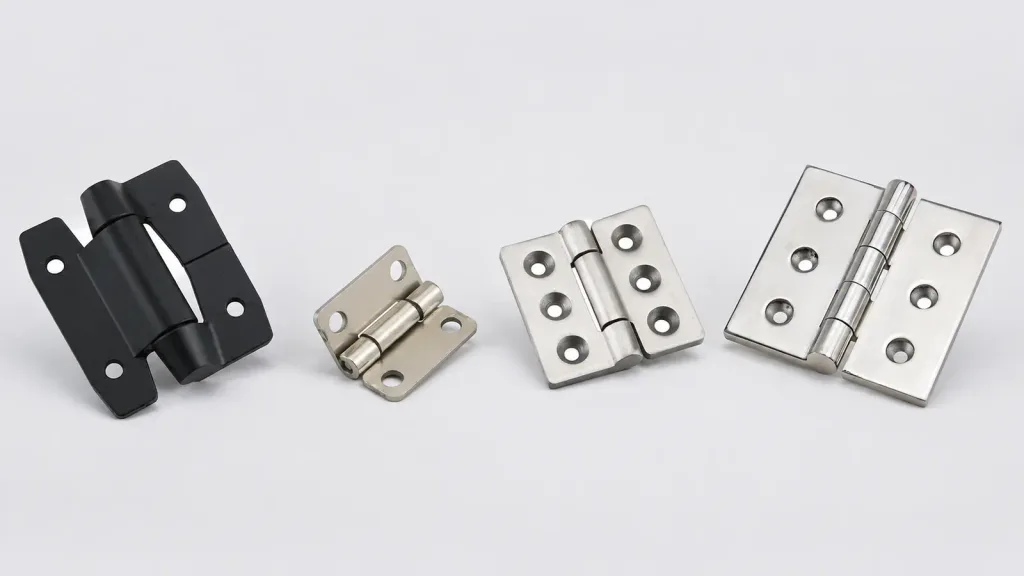
Working rule: Select the hinge around the door-and-frame geometry first. A capacity statement becomes useful only after the load direction, number of hinges, mounting structure, and test basis are known.
Butt Hinge Is an Architecture
A conventional butt hinge has two leaves, a knuckle stack, and a pin that establishes the rotation axis. The leaves attach to the moving panel and the stationary structure. As the panel opens, one leaf rotates around the pin while the other remains fixed.
That definition does not tell an engineer how much load the hinge can carry. It also says nothing about corrosion resistance, pin retention, cycle life, or whether the hinge is welded, bolted, surface-mounted, or partly recessed. Those are separate attributes.
- Butt hinge describes the leaf-knuckle-pin architecture.
- Heavy duty describes an intended performance level, not one geometry.
- Weld-on or bolt-on describes how load enters the door and frame.
- Stainless steel, carbon steel, zinc alloy, or polymer describes material choices.
- Concealed, surface-mounted, or partially recessed describes installation position and visibility.
These labels can overlap. A hinge can be a stainless steel, bolt-on, surface-mounted, heavy-duty butt hinge at the same time. Treating the labels as competing product types creates weak specifications because it mixes geometry, performance, attachment, and material in one decision.
Start at the Closed Door
The closed position establishes the first hard constraints. The leaves must sit against real mounting surfaces without forcing the door out of plane. The knuckle must clear the frame return, gasket channel, trim, nearby fasteners, and any folded sheet-metal edge. A drawing that shows the hinge by itself cannot prove this.
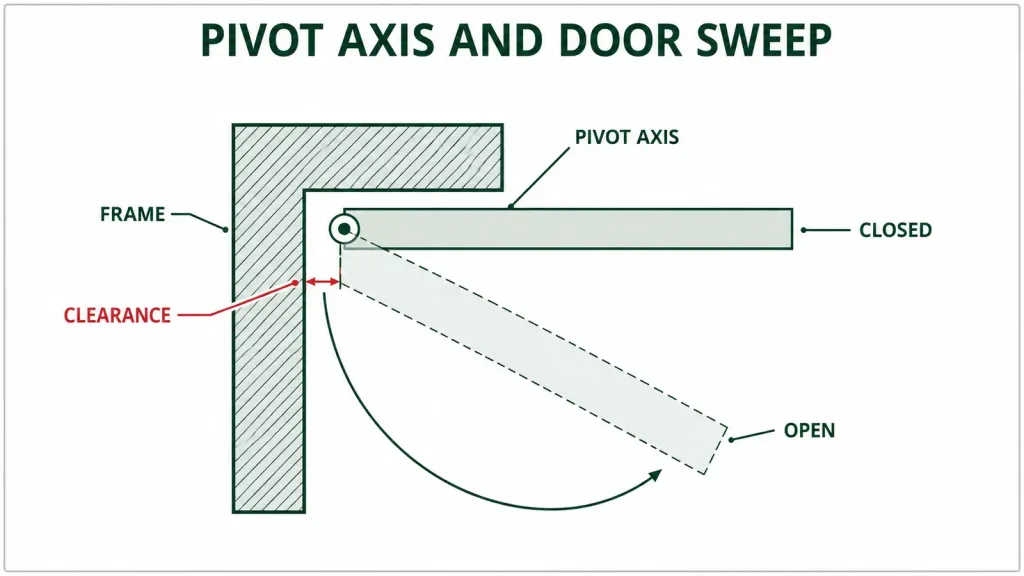
Begin with a section through the hinge axis. Include the door skin, frame flange, reinforcement, gasket, fastener heads, weld access, and the maximum permissible exterior projection. Then place the candidate hinge in that section. The pin centerline must be located relative to stable door and frame datums, not to a floating illustration.
Axis offset changes the swing. Moving the pin outward can create clearance around a thick door edge or gasketed return, but it also increases projection and can increase the moment applied to the leaf and mounting joint. Moving it inward reduces projection, yet may make the door edge collide with the frame. Neither direction is automatically better.
The sweep is larger than the hinge
Rotate the complete door section through the required angle. Watch the nearest corners, formed returns, gasket bulb, screw heads, and knuckle ends. A small CAD interference near the axis can become paint damage, gasket scuffing, high opening force, or a hard stop in production.
The drawing may fit. The panel can still bind.
Industrial Butt Hinge Dimensions
Overall height and open width are useful catalog filters, but they do not completely describe an industrial butt hinge. A defensible comparison needs the dimensions that control fit, load transfer, rotation, and assembly.
| Dimension or Feature | Cosa controlla | What to Compare |
|---|---|---|
| Overall hinge height | Available attachment length and knuckle span | Available straight mounting length on the door and frame |
| Open width | Total leaf spread in the flat position | Mounting-face width, edge distance, and exterior projection |
| Leaf width | Distance from pin area to the outer leaf edge | Fastener or weld placement and local bending path |
| Leaf thickness | Local leaf stiffness and fastener-seat geometry | Forming, recess depth, countersink feasibility, and surrounding sheet thickness |
| Diametro del perno | Pin contact geometry and available bearing area | Pin material, supported length, fit, and wear interface |
| Knuckle outside diameter | Projection, clearance, and knuckle wall section | Frame return, door edge, gasket, and tool clearance |
| Knuckle segment length | Contact distribution along the pin | Leaf arrangement, end clearance, and load direction |
| Pin centerline offset | Door sweep and lever arm into the mounting joint | Closed section, required opening angle, and nearby obstructions |
| Hole diameter and pattern | Fastener fit and load entry points | Edge distance, substrate thickness, inserts, nuts, and assembly tolerance |
| Closed thickness | Door stand-off and installed stack height | Door gap, gasket compression, shims, and mating surfaces |
| Axial endplay | Vertical movement along the pin axis | Door position, washer or thrust interface, and acceptable movement |
| Radial clearance | Free rotation and lateral play | Pin-to-bore fit, finish thickness, contamination, and wear allowance |
Dimensions must be read as a system. A larger pin inside a thin or poorly supported knuckle may not improve durability. A thicker leaf can move the door outward and alter the gasket line. A longer slot can ease assembly but may allow position drift unless the joint develops enough clamp force.
Leaf Size Is Not Load Capacity
Leaf size is visible, so it becomes an easy purchasing shortcut. It is also an incomplete predictor. Door load reaches the hinge through the door-side attachment, crosses the rotating interface at the knuckle and pin, then returns through the frame-side attachment. The weakest part of that path governs the assembly.
A broad stainless steel leaf may look stronger than a smaller carbon steel hinge. Yet the broad leaf can be mounted to thin sheet with weak inserts, while the smaller hinge may be welded to a reinforced frame. The second assembly can have the more credible load path even though its catalog outline is smaller.
The same warning applies to published kilogram or pound values. A number is not transferable until its basis is known: one hinge or a pair, vertical or horizontal orientation, static proof load or repeated cycling, door center-of-gravity distance, mounting substrate, fasteners, safety margin, and allowable permanent movement. A rating without those conditions is a comparison clue, not final approval.
A common engineering conflict: The hinge fits the drawing and the supplier’s stated load exceeds the door weight, but the door still drops at the latch side. The missing variable is often not hinge length. It may be the center-of-gravity offset, flexible mounting flange, fastener slip, poor support spacing, or unequal load sharing between hinges.
When the project has a heavy door, a wide center-of-gravity offset, impact, or a top-opening lid, move the system-level calculation to the dedicated metodo di selezione delle cerniere per impieghi gravosi. The butt hinge page should establish the candidate geometry; it should not invent a universal door-weight formula.
Inside the Knuckle Stack
The knuckle stack determines how the two leaves share the pin. Common arrangements alternate two and three knuckles, although industrial designs vary. The important details are the length and wall condition of each loaded segment, the pin support, the gaps between adjacent knuckles, and the end features that retain the pin.
Radial load acts across the pin and bore. Axial load acts along the hinge axis and can be carried by knuckle end faces, thrust washers, shoulders, or separate bearing features. These are different interfaces. A copper, polymer, or stainless thrust washer between knuckle faces can reduce direct end-face contact, but it does not automatically provide radial support inside the bore.
Plain bore, bushing, or rolling bearing
A plain-bore hinge places the pin directly against the knuckle bore. It is compact and economical when load, cycle count, contamination, clearance growth, and maintenance expectations are compatible with that contact.
A bushing introduces a replaceable or lower-friction radial interface. That can improve wear behavior, but only if the bushing material, wall thickness, housing fit, shaft finish, temperature, moisture, and contamination are considered together. A loose bushing outside diameter creates housing play; a worn inside diameter creates pin play. They look similar at the door edge but call for different corrective action.
Rolling bearings can reduce friction under suitable conditions, but they add envelope, sealing, fit, and cost requirements. They are not a default upgrade for every cabinet door. Dust, washdown, shock, poor alignment, or a flexible mounting structure can erase the expected benefit.
Pin retention follows service conditions
A removable pin supports disassembly. A headed, peened, staked, clipped, threaded, or otherwise retained pin reduces the chance of axial migration. The correct choice depends on whether door removal is required, which direction gravity acts, whether the equipment vibrates, and whether a released door would create a safety or service problem.
Do not specify “removable” and “cannot migrate in service” as though they are the same requirement. The design needs a retention method that permits the intended maintenance action while resisting unintended motion.
Mounting Interface Carries the Decision
The leaf is only one member of the joint. A bolted leaf depends on fastener preload, hole condition, bearing area, substrate thickness, reinforcement, and access to the back side. A welded leaf depends on weld location, heat input, fixture control, parent material, and the distance between the weld zone and the rotating interface.
Round holes locate the hinge more positively when the hole pattern and assembly process are controlled. Slotted holes provide adjustment in a chosen direction. The slot does not solve every tolerance problem; it merely allows movement before final clamp-up. If both leaves can slide in several directions, the installer can also lock the two hinge axes into a poor relationship.
- Keep adequate material between the hole and leaf edge.
- Check whether the screw head or washer interferes during rotation.
- Place reinforcement where the load enters the door and frame.
- Make sure tools, nuts, weld guns, and inspection access exist in the assembled product.
- Account for coatings, paint buildup, shims, and sealing layers in the final stack.
A thick hinge mounted to an unsupported sheet-metal return is still attached to an unsupported sheet-metal return. Increasing leaf thickness without strengthening the receiving structure can move the deformation into the panel, fastener holes, inserts, or weld-adjacent material.
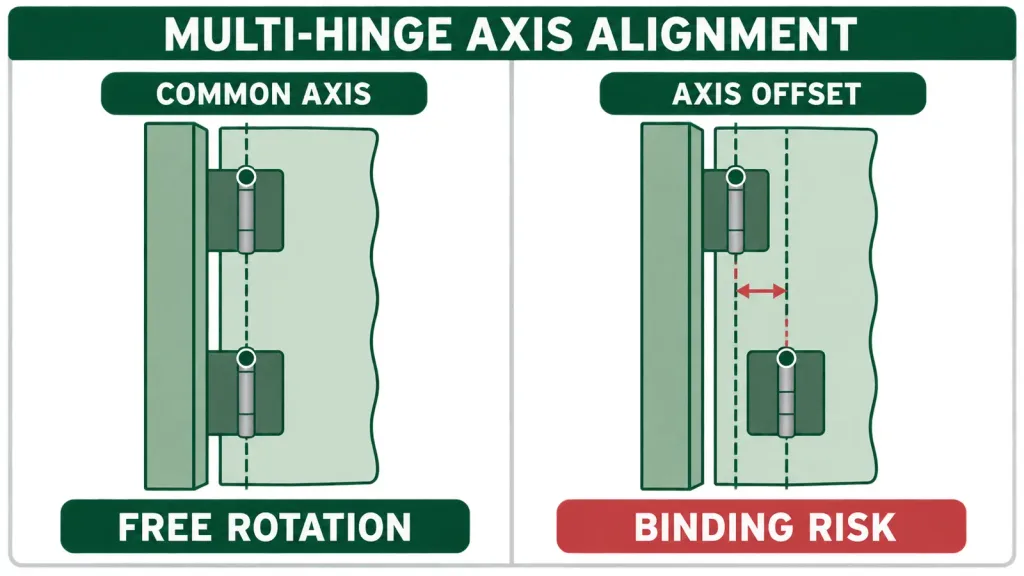
One Hinge Fits; a Pair Can Bind
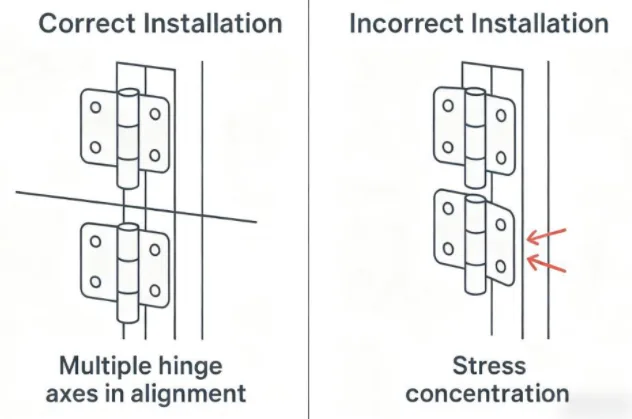
A single loose hinge can rotate around its own axis even when the installation surfaces are imperfect. Two or more hinges create a shared axis requirement. If their pin centerlines are offset, angled, or displaced by door twist, the assembly may force the pins against opposite sides of their bores.
The result can be misleading. The hinge feels smooth on the bench. The mounted door becomes stiff. An installer enlarges holes or loosens fasteners, and the door starts moving again, but now the joint can slip and lose alignment in service.
Alignment should be established from the assembled door and frame, not by measuring each hinge independently and assuming the axes will coincide. Fixture strategy, datum choice, hole tolerance, weld sequence, panel flatness, and coating thickness can all alter the installed axis.
Multiple hinges add another layer because fixture variation, mounting tolerance, panel distortion, and support stiffness affect whether the installed pivots share one functional axis. The detailed release method belongs in the guide to multi-hinge door alignment and specification. For butt hinge selection, the essential rule is narrower: every hinge in the set must be able to reach the same installed axis without forcing the structure into position.
Material Follows the Exposure
Material selection begins after the architecture and load path are credible. Stainless steel can be appropriate for wet, hygienic, outdoor, or appearance-sensitive equipment. Coated carbon steel can be practical in controlled environments and can provide a robust structural section. Zinc alloy supports compact cast geometries but must be judged by the actual section, pin design, mounting interface, and exposure. Polymer components may reduce corrosion or friction in selected interfaces, yet temperature, creep, moisture absorption, and load still matter.
The word “stainless” does not define the entire hinge. Ask about the leaf, pin, bushing, washers, fasteners, and any retained hardware separately. A stainless leaf with a dissimilar pin or unprotected mounting screw can create a different corrosion path from an all-stainless assembly.
Surface finish also changes dimensions at the interface. Plating, powder coating, passivation, polishing, and paint masking affect fit in different ways. A coating that bridges a knuckle gap or enters a close bore can increase opening force before the hinge has carried any door load.
Where Butt Hinges Work Well
Industrial butt hinges are a strong candidate when the application needs a compact discrete pivot, two accessible mounting leaves, and free rotation without built-in position control. Their value is not limited to conventional doors. The same architecture can support access panels, guards, covers, hatches, instrument housings, and service openings.
| Condizioni di applicazione | Why a Butt Hinge May Fit | Design Question That Remains |
|---|---|---|
| Electrical or control cabinet door | Compact surface-mounted or recessed pivot with familiar installation | Will the axis clear the return flange, gasket, and latch-side compression? |
| Machine guard or service panel | Discrete hinges leave open space along the door edge | Are pin retention, guarding gaps, and repeated access addressed? |
| Industrial equipment access door | Wide choice of leaf shapes, materials, and mounting patterns | Can the frame transfer the door moment without local distortion? |
| Struttura per esterni | Stainless or protected versions can support exposed installations | How are water traps, galvanic interfaces, pin exposure, and seal alignment controlled? |
| Removable maintenance door | A deliberately removable pin can permit planned disassembly | Can the pin be secured against unintended migration? |
| Heavy fabricated door | Reinforced leaves and knuckles can form a robust discrete support | What test basis, hinge spacing, mounting structure, and safety margin support the choice? |
| Short lid with separate stay or gas spring | The butt hinge provides rotation while another component controls motion | Do the assist-device forces overload or twist the hinge mounting? |
For heavier fabricated doors and equipment panels, the heavy-duty industrial hinge models provide a practical product-level starting point. The category narrows the catalog. It does not replace an application review.
When Another Architecture Fits Better
A butt hinge is not the default answer to every rotating panel. The required service action may point elsewhere.
- Frequent tool-free door removal: a lift-off architecture may be faster and less dependent on extracting a pin.
- No visible external hardware: a concealed hinge may place the mechanism inside the enclosure, provided the internal sweep and mounting structure are available.
- Hold-open or free-stop behavior: a torque hinge, counterbalance mechanism, lid stay, or separate support may be required. A free-swing butt hinge does not create controlled positioning.
- Self-closing action: a spring or cam mechanism may be more appropriate than adding friction to a plain pin.
- Severe projection limits: a recessed pivot or application-specific concealed arrangement may fit where an external knuckle does not.
The correct question is not “Which hinge is strongest?” It is “Which architecture performs the required service action without creating a new clearance, mounting, or maintenance problem?”
A Drawing Answers Only Part of the Question
A product photograph confirms general form. A dimension drawing confirms nominal geometry. A material statement identifies named materials or grades. None of those, alone, proves installed capacity or long-term door alignment.
Take the HTAN XG02-208 product data as an example. It identifies a 62 × 87 mm SUS304 hinge with a brushed finish, 4 mm material thickness, and oval mounting holes. Those details establish the nominal envelope, material, finish, section thickness, and available mounting adjustment.
They do not establish the allowable moment on an installed door. That decision still needs the door’s center-of-gravity offset, hinge quantity and spacing, mounting substrate, fasteners, load direction, and test basis. The product data is useful. The unsupported conclusion is not.
Read the data in this order:
- Architettura: leaf arrangement, knuckle stack, pin retention, removable features, washers, bushings, or bearings.
- Installed geometry: open width, closed thickness, pivot offset, projection, required recess, and rotation envelope.
- Mounting interface: hole size, slot direction, edge distance, fastener access, weld land, and receiving structure.
- Pila di materiali: leaves, pin, bushings, washers, fasteners, coatings, and dissimilar-metal interfaces.
- Performance evidence: rating conditions, test fixture, hinge quantity, load direction, cycles, allowable movement, and post-test function.
This layered reading prevents a common error: upgrading one visible attribute while leaving the governing interface unchanged. A larger hinge with the same weak substrate is not a complete upgrade. A stainless hinge with an exposed carbon-steel fastener is not a complete corrosion strategy. A bushing added to a misaligned hinge set is not an alignment correction.
A Model Review Needs Assembly Data
A useful model recommendation starts with the assembly, not with a request for “something similar” to a photograph. Send the supplier enough information to place the hinge axis and understand how the joint is loaded.
- Door or lid height, width, thickness, material, and finished mass
- Center-of-gravity location, including hardware mounted on the moving panel
- Door and frame section through the proposed hinge axis
- Required opening angle and nearby interference zones
- Mounting materials, thicknesses, reinforcements, fasteners, inserts, or weld access
- Proposed hinge quantity and approximate locations
- Orientation, vibration, shock, washdown, outdoor exposure, contamination, and temperature range
- Need for door removal, pin security, grounding, sealing, or restricted projection
- Expected operating frequency and any project-specific cycle target
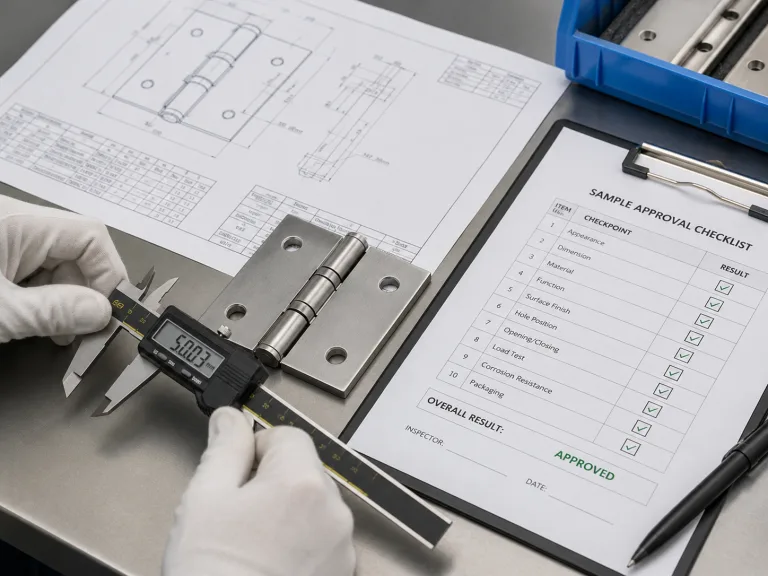
- Acceptance evidence required with samples or production parts
If the exact mass or center of gravity is not yet available, label the recommendation preliminary. That is more useful than hiding an assumption inside a precise-looking model choice.
Selection Path for Industrial Butt Hinges
The table below is a screening path, not a substitute for an assembly review. It keeps the decisions in the order that prevents the most rework.
| Stato del progetto | Butt Hinge Direction | Prossima azione ingegneristica |
|---|---|---|
| Two usable mounting faces and enough knuckle clearance | Butt hinge architecture is feasible | Place the pin centerline in the closed-door section |
| Door edge collides before reaching the required angle | Do not solve by leaf length alone | Revise axis offset, recess, door return, or hinge architecture |
| Light or moderate access panel with rigid mounting faces | Plain-bore butt hinge may be suitable | Review clearance, pin retention, cycle needs, and sample motion |
| Frequent cycling or controlled wear is important | Bushed or bearing-supported design may be justified | Define radial interface, alignment, environment, and replacement strategy |
| Heavy or wide door | Geometry screening is only the first step | Calculate the complete load path, support spacing, and mounting demand |
| Multiple hinges on fabricated sheet metal | Common-axis control is essential | Define datums, fixturing, hole tolerance, and assembly verification |
| Vibration or mobile equipment | Pin retention becomes a primary requirement | Choose a secure retention method and inspect axial migration risk |
| Outdoor, washdown, or corrosive service | Material must be specified as a complete stack | Review leaves, pin, bushings, washers, fasteners, finish, and drainage |
| Regular tool-free door removal | Standard butt hinge may add service time | Compare removable-pin and lift-off service actions |
| Panel must hold position or close in a controlled way | Free-swing butt hinge is incomplete | Add or select the required motion-control architecture |
An industrial butt hinge is ready for sample evaluation when its installed axis, closed and open envelopes, mounting interface, material stack, and pin system all match the same assembly. Load approval still belongs to the complete door, hinge set, fasteners or welds, reinforcement, and frame.
Send the Door Section, Not Just the Hinge Size
Share the door-and-frame section, finished door mass, center-of-gravity location, opening angle, mounting materials, hinge quantity, service environment, and removal requirements. HTAN can use those inputs to identify relevant models and the assumptions that still require sample or assembly verification.
Industrial Butt Hinge FAQ
What is an industrial butt hinge?
An industrial butt hinge uses two leaves joined by interleaved knuckles around a pin. The term describes the hinge architecture, not a load rating, material, mounting method, or cycle-life class.
How do I size an industrial butt hinge?
First place the pin centerline in a section of the actual door and frame. Then compare overall height, leaf width and thickness, pin and knuckle dimensions, closed thickness, hole pattern, radial clearance, and axial endplay. Door-load approval also requires the door mass, center of gravity, hinge quantity, spacing, mounting structure, and rating basis.
Does a larger butt hinge always carry more weight?
No. A larger leaf may provide more attachment area, but installed capacity can still be limited by the pin and knuckle, fasteners or welds, thin sheet, reinforcement, frame stiffness, hinge spacing, alignment, and the door’s center-of-gravity offset.
What is the difference between a butt hinge and a heavy-duty hinge?
Butt hinge describes a two-leaf, knuckle-and-pin architecture. Heavy duty describes an intended performance level. A product can be both, but not every heavy-duty hinge uses a conventional butt-hinge layout.
When should an industrial butt hinge use a bushing?
A bushing may be justified when cycle frequency, load, friction, replaceability, or controlled wear make a plain pin-to-bore interface unsuitable. The bushing material, shaft finish, housing fit, alignment, temperature, moisture, and contamination must still match the application.
Can slotted mounting holes correct hinge misalignment?
Slots can provide adjustment before final tightening, but they do not create a common axis by themselves. Door twist, frame flatness, fixture error, coating thickness, and movement during clamp-up can still leave multiple hinges misaligned.
What information should I send for a butt hinge recommendation?
Send the door and frame section, door dimensions and finished mass, center-of-gravity location, required opening angle, mounting materials and thicknesses, proposed hinge quantity, environment, operating frequency, and any need for removable or securely retained pins.


 Italiano
  English
  한국어
한국어  Русский
  Español
  Deutsch
  Français
  Português