

How to Select the Right Heavy-Duty Hinge for Industrial Doors and Lids
Una metodologia ingegneristica per prevenire i guasti, garantire la sicurezza e ottimizzare l'ergonomia.
Heavy-duty lids and panels—such as industrial machine guards, large storage container lids, equipment access hatches, and enclosure doors—present a significant engineering challenge. They are not only heavy. They are inherently hazardous if the hinge system is selected incorrectly.
Choosing the right heavy-duty hinges is not simply a matter of load rating. Engineers must evaluate torque, center of gravity, opening angle, operating environment, vibration, corrosion exposure, installation geometry, and whether the system needs pure hinging, lift assistance, counterbalance, or damping.
Il costo di sbagliare
Choosing the wrong hinge leads to predictable field failures. These are some of the most common and most costly outcomes:
- Operator safety risks: sudden lid closure can create finger, limb, or head-crushing injuries.
- Operator fatigue and injury: excessive opening force increases ergonomic risk and long-term strain.
- Equipment damage: slamming lids deform frames, damage seals, and misalign precision components.
- Premature failure: the hinge wears, bends, loosens, or breaks long before the expected lifecycle.
- Maintenance cost escalation: once field repairs begin, door alignment checks, rework, and unplanned downtime quickly multiply.
The goal of this guide is not to act as a product catalog. It is a problem-solving methodology. The correct heavy-duty hinge should be selected through a structured engineering process so the system is safe, reliable, and easy to operate from the start.
Fase uno: raccolta dei dati critici (definire i parametri dell'applicazione)
I 6 parametri fondamentali da raccogliere
- Precise lid or panel geometry: length, width, and thickness.
- Precise lid or panel weight: actual measured weight, not an estimate.
- Center of gravity (COG): this defines the true moment load on the hinge.
- Lid or panel material: carbon steel, stainless steel, aluminum, or composite. This affects both weight and mounting method.
- Mounting frame geometry and material: what the hinge is fixed to determines fastener strategy and structural stiffness.
- Motion and positioning requirements: required opening angle, installation orientation, and whether the user needs free-stop, lift-assist, counterbalance, or soft-close behavior.
Without these six parameters, heavy-duty hinge selection is guesswork. In field failures, the root problem is often not the hinge itself but the fact that the hinge was selected before the application was properly defined.
Fase due: calcoli fondamentali (quantificazione dei requisiti di assistenza)
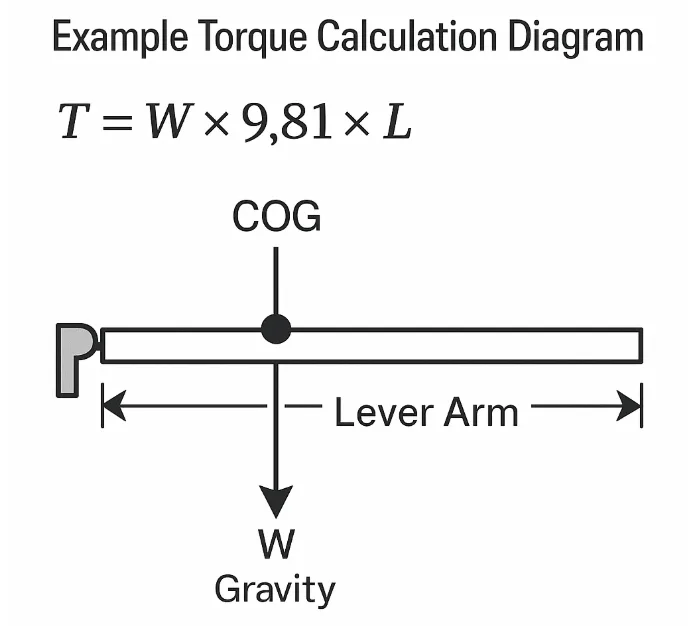
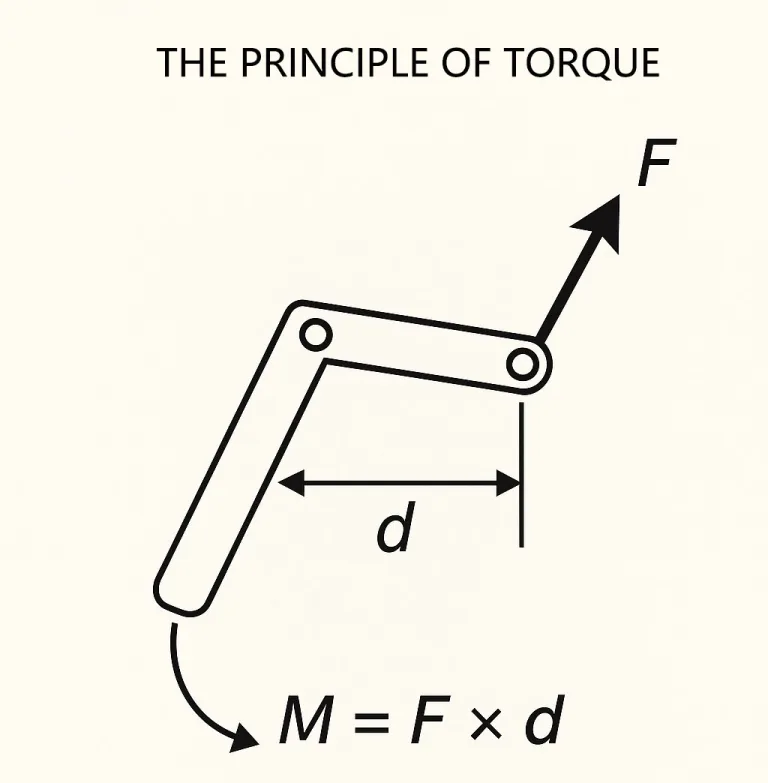
Heavy-duty hinge selection is fundamentally a torque problem. Before choosing a hinge type, you must calculate the maximum lid torque.
Calculating Maximum Lid Torque
- Determine the lever arm: the horizontal distance from the hinge pivot point to the center of gravity when the lid is in the closed or worst-case position.
- Use the calculation: Torque (N·m) = Weight (kg) × 9.81 × Lever Arm (m)
Once the maximum torque is known, the next step is to define the system’s operational goal.
Four Common Operational Goals
- Pure hinging: the hinge only provides pivot support. The operator lifts the full load.
- Lift-assist: the system reduces the operator’s perceived lifting force.
- Controbilanciamento: the lid holds or hovers at different positions with minimal effort.
- Damping / soft-close: the hinge or system controls closing speed but does not provide lift.
If you need more detailed torque logic for lids, panels, and position-control applications, review the broader Guida alla scelta della cerniera dinamometrica for related calculation principles.
Terzo passo: Classificazione e selezione delle soluzioni per cerniere
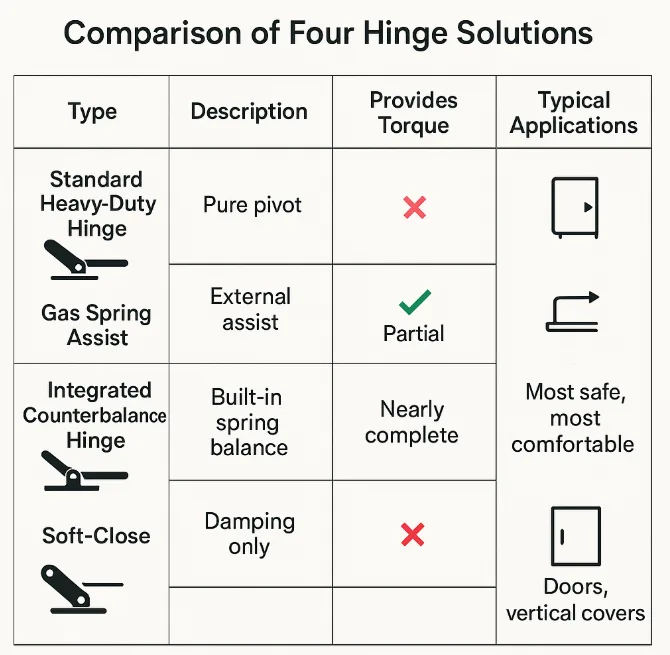
Cerniere standard per impieghi gravosi (non assistite)
- Tipi: weld-on hinges, heavy-duty continuous hinges, and pivot hinges.
- Funzione: provide structural support only. The operator bears the full lid torque.
- Best for: pure hinging or systems that use separate assist devices.
If welded mounting is preferred for maximum structural security, see our related resource on cerniere a saldare.
Cerniere a contrappeso (assistenza integrata)
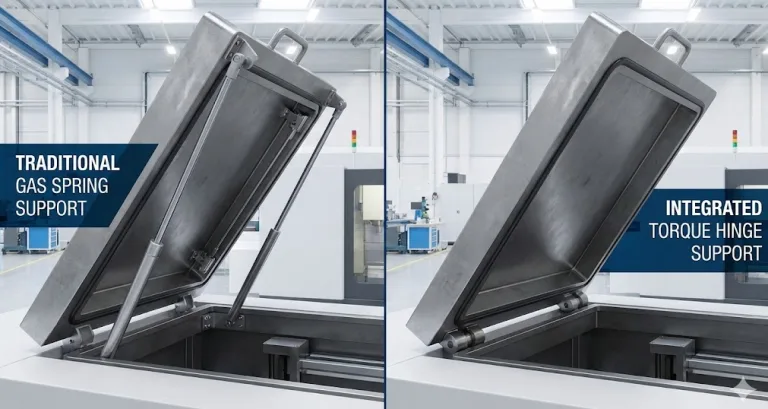
- Tipi: spring counterbalance hinges, torsion spring hinges, and integrated assist systems.
- How they work: spring torque is engineered to offset the lid torque calculated in Step Two.
- Best for: top-opening lids that need safer, lighter, and more ergonomic operation.
External Lift-Assist Systems
- Tipi: gas springs or struts used alongside structural hinges.
- Sfida: mounting geometry is critical. A wrong mounting point can make the system ineffective or unstable.
- Best for: lift-assist when integrated counterbalance hinges are not feasible.
For a direct comparison of assist strategies, you can also review cerniere a coppia vs. molle a gas vs. molle.
Smorzamento e chiusura morbida
- Tipi: dampers or hinges with integrated damping.
- Funzione: reduce closing speed and prevent slamming.
- Best for: protecting equipment and users from uncontrolled motion.
Special Selection for High-Vibration Environments
One of the biggest mistakes in heavy-duty hinge selection is assuming that any “strong enough” hinge is suitable for high-vibration service. In reality, vibration creates a different failure path, especially for loose-pin hinges.
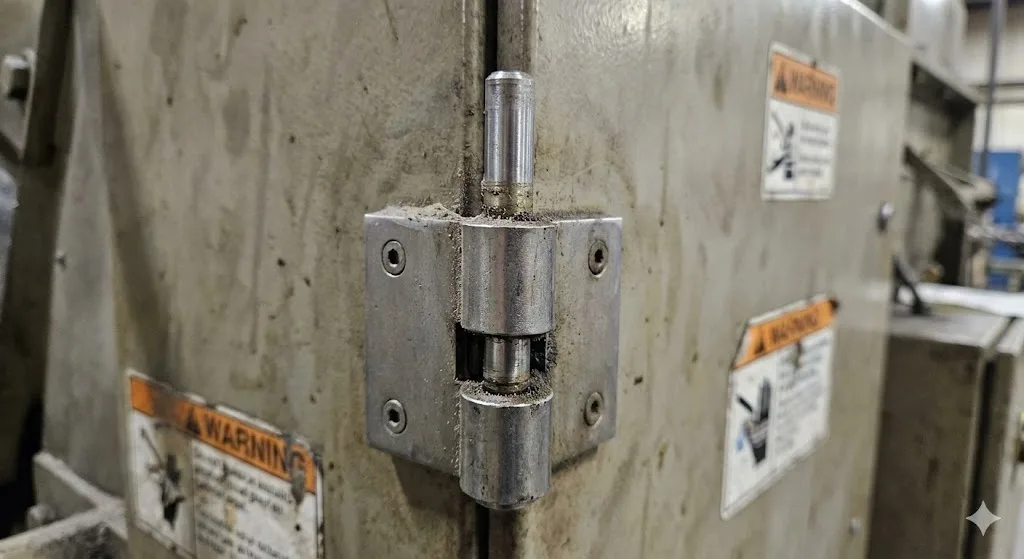
In generator enclosures, railway equipment, off-road machinery, mobile compressors, mining vehicles, and industrial HVAC systems, cabinet doors are exposed to long-term vibration and shock. In these environments, a common failure mode is pin creep, where the hinge pin gradually shifts axially over time.
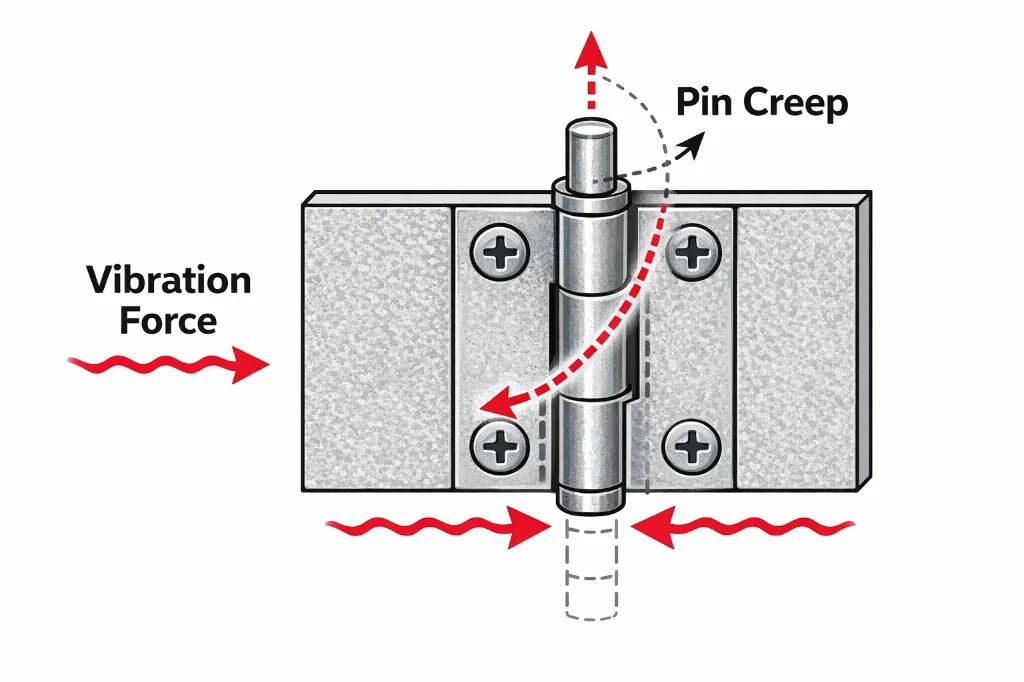
The critical point is that this is not mainly a material issue. It is a structural risk. A loose-pin hinge allows pin removal by design, and under sustained vibration that freedom can become a failure path.
In these conditions, heavy-duty riveted hinges, also called spun-pin hinges, are often the safer engineering solution because the pin is permanently fixed and cannot walk out axially under vibration. For high-vibration applications, hinge selection should evaluate not only load capacity, but also whether the pin retention method is structurally secure.
A simple FMEA-style view of high-vibration risk is useful here:
| Modalità di guasto | Main Cause | Conseguenza tipica | Prevention Direction |
|---|---|---|---|
| Pin migration (creep) | Vibration-driven micromotion in loose-pin designs | Door sagging or detachment | Use riveted or fixed-pin hinges |
| Hinge leaf fatigue cracking | Heavy load, insufficient hinge size, too few hinges | Misalignment or structural failure | Increase size, thickness, or hinge quantity |
| Allentamento del montaggio | Fasteners backing out under vibration | Hinge shifting, abnormal stress, door misalignment | Use locking nuts, threadlocker, and rigid mounting |
For teams working on cabinet systems in high-vibration service, this special selection check is often more valuable than simply asking whether a hinge is “heavy duty.”
Fase quattro: Valutazione dei materiali, dei rivestimenti e dell'ambiente
A functionally correct hinge that fails from corrosion is still the wrong choice. Environment always affects the correct material choice.
| Materiale | Uso tipico | Il migliore per |
| Acciaio al carbonio | Cost-sensitive structural applications | Dry indoor use, must be protected by coating |
| Acciaio inox 304 | General industrial stainless option | Outdoor, general industrial, and moderate corrosion environments |
| Acciaio inox 316 | Higher corrosion resistance | Coastal, marine, chemical, or aggressive outdoor service |
| Alluminio | Lightweight applications | Lower-load systems, not ideal as the main structural hinge in extreme heavy-duty service |
For broader corrosion and alloy trade-offs, you can also consult our material-focused guide on hinge material selection.
Coatings and Finishes for Carbon Steel
- Zinc plating: basic protection for dry indoor use.
- Hot-dip galvanizing: thicker corrosion protection for outdoor service.
- Verniciatura a polvere: good general protection with appearance benefits.
Pin and Bushing Details
For demanding heavy-duty applications, hardened pins and bronze or nylon bushings can significantly improve wear behavior and reduce metal-on-metal degradation.
Where These Selection Rules Matter Most
These selection principles are especially important in environments where high load, repeated access, and environmental stress occur at the same time.
- Power generation equipment: diesel and gas generator enclosures operate under continuous vibration and outdoor exposure.
- Transportation and mobile equipment: truck boxes, railway cabinets, and off-road machinery compartments face shock, bumping, and safety risks from detached doors.
- HVAC and compressed-air systems: large service doors combine heavy weight with internal rotating-equipment vibration.
- Mining and field equipment: remote-service access doors often need both corrosion resistance and long-term resistance to misalignment under vibration.
In real field retrofits, changing from loose-pin hinges to riveted heavy-duty hinges in high-vibration equipment can significantly reduce door alignment problems and cut maintenance frequency over time.
Fase cinque: Installazione, manutenzione e considerazioni sulla sicurezza
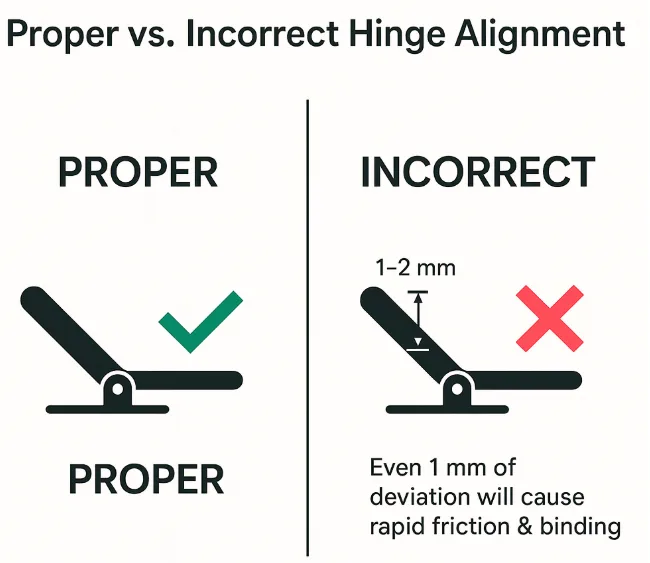
Even the right hinge will fail early if it is installed badly. With two or more hinges, the pivot axes must remain co-linear. Even slight misalignment sharply increases binding, uneven load, noise, and wear.
Installation tip: use a straight rod, level, or laser to confirm that all hinge knuckles align correctly before final fastening or welding.
Superficie di montaggio e dispositivi di fissaggio
The mounting surface must be rigid enough to transfer the full torque load safely.
- Preferibile: through-bolts with nuts and washers where feasible.
- Fastener quality: use graded fasteners appropriate to the structural demand.
- Material compatibility: match fastener and hinge material to avoid galvanic corrosion where relevant.
- In vibration environments: use Nyloc nuts, threadlocker, or equivalent anti-loosening measures as standard practice.
Additional High-Vibration Installation Practices
- Do not rely on friction fit alone for security-critical door retention.
- For extreme high-vibration service, riveted or fixed-pin structures are usually safer than removable-pin designs.
- Where welded hinges are used, fixturing and alignment before welding are critical to prevent pivot seizure or axis distortion.
If removable maintenance access is required rather than maximum pin security, compare the trade-off with lift-off hinges before finalizing the design.
Manutenzione e ispezione
- Review manufacturer cycle-life ratings, but always compare them against the real load and environment.
- Where bushings are present, many hinges can be near-maintenance-free, but field inspection for slop, alignment, corrosion, and fastener movement is still recommended.
- In high-vibration equipment, periodic checks for axial pin movement, door sag, and fastener backing-out should be part of the maintenance plan.
Conclusione: La lista di controllo per la scelta delle cerniere per impieghi gravosi
Before finalizing a heavy-duty hinge system, confirm that the following questions are all answered clearly:
- Have you clearly defined the operational goal: pure hinging, lift-assist, counterbalance, or damping?
- Does the hinge or hinge-plus-assist system match the calculated lid torque?
- Is the hinge material appropriate for the real operating environment?
- Will the application experience high vibration, shock, or frequent transport loads?
- If so, is a riveted or fixed-pin hinge structure required instead of a loose-pin design?
- Is there a clear installation plan to maintain axis alignment and fastener security?
- Have you specified the right fasteners, locking method, and hinge quantity?
Do not guess. The time invested in correct torque calculation, environment assessment, structural risk review, and installation planning prevents injuries, downtime, seal failures, and expensive rework later.
A safe and reliable heavy-duty lid or door is never the result of a hinge that merely “looks strong.” It is the result of correct engineering judgment.
FAQ
Can I retrofit a loose-pin hinge with a riveted hinge?
Yes, in many cases you can, but the retrofit must confirm hole pattern, hinge offset, leaf thickness, and door clearances first. A riveted hinge upgrade is most useful when the original failure mode is pin movement under vibration, not when the root issue is undersized leaves or weak mounting structure.
What is better for outdoor cabinets: bolt-on or weld-on heavy-duty hinges?
That depends on the design priority. Weld-on hinges are often preferred for maximum structural rigidity, while bolt-on hinges are easier to replace and service in the field. For outdoor equipment, corrosion protection, access for maintenance, and mounting strength all need to be considered together.
Do heavy-duty hinges need lubrication?
Some do and some do not. Hinges with bronze or nylon bushings can be close to maintenance-free in many applications, while plain-bearing metal hinges may benefit from periodic lubrication. The real answer depends on hinge design, operating frequency, contamination exposure, and the manufacturer’s recommendation.
How do I know if I need three hinges or four?
You should base that decision on door height, total weight, center of gravity, operating frequency, and mounting rigidity. Three hinges are often a practical starting point for many industrial doors, but taller or heavier panels may require four or more to control sagging and reduce the load per hinge.
Are continuous hinges better than discrete heavy-duty hinges for long doors?
Continuous hinges can distribute load more evenly along the full door length, which is useful for long or thin doors. Discrete heavy-duty hinges are often better where higher local load capacity, easier service, or special mounting configurations are needed. The better choice depends on door geometry and the structural behavior of the surrounding frame.
What causes a heavy equipment door to go out of alignment after installation?
Common causes include hinge-axis misalignment during installation, insufficient mounting rigidity, fastener loosening, pin creep in vibration-prone environments, and hinge undersizing relative to real door load. In most cases, door misalignment is a system problem rather than a single-part problem.



 Italiano
  English
  한국어
한국어  Русский
  Español
  Deutsch
  Français
  Português