

Outdoor Cabinet Hinge Mounting Corrosion: Leak Diagnosis
Outdoor cabinets are usually designed around the obvious protection points: the gasket, latch, door frame, coating system, and enclosure rating. But many field corrosion problems begin in a less visible place — the hinge mounting interface.
A cabinet door may look sealed from the outside, yet moisture can still migrate through hinge fastener holes, behind the hinge leaf, or into the small gap between the door skin and reinforcement structure. Over time, this can create rust streaks from the hinge side, blistered paint around screw heads, loose hinge fasteners, door sag, latch misalignment, and uneven gasket compression.
This article focuses on one specific failure mode: outdoor cabinet hinge mounting corrosion caused by through-fastened hinge interfaces. It explains how moisture paths form, how to distinguish hinge-side corrosion from latch or gasket problems, and when a surface-mounted retrofit hinge with blind fasteners or an adapter plate can reduce hidden corrosion risk.
This is not a general surface-mounted versus concealed hinge comparison. It is a diagnostic and retrofit guide for outdoor cabinet doors where corrosion starts at the hinge mounting interface.
Why Hinge-Side Rust Is Often Misdiagnosed
When water appears inside an outdoor enclosure, the first reaction is usually to check the gasket or latch. That is reasonable because the door seal and latch compression are visible and easy to understand.
However, hinge-side corrosion can create a different failure chain. The gasket may still look acceptable. The latch may still close. The door may still pass a quick visual inspection. But moisture can still move through the hinge mounting area, especially when the hinge uses through-fasteners that penetrate the door skin or reinforcement structure.
The failure chain often looks like this:
- Water sits on or runs across the outside hinge area.
- Thermal cycling and door movement relax the hinge fastener clamp force.
- Moisture migrates along screw threads or behind the hinge leaf.
- Corrosion begins inside the mounting interface or under the coating edge.
- Fasteners lose grip, the hinge leaf shifts, or the door begins to sag.
- The gasket no longer compresses evenly along the hinge side.
- The enclosure develops recurring leakage, rust streaks, or latch alignment problems.
For maintenance teams, the confusing part is that the final symptom may look like a gasket issue. The root cause may actually be the hinge mounting path.
Where Corrosion Starts: The Hinge Mounting Interface
The hinge mounting interface is the area where the hinge leaf, fasteners, door skin, reinforcement plate, coating, and sealant all meet. In outdoor cabinets, this interface is exposed to moisture, vibration, handling, and repeated door movement.
Corrosion often starts at one of these points:
- Around hinge screw heads
- Under the hinge leaf
- Inside drilled mounting holes
- Along the edge of damaged powder coating
- Between stainless hinge hardware and coated or galvanized door material
- At the contact surface between hinge leaf and door skin
- Inside the cavity behind a through-fastened hinge
The visible rust on the hinge barrel is not always the first sign of failure. In many cases, rust around the screw heads or blistered paint near the hinge leaf appears before the hinge itself looks damaged.
When stainless hinges meet galvanized or powder-coated door skins, the failure is often less about “stainless quality” and more about mixed-metal contact, trapped moisture, and coating breach. Buyers should understand 스테인리스 스틸 경첩이 여전히 부식되는 이유 before approving a material change.
How Through-Fastened Hinges Create Moisture Paths
A through-fastened hinge uses bolts or screws that pass through the door skin, reinforcement structure, or frame. This can be mechanically strong, but it can also create a potential moisture path if sealing, coating, and fastener compression are not controlled.
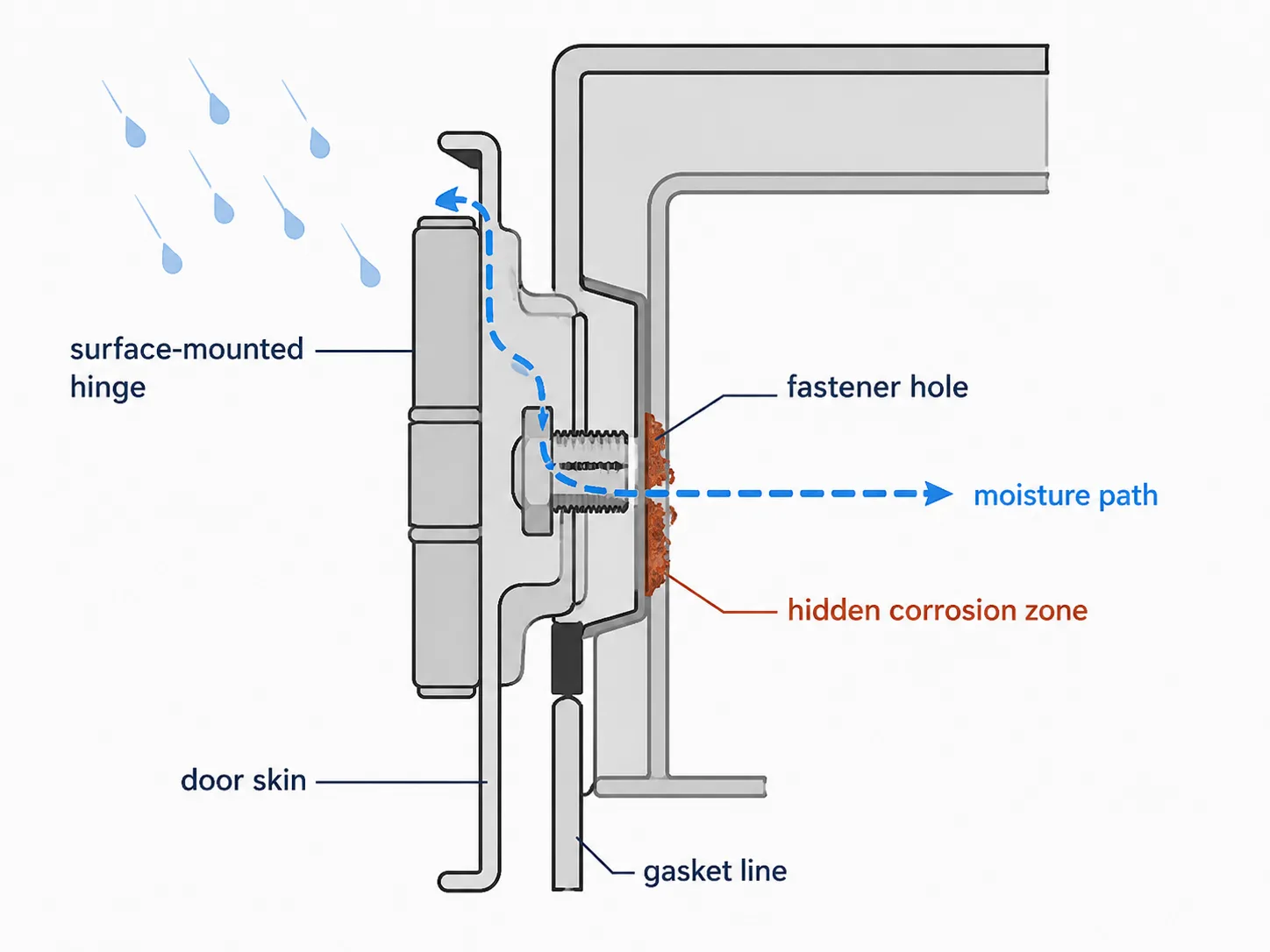
The risk is highest when:
- A drilled hole exposes bare metal under the coating.
- The sealing washer loses compression over time.
- The fastener thread creates a capillary path.
- The hinge leaf traps water behind its mating surface.
- The door flexes during opening and closing.
- Vibration or thermal cycling reduces fastener preload.
- Salt, dust, or chemicals remain around the hinge area.
Once moisture reaches the hidden side of the door skin, corrosion can grow from the inside out. That is why a door may show only small external staining while the mounting substrate underneath the hinge leaf is already weakening.
This does not mean all through-fastened hinges are wrong. Many outdoor cabinets use them successfully. The issue is whether the hinge fastener path is sealed, isolated, inspected, and matched to the exposure level. The corrosivity of the surrounding atmosphere can be classified using ISO 9223, the international classification for atmospheric corrosivity, which rates environments by time of wetness, airborne salinity, and pollution — a useful reference when deciding how aggressively the mounting interface must be sealed.
Leak Diagnosis: Hinge Mounting, Latch Creep, or Gasket Aging?
Before replacing the gasket, tightening the latch, or changing the hinge style, maintenance teams should identify the main leakage path. A hinge-side moisture problem often looks different from latch creep or gasket aging.
| Observed Symptom | More Likely Cause | What to Check Next |
|---|---|---|
| Rust streaks start below hinge screw heads | Hinge fastener leakage or coating breach | Remove one hinge or inspect screw holes for corrosion |
| Door closes but hinge-side gasket gap remains | Hinge-side door shift or mounting surface corrosion | Check hinge play, door sag, and fastener looseness |
| Water appears after wind-driven rain near hinge line | Hinge mounting path or hinge-side gasket gap | Inspect hinge leaf edge and mounting interface |
| Uniform wet floor with no hinge rust | Latch compression loss or gasket aging | Check latch pull-in force and gasket recovery |
| Rust stains from hinge barrel plus door sag | Hinge wear with fastener or substrate corrosion | Check pin wear, knuckle play, mounting hole condition |
| Paint blistering around hinge leaf | Moisture trapped behind hinge or damaged coating edge | Remove hinge and inspect hidden mating surface |
If the hinge-side leak may affect the enclosure rating, the approval step should move beyond a visual seal check and include the IP 등급 인클로저 힌지 체크리스트 for gasket compression, latch force, mounting holes, and hinge-side sealing continuity.
Diagnostic Checks for Hinge Mounting Corrosion
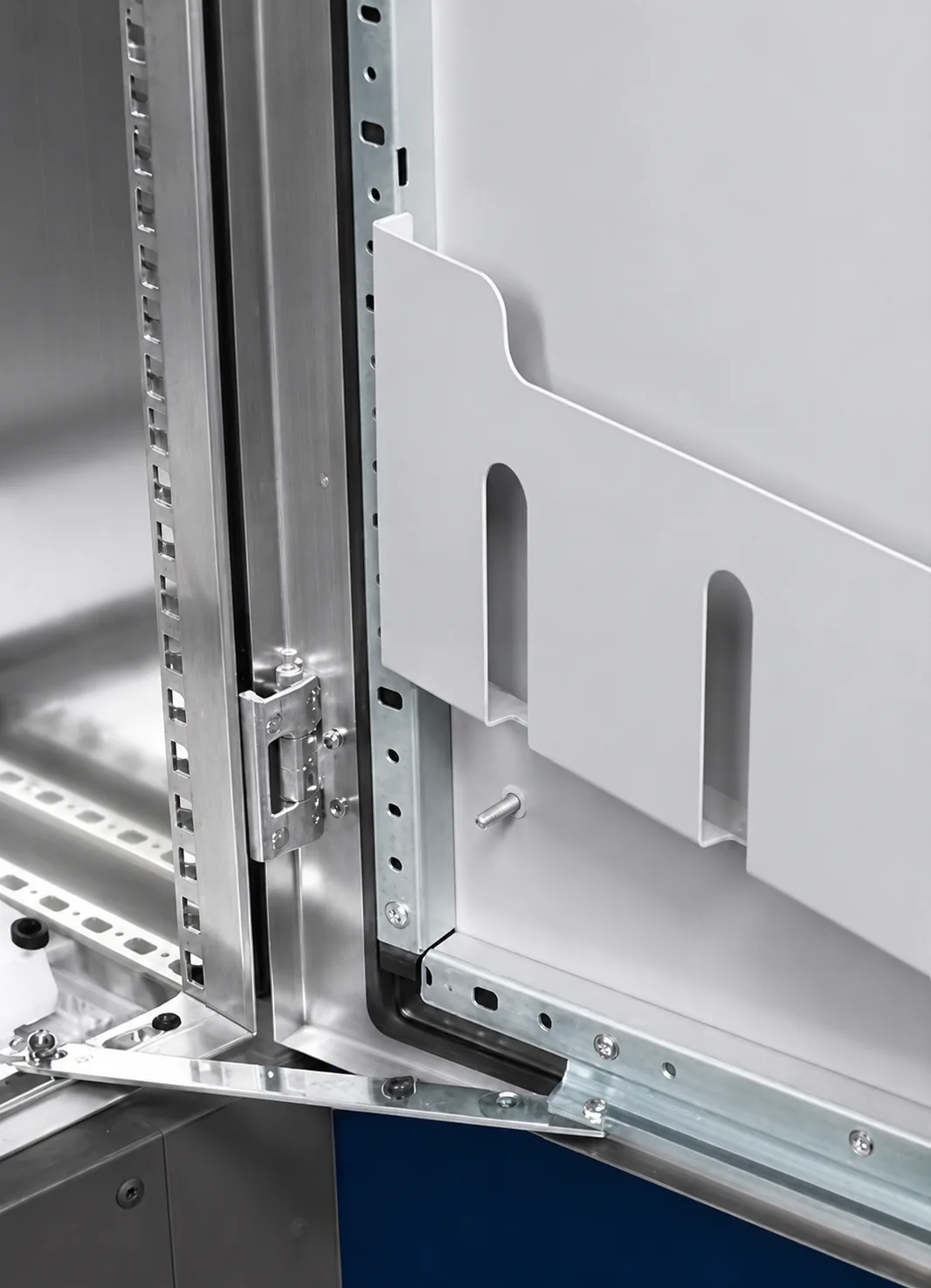
A structured inspection helps avoid replacing the wrong part. The goal is to determine whether the leak comes from the hinge mounting interface, the gasket, the latch, or a combination.
Create a Rust Map
Record where corrosion first appears. Hinge-related moisture paths often show rust or staining around hinge screw heads, under the lower edge of a hinge leaf, downward from the hinge line, near the door skin reinforcement, or at the edge of blistered coating. If rust is concentrated near the latch keeper instead, latch-side compression may be the primary issue.
Inspect the Hinge Leaf Edge
Look for a dark line, lifting paint, trapped dirt, or moisture marks along the edge of the hinge leaf. This may indicate water trapped behind the hinge instead of flowing away from the door surface.
Check Fastener Grip
Loose fasteners can create both mechanical and sealing problems. A fastener that no longer holds torque may indicate thread damage, substrate corrosion, or movement under the hinge leaf. Avoid simply installing a larger screw before identifying the cause. If the material underneath the hinge leaf is already corroded, a larger fastener may only delay the same failure.
Check Door Position and Gasket Compression
A hinge-side mounting problem can become a door alignment problem. If the door has shifted, the gasket may not compress evenly near the hinge side. When rust stains are combined with latch misalignment or a dropped door corner, the problem may already include hinge-side movement. In that case, the hinge sag diagnosis and prevention workflow should be used before replacing the hinge with the same footprint.
Remove One Representative Hinge
For recurring corrosion problems, remove one hinge from a non-critical cabinet or a service sample. Inspect the paint condition under the hinge leaf, corrosion around the screw holes, moisture marking behind the hinge, fastener thread condition, door skin deformation, and any gap between hinge leaf and mounting surface. This step often reveals whether the visible rust is only a surface problem or part of a hidden moisture path.
When Surface-Mounted Retrofit Hinges Help
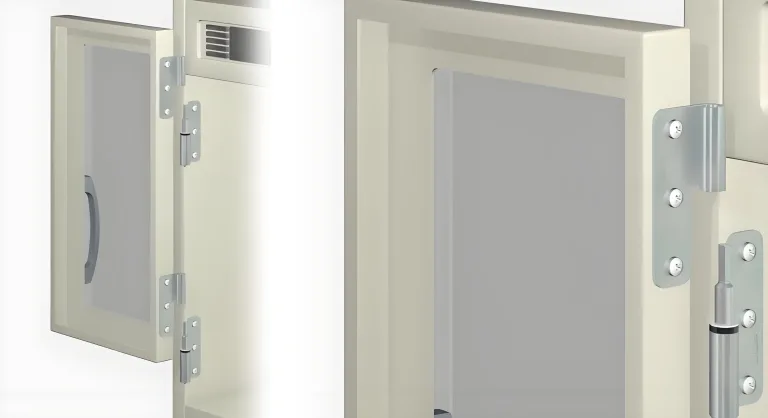
Surface-mounted hinges can help reduce hidden corrosion risk when they are used to eliminate or control through-fastener moisture paths. The benefit is not simply that the hinge is visible. The benefit comes from moving the critical sealing surface to an inspectable exterior plane.
A surface-mounted retrofit can help when:
- Existing through-holes have become corrosion paths.
- The original hinge area has hidden moisture behind the door skin.
- Fastener holes are enlarged, rusted, or difficult to reseal.
- The door still has enough structural strength for an adapter plate.
- The project needs easier inspection of hinge-side corrosion.
- Future hinge replacement should not disturb the sealed inner door cavity.
In a retrofit, the old fastener holes should not be ignored. They must be sealed, covered, or isolated. A surface-mounted hinge works best when paired with a sealing adapter plate, blind threaded inserts or rivet nuts, a non-curing sealing pad or compatible gasket layer, correct fastener material, proper surface preparation, and a repeatable torque and inspection procedure.
This approach changes the failure mode. Instead of hiding corrosion inside the door cavity, the hinge interface becomes easier to inspect and maintain.
When Surface-Mounted Hinges Are Not Enough
A surface-mounted hinge is not a universal fix. It may not solve the problem if the door skin is already weakened, the frame is distorted, the gasket seat is damaged, or the cabinet design traps water around the hinge line.
Do not treat surface-mounted hardware as a shortcut when:
- The door skin has lost structural strength.
- The frame is out of square.
- The hinge-side gasket channel is damaged.
- The door is too heavy for the existing mounting surface.
- The enclosure still allows water to pool behind the hinge leaf.
- Mixed metals and fasteners are not isolated.
- The old through-holes are not sealed.
In these cases, the correct repair may require door reinforcement, hinge relocation, frame correction, gasket seat repair, or a full door replacement.
Material and Fastener Checks Before Approval
Once the hinge style is selected, the material stack-up must be reviewed. A surface-mounted design still fails if the hinge, fasteners, door material, coating, and sealant are incompatible.
Procurement teams should verify hinge leaf material, hinge pin material, fastener material, door and frame material, surface coating system, sealant or isolation layer, drainage around the hinge line, expected corrosion exposure, maintenance interval, and replacement availability.
For coastal cabinets where salt exposure is the primary design driver, the hinge material decision should be tied back to the 해안 프로젝트를 위한 NEMA 4X 힌지 사양 rather than treated as a generic stainless-versus-coated choice.
Retrofit Decision Matrix
| Field Condition | Surface-Mounted Retrofit Direction | Additional Action Needed |
|---|---|---|
| Rust around through-fastened hinge screws | Often suitable | Seal old holes and inspect substrate |
| Door skin still structurally sound | Suitable | Use adapter plate or blind fastener kit |
| Old holes enlarged or stripped | Suitable with reinforcement | Add backing plate, insert, or adapter |
| Door already sagging | Conditional | Diagnose hinge wear and frame alignment first |
| Gasket gap remains after hinge repair | Conditional | Check latch force and gasket seat |
| Frame distorted or door skin weakened | Not enough alone | Repair frame or replace door |
| Severe coastal exposure | Suitable only with material review | Verify hinge, pin, fastener, and sealant materials |
| Internal moisture already present | Conditional | Inspect cabinet interior and dry zone protection |
This matrix helps buyers decide whether a hinge change is a hardware replacement, a sealing repair, or a larger door-system correction.
What to Send a Supplier for a Hinge Corrosion Review
To get a useful recommendation, the supplier needs more than a photo of the hinge. Provide a data package that shows the door structure, corrosion pattern, and environment.
- Door width, height, thickness, and approximate weight
- Door skin material and frame material
- Exterior coating system and coating condition
- Current hinge type, hinge count, and mounting pattern
- Photos of corrosion before and after hinge removal
- Close-up photos of screw holes, hinge leaf edges, and blistered paint
- Distance to coast, de-icing salt exposure, industrial emissions, or high-condensation conditions
- Required enclosure protection target
- Gasket location and latch position
- Whether the door has sagged or the latch no longer aligns
- Maintenance interval and service access frequency
- Desired retrofit approach: reuse hole pattern, adapter plate, blind fastener kit, or new hinge location
- Required documents: drawing, material certificate, surface treatment details, sample report, or test evidence
A supplier that asks for these details is more likely to recommend a mounting interface solution instead of simply replacing the old hinge with the same style.
최종 권장 사항
When rust appears along the hinge line of an outdoor cabinet, do not treat the hinge as an isolated part. Treat the hinge mounting interface as a boundary between the exterior environment and the protected cabinet interior.
Through-fastened hinges can work when the fastener path, coating edge, sealant, and mounting substrate are controlled. But when corrosion begins around hinge screws, under the hinge leaf, or inside the door skin, replacing the same hinge may only repeat the failure.
Surface-mounted retrofit hinges can reduce hidden corrosion risk when they move the sealing surface to an inspectable exterior plane, eliminate unnecessary through-penetrations, and use blind fasteners or adapter plates to isolate old damage. The retrofit must still be checked against door strength, gasket compression, latch alignment, fastener material, and site exposure.
The safest repair decision comes from diagnosing the mounting interface first. Find the moisture path, repair the weakest boundary, and specify the hinge as part of the full door system.
자주 묻는 질문
Why does rust often start around outdoor cabinet hinge screws?
Rust often starts around hinge screws because drilled holes can expose bare metal, trap moisture, or create a path for water to move along fastener threads. If the hinge leaf also traps water behind it, corrosion may begin under the hardware before it becomes visible outside.
Does a stainless steel hinge prevent hinge-side corrosion?
Not by itself. Stainless steel helps in many outdoor environments, but corrosion can still occur if moisture is trapped, mixed metals are not isolated, fasteners are incompatible, or the coating around the mounting hole is damaged.
When should a through-fastened hinge be replaced with a surface-mounted retrofit hinge?
A surface-mounted retrofit should be considered when the original through-fastener holes have become moisture paths, the hinge area has hidden corrosion, or future inspection and replacement need to be easier. The old holes must still be sealed or covered correctly.
Can hinge-side corrosion affect gasket compression?
Yes. If corrosion weakens the hinge mounting surface or allows the door to shift, the gasket may no longer compress evenly near the hinge side. This can lead to repeated leakage even after gasket replacement.
What should procurement ask before approving a retrofit hinge?
Procurement should ask for the hinge drawing, material details, fastener compatibility, sealing method, mounting pattern, sample approval process, and confirmation that old through-holes will be sealed or isolated.
Request a Hinge Mounting Corrosion Review
If your outdoor cabinet shows rust around hinge screws, blistered paint near the hinge leaf, latch misalignment, or recurring hinge-side gasket leakage, HTAN can help review the door hardware system before you replace the same hinge again. Share your door drawing, hinge photos, corrosion pattern, site environment, gasket layout, latch position, and required protection target. Our engineering team can help recommend a mounting interface direction, sealing method, and hinge material strategy for your outdoor cabinet platform.



 한국어
한국어  English
  Русский
  Español
  Italiano
  Deutsch
  Français
  Português