

Battery Cabinet Hinges: Load, Corrosion & Access Guide
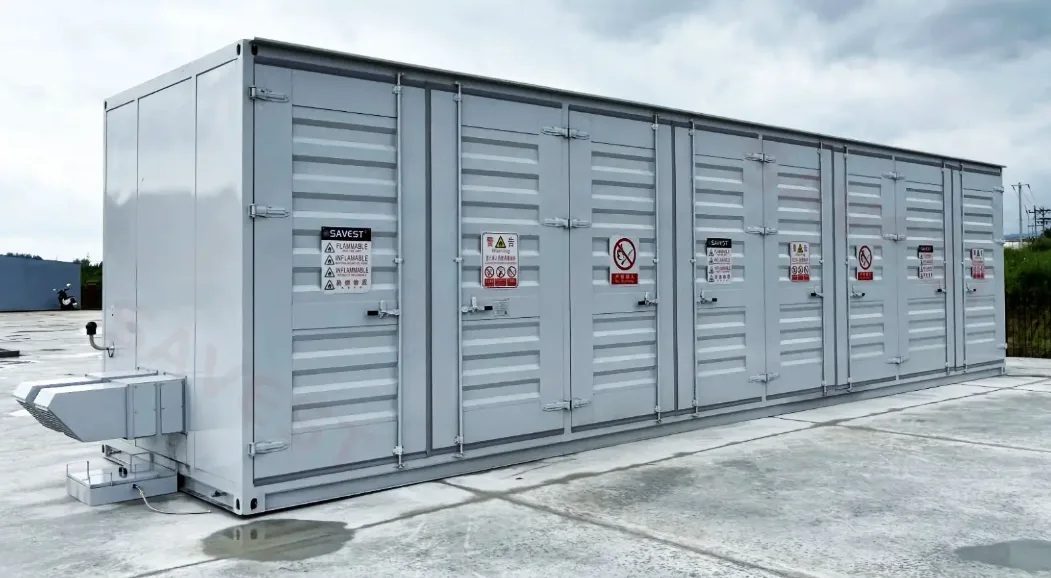
Battery cabinet hinges are not ordinary cabinet hardware. In energy storage systems, telecom power cabinets, solar battery enclosures, EV infrastructure, and backup power cabinets, the hinge must support a heavy door, resist corrosion from the operating environment, and still allow safe access for inspection, battery replacement, and emergency maintenance.
A poorly selected hinge can cause more than a noisy or misaligned door. It can reduce sealing performance, make emergency service difficult, accelerate corrosion around mounting points, or create a safety risk when a heavy cabinet door starts to sag. For this reason, battery cabinet hinge selection should be treated as part of the enclosure design, not as a small accessory decision.
This guide explains how to evaluate battery cabinet hinges based on three practical engineering factors: door load, resistenza alla corrosione, e maintenance access. It is written for enclosure designers, OEM buyers, maintenance teams, and engineers selecting hinges for energy storage and power cabinet applications.
Why Battery Cabinet Hinges Require Different Selection Criteria
Battery cabinets place different demands on hinges compared with general industrial cabinets. The doors are often larger, heavier, and fitted with additional components such as locks, sealing gaskets, vents, monitoring devices, insulation layers, or reinforced panels. In outdoor systems, the hinge must also deal with humidity, rain, temperature changes, dust, and possible salt exposure.
The application is also maintenance-sensitive. Battery cabinets may need regular inspection, module replacement, cable checks, thermal management maintenance, and emergency access. If the hinge becomes stiff, corroded, misaligned, or overloaded, the cabinet may no longer open safely or seal correctly after service.
For broader enclosure hardware decisions, you can also review the Guida alle cerniere per armadi industriali. This article focuses specifically on battery cabinet applications where load, corrosion, and access must be evaluated together.
Door Load and Hinge Capacity for Battery Cabinets
Door Weight, Width, and Center of Gravity
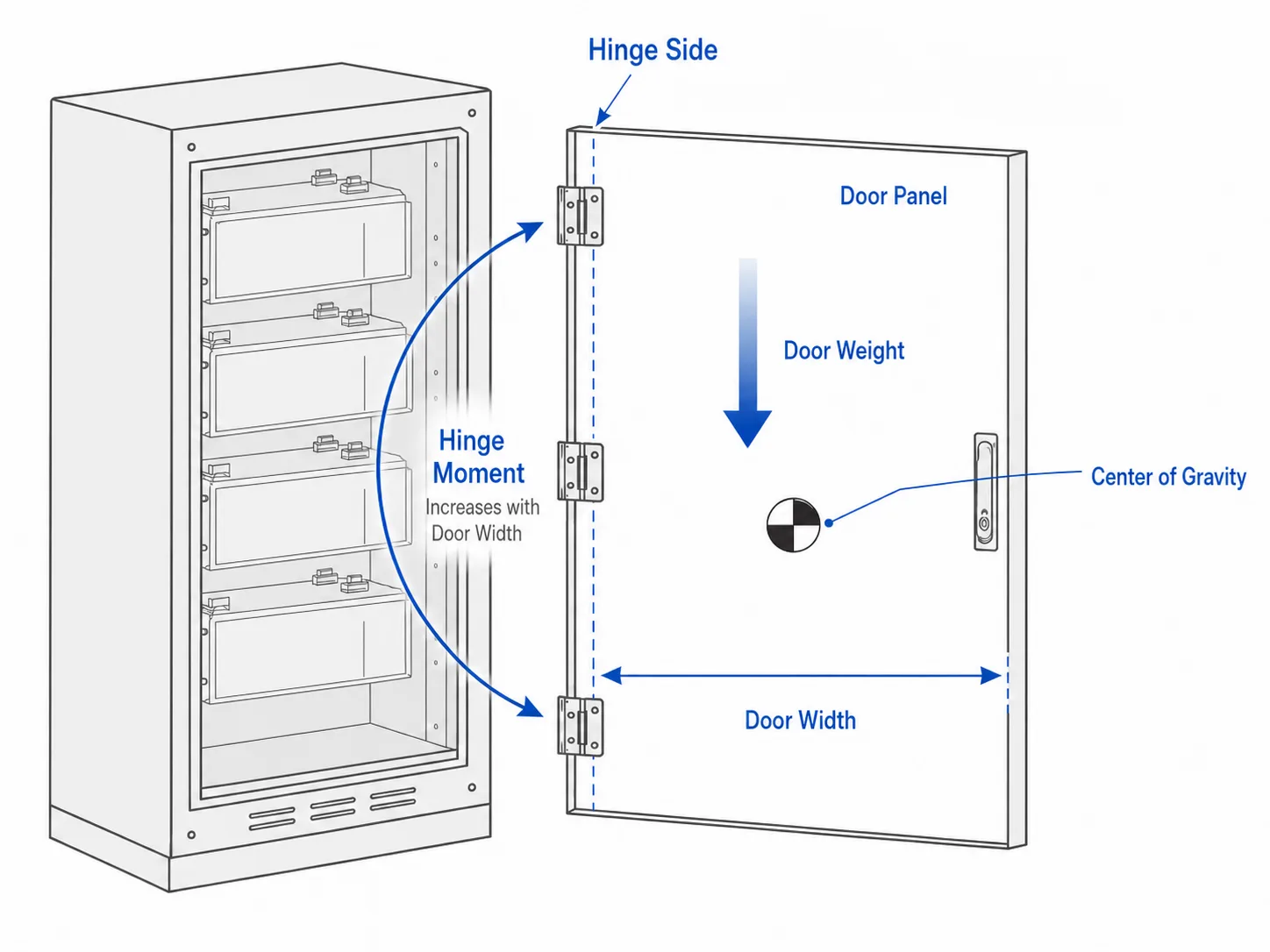
The first step in selecting battery cabinet hinges is not simply checking the door weight. Engineers should also consider the door width, center of gravity, mounted hardware, gasket compression, and how far the door opens during service.
A narrow door and a wide door with the same weight do not create the same hinge stress. A wider door increases leverage on the hinge side, which can accelerate pin wear, screw loosening, frame deformation, and door sag. In battery cabinets, this matters because door sag can affect sealing, lock alignment, and service access.
When evaluating hinge capacity, collect at least the following data:
- Total door weight: include the door panel, locks, seals, vents, covers, and any mounted components.
- Door width and height: wider doors create greater leverage on the hinge line.
- Center of gravity: check whether mounted parts shift the load away from the hinge side.
- Opening angle: a larger opening angle can increase handling stress during maintenance.
- Service frequency: daily or weekly access increases cycle and wear requirements.
- Installation environment: outdoor, coastal, humid, or battery room conditions affect material choice.
Static Load vs Repeated Service Load
Static load capacity describes what the hinge can support when the door is stationary. For battery cabinets, repeated service load is often more important. Every opening and closing cycle creates movement, vibration, and impact at the hinge pin, knuckle, mounting plate, and fasteners.
A hinge that looks acceptable under static weight may still fail in the field if the cabinet door is frequently opened, if the cabinet is installed outdoors, or if the frame is not rigid enough to keep the hinge line aligned. This is why battery cabinet hinge selection should include both load rating and lifecycle expectations.
For heavy battery cabinet doors, use a suitable safety factor instead of selecting a hinge at the exact door weight. In many industrial applications, a safety factor of 1.5 to 2.0 is used as a starting point, but the actual requirement should be adjusted based on door size, vibration, installation quality, and maintenance frequency.
If your project involves very large or heavy access doors, compare this requirement with a dedicated heavy-duty hinge selection method rather than relying only on catalog load values.
Mounting Plate Strength and Fastener Selection
The hinge is only one part of the load path. The cabinet frame, mounting plate, threaded inserts, welds, screws, and reinforcement structure must also carry the load. In battery cabinets, hinge failure is often caused by weak mounting conditions rather than the hinge body alone.
Common weak points include thin sheet metal around the hinge, undersized screws, poor thread engagement, frame distortion after installation, or mixed fastener materials that corrode faster than the hinge itself. For heavy doors, reinforced hinge mounting areas are usually safer than relying on thin enclosure walls.
Corrosion Risks in Battery Cabinet Environments
Battery Room and Outdoor Cabinet Exposure
Battery cabinet hinges may be exposed to several corrosion sources depending on the application. Indoor battery rooms can involve humidity and, in some cases, acidic or alkaline contamination. Outdoor solar, telecom, and energy storage cabinets must handle rain, condensation, dust, temperature cycling, and sometimes chloride exposure from coastal air.
For lead-acid battery environments, corrosion resistance should be evaluated more carefully because acid mist or chemical residue can accelerate surface attack. For lithium battery cabinets, chemical exposure may be lower, but outdoor moisture, condensation, and salt spray can still damage hinges, screws, and mounting interfaces over time.
The key point is that “stainless steel” should not be treated as a single material category. SS304 may be acceptable for many indoor or general outdoor applications, while SS316 or additional surface protection may be required for coastal, humid, washdown, or chemically aggressive environments.
SS304, SS316, and Coated Steel Options
Battery cabinet hinge material should be selected according to both corrosion exposure and load requirements. SS304 stainless steel is commonly used for general industrial applications where the environment is not highly corrosive. SS316 stainless steel provides better resistance in chloride-rich or more aggressive environments because of its molybdenum content.
Coated carbon steel hinges may be suitable for cost-sensitive indoor cabinets, but the coating must remain intact. Once the coating is scratched or worn at the hinge knuckle, pin area, or screw hole, corrosion can start at the exposed surface. This is especially important for cabinets that are opened frequently or installed outdoors.
If the main concern is why stainless hardware can still rust, review the article on stainless steel hinge corrosion. For broader material comparison, the carbon steel vs stainless steel hinges guide can help separate cost, strength, and corrosion trade-offs.
Fasteners and Galvanic Corrosion
One common mistake is selecting a corrosion-resistant hinge but using incompatible screws, washers, or inserts. For example, stainless steel hinges combined with untreated carbon steel fasteners can create corrosion problems around the mounting area. In outdoor battery cabinets, the screw interface is often where rust, loosening, or staining first appears.
To reduce this risk, match fastener material to the hinge and enclosure design whenever possible. Stainless steel screws, suitable washers, anti-seize compounds, and isolation between dissimilar metals may be necessary in corrosive or humid environments.
Salt Spray and Environmental Testing
Salt spray test data can be useful when comparing hinge options, especially for outdoor battery cabinets, coastal telecom cabinets, and solar energy storage systems. However, salt spray hours should not be treated as the only selection criterion.
A hinge with good salt spray performance may still fail if the mounting plate is too thin, the pin design is weak, the cabinet frame twists, or the door load is underestimated. Corrosion testing should be evaluated together with load capacity, opening frequency, material compatibility, and real installation conditions.
Maintenance Access Requirements for Battery Cabinets
Why Access Design Matters
Battery cabinets require safe and predictable access. Maintenance teams may need to inspect terminals, replace modules, check cables, clean vents, test sensors, or respond to emergency faults. If the door cannot open wide enough, if the hinge binds, or if the door is difficult to remove, service time increases and safety risks become higher.
For this reason, hinge selection should consider how the cabinet will actually be serviced. A cabinet opened once a year does not need the same hinge strategy as a battery cabinet that requires frequent inspection or module replacement.
When a Full-Opening Hinge Is Enough
For many battery cabinets, a fixed hinge with a wide opening angle is sufficient. This is usually appropriate when the door does not need to be removed, the maintenance space is adequate, and the door weight can be safely controlled during service.
Fixed hinges can also provide better retention and sealing stability in some outdoor enclosures. If the cabinet must maintain consistent gasket compression, resist vibration, and reduce the chance of accidental door removal, a fixed hinge may be more suitable than a quick-release hinge.
When a Lift-Off Hinge Makes Sense
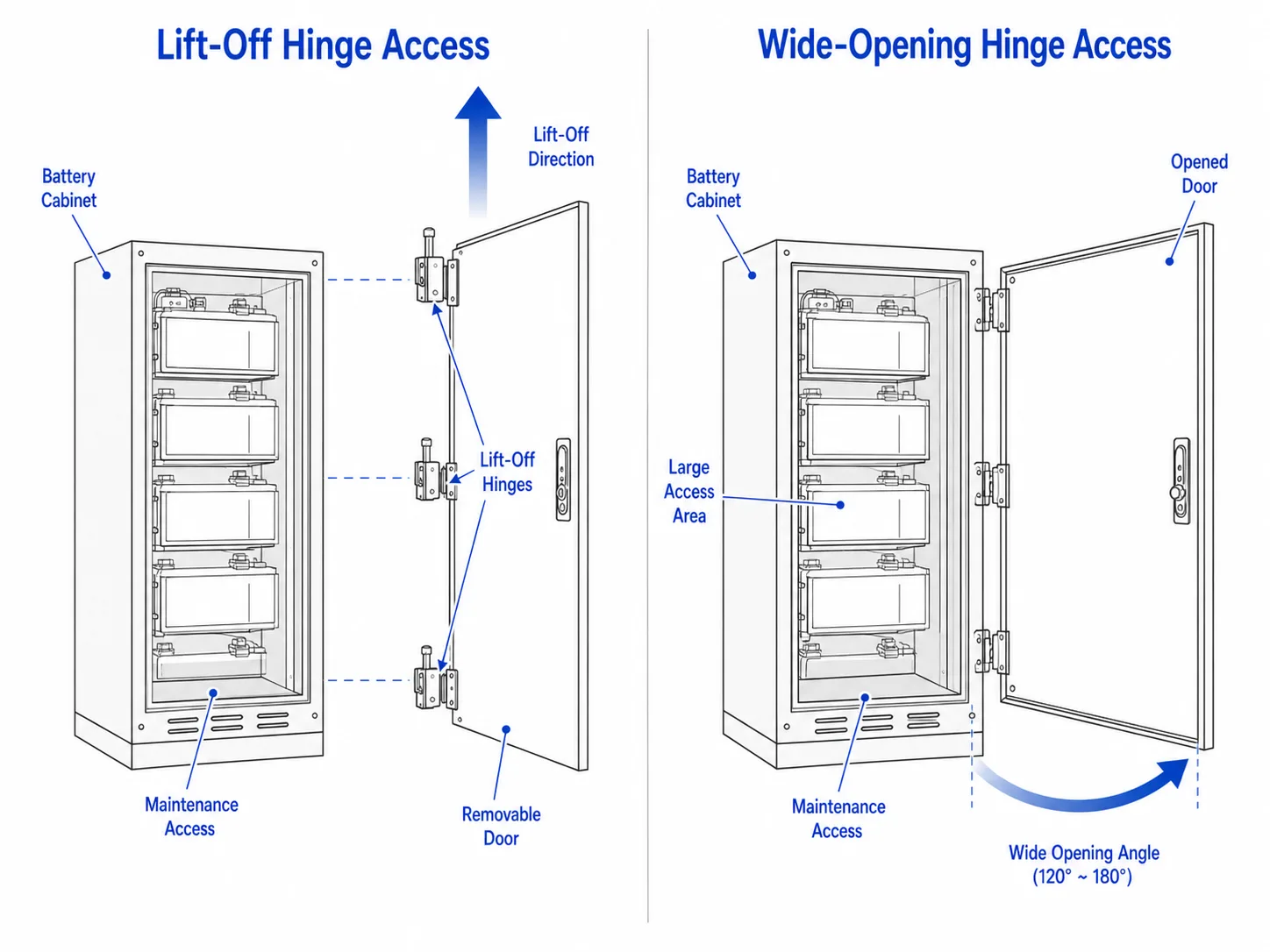
Lift-off hinges are useful when the battery cabinet door needs to be removed quickly for maintenance, replacement, or restricted-space access. This can reduce service time when technicians must work directly inside the cabinet or replace large internal components.
However, lift-off hinges should not be selected only because they are convenient. The designer must confirm that the door can be lifted safely, that the hinge pin and bushing remain protected from corrosion, and that the removable design does not compromise security, sealing, or vibration resistance.
For the general structure and working principle of removable hinge designs, refer to the lift-off hinges complete guide. For enclosure-specific decisions, the lift-off vs fixed enclosure hinges guide explains when quick removal is beneficial and when fixed retention is safer.
When a Continuous Hinge Is Safer for Heavy Doors
For very wide or heavy battery cabinet doors, a continuous hinge can help distribute load along a longer hinge line. This may reduce local stress at individual hinge points and improve alignment on tall cabinet doors.
The trade-off is that continuous hinges usually do not provide fast door removal. They may also require more precise installation along the full hinge length. For cabinets where load distribution and frame stability are more important than quick removal, a continuous hinge may be a better choice than two or three smaller hinges.
Battery Cabinet Hinge Type Selection Table
| Battery Cabinet Condition | Recommended Hinge Option | Why It Fits | Key Risk to Check |
|---|---|---|---|
| Indoor backup battery cabinet with moderate door weight | Stainless steel butt hinge or coated heavy-duty hinge | Provides basic support and corrosion resistance for controlled environments | Coating damage, screw corrosion, and insufficient load rating |
| Outdoor telecom battery cabinet | SS304 or SS316 heavy-duty hinge, depending on exposure | Balances load capacity with humidity and outdoor corrosion resistance | Condensation, salt exposure, and mixed-metal fasteners |
| Coastal or highly humid energy storage cabinet | SS316 hinge with compatible stainless fasteners | Improves resistance to chloride-related corrosion and staining | Pitting corrosion, crevice corrosion, and fastener rust |
| Frequent battery module replacement | Heavy-duty lift-off hinge | Allows the door to be removed for faster maintenance access | Safe door lifting, hinge seizure, and retained security |
| Very wide or heavy battery cabinet door | Continuous hinge or reinforced heavy-duty hinge set | Distributes load and helps reduce door sag risk | Frame rigidity, installation accuracy, and service access limitation |
| Cabinet requiring strong sealing stability | Fixed hinge with reinforced mounting plate | Helps maintain gasket compression and door alignment | Hinge alignment, gasket compression loss, and mounting deformation |
Common Failure Modes in Battery Cabinet Hinges
Door Sag and Seal Compression Loss
Door sag is one of the most common hinge-related failures in heavy cabinet applications. In battery cabinets, sagging is more than an appearance issue. It can reduce gasket compression, make the lock difficult to engage, cause the door to scrape the frame, and weaken environmental protection.
The main causes include underestimated door weight, excessive door width, weak mounting plates, loose screws, poor hinge alignment, or frame deformation after installation. If the door begins to drop after several months of use, check the hinge pin, knuckle clearance, screw tightness, and cabinet frame before replacing the hinge.
For a broader explanation of hinge sag causes and prevention, refer to the Guida alla prevenzione della flessione delle cerniere.
Corrosion Seizure During Emergency Maintenance
Corrosion can make a battery cabinet hinge stiff, noisy, or completely seized. This is especially serious when emergency service is required and the door must open immediately. Corrosion can develop at the pin, knuckle, screw holes, or between dissimilar metals.
To reduce seizure risk, specify suitable stainless steel or protective coating, avoid incompatible fasteners, and include hinge inspection in the maintenance schedule. Cabinets in humid, coastal, or chemically exposed locations should be checked more frequently.
Loose Fasteners and Frame Misalignment
Even a strong hinge can fail if the mounting system loosens. Repeated opening, vibration, thermal cycling, and heavy door leverage can loosen screws or deform thin sheet metal around the hinge. Once the hinge line shifts, the door may no longer close evenly.
For battery cabinets, this can affect locking, sealing, grounding continuity, and technician safety. Reinforced hinge mounting zones, proper screw engagement, thread-locking methods, and compatible fasteners are important details during design and assembly.
Quick-Release Failure in Lift-Off Hinges
Lift-off hinges can improve maintenance access, but the removable function must remain reliable. Dust, corrosion, paint buildup, burrs, or misalignment can make the door difficult to lift off. If technicians cannot remove the door during service, the benefit of the lift-off design is lost.
For battery cabinets that use lift-off hinges, confirm that the hinge pin has enough clearance, the removable direction is not blocked by nearby structures, and the door can be safely handled after removal.
Battery Cabinet Hinge Selection Checklist
Before confirming the hinge design, use the following checklist to reduce the risk of under-specification:
| Selection Item | Cosa controllare | Perché è importante |
|---|---|---|
| Door weight | Total weight including locks, seals, vents, and mounted components | Prevents under-rated hinge selection |
| Door width | Distance from hinge line to far edge of door | Controls leverage and sag risk |
| Opening angle | Required access angle for inspection and battery replacement | Ensures serviceability |
| Access frequency | Daily, monthly, annual, or emergency-only service | Determines lifecycle and wear requirements |
| Ambiente | Indoor, outdoor, coastal, humid, chemical, or battery room exposure | Determines material and corrosion protection |
| Material compatibility | Hinge, screws, washers, frame material, and coating system | Reduces galvanic corrosion and fastener failure |
| Mounting strength | Frame thickness, reinforcement plate, welds, inserts, or threads | Prevents loosening and frame deformation |
| Maintenance access | Whether the door must swing wide or be removed | Determines fixed, lift-off, or continuous hinge choice |
| Sealing requirement | Gasket compression and enclosure protection level | Prevents leakage from door misalignment |
| Inspection plan | Lubrication, corrosion check, fastener check, and alignment check | Extends hinge life and reduces downtime |
Recommended Hinge Strategy by Battery Cabinet Application
Solar Energy Storage Cabinets
Solar battery cabinets are often installed outdoors, where rain, condensation, dust, UV exposure, and temperature changes affect hinge life. For these applications, corrosion resistance and sealing stability should be prioritized. If the cabinet is located near the coast, SS316 and compatible stainless fasteners are usually safer than standard coated steel.
Telecom Battery Cabinets
Telecom battery cabinets may be placed in remote locations with limited maintenance access. In this case, the hinge should be selected for long-term reliability rather than lowest initial cost. Door alignment, corrosion resistance, and fastener security are especially important because delayed maintenance can turn a small hinge problem into an access problem.
EV Charging and Power Infrastructure Cabinets
Battery and power cabinets used around EV infrastructure may require frequent inspection and secure enclosure access. Depending on the layout, a fixed heavy-duty hinge may be preferred for retention and sealing, while a lift-off hinge may be useful when service teams need fast door removal in restricted spaces.
Data Center and Backup Power Cabinets
Backup power cabinets in data centers or critical facilities require predictable access and low downtime. Hinges should be selected to support repeated service, maintain door alignment, and prevent corrosion around fasteners. A hinge that binds during emergency maintenance can delay service even if the rest of the cabinet is well designed.
Maintenance Recommendations for Battery Cabinet Hinges
Battery cabinet hinges should be included in the regular maintenance schedule. The inspection frequency depends on the environment and access frequency, but the following checks are useful for most applications:
- Check whether the door opens smoothly without binding or scraping.
- Inspect hinge pins, knuckles, screws, and mounting plates for corrosion.
- Confirm that fasteners remain tight and are not rusting.
- Check whether the door still compresses the gasket evenly.
- Look for early signs of door sag, frame distortion, or hinge looseness.
- Clean dust, chemical residue, or moisture buildup around the hinge area.
- Use suitable lubrication only when the hinge design and environment allow it.
For outdoor and corrosive environments, inspection intervals should be shorter. If the cabinet is installed in a coastal area, battery room, or high-humidity location, corrosion checks should focus especially on screw holes, hinge pins, and areas where water or residue can collect.
Conclusione
Battery cabinet hinge selection should be based on the real operating conditions of the cabinet, not only on hinge size or appearance. A reliable hinge system must support the door load, resist corrosion, maintain alignment, protect sealing performance, and allow safe maintenance access over the cabinet’s service life.
For most battery cabinet projects, the best hinge choice depends on three questions:
- How heavy and wide is the door?
- What corrosion environment will the cabinet face?
- Does the door need to open wide, stay fixed, or be removed for service?
If the cabinet uses a heavy door, is installed outdoors, or requires frequent battery maintenance, the hinge should be specified together with the frame design, fasteners, sealing system, and inspection plan. This approach reduces the risk of sagging doors, seized hinges, corrosion failures, and emergency access problems.
FAQ
How do I choose hinges for a heavy battery cabinet door?
Start by calculating the total door weight, including locks, seals, vents, and any mounted components. Then check the door width, center of gravity, opening angle, and service frequency. For heavy or wide doors, use a suitable safety factor and consider reinforced mounting plates or continuous hinges to reduce sag risk.
Is 304 or 316 stainless steel better for battery cabinet hinges?
SS304 is often suitable for indoor or general outdoor battery cabinets. SS316 is usually better for coastal, humid, chloride-rich, or more corrosive environments because it provides stronger resistance to pitting and staining. Fasteners should also be compatible with the hinge material.
Are lift-off hinges suitable for battery cabinet maintenance?
Lift-off hinges can be suitable when the door must be removed for battery replacement, inspection, or restricted-space maintenance. However, they must be selected carefully. The door must be safe to lift, the hinge should resist corrosion, and the removable design should not weaken sealing, security, or vibration resistance.
Why does a battery cabinet door sag after several months?
Battery cabinet door sag usually comes from underestimated door load, excessive door width, weak mounting plates, loose screws, hinge pin wear, poor hinge alignment, or frame deformation. Sagging should be corrected early because it can affect gasket compression, lock alignment, and enclosure protection.
How often should battery cabinet hinges be inspected?
For normal indoor cabinets, hinge inspection can usually be included in the regular maintenance cycle. For outdoor, humid, coastal, or high-use battery cabinets, hinges should be checked more frequently for corrosion, loosened fasteners, stiffness, and door alignment problems.




 Italiano
  English
  한국어
한국어  Русский
  Español
  Deutsch
  Français
  Português