

Heavy-Duty Hinge Selection: A Complete Engineering Guide
An engineering methodology to prevent failure, ensure safety, and optimize ergonomics.
Heavy-duty lids and panels—such as industrial machine guarding, large storage container lids, and ground access hatches—present a significant engineering challenge. They are not just heavy; they are inherently hazardous when operated.
The Cost of Getting It Wrong
Choosing the wrong hinge leads to catastrophic consequences. These are common failure modes in the field:
- Operator Safety Risks: Sudden lid closure, leading to severe finger, limb, or head-crushing injuries (OSHA Caught-In or -Between Hazards).
- Operator Fatigue and Injury: Requiring excessive force to lift a lid violates ergonomic principles and directly causes muscle strain and chronic back injuries (OSHA Ergonomics Guidelines).
- Equipment Damage: Lids slamming against frames cause costly structural damage, seal failure, or the misalignment of precision components.
- Premature Failure: The hinge wears, bends, or breaks long before its expected lifecycle, resulting in high repair costs and unplanned downtime.
The Goal of This Guide
This is not a product catalog. It is a problem-solving methodology. We will walk you through a systematic engineering decision process to ensure you get the selection right the first time.
Step One: Critical Data Collection (Define Your Application Parameters)
The 6 Core Parameters You Must Collect
- Precise Lid/Panel Geometry: Length, Width, and Thickness.
- Precise Lid/Panel Weight (W).
- Lid/Panel Center of Gravity (COG): Its location dictates the true force required to move the lid.
- Lid/Panel Material: Examples: A36 Carbon Steel, 304 Stainless Steel, 6061 Aluminum, or composites. This directly impacts weight, rigidity, and the mounting method.
- Mounting Frame Geometry and Material: What are you mounting the hinge to? This determines the required fastener type.
- Motion and Positioning Requirements: What angle does the lid need to open to? (e.g., 90°, 105°, 180°). What is the mounting orientation? (Horizontal lid, vertical door, or angled?).
Step Two: Core Calculations (Quantifying Assist Requirements)
Torque Calculation
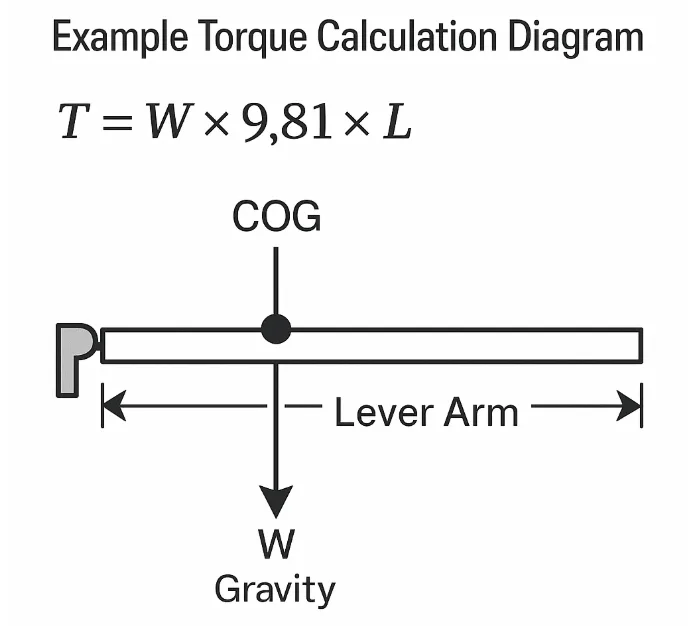
Hinge selection is a science of “torque.” You must determine the Maximum Lid Torque.
Calculating Your Maximum Lid Torque
- Determine the Lever Arm: This is the horizontal distance from the hinge’s pivot point to the Center of Gravity (COG) when the lid is in the closed (horizontal) position.
- Perform the Calculation:$$Torque (N \cdot m) = Weight (kg) \times 9.81 (m/s²) \times Lever\ Arm (m)$$
Define Your Operational Goal: Type of Heavy-Duty Assist
With your torque value, you must now define what the hinge system needs to do.
- Pure Hinging (Support Only): The user must lift the full weight. The hinge only provides a pivot. Suitable for “heavy-duty” lids with relatively low torque.
- Lift-Assist: Reduces the user’s “perceived lift weight” to make opening easier. For example, reducing a 40 kg perceived force to 5 kg to meet ergonomic standards.
- Counterbalance: The lid “hovers” at any angle within its range of motion, feeling virtually weightless. This is the safest, most ergonomic solution.
- Damping / Soft-Close: Controls the closing speed to prevent slamming. It provides no lift assistance.
Now you have a specific torque value (e.g., 196.2 N·m) and a clear operational goal (e.g., Counterbalance).
Step Three: Classifying and Selecting Hinge Solutions
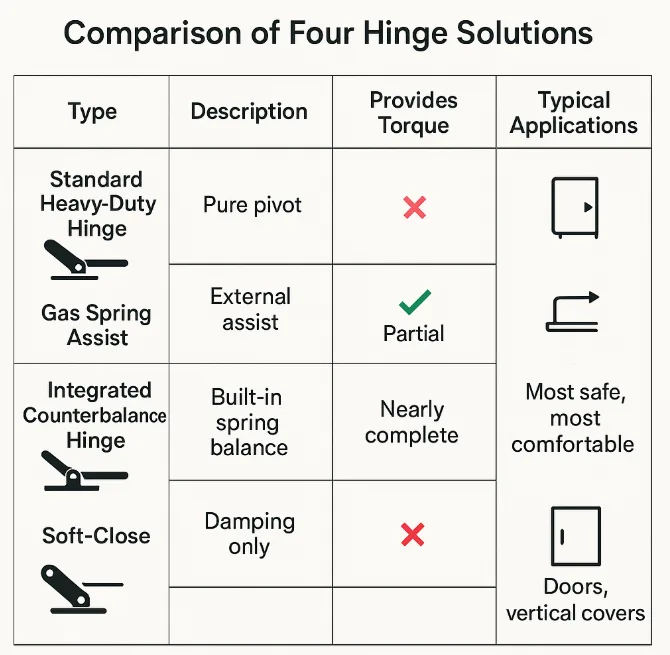
Standard Heavy-Duty Hinges (Non-Assisted)
- Types: Weld-On Hinges, Heavy-Duty Continuous Hinges, Pivot Hinges.
- Function: Provide zero torque assistance. The operator bears the full weight and torque of the lid.
- Best For: “Goal A: Pure Hinging.” Often used in combination with external lift systems (Category 3).
Counterbalance Hinges (Built-in Assist)
- Types: Mechanical Spring Counterbalance Hinges, Torsion Spring Hinges.
- How They Work: Powerful spring mechanisms are integrated into the hinge body. Their output torque is precisely engineered to offset the lid torque you calculated in Step 2.
- How to Select: Key: You must match your calculated torque value (e.g., 196.2 N·m) to the manufacturer’s “hinge torque rating.”
- Pros: All-in-one solution, makes lids feel “weightless,” extremely safe, and highly ergonomic.
- Best For: “Goal C: Counterbalance.” This is the optimal solution for heavy, top-opening access lids.
External Lift-Assist Systems (Used with Standard Hinges)
- Types: Gas Springs / Struts.
- How They Work: They are separate components installed alongside Standard Heavy-Duty Hinges (Category 1) to provide lift-assist.
- Key Challenge: Gas spring selection and mounting point calculations are notoriously complex. Incorrect mounting geometry will cause the spring to fail, provide the wrong force, or even prevent the lid from closing.
- Best For: “Goal B: Lift-Assist.” Used when an all-in-one counterbalance hinge (Category 2) is not feasible due to cost or space.
Damping and Soft-Close
- Types: Dampers or hinges with integrated damping.
- Function: They provide a resistive force opposite the direction of motion to slow it down. They do not provide lift.
- Best For: “Goal D: Soft-Close.” Used to protect equipment and operators from slamming lids (especially on vertical doors).
Step Four: Material, Coating, and Environmental Assessment
Material & Coating Decision Matrix
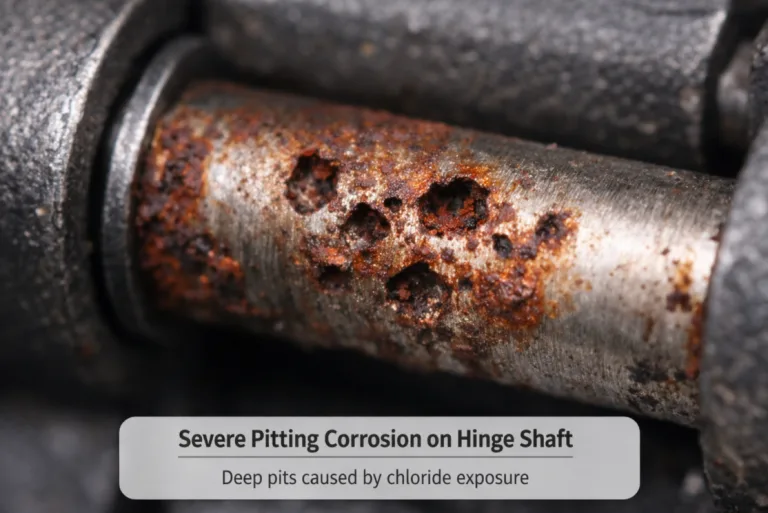
A functionally correct hinge that fails from corrosion is still the wrong choice. The environment dictates the material.
| Material | Reference Standard | Best For… |
| Carbon Steel | ASTM A36 / A108 | Dry, indoor environments (must be coated) |
| 304 Stainless Steel | ASTM A240 / A276 | Indoor, general outdoor, food processing |
| 316 Stainless Steel | ASTM A240 / A276 | Marine, coastal, chemical processing |
| Aluminum | ASTM B221 / B209 | Light-load applications, not for main structural points |
Coatings and Finishes (for Carbon Steel)
- Zinc Plating: Basic rust protection for dry, indoor environments.
- Hot-Dip Galvanizing: A thick protective layer for outdoor environments.
- Powder Coating: Provides good protection and aesthetic color options.
Pivot Pin and Bushing Details
For heavy-duty applications, look for: Hardened steel pins and Bronze or Nylon bushings. Bushings reduce metal-on-metal friction and wear.
Step Five: Installation, Maintenance, and Safety Considerations
Hinge Alignment: Correct vs Incorrect Installation
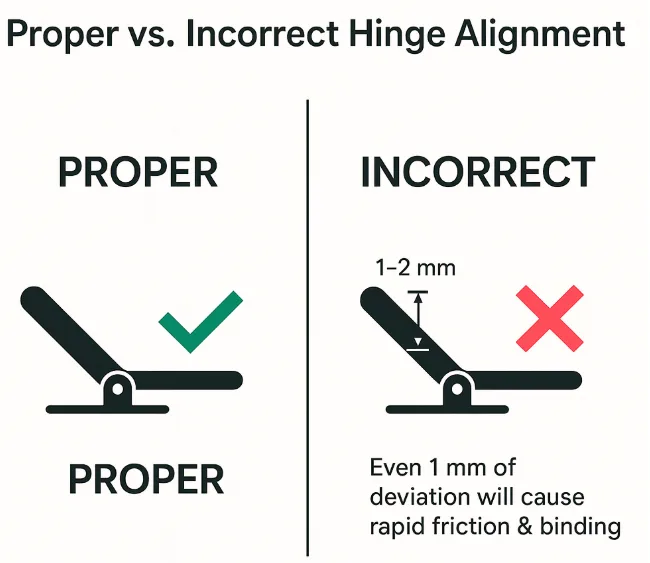
This is the most common installation failure. When using two or more hinges, their pivot pins must be in a single straight line (co-linear). Slight misalignment (even 1 mm) increases the load on the hinges exponentially, causing them to bind, squeak, and wear out extremely fast.
Installation Tip: Use a long, straight rod, a level, or a laser level to ensure all hinge knuckles are perfectly aligned.
Mounting Surface and Fasteners
The mounting surface must be flat and rigid enough to handle the full torque transferred by the hinge.
- Preferred: Through-bolts, nuts, and washers.
- Use graded fasteners (e.g., ISO 4014 / 4017 bolts).
- Prevent Galvanic Corrosion: Match the fastener material to the hinge material (e.g., 316 SS bolts for 316 SS hinges).
- In high-vibration environments, a thread-locking compound or locking nuts are mandatory.
Weld-On Considerations
- Ensure hinges are perfectly aligned and fixtured before welding.
- Control heat input to prevent the hinge’s pivot area from warping or seizing.
- If the hinge has nylon or plastic bushings, they must be removed before welding or protected from the heat.
Maintenance and Inspection
- Cycle Life: Follow the manufacturer’s cycle life rating, but note that real-world life depends on load and environment.
- Lubrication: Follow manufacturer recommendations. Many heavy-duty hinges with bushings are maintenance-free.
Conclusion: Your Heavy-Duty Hinge Selection Checklist
The Engineer’s Final Checklist
Before finalizing your design, confirm “yes” to all of the following:
- Have I clearly defined my operational goal (Hinging, Assist, or Counterbalance)?
- Does my selected hinge’s (or hinge + gas spring) torque rating match my calculation?
- Is my selected hinge material (e.g., 316 SS) appropriate for my operating environment (e.g., marine)?
- Do I have a clear installation plan to ensure all hinge pivots are perfectly co-linear?
- Have I specified the correct fasteners (material, type, and grade)?
Final Thought
Do not guess. The time invested in calculation upfront prevents safety incidents, equipment damage, and costly rework later. A smooth, safe, and easily operable heavy-duty lid is the direct result of quality engineering.


 English
  한국어
한국어  Русский
  Español
  Italiano
  Deutsch
  Français
  Português