

Why Outdoor Cabinets Require Concealed Hinges | Security, IP66, Corrosion
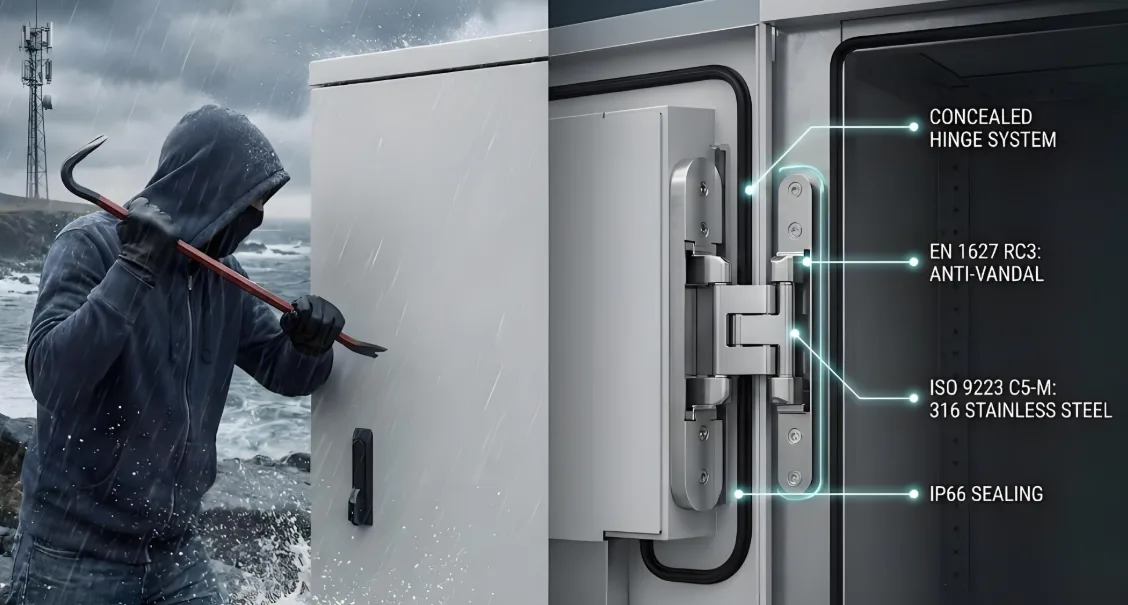
Outdoor cabinets require concealed hinges for three practical reasons: exposed hinges create the easiest physical attack point, internal hinge placement protects long-term sealing performance, and concealed designs hold up better against corrosion, impact, and public-environment abuse over time.
For 5G base stations, roadside distribution boxes, outdoor kiosks, and other unattended public infrastructure, hinge selection is not just a hardware choice. It is part of the enclosure’s security, durability, and lifecycle strategy. In these environments, standard exposed hinges often become the first point of failure under vandalism, salt spray, vibration, and weather loading.
This article explains why concealed hinges are the safer engineering choice for outdoor cabinets, and what designers should specify for anti-vandal security, IP66 sealing, impact resistance, corrosion class, and outdoor service life.
What to Specify for Outdoor Public Facility Cabinets
| Item | Why It Matters | Recommended Direction |
|---|---|---|
| Hinge type | Removes exposed attack point | Concealed hinge |
| Security target | Defines physical attack resistance | RC3-oriented enclosure design |
| Impact resistance | Protects against accidental and deliberate public impact | IK10 |
| Sealing target | Protects electronics from dust and water | IP66 or NEMA 4X project requirement |
| Corrosion class | Determines hinge material grade | ISO 9223 C4/C5 → AISI 316 or 316L |
| Fastener strategy | Reduces vibration loosening | Thread-locking and anti-loosening measures |
| Opening control | Reduces wind-sail risk outdoors | 90°–120° with retention or door stay |
| 3D validation | Prevents gasket drag and interference | STEP-file motion check in CAD |
Why Exposed Hinges Fail Outdoors
Outdoor cabinets in telecom, transport, utilities, and public payment systems face a combined threat that indoor enclosures usually do not: targeted vandalism, long-term corrosion, weather loading, and accidental impact. These risks do not act separately. They amplify each other.
- Physical attack: exposed pins and exposed fasteners are easy targets for cutters, pry bars, and simple hand tools.
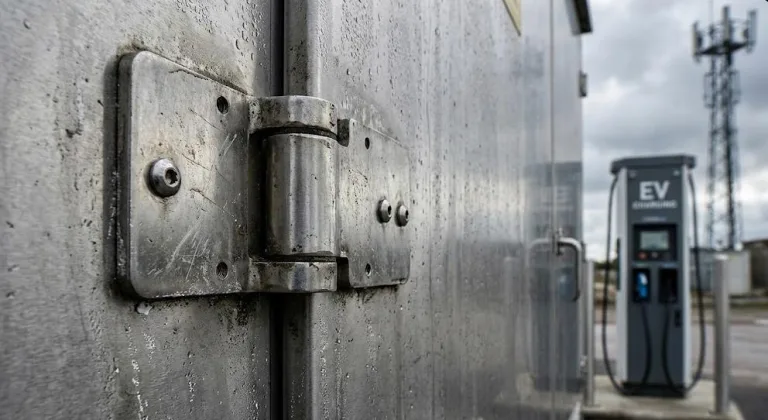
- Environmental erosion: salt spray, UV, thermal cycling, and moisture gradually weaken exposed hardware.
- Compounded vulnerability: corrosion reduces pin strength, making forced entry faster and easier over time.
In many outdoor enclosures, the exposed hinge becomes the weakest link. An attacker does not need to defeat the full locking system if the hinge side can be cut, pried, or detached first.
That is why concealed hinges are a security engineering decision, not a cosmetic upgrade.
Physical Attack Resistance: Why Concealed Hinges Extend Breach Time
For public-facing outdoor cabinets, the goal is often not to make the enclosure “impossible” to attack, but to increase attack difficulty and delay breach long enough to deter the attempt or trigger response systems. This is why RC3-level design logic matters in field conditions.
How External Hinges Are Defeated
- Pin destruction: exposed pins can be cut with shears, hacksaws, or grinders.
- Fastener removal: externally accessible screws create an easy bypass path.
- Corrosion-assisted attack: in coastal or industrial atmospheres, corrosion reduces pin cross-section, lowering the force needed to break it.
How Concealed Hinges Change the Attack Path
With concealed hinges, the hardware is not exposed from the outside. That forces the attacker to attack the door skin, frame edge, or lock area first rather than the hinge pin directly. In practical terms, this increases attack complexity and usually extends breach time significantly.
Concealed mounting also removes the common “unscrew the hinge from outside” bypass route. When the door is closed, the mounting points are blocked by the frame, so the hinge side cannot simply be disassembled from outside the cabinet.
IK10 Impact Resistance: Why Hinge Layout Matters
Outdoor cabinets must also survive accidental or intentional impact from tools, debris, public contact, and vehicle-related incidents. The key reference here is IK10 impact resistance under IEC 62262.
- IK10 baseline: 20 joules of impact energy.
- Why hinges matter: the enclosure does not truly “pass impact” if the shell survives but the hinge assembly becomes the failure point.
- Concealed hinge advantage: impact energy is transferred into the frame and door interface more evenly, rather than concentrating on an exposed hinge pin.
Specification tip: Always verify that the actual hinge configuration was included in the IK10 test assembly. A strong cabinet wall alone does not prove hinge-side impact resistance.
Environmental Sealing: Why Concealed Hinges Help Maintain IP66
For outdoor electronics, sealing is not a one-time lab result. It must survive years of UV exposure, gasket aging, thermal cycling, and maintenance activity. That is where hinge placement becomes important.
The Problem with Seal Interruptions
External hinges often require through-holes, cutouts, or interruptions near the sealing perimeter. Over time, those interrupted regions become stress points where gasket compression changes, UV damage concentrates, and water ingress risk grows.
Concealed hinges are installed inside the sealing line, allowing the enclosure to maintain a more continuous gasket path. This is one of the key reasons concealed hinge layouts are favored in long-life outdoor cabinets targeting IP66 or NEMA 4X service.
For a deeper procurement-focused discussion of coastal sealing, salt spray, and NEMA 4X requirements, see our NEMA 4X hinges for coastal projects guide.
Long-Term Outdoor Seal Degradation
- UV degradation: gasket materials harden and crack faster at stressed edges.
- Thermal cycling: repeated expansion and contraction can enlarge weak points around interrupted sealing zones.
- Freeze-thaw damage: trapped moisture expands during icing and mechanically worsens leaks over time.
By avoiding external seal interruptions at the hinge side, concealed hinge layouts remove one of the most common outdoor leak-initiation points.
Corrosion Resistance: How to Select Materials by ISO 9223 Zone
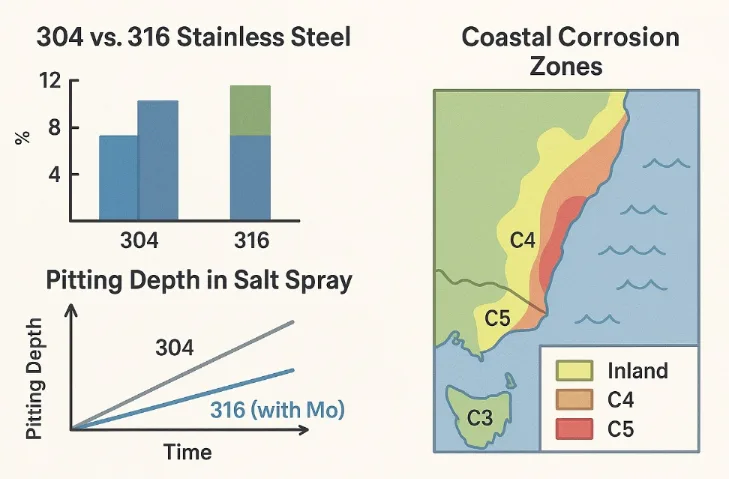
Outdoor concealed hinge selection should be tied to atmospheric corrosivity, not generic “outdoor use” language. ISO 9223 provides a practical framework for this decision.
| ISO 9223 Category | Typical Environment | Recommended Hinge Material | Salt Spray Target |
| C3 | Urban inland, moderate industrial | AISI 304 stainless steel | 500+ hours |
| C4 | Coastal 1–5 km from shore, chloride-rich industrial | AISI 316 stainless steel | 1000+ hours |
| C5 / CX | Direct marine, offshore, heavy chemical | AISI 316L or duplex stainless | 1500+ hours |
The practical rule: for installations close to the coastline, AISI 316 should usually be treated as the minimum baseline. If your project is primarily a coastal corrosion and procurement problem rather than a public-cabinet security problem, continue with NEMA 4X hinges for coastal projects.
For a broader material comparison focused on concealed hinge construction rather than outdoor public cabinets specifically, see our zinc die-cast vs stainless steel concealed hinge guide.
Procurement tip: Always request a third-party salt spray report for the actual base material and finish combination being specified. “Corrosion resistant” without test evidence is not enough for public infrastructure procurement.
Outdoor Use Cases Where Concealed Hinges Matter Most
Different outdoor sectors emphasize different priorities, but the core value of concealed hinges remains the same: they reduce exposed attack points and improve long-term cabinet durability.
- Telecom and 5G cabinets: sealing continuity and corrosion resistance are the main priorities, especially in coastal deployments.
- Transportation and roadside control cabinets: vibration resistance and anti-loosening strategy matter more because cabinets face repeated movement and public exposure.
- Financial kiosks and ATMs: brute-force resistance matters most, so concealed hinges should work together with multi-point locking architecture.
If your main concern is high-security digital infrastructure rather than roadside or public utility cabinets, see our data center concealed hinge security analysis.
Outdoor Design Inputs Beyond Indoor Hinge Selection
Outdoor concealed hinge selection requires more than standard indoor load and motion checks. These design inputs should be defined before finalizing cabinet geometry.
Wind Loading and Safety Factor
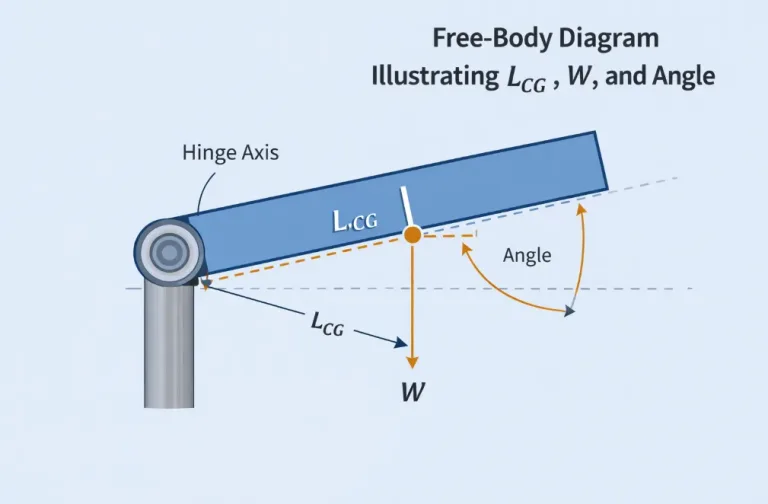
- Base calculation: door weight plus any mounted components.
- Outdoor margin: use a minimum safety factor of 2.0 for most public outdoor cabinets.
- Reason: outdoor doors experience dynamic wind loading, corrosion-related capacity loss over time, and field misuse during maintenance.
A 40 kg outdoor cabinet door should therefore be treated as a system that needs significantly more than 40 kg of nominal hinge capacity.
Opening Angle and Wind-Sail Risk
- Preferred range: 90°–120° for many exposed outdoor locations.
- Reason: wider opening increases wind catch and makes the door behave like a sail.
- Recommendation: specify hold-open control, detent, friction, or a separate door-retention solution where needed.
3D Verification with Gasket Geometry
Concealed hinges combine rotation and translation, so gasket compression and door-return geometry must be checked in 3D CAD. Outdoor cabinets often use thicker gasket systems than indoor cabinets, which increases interference risk if hinge throw is not verified early.
That is why concealed hinge selection for outdoor cabinets should be confirmed with the real STEP file, actual gasket profile, and actual door return geometry before sheet metal tooling is frozen.
Conclusion
Outdoor cabinets require concealed hinges because exposed hinges are easier to attack, harder to protect over time, and more likely to undermine long-term sealing and durability in public environments. For unattended infrastructure, concealed hinges improve anti-vandal resistance, help preserve IP66 or NEMA sealing integrity, and support longer service life in corrosive outdoor conditions.
The right time to define concealed hinge strategy is the concept design phase, not after sheet metal geometry is frozen. If the project is public-facing, outdoor, and expected to survive years of weather and abuse, concealed hinges should be treated as a baseline design decision rather than an optional upgrade.


 English
  한국어
한국어  Русский
  Español
  Italiano
  Deutsch
  Français
  Português