

NEMA 4X Hinges for Coastal Projects | SS316, Salt Spray, Sealing
For coastal electrical enclosures, outdoor cabinets, port equipment, and seaside infrastructure, IP65 or IP66 alone is not a sufficient purchasing standard. These ratings address dust and water ingress, but they do not verify corrosion resistance of the enclosure hardware itself. In long-life coastal projects, buyers usually need a NEMA 4X-based hinge specification, an SS316 material baseline, and clear supplier acceptance documents to avoid early rust, seized hinges, seal failure, and expensive maintenance.
This page is written for buyers, project engineers, and OEM sourcing teams who need to specify hardware for salt-spray and high-humidity environments. The focus is not on generic outdoor performance, but on what buyers should specify, what suppliers should prove, and how coastal project risk should be controlled before purchase.
What Buyers Should Know First About Coastal Hinge Selection
- IP65 or IP66 does not mean corrosion-resistant. It only confirms dust and water ingress protection.
- NEMA 4X is the more appropriate purchasing language when corrosion resistance is required together with sealing.
- SS316 is usually the safer baseline for long-life coastal deployments; SS304 is often only a budget compromise.
- Salt spray reports and mill certificates are procurement gates, not optional extras.
- Wind, gasket compression, and galvanic corrosion are project risks buyers should define early, not after field complaints begin.
IP65 / IP66 vs NEMA 4X: What the Difference Means for Buyers
When reviewing quotations or BOMs for coastal projects, buyers should not treat IP and NEMA ratings as interchangeable. They answer different questions.
IP65 / IP66 Focus on Dust and Water Ingress
IP ratings under IEC 60529 mainly test whether dust and water can enter the enclosure interior. They are useful, but they do not verify whether the hinge, latch, fastener, or enclosure material itself can survive coastal corrosion.
This means a product can pass IP65 while still rusting quickly in salt-spray service if its hinge material, coating system, or fastener selection is inadequate.
NEMA 4X Adds Corrosion Resistance
NEMA 250 Type 4X is more suitable for coastal procurement because it addresses not only enclosure sealing, but also corrosion resistance and external icing tolerance. For outdoor electrical cabinets, telecom boxes, control panels, and marine-adjacent equipment, this is often the more useful purchasing standard.
Procurement rule: if the project is coastal and long-life, RFQs should ask for hardware suitable for NEMA 4X-level service, not just IP65 or IP66 language.
What Buyers Should Specify for Coastal NEMA 4X Projects
| Item | Why It Matters | Buyer Requirement |
|---|---|---|
| Enclosure protection target | IP alone is not enough for coastal corrosion | NEMA 4X required |
| Base hinge material | Determines chloride resistance | SS316 preferred |
| Surface finish | Affects salt retention and tea staining risk | Electropolished where appearance retention matters |
| Fasteners | Wrong screws fail before the hinge | SS316 fasteners required |
| Isolation hardware | Prevents galvanic corrosion in mixed-metal assemblies | Isolation washers required where needed |
| Salt spray report | Validates corrosion system performance | ASTM B117 / ISO 9227, 1000-hour minimum |
| Mill certificate | Confirms real 316 chemistry | Mo content 2.0%–3.0% |
| Functional requirement | Controls wind and sealing-related field issues | Constant torque or adjustable hinge if needed |
SS304 vs SS316 for Coastal Projects
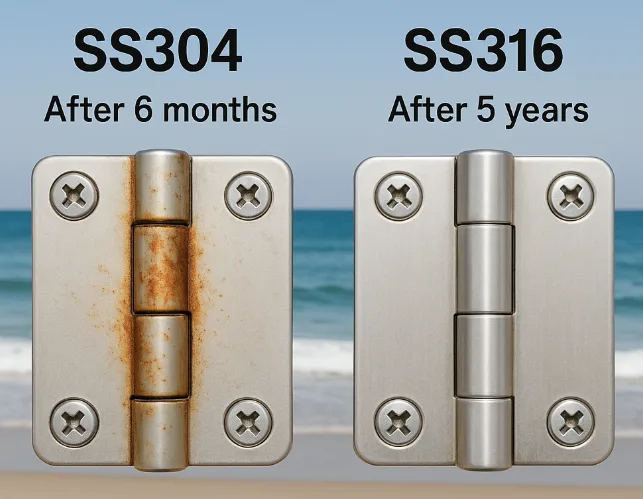
The price difference between SS304 and SS316 is real, but in coastal procurement the more important question is not initial material cost alone. It is whether the hardware will still perform acceptably after years of chloride exposure.
When SS304 Is Only a Budget Compromise
SS304 can perform adequately in many inland or standard outdoor environments. In coastal air, however, chlorides promote tea staining and surface corrosion much sooner. For short-life installations, temporary facilities, or projects with frequent maintenance and freshwater cleaning, SS304 may still be used as a cost compromise.
For long-life outdoor deployments, unmanned equipment, and appearance-sensitive enclosures, SS304 is usually not the safest baseline.
Why SS316 Should Be the Default Baseline
SS316 contains molybdenum, which significantly improves chloride resistance. In practical procurement terms, this means lower risk of tea staining, pitting, and appearance-related complaints over time. For projects with a design life of five years or more near the coastline, SS316 should usually be treated as the default baseline rather than an upgrade option.
If you need the broader material comparison beyond coastal projects, review our carbon steel vs stainless steel hinges guide. If the main concern is why stainless hardware still corrodes, continue with stainless steel hinge corrosion.
Surface Finish and Electropolishing
Material grade is not the whole story. Surface condition also affects how quickly salt deposits accumulate and how easily the surface can be cleaned by rain or maintenance.
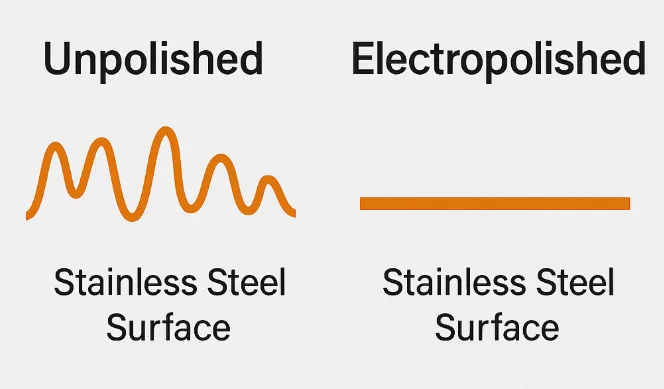
Electropolishing reduces surface roughness and removes microscopic irregularities where salt and contaminants can lodge. In coastal projects, this improves appearance retention and can reduce the speed of visible staining.
- Use electropolishing when: the project is appearance-sensitive, customer-facing, or expected to maintain a clean premium finish over time.
- Do not treat electropolishing as a substitute for SS316: it improves surface behavior, but it does not replace correct base material choice.
Coastal Project Risks Buyers Should Address Early
Coastal hardware failures are not limited to visible rust. Buyers should also evaluate wind, sealing, and mixed-metal installation risks early in the design phase.
Risk 1: Wind Loading and Uncontrolled Door Movement
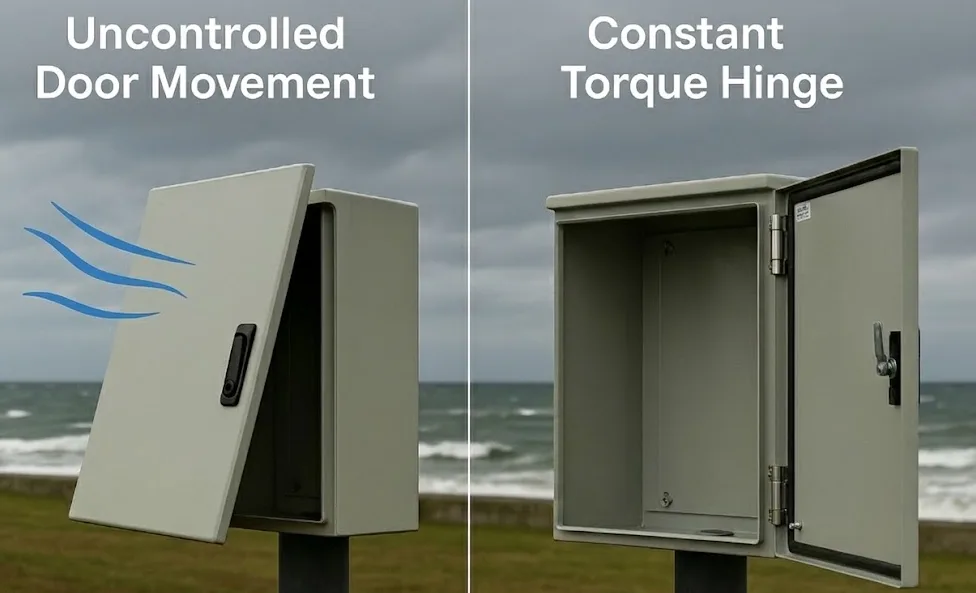
In coastal projects, wind load can make access doors unsafe to operate. Standard hinges allow uncontrolled movement, which can damage the enclosure or injure maintenance personnel.
Buyer solution: specify torque hinges or constant torque hinges where the enclosure door must remain stable during maintenance.
Risk 2: Seal Leakage from Gasket Compression Set
Over time, gaskets lose compression and sealing force drops. In coastal environments, this can allow moisture ingress and increase enclosure failure risk.
Buyer solution: where post-installation adjustment is necessary, specify adjustable hinge capability so sealing pressure can be restored without changing the entire door set. If your project also deals with condensation-heavy service environments, compare the sealing logic against cold storage hinges requirements.
Risk 3: Galvanic Corrosion in Mixed-Metal Assemblies
When stainless steel hinges are installed directly onto aluminum or galvanized steel in the presence of salt water, galvanic corrosion can accelerate damage to the less noble metal.
Buyer solution: require isolation washers or non-conductive barriers in mixed-metal assemblies, and do not assume that “stainless hardware” alone solves the corrosion problem.
Supplier Acceptance Standards
For coastal projects, buyers should not rely only on verbal material claims or generic “marine grade” language. Two supplier documents matter most.
Salt Spray Test Report
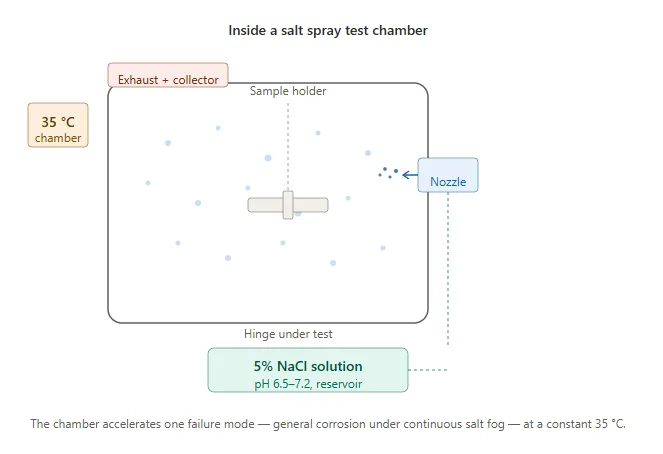
Request a third-party salt spray test report performed to ASTM B117 or ISO 9227.
- Procurement target: 1000 hours or more with no red rust on the surface.
- Warning: 96-hour or 200-hour reports are not strong enough for long-life coastal deployments.
Mill Certificate and Chemistry Check
Request a material mill certificate and check the chemistry, especially molybdenum content for SS316.
- Audit focus: Mo should typically be 2.0%–3.0% for real SS316 chemistry.
- Warning: if molybdenum is missing or below that range, the material may not provide true 316-level corrosion resistance.
Summary and Buyer Recommendations
For coastal industrial projects, hinge selection should be treated as a protection and lifecycle decision, not a low-cost commodity purchase. Although SS316 and electropolishing increase initial cost, they often reduce replacement, repair, and appearance-related service problems over the life of the project.
- Specify NEMA 4X, not just IP65/IP66.
- Use SS316 as the baseline for long-life coastal installations.
- Prioritize electropolishing when appearance retention matters.
- Require 1000-hour salt spray evidence and mill certificates.
- Address wind control, sealing adjustment, and galvanic isolation in the RFQ stage.
FAQ
Q1: Can SS304 be used in coastal projects if the budget is limited?
A1: It can be used as a compromise for temporary, short-life, or regularly maintained projects, but it is not the safest baseline for long-term unmanned coastal equipment.
Q2: What is the risk of low-cost SS316 hinges?
A2: Low-cost products may have poor chemistry control, casting defects, or weaker corrosion performance. That is why third-party salt spray reports and mill certificates matter.
Q3: Do installation screws matter in coastal service?
A3: Yes. If the hinge is SS316 but the fasteners are lower-grade or incompatible, the fasteners may corrode first and compromise the assembly.
Q4: Will constant torque hinges increase cost significantly?
A4: Unit cost is higher, but in wind-prone coastal service they can replace extra support hardware and improve maintenance safety, so total system cost may be reasonable or even lower.

 English
  한국어
한국어  Русский
  Español
  Italiano
  Deutsch
  Français
  Português