

Cabinet Door Safety Hinges | Prevent Falling Doors with Free-Stop Control
Heavy control cabinet doors can fall, slam shut, or release suddenly during maintenance. In industrial automation lines, electrical cabinets, and power distribution facilities, this is a real mechanical hazard that can cause head injuries, crushed fingers, damaged components, and unsafe one-handed operation.
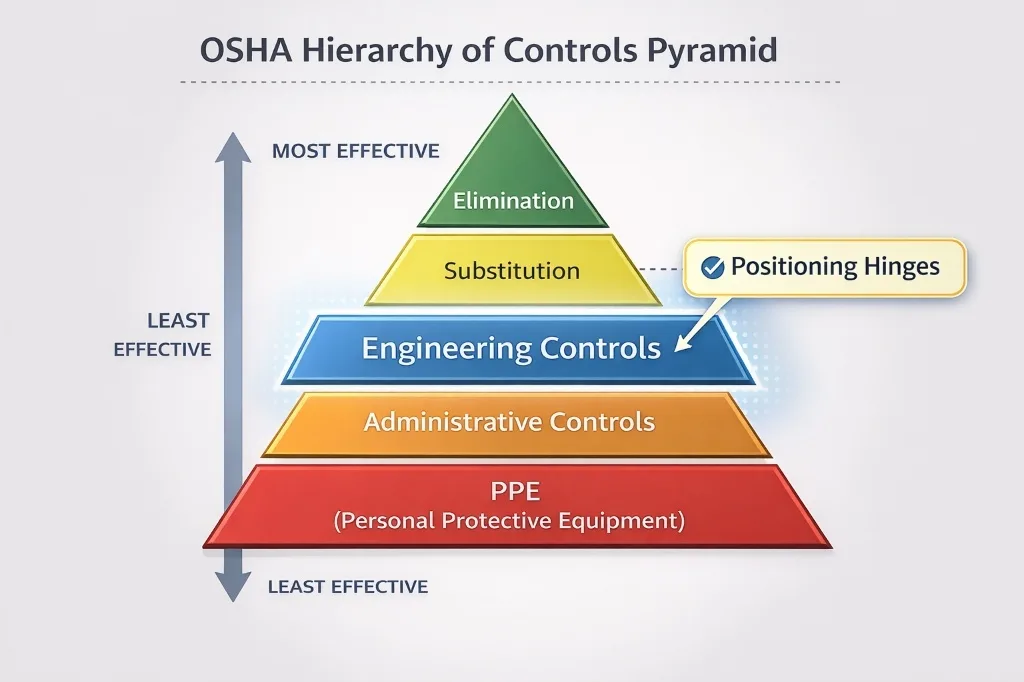
Positioning hinges, also called constant torque hinges, reduce this risk by controlling door movement and allowing free-stop holding without external supports. In practical safety engineering terms, they are not just a convenience feature. They are an engineering control that helps limit hazardous motion at the source.
This guide explains when positioning hinges are the safer choice for industrial cabinet doors, how to estimate torque for fall prevention, what engineers should verify before approval, and how to check long-term field safety after installation.
Why Falling Cabinet Doors Are a Real Safety Hazard
Uncontrolled cabinet door movement is a typical mechanical hazard. A heavy door that closes too fast, drops after partial opening, or slips from an operator’s hand creates risk not only for people, but also for the equipment mounted on or near the door. In industrial settings, this risk becomes more serious because cabinet doors are often large, heavy, and opened during inspection or service when the operator may already be handling tools, meters, or cables.
That is why risk reduction should prioritize structural and engineering measures rather than relying only on warning labels or operator behavior. A safer hinge strategy is one of the most direct ways to reduce this hazard.
Why Positioning Hinges Are the Safer Choice
When engineers compare cabinet door support methods, the key question is not only whether the door can be opened, but whether its motion stays controlled throughout the full range of movement.
| Solution | Movement Performance | Potential Safety Risk | Main Limitation |
| Standard Hinge | Fully gravity-driven | High risk of sudden falling or fast closing | No motion-control function |
| Gas Spring | Assisted opening, but pressure-dependent | Sudden loss of support if pressure drops | Can fail abruptly and needs maintenance |
| Mechanical Strut | Support only at fixed points | Unexpected fall if released or misused | Not free-stop; more awkward in one-handed use |
| Positioning Hinge | Controlled movement and stop at any position | Lower fall risk due to continuous resistance | Requires correct torque sizing and installation |
For heavy cabinet doors, positioning hinges are often the safer choice because they provide continuous resistance instead of relying on a single locking point or internal gas pressure.
When Positioning Hinges Are the Safer Choice for Cabinet Doors
- Heavy top-opening or side-opening doors: where gravity can create a strong closing moment.
- Maintenance access requiring one-handed operation: where the operator must hold tools or components while opening the door.
- Control and power cabinets serviced frequently: where repeated opening cycles increase the consequences of drift or sudden release.
- Installations where sudden movement could injure personnel: especially when the door edge is near the operator’s head, hands, or upper body.
In these situations, the design objective is not simply to “support” the door. It is to make door motion slow, predictable, and stable enough to reduce hazard during real work.
Core Technical Definitions
- Positioning Hinge: a hinge with an internal friction damping or torque-control mechanism that resists gravitational movement.
- Constant Torque: approximately stable resistive torque over a defined angular range, helping the door move more evenly.
- Free-stop: the ability of the door to remain stationary at intermediate angles without gas springs or prop rods.
- Safety by Design: reducing hazardous movement through structural design rather than relying only on labels or procedures.
Practical Torque Example for Fall Prevention
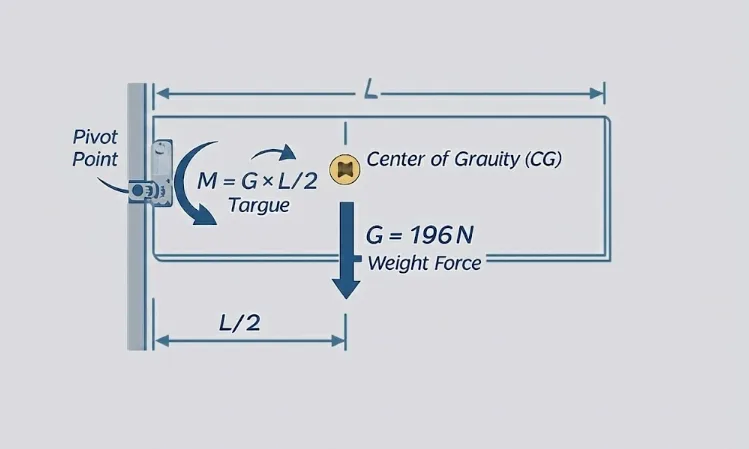
To prevent door fall, hinge selection should be based on a mechanical estimate rather than guesswork.
- Door mass: 20 kg
- Gravity: 9.8 N/kg
- Door width: 0.6 m
- Assumption: hinge is mounted on the side, so the center of gravity is at 0.3 m from the hinge axis
Step 1: Door weight
G = 20 × 9.8 = 196 N
Step 2: Maximum gravitational torque
Mmax = 196 × 0.3 = 58.8 N·m
Step 3: Add a safety factor
Using a 1.2 safety factor:
Ttotal = 58.8 × 1.2 = 70.56 N·m
Step 4: Divide by two hinges
Required rated torque per hinge = 70.56 / 2 = 35.28 N·m
This example is intended specifically for cabinet door fall prevention, not as a full general selection lesson. For deeper calculation logic and broader model-matching methods, continue with the torque hinge selection guide.
Engineering note: the goal is to counteract gravity enough to achieve stable hovering. Excess torque may make the door harder to operate and can increase long-term stress on mounting points.
What Engineers Should Verify Before Approval
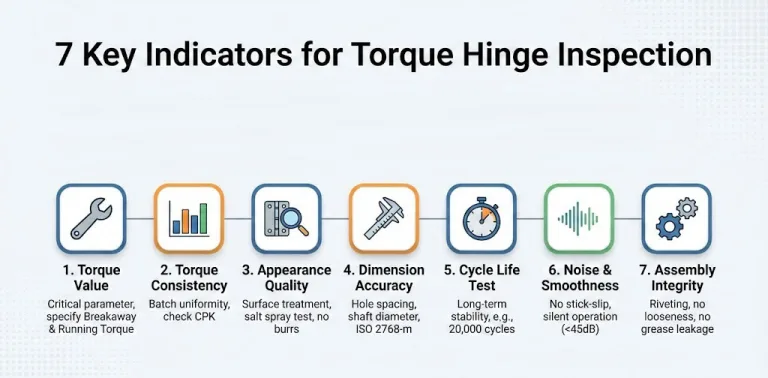
Before approving a positioning hinge for cabinet safety, engineers should check more than the nominal torque value.
| Verification Item | Recommended Target | Typical Reference |
| Fatigue life | More than 20,000 cycles with controlled torque decay | Supplier cycle-life report |
| Corrosion resistance | 96–480 hours neutral salt spray depending on environment | ASTM B117 |
| Torque tolerance | Within ±15% of rated torque | Supplier torque calibration report |
| Fastener strength | Higher than grade 8.8 where applicable | ISO 898-1 |
These checks are important because a positioning hinge that is underspecified, poorly calibrated, or installed with weak fasteners can still become a safety risk even if the basic concept is correct.
Failure Mode and Effects Analysis (FMEA)
For cabinet door fall prevention, the most practical risk question is not “can the hinge move?” but “how can it fail, and what happens next?”
| Failure Mode | Potential Cause | Risk Level | Prevention Strategy |
| Door slides down slowly | Insufficient torque or increased load | Medium | Use 1.2× safety factor and recalculate if load changes |
| Axis or structure fracture | Fatigue, shock, or corrosion | Very high | Use stronger materials and plan inspection intervals |
| Loss of positioning function | Wear, torque decay, or temperature-related drift | High | Perform periodic hover tests and replace if resistance weakens |
| Mounting loosening | Vibration, low preload, or missing anti-loosening measures | High | Use threadlocker or lock washers and install to correct torque specs |
Industry Best Practices and Field Safety Checklist
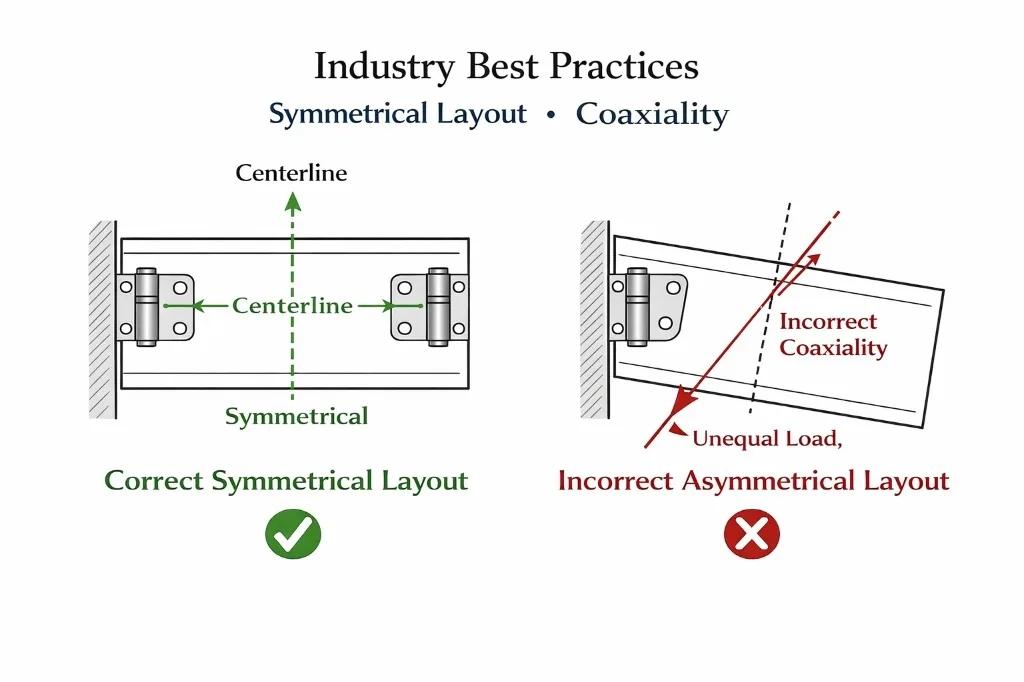
Best Practices
- Use a symmetrical layout: left-right or top-bottom balance helps avoid offset loading and abnormal torque behavior.
- Match material to environment: humid, dusty, or corrosive environments benefit from stainless steel construction.
- Check temperature suitability: confirm the hinge’s internal materials and lubrication remain stable in the operating range.
- Maintain installation precision: poor coaxiality or parallelism adds side load, increases wear, and weakens long-term stability.
Field Safety Checklist
- Static hover test: hold the door at 30°, 60°, and 90°; no visible drift within 15 seconds.
- Operation feel check: movement should be smooth, without sudden jumps, sticking, or abnormal noise.
- Fastener integrity: no looseness, cracks, or corrosion.
- Load verification: if displays, fans, or cooling units have been added to the door, torque must be recalculated.
- Appearance check: no oil leakage, abnormal wear powder, or visible damage at the hinge area.
FAQ
Q1: Are positioning hinges safer than gas springs for cabinet doors?
A1: In many fall-prevention applications, yes. Positioning hinges usually degrade more gradually, while gas springs can lose support suddenly if internal pressure fails.
Q2: Will positioning hinges make the cabinet door hard to open?
A2: Not if the torque is selected correctly. The aim is controlled movement, not excessive resistance. Both holding behavior and operating feel should be checked after installation.
Q3: What should I do if torque declines after years of use?
A3: Use hinges with documented life data, perform periodic hover checks, and replace them if a clear downward trend in door stability appears. For broader diagnosis of torque loss and instability, review the torque hinge sagging guide.
Q4: Can positioning hinges completely eliminate finger-pinch risk?
A4: No mechanical solution eliminates all risk, but positioning hinges significantly reduce the chance of gravity-driven sudden movement and therefore lower the injury risk.
Q5: Is stainless steel mandatory?
A5: Not in every environment, but it is strongly recommended where moisture, dust, or corrosive exposure could weaken the hinge structure over time.
Conclusion
Falling cabinet doors are a real mechanical hazard, especially in industrial control and power-distribution environments where doors are heavy and service access is frequent. Positioning hinges improve safety by controlling motion, enabling free-stop operation, and reducing the chance of sudden gravity-driven release.
The most effective approach is to size the hinge properly, verify torque through a real-case calculation, and then confirm safe performance through FMEA, installation best practices, and regular field checks. When used this way, positioning hinges become a practical engineering control that improves both maintenance safety and cabinet usability over the full life of the equipment.


 English
  한국어
한국어  Русский
  Español
  Italiano
  Deutsch
  Français
  Português