

Torque Hinges vs Gas Springs vs Springs: Which to Use?
Position Hold, Lift Assist, Return Force & Hybrid Systems
Torque hinges, gas springs, and mechanical springs are often compared as though they perform the same job. They do not. A torque hinge resists rotation and can hold a panel at intermediate angles. A gas spring applies an offset force that can reduce the effort required to lift a heavy cover. A mechanical spring stores energy and normally drives the panel toward a preferred position.
The correct choice starts with the required motion, not with component price, maximum force, or a preference for one technology. This guide compares torque hinges vs gas springs vs springs by moment behavior, packaging, user effort, failure response, service access, retrofit impact, and complete system cost so an OEM can choose the mechanism architecture before sizing individual components.
Quick Answer: Match the Mechanism to the Motion You Need
Use a torque hinge when the panel must remain where the user leaves it and the mechanism must fit at the pivot. Use a gas spring when reducing lift effort is the main requirement. Use a mechanical spring when the panel should return, counterbalance, or store energy and precise intermediate holding is not required. Use a hybrid when the panel needs meaningful lift assistance and controlled intermediate positioning.
| Required Panel Behavior | Best Starting Architecture | Why | Main Question to Resolve |
|---|---|---|---|
| Hold at many intermediate angles | Torque hinge | Resisting torque is integrated at the pivot | Can the required holding torque be achieved without excessive user effort? |
| Reduce the effort needed to lift a heavy lid | Gas spring or engineered counterbalance | Positive assistance offsets part of the gravitational moment | Does the installed force curve remain acceptable through the full travel? |
| Return automatically to one position | Mechanical spring | Stored energy drives the panel toward a preferred position | How will rebound, fatigue, and attachment loads be controlled? |
| Hold position and reduce lift effort | Hybrid mechanism | One device assists gravity while another controls position | Will the combined moment become excessive at any angle? |
| Fit inside a very tight hinge-line envelope | Torque hinge, subject to user-force limits | No remote cylinder stroke is required | Can the hinge line and fasteners carry the required moment? |
| Provide the lowest-cost simple return function | Mechanical spring | The spring itself may be simple when no hold or damping function is required | Will guards, anchors, linkages, or a separate lock erase the apparent savings? |
Do not start with “support this lid.” Define whether the panel must hold, assist, return, damp, lock, or combine several functions. Also define the operating angles, permitted user force, drift limit, attached equipment, environment, available envelope, and service method.

The first decision is the required motion function—not the largest catalog force or the lowest unit price.
Compare the Moment Curves Through the Full Travel
A hinged panel creates a moment about the pivot. The load cannot be judged from panel mass alone because the perpendicular distance from the hinge axis to the weight line of action changes as the panel rotates:
Mpanel(θ) = W × d⊥(θ)
Here, W is panel weight and d⊥(θ) is the perpendicular lever arm at angle θ. The selected mechanism creates an opposing or assisting moment of its own:
- Torque hinge:
MTH(θ)is the product-specific resisting-torque curve. It may differ by direction, temperature, angle, and life condition. - Gas spring:
MGS(θ) = FGS(θ) × r⊥(θ). Both cylinder force and the installed lever arm can change through the stroke. - Linear spring:
MS(θ) = FS(θ) × r⊥(θ). Force depends on spring rate, preload, and linkage geometry. - Torsion spring: a preliminary relationship is
MTS(θ) = k(θ - θ0), subject to actual spring geometry, preload, friction, and stress limits.
| Curve Question | Torque Hinge | Gas Spring | Mechanical Spring |
|---|---|---|---|
| What changes through travel? | Specified resisting torque, angle, and direction | Force, stroke, installation angle, and lever arm | Deflection, preload, and linkage geometry |
| Does it create lift assistance? | Normally no | Yes | Yes when arranged as a counterbalance |
| Does it hold arbitrary angles? | Yes within the approved torque condition | Not automatically; balance is geometry-dependent | Not normally without friction, a lock, or a detent |
| What evidence is required? | Torque-angle data in both directions | Force-stroke data and installed geometry | Spring force or torque data and installed geometry |
A mechanism that balances the panel at one angle can still be too heavy to open, rise unexpectedly, or refuse to close elsewhere in the range. Compare the net moment at closed, intermediate, service, and fully open positions before selecting a component family.
Scope boundary: This article compares mechanism behavior. Detailed torque calculation, hinge quantity, design margin, and torque tolerance belong in the torque hinge selection guide. Gas-spring sizing must use the selected supplier’s force-stroke data and the actual mounting coordinates.
Torque Hinges: Best for Compact Position Holding
A torque hinge places the resisting mechanism directly on the rotational axis. Internal friction elements and preload features create controlled resistance so the panel can remain at intermediate angles when the available torque exceeds the panel’s net moment.
Choose a torque hinge when: the main requirement is stable position holding, the mechanism must remain close to the pivot, visible support hardware is undesirable, and the hinge line can be manufactured and assembled with adequate alignment and structural support.
- It can combine the pivot and holding functions in one assembly.
- It avoids a separate cylinder stroke or remote spring linkage.
- It can provide a defined motion feel, including direction-specific behavior on suitable designs.
- It may reduce component count when it replaces a free hinge plus a separate holding device.
Do not select it only because it is compact. A torque hinge normally resists motion in both opening and closing directions; it does not create positive lift assistance. A high-torque solution may hold a heavy lid but still demand unacceptable operating force. Multiple units also need a controlled common axis, and their torque may change with friction condition, preload, wear, contamination, and temperature.
Review the torque hinges product family only after confirming that position control is the primary function. The drawing or supplier data should identify torque direction, usable angle range, tolerance, life condition, adjustment method, and any requirement for paired units.
Gas Springs: Best for Reducing Lift Effort
A gas spring acts between two offset mounting points. Its force, multiplied by the perpendicular lever arm to the panel pivot, creates an assisting moment. Correct geometry can reduce the force a user must apply to raise a heavy cover.
Choose a gas spring when: substantial lift assistance is required, the enclosure can accommodate the cylinder and rod sweep, the lid and frame can support offset bracket reactions, and the product can be safely supported during service.
- It can offset a large share of the gravitational moment.
- Changing mounting coordinates can shape the assistance through travel.
- Supplier data normally defines force, stroke, extended and compressed length, end fittings, and temperature behavior.
- Some models provide controlled extension characteristics, subject to the actual product design.
Do not assume it provides any-angle holding. Stable positions depend on the relationship among cylinder force, panel moment, friction, and geometry. The assembly also needs a clear stroke envelope, offset brackets, local reinforcement, and replacement access. Temperature, seals, rod condition, internal friction, orientation, and service time can influence the available force.
A gas spring should not be rejected because it is visible or contains seals. On a genuinely heavy lid, reducing operator effort may be more important than minimizing component count. The correct design uses real force-stroke data, installed coordinates, bracket loads, travel clearance, and a safe maintenance method.
Mechanical Springs: Best for Return Force or Counterbalance
“Mechanical spring” may mean a torsion spring at the pivot, an extension spring between brackets, a compression spring acting through a linkage, or a constant-force arrangement. Each produces a different load curve and has different retention, guarding, and fatigue requirements.
Choose a mechanical spring when: the primary task is return, counterbalance, latch bias, or energy storage and the product does not need stable holding at arbitrary intermediate angles.
- A standard spring can be economical in a simple geometry.
- Different spring forms can fit around the pivot or operate remotely.
- Within its approved range, output can be calculated from spring data, preload, and geometry.
- A cam or linkage can shape the effective counterbalance curve when the additional parts are justified.
Control the stored energy. Springs normally drive the panel toward a preferred position. Rebound, snapback, attachment loads, over-deflection, relaxation, corrosion, and fatigue require explicit review. A low-cost spring can also require anchors, guides, cables, guards, dampers, or locks that move cost and packaging elsewhere in the assembly.
Compare Space, Failure Response, and Complete System Cost
Reserve the Real Moving Envelope in CAD
Packaging includes more than the catalog dimensions. The CAD model must reserve the full moving envelope, assembly-tool access, fastener access, reinforcement, cable clearance, guards, stops, and replacement space. Check closed, intermediate, and fully open positions with tolerance—not only nominal geometry.
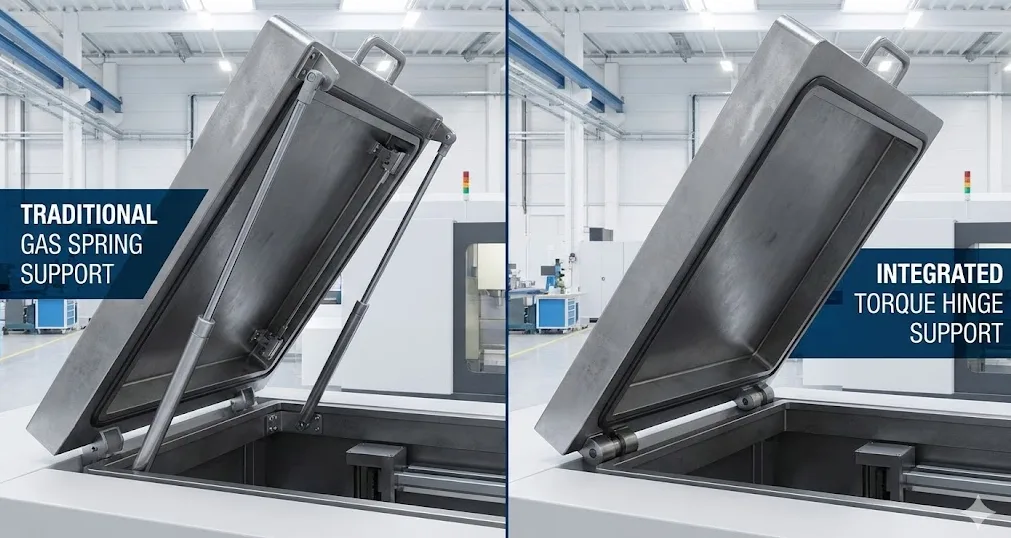
- Torque hinge: concentrated at the pivot, but the leaves, fasteners, panel edge, and frame must carry the functional moment.
- Gas spring: requires cylinder swing, rod stroke, two offset mounts, local bracket support, and safe access to the end fittings.
- Mechanical spring: may require coil clearance, moving legs, anchors, guides, cables, cams, or linkage guards.
Compare Torque Fade, Gas-Force Loss, and Spring Fatigue
No mechanism has one universal failure signature. A gas spring may lose support gradually through leakage, while an end fitting or bracket can fail more suddenly. A torque hinge may show progressive torque change, while a shaft, housing, leaf, retention feature, or fastener can create an abrupt structural failure. A mechanical spring may relax over time or fracture after fatigue, corrosion, or overload.
| Engineering Check | Torque Hinge | Gas Spring | Mechanical Spring | Evidence to Request |
|---|---|---|---|---|
| Functional output change | Torque fade, torque rise, stick-slip, direction imbalance | Force loss, force drift, extension-speed change, stiction | Relaxation, set, rate change, preload loss | Before-and-after output curves under defined conditions |
| Structural load path | Leaf, housing, shaft, fasteners, hinge-line support | Rod, cylinder, end fittings, offset brackets, fasteners | Wire, legs, hooks, anchors, guides, linkage | Load-path drawing and overload or retention review |
| Environmental sensitivity | Temperature, contamination, corrosion, friction condition | Temperature, seal and rod condition, corrosion, contamination | Corrosion, temperature, relaxation, debris, rubbing | Project-specific environmental test plan |
| Likely service action | Inspect mounting; adjust only when approved; replace worn or damaged units | Support the lid independently and replace the unit or mounting hardware | Control stored energy and replace the spring or damaged anchor | Written service sequence and spare-part definition |
| Early warning signs | Changed feel, drift, noise, play, leaf or fastener movement | Reduced support, leakage evidence, rod contamination, uneven extension | Changed return force, deformation, corrosion, rubbing, noise | Defined field-inspection criteria |
The comparison must include the complete assembly. A correctly rated component can still perform poorly when its brackets, anchors, fasteners, alignment, or supporting sheet metal are inadequate. Long-term internal torque decay is a separate diagnostic task; use the guide on why torque hinges lose strength after the architecture has already been selected.
Compare the Complete Mechanism Cost
Part price is only one term. Compare each concept at the same functional boundary. A gas-spring assembly may also include free hinges, end fittings, brackets, reinforcement, installation, inspection, service support, and replacement access. A mechanical spring may require anchors, guards, a linkage, damper, or lock. A torque hinge may require stronger hinge-line structure, tighter alignment control, or paired units.
A project-specific cost model can include:
TCO = Ccomponents + Cstructure + Cassembly + Cinspection + Cservice + Cspares + Creplacement labor + Cdowntime + Clogistics
This is an accounting structure, not a universal cost formula. Populate it with the released BOM, supplier quotations, observed assembly time, actual service sequence, spare-part policy, and traceable field evidence. Keep one-time redesign or tooling cost separate from recurring production and service cost. When failure frequency is unknown, test clearly labeled assumptions instead of inventing a replacement interval.
Check User Effort and Failure Safety Together
A mechanism can hold the panel but still be ergonomically unacceptable. It can also feel easy to open while creating excessive closing force, rebound, pinch exposure, or an unsafe service condition. Measure opening and closing effort through the full travel rather than checking only one position.
- Check loss of output. Determine what happens if hinge torque fades, gas-spring force decreases, or spring preload relaxes.
- Check excessive output. Too much torque can make a panel difficult to reposition; too much gas or spring assistance can make it rise unexpectedly or resist closure.
- Define the service support. A panel may need temporary support before removing a torque hinge, independent support before disconnecting a gas spring, or controlled energy release before removing a spring.
- Separate normal holding from a safety function. A latch, prop, stay, interlock, guard, or redundant support may still be required when personnel work beneath or inside the open panel.
- Prototype the complete assembly. Test the actual panel mass, handles, cables, seals, latches, accessories, mounting tolerances, and expected temperature range.
Do not call a mechanism fail-safe without naming the failure and the independent feature that keeps the panel safe. Normal operating resistance or assistance is not automatically a positive service support.
Use a Hybrid When Assistance and Position Hold Are Both Required
A hybrid system is appropriate when one mechanism solves the gravity or user-effort problem and another solves the positioning or motion-quality problem. It should not be used merely to compensate for incomplete sizing.
Gas Spring Plus Torque Hinge
The gas spring can offset a large share of the gravitational moment while the torque hinge adds controlled resistance and intermediate-position stability. Evaluate the combined moment through the complete travel so the panel does not rise unexpectedly near one end or become too difficult to close.
Mechanical Spring Plus Torque Hinge
A torsion, extension, or constant-force spring can reduce the net gravity load while the torque hinge controls position and motion feel. This avoids a pressurized cylinder but introduces stored-energy retention, fatigue, anchor loading, and guarding requirements.
Example: A Heavy Cover Needs Assistance and Intermediate Holding
This is a composite engineering scenario created to explain the selection logic. It is not a customer project record or product test claim.
An equipment manufacturer is redesigning a top-opening service cover. The existing gas spring provides acceptable lifting effort, but the cover is stable only near the fully open position. The new requirement adds intermediate service angles and reduces the sidewall space available for the cylinder.
A torque-hinge-only concept fits the available envelope, but the torque required to hold the cover would also be felt during opening and closing. A pure gas-spring revision improves one part of the travel but creates excessive opening bias elsewhere. The preliminary direction is therefore a lower-force assist mechanism plus torque hinges, with an independent service stay because personnel may work beneath the open cover.
The recommendation remains preliminary until the prototype confirms user force, intermediate hold, closing behavior, bracket reactions, hinge alignment, temperature behavior, tolerance sensitivity, and service access. For higher-load top-opening panels, use the heavy-duty torque hinge selection guide to determine whether a torque-hinge-only concept remains practical.
Can You Replace a Gas Spring With a Torque Hinge?
Sometimes—but not by moving one component into the holes left by the other. A gas spring creates an assisting moment through offset brackets. A torque hinge applies resisting torque directly at the pivot. Changing architectures therefore changes the load path, user effort, opening-stop function, structural reactions, and service method.
| Retrofit Check | Why It Matters | Next Engineering Action |
|---|---|---|
| Panel moment through the full travel | The existing gas spring may carry a large share of the gravity load | Obtain panel mass, center of gravity, accessories, and operating angles |
| User opening and closing force | A torque hinge resists movement but does not automatically assist lifting | Measure force on a representative complete panel |
| Hinge-line structure | The new mechanism transfers functional moment into the pivot structure | Review the panel edge, frame, backing, leaves, and fasteners |
| Common-axis alignment | Multiple high-torque hinges can bind when their axes are not coaxial | Define datums, tolerances, and the assembly-control method |
| Opening stop | The gas-spring geometry may previously have limited travel | Add and verify an independent stop if required |
| Service support | Removing the gas spring may remove the current support method | Define a safe independent support before releasing the old mechanism |
| Existing brackets and holes | Unused features can create interference, leakage, or local weakness | Issue a revised drawing and sealing or corrosion treatment |
| Validation range | Temperature, tolerance, cables, seals, and wear change real behavior | Test the complete assembly under project-specific conditions |
The retrofit may still reduce component count, free packaging space, or improve intermediate positioning. Include the one-time redesign, tooling, drawing, validation, and field-change costs in the business case instead of comparing only the replacement price of the old gas spring.
Choose by Position Hold, Lift Assist, Return Force, and Constraints
| Dominant Requirement | Preferred Starting Architecture | Reason | Main Validation Risk |
|---|---|---|---|
| Compact display or control panel that must remain at many angles | Torque hinge | Position control is integrated at the pivot | Torque tolerance, user force, alignment, and drift |
| Heavy top-opening lid requiring low user effort | Gas spring or engineered counterbalance | Positive assistance offsets gravity | Moment curve, bracket reactions, and force change |
| Simple cover that must return automatically | Mechanical spring | Return force is the primary task | Rebound, fatigue, retention, and guarding |
| Heavy lid requiring low effort and intermediate hold | Hybrid mechanism | Separates lift assistance from position control | Excess combined moment at part of the travel |
| Very tight enclosure with no room for offset hardware | Torque hinge, subject to required torque and user force | No external cylinder stroke is required | Hinge-line strength and ergonomics |
| Lowest part cost with no intermediate hold requirement | Mechanical spring | A simple elastic element may meet the task | Hidden anchors, linkage, damper, guard, or lock cost |
| Existing gas-spring system with acceptable operation and service history | Retain the current architecture | No mechanism change is automatically beneficial | Redesign without a measurable project benefit |
| Existing gas-spring system with repeated packaging, positioning, or service problems | Compare torque-hinge and hybrid retrofit concepts | A new architecture may remove the documented system problem | Underestimating user effort, pivot loads, and validation cost |
The matrix identifies a starting architecture, not a released component. The next step is to obtain the mechanism curves and verify the complete assembly through the full travel.
Confirm These Inputs Before Component Sizing
- Define the motion task: position hold, lift assistance, return, counterbalance, damping, locking, or a combined function.
- Obtain the real panel load: mass, center of gravity, handles, glass, displays, cables, seals, latches, and any accessories that move with the panel.
- Define the operating range: closed, intermediate, service, and maximum opening angles.
- Set user-force and holding limits: permitted opening and closing effort, required hold positions, and allowable drift.
- Request mechanism curves: torque-angle data, gas-spring force-stroke data, or spring force/torque data under defined conditions.
- Model the envelope: include component travel, tolerance, tools, brackets, guards, cable routing, and replacement access.
- Review the load path: hinge line, brackets, anchors, fasteners, panel edge, frame, backing, and opening stops.
- Define the environment: temperature, corrosion, contamination, cleaning, vibration, storage, and outdoor exposure where applicable.
- Define failure and service response: what happens when output decreases or increases, and how the panel will be independently supported during maintenance.
- Test the complete panel: verify user effort, movement, holding, rebound, interference, structural movement, hot/cold behavior, and tolerance sensitivity before production release.
The result is a preliminary architecture until engineering review confirms the calculations and load paths. Sample approval requires testing a representative assembly. Production approval requires evidence that controlled components and assembly methods reproduce the accepted behavior. For a project-specific review, send the panel drawing, mass and center of gravity, operating angles, required motion, available envelope, and current support mechanism.
FAQs
Can a torque hinge replace a gas spring?
Sometimes, but not as a direct substitution. A torque hinge can replace the position-holding function when the required torque and user effort are acceptable, but it does not automatically replace positive lift assistance. The retrofit requires a new moment analysis, hinge-line structural review, alignment plan, opening-stop review, service-support plan, and prototype user-force test.
When is lift assistance more important than position holding?
Lift assistance becomes the priority when the panel’s gravitational moment would require excessive user effort or create an unacceptable manual-lifting condition. A gas spring or engineered counterbalance may then be the better starting point. If the panel must also remain stable at intermediate angles, evaluate a hybrid rather than relying on position-holding friction alone.
Do gas springs hold a panel at any angle?
Not automatically. A gas spring creates an angle-dependent assisting moment through its force and mounting geometry. It may create a balance region, but stable holding across many angles normally requires carefully designed geometry or an additional friction, locking, detent, or positioning mechanism.
Are mechanical springs cheaper than torque hinges and gas springs?
The spring component may be cheaper, but the complete mechanism may also require anchors, guards, a cam or linkage, a damper, a lock, preload control, and additional assembly. Compare the complete functional BOM, structural support, assembly work, inspection, service action, and failure consequence rather than the spring price alone.
When should a hybrid gas spring and torque hinge system be used?
Use a hybrid when the panel requires meaningful lift assistance and stable controlled positioning. The gas spring or another counterbalance reduces the net gravity moment, while the torque hinge contributes holding resistance and motion feel. The combined moment must be checked through the full travel so the panel does not rise unexpectedly or become difficult to close.

 English
  한국어
한국어  Русский
  Español
  Italiano
  Deutsch
  Français
  Português