

How Industrial Hinges Are Made: The Manufacturing Process
When a buyer evaluates an industrial hinge, the finished part gives away very little. Two hinges can look identical in a photo and behave completely differently in service, because the difference was built into them at the factory — in the steel grade, forming method, machining tolerance, assembly control, and surface treatment.
Understanding how an industrial hinge is made helps engineers, buyers, and OEM project owners judge whether a hinge will hold up before they place an order. This guide walks through the manufacturing process from raw material to finished part, and shows what each stage means for strength, fit, corrosion resistance, lead time, and quality consistency.
Summary: How an Industrial Hinge Is Made
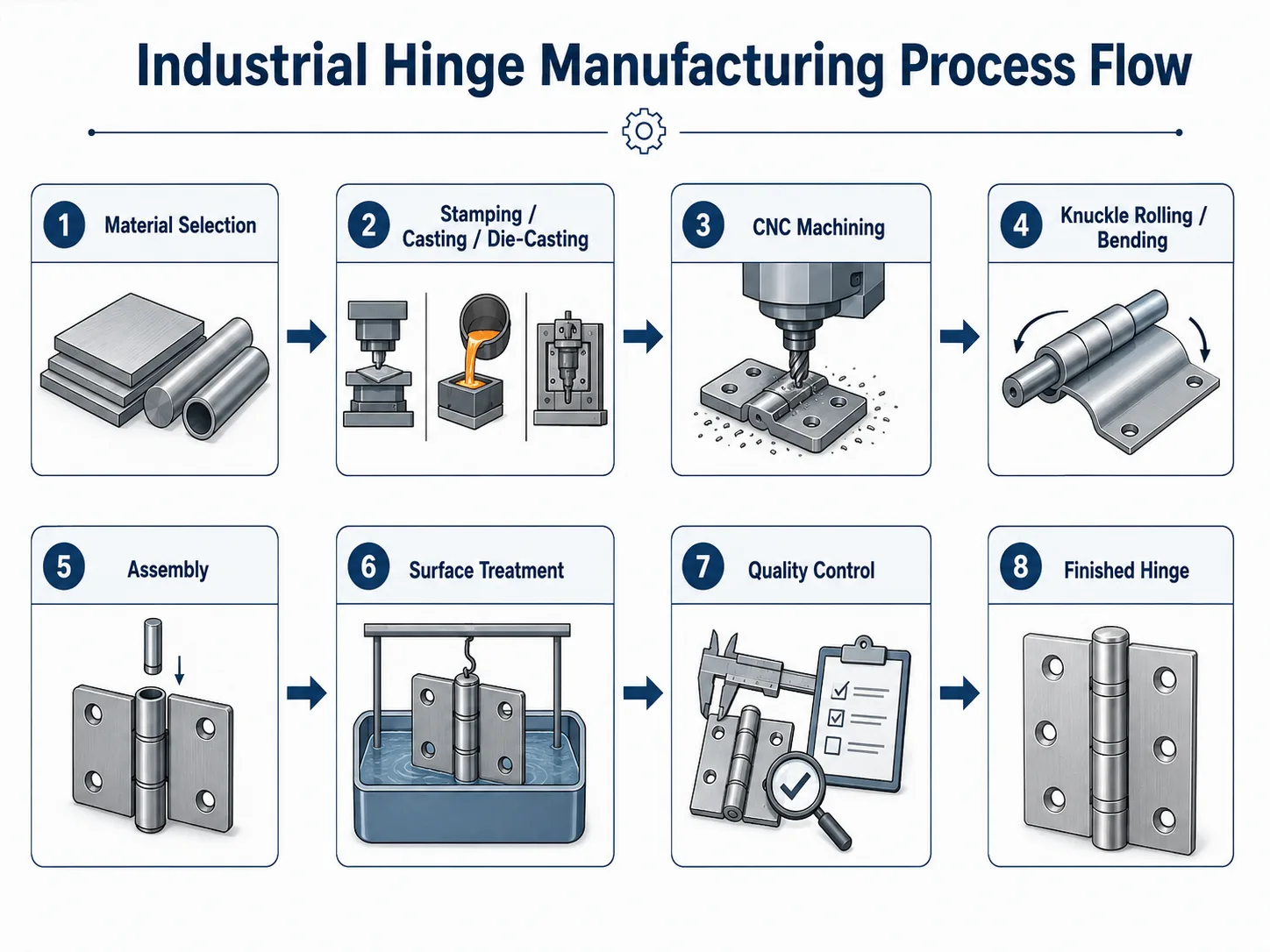
An industrial hinge is made through seven core stages: material selection, forming, machining, bending or knuckle rolling, assembly, surface treatment, and quality control. Each stage sets a property the buyer later depends on — strength from the material and forming, fit from machining, smooth movement from the knuckle and assembly, corrosion resistance from the finish, and consistency from the quality system behind the process.
- Material sets strength and corrosion resistance
- Forming creates the base shape
- Machining controls fit and hole accuracy
- Bending and rolling create the pivot geometry
- Assembly controls movement and torque feel
- Surface treatment protects against corrosion
- Inspection keeps the batch consistent
- Tooling affects custom lead time and cost
The Manufacturing Process at a Glance
Before looking at each stage in detail, it helps to understand the complete path a hinge takes through the factory. A stamped butt hinge, a die-cast torque hinge, and a machined heavy-duty hinge may use different equipment, but the manufacturing logic is similar.
| Stage | What Happens | What It Determines |
|---|---|---|
| 1. Material selection | Choose steel grade or alloy for the load and environment | Strength and corrosion resistance |
| 2. Forming | Stamp, cast, or die-cast the leaves and body | Base shape, strength, and dimensional consistency |
| 3. Machining | CNC, mill, and drill the holes and features | Fit, hole pattern, and tolerance |
| 4. Bending / rolling | Form the knuckle and any bent geometry | Pivot fit and smooth operation |
| 5. Assembly | Join leaves with pin, bushing, or friction parts | Movement, holding torque, and feel |
| 6. Surface treatment | Plate, coat, passivate, or polish | Corrosion resistance and appearance |
| 7. Quality control | Inspect dimensions, finish, and performance | Consistency across the batch |
Stage 1: Material Selection
Buyer takeaway: Material selection sets the hinge’s strength, corrosion resistance, price, and service life before any machining or finishing begins.
Manufacturing begins before any metal is cut. The material choice fixes the two properties buyers care about most: load capacity and environmental durability. Get this decision wrong and no amount of good machining or finishing will fully save the part in service.
Stainless Steel
Commonly 304 or 316. Used when corrosion resistance matters, with 316 preferred for salt, chlorides, coastal, marine, and washdown environments.
Carbon Steel
Offers high strength at lower cost, but depends on plating, coating, or another surface treatment because bare carbon steel will rust.
Zinc Alloy
Used in die-cast parts where dimensional precision and detailed shapes are required for medium-load applications.
For a buyer, the material is the first thing to confirm on any quote. A hinge quoted far below the others is often quoted on a lower-grade material or a thinner gauge. That difference may not show up on the invoice, but it can show up later as corrosion, bending, wear, or field failure.
Stage 2: Forming — Stamping, Casting, and Die-Casting
Buyer takeaway: The forming method tells you what the hinge is built for — flat volume production, heavy structural bodies, or precise detailed shapes.
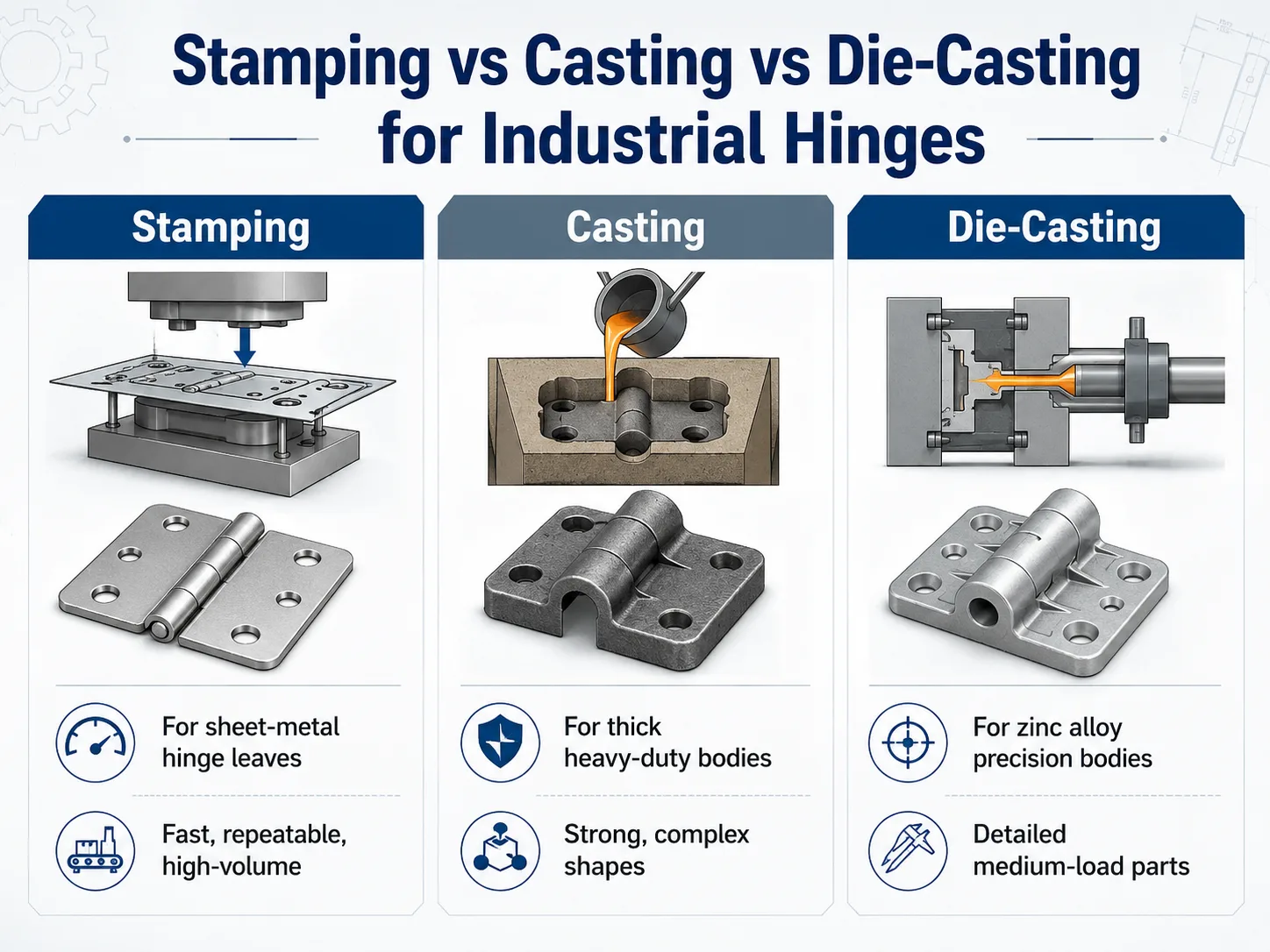
Forming is where flat sheet metal or molten metal becomes the recognizable shape of a hinge leaf or body. The method depends on the hinge design, production volume, strength requirement, and tooling budget.
Stamping
A press with a hardened die cuts and forms the leaf from sheet metal. It is fast, repeatable, and economical at volume.
Best for: high-volume butt hinges and consistent flat leaves.
Casting
Molten metal is poured into a mold to form heavier three-dimensional bodies that would be difficult to stamp.
Best for: thick, strong, complex heavy-duty hinge bodies.
Die-Casting
Molten zinc alloy is forced into a precision mold under pressure, producing accurate detailed shapes.
Best for: precise, detailed, medium-load torque and positioning hinge bodies.
Stamping, casting, and die-casting also affect custom cost and lead time. Stamped parts need dies; cast and die-cast parts need molds. When the tooling does not already exist, the first production run takes longer and usually carries a setup cost.
Stage 3: Machining — CNC, Milling, and Drilling
Buyer takeaway: Machining controls whether the hinge bolts up cleanly, rotates smoothly, and stays consistent across a production batch.
Once the base shape exists, machining adds the features that forming cannot control precisely enough on its own: exact hole positions, flat mating faces, pin bores, and fine dimensional details.
CNC machining and milling bring the part to its final dimensions under repeatable control. Drilling and reaming create the mounting holes and pin bore to controlled diameter and position. The tolerance held here determines whether the mounting holes line up, whether the pin turns smoothly without play, and whether multiple hinges on the same door share load evenly.
For OEM buyers, machining tolerance is worth asking about directly. It rarely appears in a catalog, but it strongly affects assembly on a production line. A supplier that machines in-house and controls its tolerances can hold a hole pattern precisely. The way a hinge’s holes are specified is covered in our guide to hinge mounting hole patterns.
Stage 4: Bending and Rolling the Knuckle
Buyer takeaway: Knuckle accuracy affects smooth rotation, pin fit, wear pattern, and long-term door alignment.
The knuckle is the rolled barrel that holds the pin. It turns two leaves into a working pivot. On many hinge types, the edge of the leaf is rolled or bent into a curl that becomes the barrel, while any offset or bent-arm geometry is formed at this stage.
If the knuckle is rolled to a consistent diameter and the leaves interlock cleanly, the pin runs smoothly and the load is shared along the barrel. If the knuckle is uneven, the hinge can bind, wear at concentrated points, or develop play. On bent and offset hinges, bend accuracy also determines whether the door clears the frame and sits correctly against a seal.
Stage 5: Assembly
Buyer takeaway: Assembly determines movement feel, holding torque, part-to-part consistency, and how the hinge performs over repeated cycles.
Assembly is where separate components become a single moving part. At its simplest, this means interlocking the leaves and inserting the pin. On functional hinges, assembly also adds the components that create smooth motion, positioning, removal, or torque resistance.
Basic Hinges
Leaves are interlocked at the knuckle and secured with a pin.
Torque Hinges
Friction elements, washers, or contact plates are added and controlled for consistent holding resistance.
Lift-Off Hinges
Male-and-female components are paired so the door can be removed without tools.
In a two-hinge installation, the left and right hinges must behave closely enough to share load without skewing the door. For torque hinges, manufacturers often screen and match parts so resistance remains consistent across the batch.
Stage 6: Surface Treatment
Buyer takeaway: Surface treatment protects the hinge from the operating environment, and hidden shortcuts here often appear later as early corrosion.
Surface treatment protects the finished hinge from corrosion and wear. For outdoor, coastal, washdown, or corrosive environments, the finish can be as important as the base material.
Plating
A metallic layer such as zinc or nickel protects carbon steel or zinc alloy and improves appearance.
Powder Coating
A durable coated finish that adds corrosion resistance and color, common on carbon steel and zinc-alloy hinges.
Passivation & Polishing
Stainless steel is passivated to strengthen its corrosion barrier and polished for appearance and cleanability.
Matching the treatment to the environment is what makes the difference between a hinge that lasts and one that rusts early. A powder-coated carbon steel hinge can serve well indoors but fail outdoors if the coating is thin or damaged at the holes. A passivated 316 stainless hinge performs better in salt exposure where a plated steel hinge may not be suitable.
Stage 7: Quality Control and Inspection
Buyer takeaway: A single good sample proves little. A controlled quality process proves that the thousandth hinge can match the first.
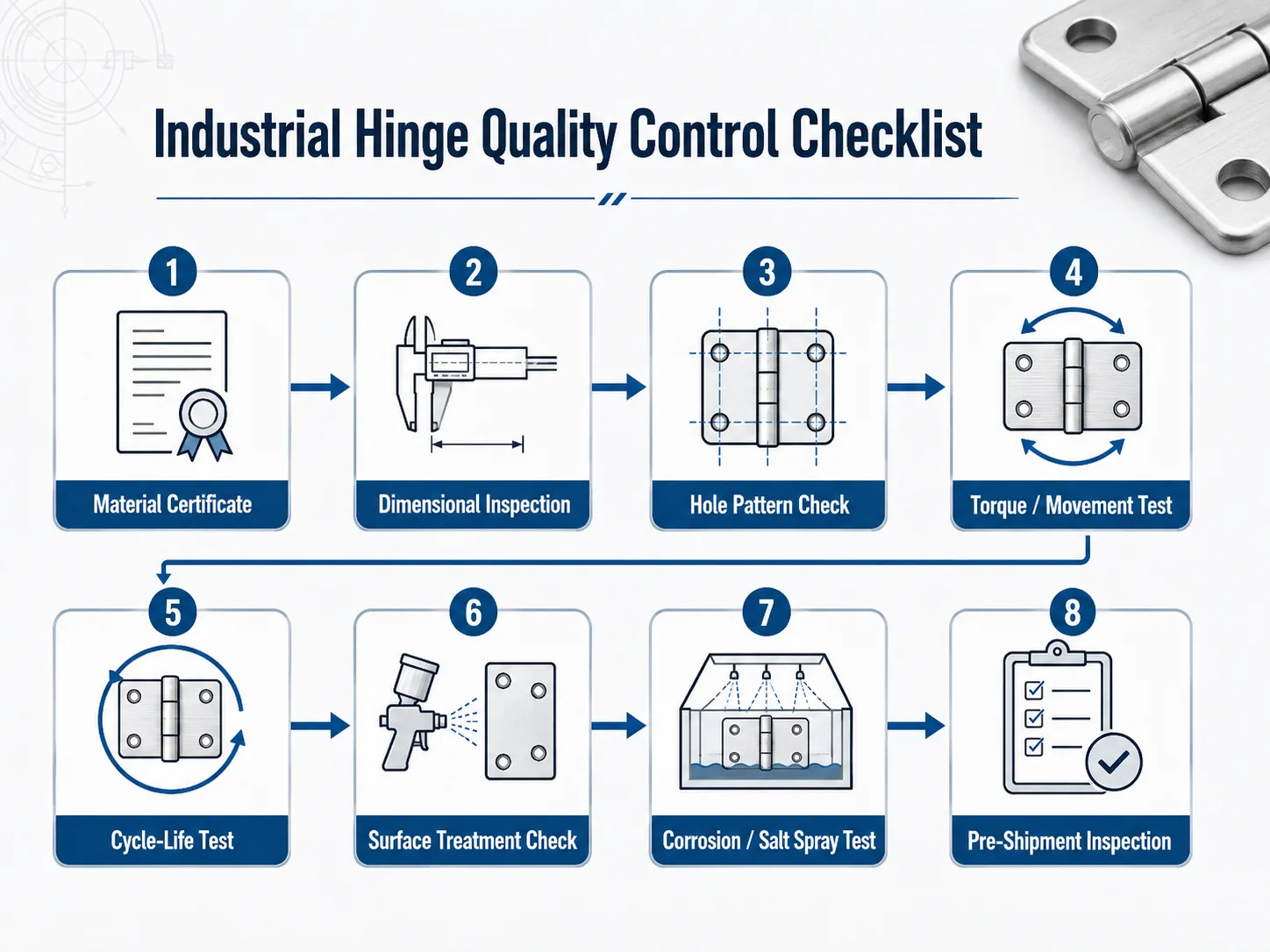
Quality control is not a single final step. It is a discipline that runs across incoming material, forming, machining, assembly, finishing, and finished-part inspection.
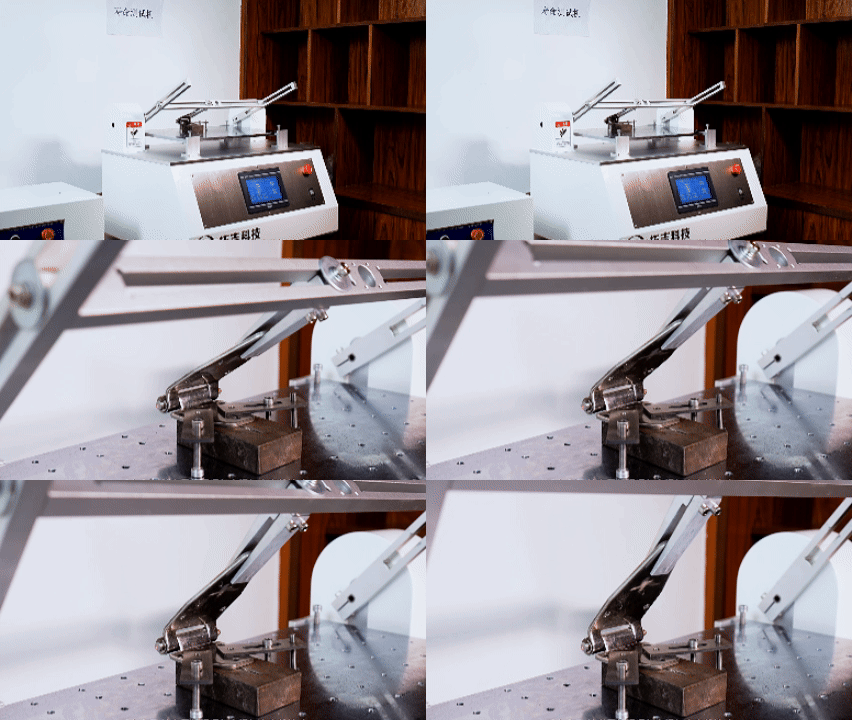
A capable manufacturer verifies dimensions against the drawing, checks the finish, and tests performance where needed: holding torque at defined angles for torque hinges, smooth operation and play for pivots, cycle life for repeated movement, and corrosion resistance where the application demands it.
What a Buyer Can Ask For as Proof
- Material grade and certificate
- Dimensional inspection report
- Surface-treatment specification
- Torque or holding-force data
- Cycle-test results
- Salt-spray or corrosion results
- Pre-shipment inspection
- ISO 9001 or equivalent system
How Long Does It Take to Manufacture a Hinge?
Buyer takeaway: Lead time depends on whether tooling and first-article approval already exist.
A standard hinge that is already tooled and stocked can ship quickly because the difficult stages were completed earlier. A custom hinge starts much of that clock over.
The stage that most affects custom lead time is tooling. A stamped part needs a die, and a cast or die-cast part needs a mold. Once the tooling exists, repeat orders run faster because the process is already proven. This is why suppliers can quote stock parts in days but custom parts in weeks: the difference is whether design, tooling, and first-article approval have already been completed.
How Manufacturing Differs by Hinge Type
The seven stages are the common backbone, but different hinge types emphasize different stages. Knowing this helps buyers ask better questions.
| Hinge Type | Manufacturing Emphasis | Where Quality Is Won or Lost |
|---|---|---|
| Butt / sheet-metal hinges | Stamping and drilling | Consistent leaf forming and accurate hole pattern |
| Heavy-duty hinges | Casting or thick-plate forming, machining | Material strength and machined fit under load |
| Torque / positioning hinges | Die-casting and precision assembly | Friction element consistency and matched behavior |
| Lift-off hinges | Forming and paired assembly | Male/female fit and repeatable alignment |
| Weld-on hinges | Forming the barrel and weld areas | Barrel concentricity and weld-ready surfaces |
| Concealed hinges | Stamping, bending, and assembly | Bent-arm accuracy and smooth linkage |
For a torque hinge, ask about assembly and friction consistency. For a heavy-duty hinge, ask about material and machined fit. For a concealed hinge, ask about the accuracy of the bent geometry. This is also the foundation for judging a supplier’s real capability, which our guide on how to evaluate an industrial hinge supplier builds on directly.
Why the Manufacturing Process Matters to Buyers
For an engineer or OEM buyer, understanding manufacturing turns a hinge from a mystery part into something that can be evaluated and specified with confidence. Strength comes from material and forming. Fit comes from machining. Feel comes from assembly. Durability comes from surface treatment and quality control.
It also reframes price. A hinge quoted well below the rest is not cheaper by magic. It is often cheaper because something in the process was reduced: a lower material grade, thinner gauge, looser tolerance, thinner finish, or lighter inspection. Sometimes that trade-off is acceptable for a low-risk door. Often it is not.
Need to Review a Hinge Against Your Application?
A manufacturer that controls the full process in-house can hold quality consistent and trace a problem back to its source. If you want to review a hinge against your application and see how it would be made, you can share your requirement here for an engineering review.
FAQs
How are industrial hinges made?
Industrial hinges are made in a sequence of stages: selecting the material (usually stainless steel, carbon steel, or zinc alloy), forming the leaves or body by stamping, casting, or die-casting, machining the holes and features by CNC and drilling, bending or rolling the knuckle, assembling the leaves with a pin and any bushing or friction parts, applying a surface treatment for corrosion resistance, and inspecting the finished part against dimensional and performance standards. Each stage sets a property the buyer later depends on, from strength to fit to durability.
What is the difference between stamping and casting a hinge?
Stamping uses a press and a hardened die to cut and form a hinge leaf from sheet metal; it is fast, repeatable, and economical at volume, making it the standard for butt and sheet-metal hinges. Casting pours molten metal into a mold to form heavier, three-dimensional bodies that are hard to stamp, suiting thick, strong, complex shapes for heavy-duty hinges. Die-casting is a related process that forces molten zinc alloy into a precision mold under pressure for high dimensional accuracy, common in torque and positioning hinges.
What materials are industrial hinges made from?
Industrial hinges are made mainly from three material families. Stainless steel, commonly 304 or 316, is used for corrosion resistance, with 316 adding molybdenum for far better resistance to salt and chlorides. Carbon steel offers high strength at lower cost but needs a surface treatment because it rusts if left bare. Zinc alloy, formed by die-casting, gives excellent dimensional precision for medium loads and is usually plated or powder-coated. The right choice depends on the load and the environment the hinge will face.
Why does the manufacturing process affect hinge quality and price?
Because each stage sets a property the buyer depends on, and each stage can be reduced to cut cost. A lower material grade, a thinner gauge, looser machining tolerance, a skipped or thinner surface treatment, or lighter inspection all lower the price but also lower the strength, fit, corrosion resistance, or consistency of the part. A hinge quoted far below the others is usually cheaper because something in the process was reduced, and that trade-off often shows up later as field failures rather than on the invoice.
What should I ask a hinge manufacturer to verify quality?
Ask for the material grade and certificate, a dimensional inspection report, the surface-treatment specification, and performance data such as holding torque, cycle-test results, and salt-spray or corrosion results where relevant. Ask whether the factory controls the process in-house, whether it holds ISO 9001 or an equivalent quality system, and whether it will provide a pre-shipment inspection. A supplier that can provide this proof is demonstrating a controlled process; one that offers only reassurance is asking the buyer to carry the risk.



 English
  한국어
한국어  Русский
  Español
  Italiano
  Deutsch
  Français
  Português