

How to Evaluate an Industrial Hinge Supplier
Most hinge problems that show up months after a product ships were actually decided at the sourcing stage, not the design stage. The wrong supplier can send a first sample that looks perfect and then show inconsistent quality across production batches, miss the lead time that your whole build depends on, or turn out to be a reseller with limited control over the process that actually made the part. Choosing a hinge supplier is a risk decision, and the time to make it well is before the purchase order, not after the first failure.
This guide is a practical framework for evaluating an industrial hinge supplier before you order. It walks through how to tell a real manufacturer from a reseller, which engineering and quality capabilities actually matter, how to read certifications and quotes, and what to send a supplier so the comparison is fair. The goal is to buy on total cost and reliability, not just the lowest unit price on the first quote.
Quick Answer: What to Check Before You Order
Summary: To evaluate an industrial hinge supplier before ordering, confirm five things: that the company is a direct manufacturer rather than a reseller; that it can provide engineering support, drawings, and samples; that it can prove quality with real test data; that its certifications match your application; and that its lead time, minimum order, and communication fit your build. A low unit price is not enough if the supplier cannot hold quality consistent across production or support the part after the order ships — total cost, not the first quote, is what to compare.
Before ordering from an industrial hinge supplier, confirm five things: that they are a direct manufacturer rather than a trader, that they have real engineering and testing capability, that their quality system and certifications match your application, that their quoted lead time and minimum order fit your build, and that the total cost of ownership — not just the unit price — is competitive. A supplier that is strong on all five is worth more than one that is only cheapest on paper, because the hidden costs of a weak supplier show up later as failures, delays, and rework.
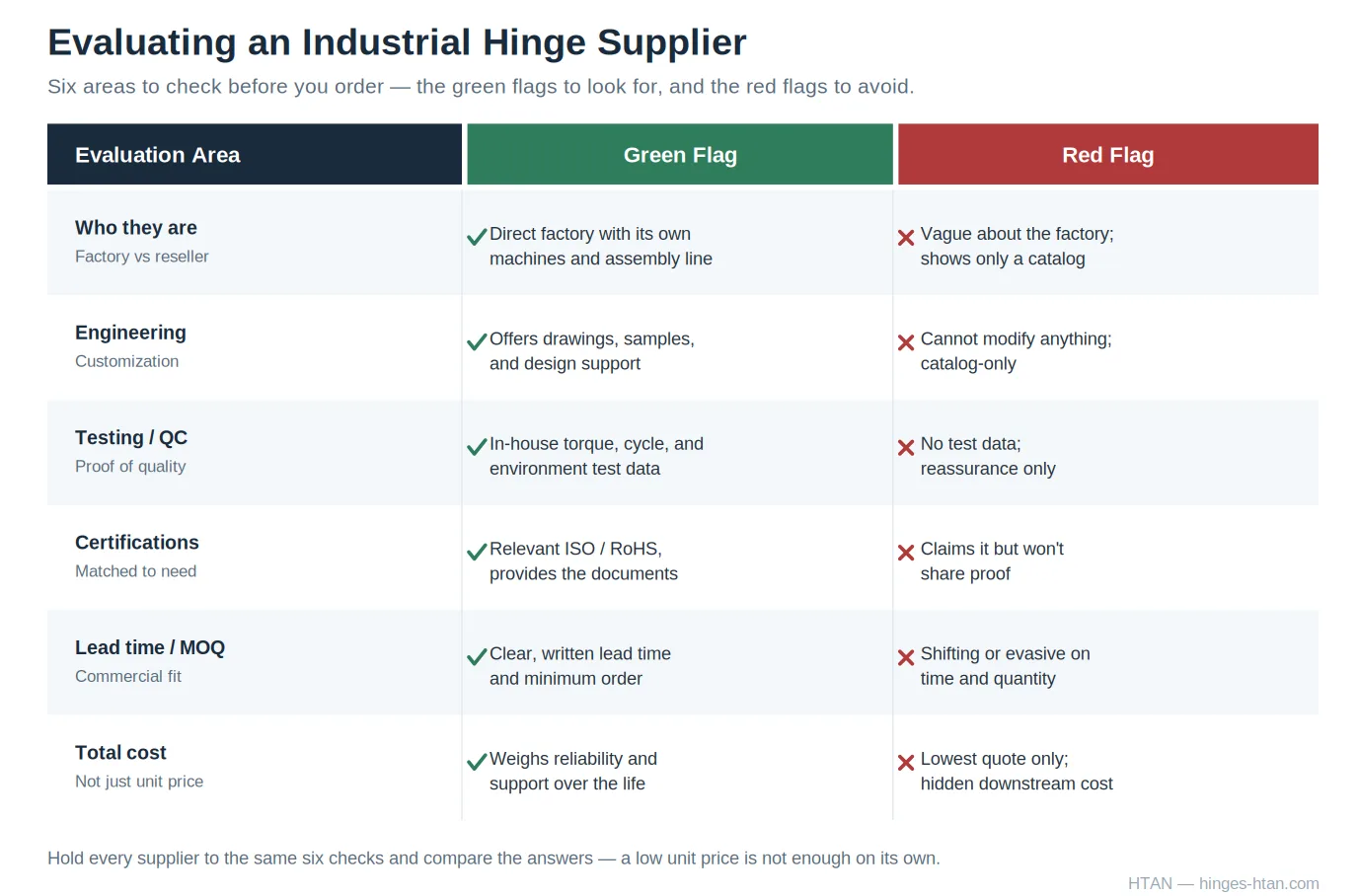
| Evaluation Area | Green Flag | Red Flag |
|---|---|---|
| Who they are | Direct factory with its own machines and line | Vague about the factory; only shows a catalog |
| Engineering | Offers drawings, samples, and design support | Cannot modify anything; catalog-only |
| Testing / QC | In-house torque, cycle, and environment testing | No test data; “trust us” on quality |
| Certifications | Relevant ISO / RoHS, provides documents | Claims certification but won’t share proof |
| Lead time / MOQ | Clear, written lead time and minimum | Shifting or evasive on time and quantity |
Factory or Trading Company?
The first and most important thing to establish is whether you are talking to the company that actually makes the hinge, or to a reseller that buys it from someone else. This single distinction affects price, quality control, customization, and — most of all — what happens when something goes wrong.
A direct manufacturer controls the tooling, the machining, and the assembly, so it can adjust a design, hold quality across a run, and diagnose a problem down to the process that caused it. A trading company sits between you and the real factory: it adds margin, it cannot change the part itself, and when a batch is wrong it has to relay the problem to a factory it may not control. Neither is dishonest by definition, but for anything custom, quality-critical, or long-term, buying from the maker removes a layer of risk and cost.
You can usually tell the difference by asking specific questions a maker can answer instantly and a reseller cannot: What machines run the part? Can you show the production line? Can you modify this dimension, and what does the tooling change cost? Who signs off on quality? A direct factory answers these plainly; a reseller gets vague or has to “check with the factory.”
Engineering and Customization Capability
For any application that is not a perfect match for a catalog part, the supplier’s engineering capability is what separates a usable hinge from a forced fit. A capable supplier can take your door weight, offset, load, and environment and either recommend the right standard part or develop one to suit — and back that with samples and test data rather than a promise.
The concrete capabilities worth confirming are the ability to work from or produce drawings, to build a sample before committing to a full run, to provide design support on load and torque, and to run the part through its own process rather than outsourcing the hard steps. If your project is a non-standard door, this capability matters more than a low unit price — a supplier who can get the geometry and load right the first time saves the cost of a failed batch. The custom versus standard decision is itself a supplier conversation, and a good supplier helps you make it rather than just quoting whatever you ask for.
Testing and Quality Control
A hinge that passes the first-article inspection but drifts across production is one of the most expensive things a buyer can receive, because the failure appears in the field after the product has shipped. What prevents this is not a promise of quality but a supplier’s ability to measure and prove it — repeatably, batch after batch.
Ask what the supplier can actually test in-house. For torque and friction hinges, that means measuring holding torque at defined angles and confirming it stays within tolerance across a batch. For any hinge, it means cycle-life testing to a target number of cycles, and environmental or corrosion testing where the application demands it. A supplier that can show you real test data — initial torque figures, cycle results, salt-exposure results — is demonstrating a quality system; one that offers only reassurance is asking you to carry the risk. In practice, ask whether they can provide a sample inspection report, a batch inspection record, torque-tolerance data, cycle-test conditions, or a salt-spray report where the application calls for it. Consistency across a production run is the quality that matters, not a single good sample.
Certifications and Compliance
Certifications are a useful shortcut for judging a supplier’s systems, but only when they are relevant to your application and backed by documents you can actually see. The two most commonly relevant to industrial hinges are a quality-management system such as ISO 9001, which signals repeatable process control, and material compliance such as RoHS, which matters for products sold into regulated markets.
The important discipline is to match the certification to the need rather than treating “certified” as a blanket virtue. A general industrial door hinge does not need a medical quality system; a hinge going into medical or laboratory equipment may. Whatever is claimed, ask for the actual certificate and, where relevant, a material declaration — a supplier with real certification provides the paperwork without friction, while one that resists sharing proof is a red flag regardless of what the website says. When you get a certificate, check that it matches the company name, the scope, the expiration date, and the product category you are actually buying.
Lead Time, MOQ, and Communication
The best hinge in the world is useless if it arrives after your build slot or requires a minimum order ten times your need. These commercial terms decide whether a technically good supplier is actually workable for your project, and they are easy to check early.
- Lead time: Ask for it in writing, separately for standard stock and for custom orders. A supplier who ships stock parts in days but is clear that custom runs take weeks is being honest; one who is evasive about time is a risk to your schedule.
- Minimum order quantity: Confirm the MOQ against your real need. A low or single-piece minimum on standard parts is buyer-friendly; a high minimum on a custom part is normal because of tooling, so plan for it.
- Communication: Notice how quickly and clearly they answer technical questions before the sale. That responsiveness is the same responsiveness you will get when there is a problem — and it is one of the most reliable predictors of how a supplier behaves under pressure.
Total Cost of Ownership, Not Just Unit Price
The lowest quote is not the same as the lowest cost. A cheap hinge that loosens, corrodes, or fails in the field carries costs that never appear on the purchase order: warranty claims, field repairs, production stoppages, and damage to your own product’s reputation. On a component as small as a hinge, those downstream costs can dwarf the few cents saved per unit up front.
Evaluating on total cost of ownership means weighing the unit price against reliability, consistency, lead-time certainty, and the supplier’s ability to support you if something goes wrong. For a low-risk, non-critical door, the cheapest workable part may be the right call. For anything load-bearing, sealed, safety-related, or hard to service after installation, the more reliable supplier is usually cheaper over the life of the product even at a higher unit price. The right question is not “what is the cheapest hinge,” but “what is the lowest total cost for a hinge that will not fail in this application.”
What to Send a Supplier for an Accurate Quote
The quality of the quote you get back depends heavily on the quality of the information you send. A vague inquiry produces a vague, padded quote and several rounds of questions; a complete package lets a capable supplier give you a real recommendation and price quickly, and lets you compare suppliers on the same basis. Include:
- The application: what the hinge goes on, the door or panel weight and size, and how it is used.
- Mechanical needs: load, opening angle, and any holding-torque or free-stop requirement.
- Environment: indoor, outdoor, coastal, washdown, chemical, or temperature extremes, so material and finish can be matched.
- Mounting: the mounting method and hole pattern, or a drawing or photo of the existing hinge.
- Quantity and timing: the expected order quantity and the date you need parts, so lead time and MOQ can be confirmed against your build.
With that package, a capable supplier can tell you quickly whether a standard part fits or a custom one is warranted, quote a realistic price and lead time, and — if they have the engineering depth — flag a problem in your requirement before it becomes a failed batch. If you want to evaluate a supplier against this framework, you can send your requirement here and judge the response by how completely and quickly it comes back.
For reference, HTAN is a direct hinge factory with in-house engineering, torque and cycle testing, ISO 9001 and RoHS documentation, and stock parts that ship quickly alongside OEM and custom work — the same criteria this guide asks you to apply to any supplier. The point is not to take that on trust, but to hold every supplier, including us, to the checks above and compare the answers.
Once you have chosen a supplier you trust, the next step is matching the specific hinge type and load to your door, which our industrial hinge selection guide walks through in detail.
FAQs
How do I know if a hinge supplier is a real manufacturer or a trading company?
Ask specific questions that only a maker can answer instantly: what machines run the part, whether they can show the production line, whether they can modify a dimension and what the tooling change costs, and who signs off on quality. A direct factory answers these plainly and can adjust the design and diagnose problems down to the process. A trading company tends to be vague or has to check with the factory, adds margin, and cannot change the part itself. For custom or quality-critical parts, buying from the maker removes a layer of risk and cost.
What certifications should an industrial hinge supplier have?
Match the certification to the application rather than treating certified as a blanket virtue. The two most commonly relevant to industrial hinges are a quality-management system such as ISO 9001, which signals repeatable process control, and material compliance such as RoHS for regulated markets. A general door hinge does not need a medical quality system, while a hinge for medical or laboratory equipment may. Whatever is claimed, ask for the actual certificate and, where relevant, a material declaration; a real supplier shares the paperwork without friction.
Why is the cheapest hinge quote not always the cheapest option?
Because the lowest unit price does not include the downstream costs of a weak part. A cheap hinge that loosens, corrodes, or fails in the field brings warranty claims, field repairs, production stoppages, and damage to your product’s reputation, and those costs can far exceed the cents saved per unit. Evaluating on total cost of ownership weighs unit price against reliability, consistency, lead-time certainty, and support. For load-bearing, sealed, or safety-related applications, the more reliable supplier is usually cheaper over the life of the product.
What information should I give a hinge supplier to get an accurate quote?
Send the application and the door or panel weight and size; the mechanical needs including load, opening angle, and any holding-torque requirement; the environment such as indoor, outdoor, coastal, washdown, or temperature extremes; the mounting method and hole pattern or a drawing or photo of the existing hinge; and the expected quantity and the date you need parts. A complete package lets a capable supplier give a real recommendation and price quickly, and lets you compare suppliers on the same basis.
What testing should a good hinge supplier be able to show?
A supplier should be able to test and prove quality in-house, not just promise it. For torque and friction hinges, that means measuring holding torque at defined angles and confirming it stays within tolerance across a batch. For any hinge, it means cycle-life testing to a target number of cycles, and environmental or corrosion testing where the application requires it. A supplier that shows real test data such as initial torque figures, cycle results, and salt-exposure results is demonstrating a quality system; one that offers only reassurance is asking you to carry the risk.



 English
  한국어
한국어  Русский
  Español
  Italiano
  Deutsch
  Français
  Português