

Custom vs Standard Hinges: How to Choose for Your Project
Here is a situation that plays out on a lot of custom door and enclosure projects. The design is finished, the door is heavier, thicker, or shaped differently from a standard cabinet door, and someone on the team is holding a catalog of standard hinges trying to make one of them fit. Sometimes a standard hinge works fine and buying a custom one would be a waste of money. Other times, forcing a standard hinge onto a non-standard door quietly builds in a failure — the door sags, the seal leaks, or the mounting fights the panel — and the real cost shows up months later.
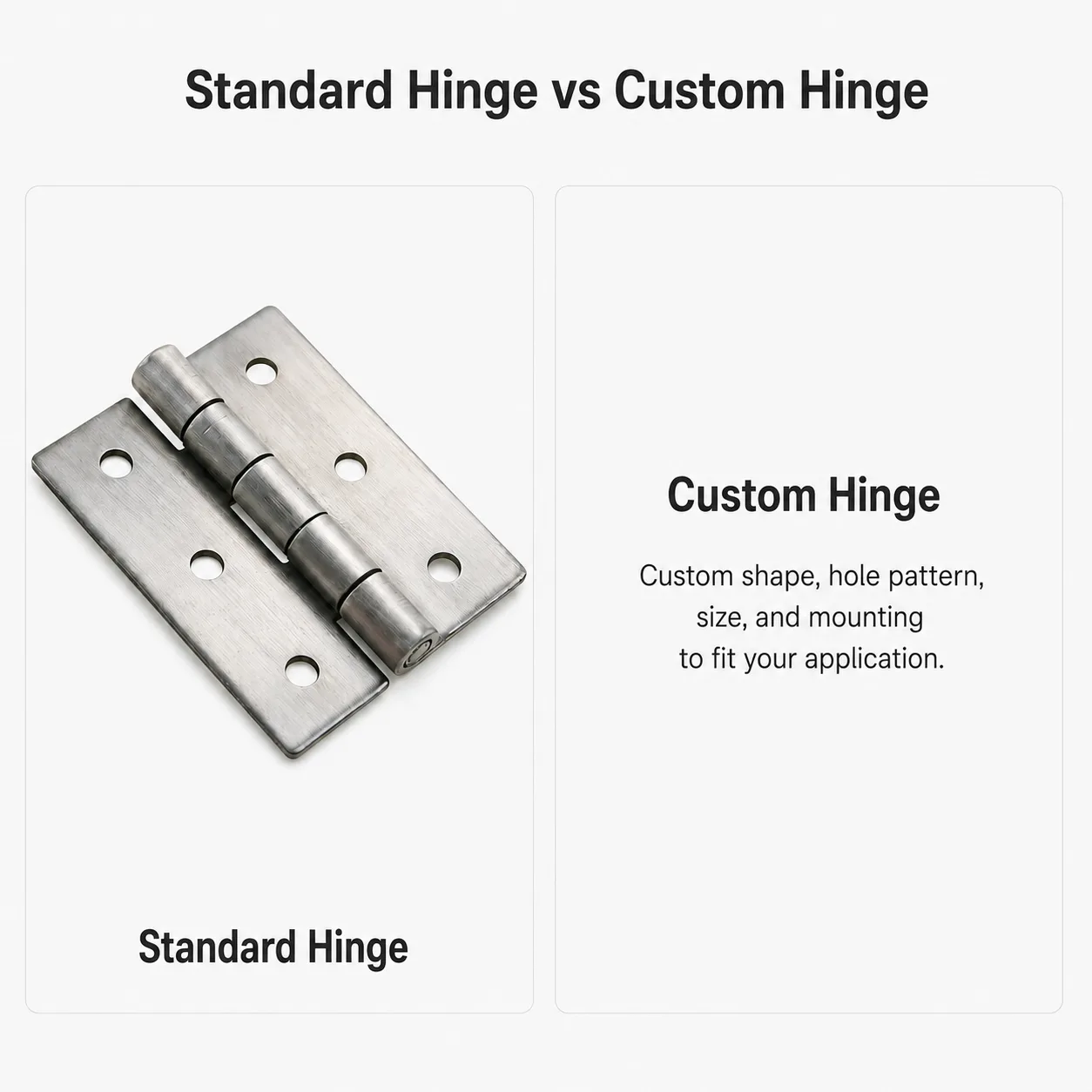
The decision that matters is not “which hinge,” it is one step earlier: should this project use a standard off-the-shelf hinge or a custom one? Getting that call right saves money on the easy projects and prevents field failures on the hard ones. This guide gives you a way to decide, explains what changes when you go custom, and lists what a manufacturer needs from you to quote one.
Quick Answer: Standard or Custom?
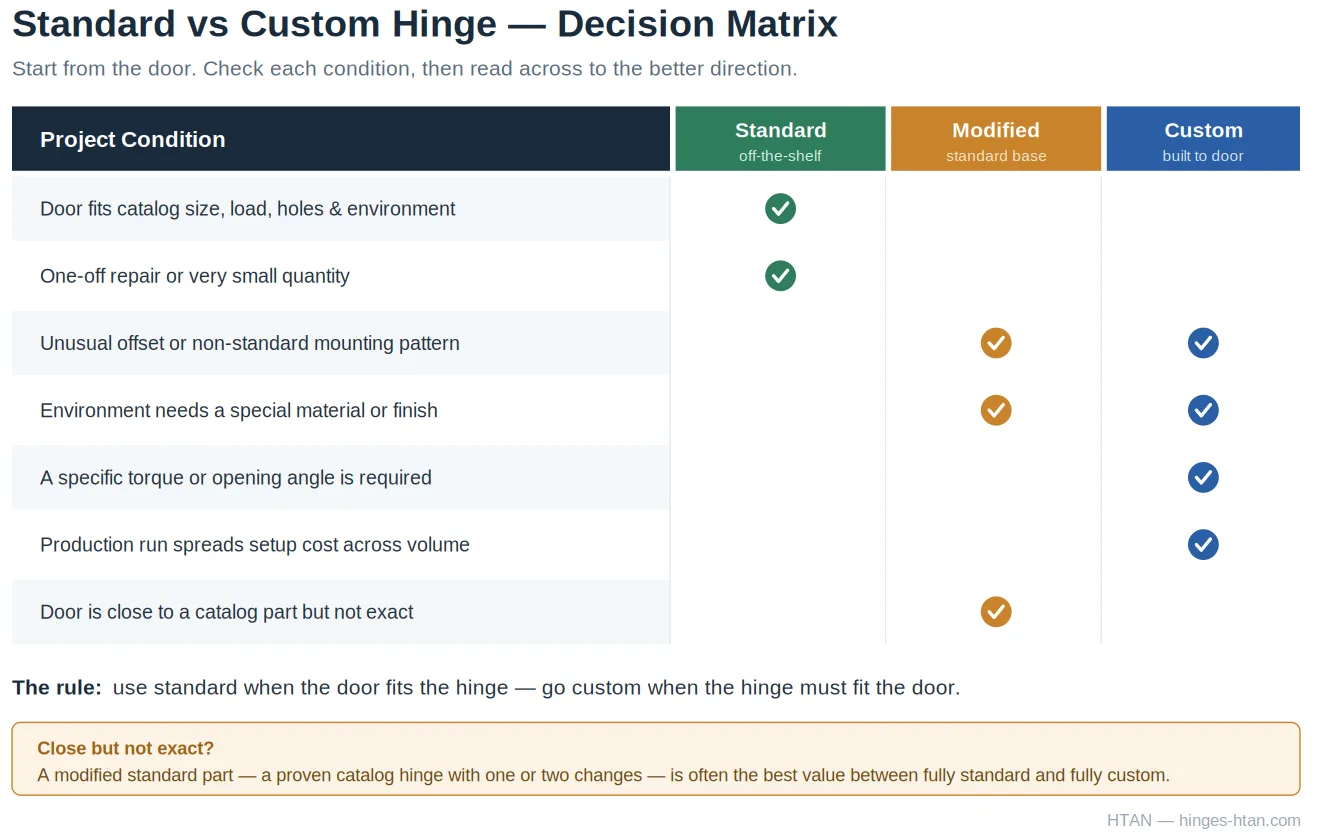
Use a standard hinge when your door’s weight, size, mounting pattern, material, and environment all fall within what a catalog part already covers — it is cheaper, ships from stock, and carries no tooling risk. Choose a custom hinge when the door falls outside those limits in a way that matters: an unusual offset, a non-standard hole pattern, a special material or finish for the environment, a specific torque or opening angle, or a load that no stock part handles safely. The practical rule is simple: use standard when the door fits the hinge, and go custom when the hinge must fit the door.
| Project Condition | Better Direction |
|---|---|
| Door fits catalog size, load, holes, and environment | Standard hinge |
| One-off repair or very small quantity | Standard hinge |
| Unusual offset or non-standard mounting pattern | Custom or modified standard |
| Environment needs a special material or finish | Custom or modified standard |
| A specific torque or opening angle is required | Custom hinge |
| Production run spreads setup cost across volume | Custom hinge |
| Door is close to a catalog part but not exact | Modified standard hinge |
What “Standard” Actually Gives You
A standard hinge is a catalog part made in volume to fixed dimensions. Its strengths are exactly what you would expect from a mass-produced component: it is the cheapest option per piece, it usually ships from stock in days rather than weeks, and because thousands have been made before yours, its behavior is well proven with no first-article surprises. For any door that comfortably fits a stock part’s weight range, mounting pattern, and environment, a standard hinge is the right answer and paying for custom would add cost and lead time for nothing.
The limitation is also exactly what you would expect: the door has to fit the hinge, not the other way around. A standard hinge comes with a fixed hole pattern, a fixed offset, a set material and finish, and a fixed load rating. When your door matches those, everything is easy. When it doesn’t, you are left drilling new holes, adding shims, doubling up hinges to reach a load, or accepting a finish that is wrong for the environment — workarounds that often cost more in labor and risk than a custom part would have cost outright.
What Changes When You Go Custom
A custom hinge is built to your door instead of the reverse. That flexibility is the whole point, and it shows up in several dimensions at once — you are not usually customizing one thing, you are matching the part to the real door.
- Geometry: the leaf size, offset, hole pattern, and pin can be set to your door and frame, so the hinge mounts cleanly and the door sits correctly against the seal without shims or re-drilling.
- Material and finish: the grade and coating can be chosen for the actual environment — stainless for corrosion, a specific finish for hygiene or appearance — rather than accepting whatever the stock part happens to be.
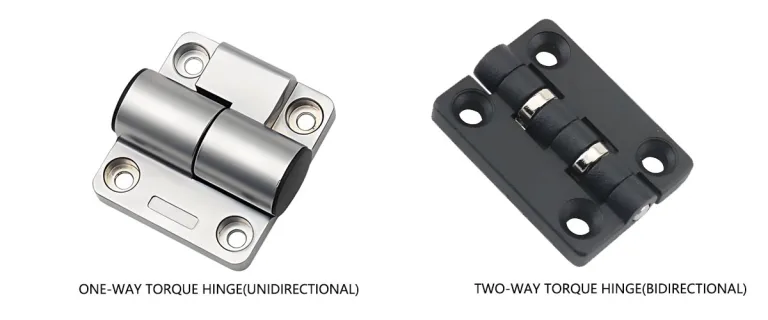
- Function: load rating, opening angle, and, for torque hinges, the holding force can be specified to the door’s real weight and use, instead of stacking or oversizing standard parts to get there.
- Integration: features like a cable pass-through, a particular mounting method, or handedness can be built in, removing the extra brackets and adapters a standard part would need.
The trade-off for all of that is cost structure and time. A custom part carries a setup or tooling cost, usually comes with a minimum order quantity, and has a longer lead time — commonly a few weeks for samples and production rather than shipping from stock. On a one-off repair, that rarely makes sense. On a production run, or on a door where a forced-fit standard part would fail, the custom part is often cheaper over the life of the project once the workarounds and field failures are counted.
What Can Usually Be Customized
When people hear “custom hinge” they often picture a part designed from scratch, but most customization is a change to one or two features of a known design. These are the elements a manufacturer can typically adjust:
| Custom Element | Typical Change |
|---|---|
| Leaf size | Longer or wider leaf to reach the door’s mounting area |
| Hole pattern | Match an existing door and frame drilling |
| Offset | Match a gasket, overlay, or recessed door geometry |
| Material | Carbon steel, 304 stainless, 316 stainless, zinc alloy, aluminum |
| Finish | Zinc plating, powder coating, brushed or polished stainless |
| Torque | A specific holding force for lids and panels |
| Opening angle | A limited or wider opening range |
| Mounting method | Bolt-on, weld-on, concealed, or lift-off |
A Side-by-Side Comparison
| Factor | Standard Hinge | Custom Hinge |
|---|---|---|
| Unit cost | Lowest | Higher per piece, plus setup/tooling |
| Lead time | Often from stock, days | Typically a few weeks for samples and production |
| Minimum order | Usually one piece | Usually a minimum quantity |
| Fit to the door | Door must fit the hinge | Hinge is built to the door |
| Material / finish choice | Fixed to the catalog part | Chosen for the environment |
| Load / torque / angle | Fixed load, angle, and material specs | Specified to the application |
| Best for | Doors within stock limits; repairs; small quantities | Non-standard doors; production runs; specific environments |
How to Decide for Your Door
Rather than starting from “standard or custom,” start from the door and let it tell you. Work through these questions, and if the door falls outside a stock part on any one that matters, that is the signal to at least price a custom option.
- Weight and width: Does a stock hinge’s load rating cover the real door weight — including everything mounted on it — with margin, without stacking extra hinges to get there?
- Mounting: Does the door and frame match a standard hole pattern and offset, or would a stock part need re-drilling, shims, or an adapter?
- Environment: Does a catalog material and finish suit the exposure — salt, washdown, chemicals, temperature — or is the right grade only available as a special?
- Function: Do you need a specific opening angle, holding torque, or feature like a cable pass-through that no stock part provides?
- Quantity: Is this a one-off or small repair (favoring standard) or a production run where custom cost spreads across many units?
A useful way to read the answers: if the door fits a stock part on all five, buy standard and move on. If it fails one or two on things that matter for safety or sealing, custom is usually worth pricing. If it fails several, forcing a standard part is the expensive choice even though it looks cheaper on the purchase order. For the underlying method of matching a specific hinge type to a door’s load and duty once you are choosing the part itself, our industrial hinge selection guide covers that next layer of the decision.
The Middle Ground: Modified Standard Parts
The choice is not always all-or-nothing. A common and cost-effective path is a modified standard part — a proven catalog hinge with one or two changes, such as a different hole pattern, a material upgrade, or a finish change, while keeping the base design that is already validated. This keeps much of the cost and reliability advantage of a standard part while solving the specific mismatch that ruled the pure stock part out.
This middle path is worth raising with a manufacturer early, because it is often the best value when a door is close to a standard part but not quite there. It usually costs less and ships faster than a fully bespoke design, since the base tooling already exists. When you ask for a quote, it is worth asking whether a modified standard part could meet the requirement before committing to a full custom development.
When Custom Hinges Usually Do Not Make Sense
Custom is not the default answer, and it is worth being honest about when it adds cost without adding value. In these cases a standard part is almost always the better call:
- A one-off repair with no special load or environment, where a stock part will do the job.
- A door that already matches a stocked hinge on weight, mounting, and finish.
- A quantity too low to justify the setup or tooling cost of a custom run.
- A project where lead time matters more than exact geometry, and a close stock part ships now.
- A problem that is really a sizing mistake — the right standard part exists, it just wasn’t specified correctly.
What a Manufacturer Needs to Quote a Custom Hinge
If you decide to price a custom or modified hinge, the speed and accuracy of the quote depend almost entirely on the information you provide up front. A vague request produces a vague answer and several rounds of back-and-forth. A complete package gets a real recommendation quickly. The most useful package includes:
- Door data: the door weight (including mounted components), the size and thickness, and the mounting offset measured from the frame — not estimated.
- Mounting details: the available mounting face, the hole pattern if fixed, and the opening direction or handedness.
- Function: the required opening angle, any holding-torque or free-stop requirement, and the expected duty cycle.
- Environment: the exposure the hinge will see — indoor, outdoor, coastal, washdown, chemical, temperature range — so the material and finish can be matched.
- Quantity and a sample or drawing: the expected order quantity, and a drawing, CAD file, or a photo of the existing hinge and door, which removes most of the guesswork.
With that package, a manufacturer can tell you quickly whether a standard part fits, whether a modified standard part will do, or whether a full custom design is warranted — and give you real cost and lead-time numbers to decide on. If you want to start that evaluation, you can send your door details here and get a matched recommendation rather than guessing from a catalog.
And if the door turns out to fit a stock part after all, that is a good outcome too — you can browse proven options across our standard hinge categories rather than paying for custom development that does not add value to the project.
FAQs
What are the main differences between custom hinges and standard hinges?
A standard hinge is a catalog part made in volume to fixed dimensions, load rating, material, and hole pattern — cheapest per piece and usually shipped from stock, but the door has to fit the hinge. A custom hinge is built to your door, so the geometry, material, finish, load, and opening angle are set to the application. Custom carries a setup cost, a minimum order quantity, and a longer lead time, but avoids the workarounds and failures that come from forcing a stock part onto a non-standard door.
How do I choose the right hinge for my custom door project?
Start from the door, not the hinge. Check whether a stock part covers the door’s weight, mounting pattern, material and finish, function, and quantity. If the door fits a standard part on all of those, buy standard. If it falls outside on something that matters for safety or sealing — an unusual offset, a special material, a specific torque or angle, or a load no stock part handles — price a custom or modified part instead of forcing a stock one.
Are custom hinges much more expensive than standard hinges?
Per piece, yes, and they add a setup cost and usually a minimum order quantity. But on a production run or on a door where a forced-fit standard part would fail, custom is often cheaper over the life of the project once you count the labor of workarounds and the cost of field failures. For a one-off repair, a standard part is almost always the better value.
Is there an option between fully standard and fully custom?
Yes — a modified standard part. This is a proven catalog hinge with one or two changes, such as a different hole pattern, a material upgrade, or a finish change, while keeping the validated base design. It usually costs less and ships faster than a fully bespoke hinge because the base tooling already exists, and it is often the best value when a door is close to a standard part but not quite there.
What information do I need to get a custom hinge quoted?
The door weight including mounted components, the size and thickness, and the mounting offset measured from the frame; the available mounting face, hole pattern, and opening direction; the required opening angle and any holding-torque requirement; the environment the hinge will face; and the expected quantity with a drawing, CAD file, or photo of the existing hinge and door. A complete package gets a real recommendation quickly instead of several rounds of back-and-forth.



 English
  한국어
한국어  Русский
  Español
  Italiano
  Deutsch
  Français
  Português