

PPAP Requirements for Hinge Suppliers: Level 1–3 Docs
PPAP documentation requirements for hinge suppliers depend on the risk level of the hinge, the customer’s approval process, and the production stage of the project. A simple cabinet hinge, an industrial enclosure hinge, and an automotive hinge may all require different submission levels even if the manufacturing process looks similar.
For hinge buyers, PPAP helps confirm that the supplier can repeatedly manufacture parts that match the approved drawing, material specification, dimensional tolerance, surface finish, function requirement, and inspection plan. For hinge suppliers, PPAP is not just paperwork. It is the evidence package that connects design intent, production process, quality control, and customer approval before regular production begins.
This guide compares PPAP Level 1, Level 2, and Level 3 for hinge suppliers. It explains what documents are normally expected, when each level may be appropriate, and what buyers should verify before approving hinge samples or moving into production.
When Do Hinge Suppliers Need PPAP Documentation?
PPAP is most common in automotive and other controlled manufacturing supply chains, where the AIAG-published PPAP manual defines the five submission levels and their required evidence. The same approval logic also applies to industrial equipment, electrical enclosures, transportation hardware, medical equipment, and high-volume OEM hinge programs. The higher the risk of part failure, the stronger the case for a more complete documentation package.
A hinge project may need PPAP documentation when the part is new, the drawing has changed, tooling has changed, material has changed, production has moved to a different site, or the customer requires production approval before shipment. PPAP may also be requested when a hinge is used in a safety-related, structural, automotive, or high-cycle application.
For buyers, the key question is not “Can the supplier send a PPAP file?” The better question is whether the PPAP level matches the hinge’s real risk: load, cycle life, corrosion exposure, dimensional tolerance, assembly interface, and customer-specific quality requirements.
PPAP Level 1, Level 2, and Level 3: What Changes?
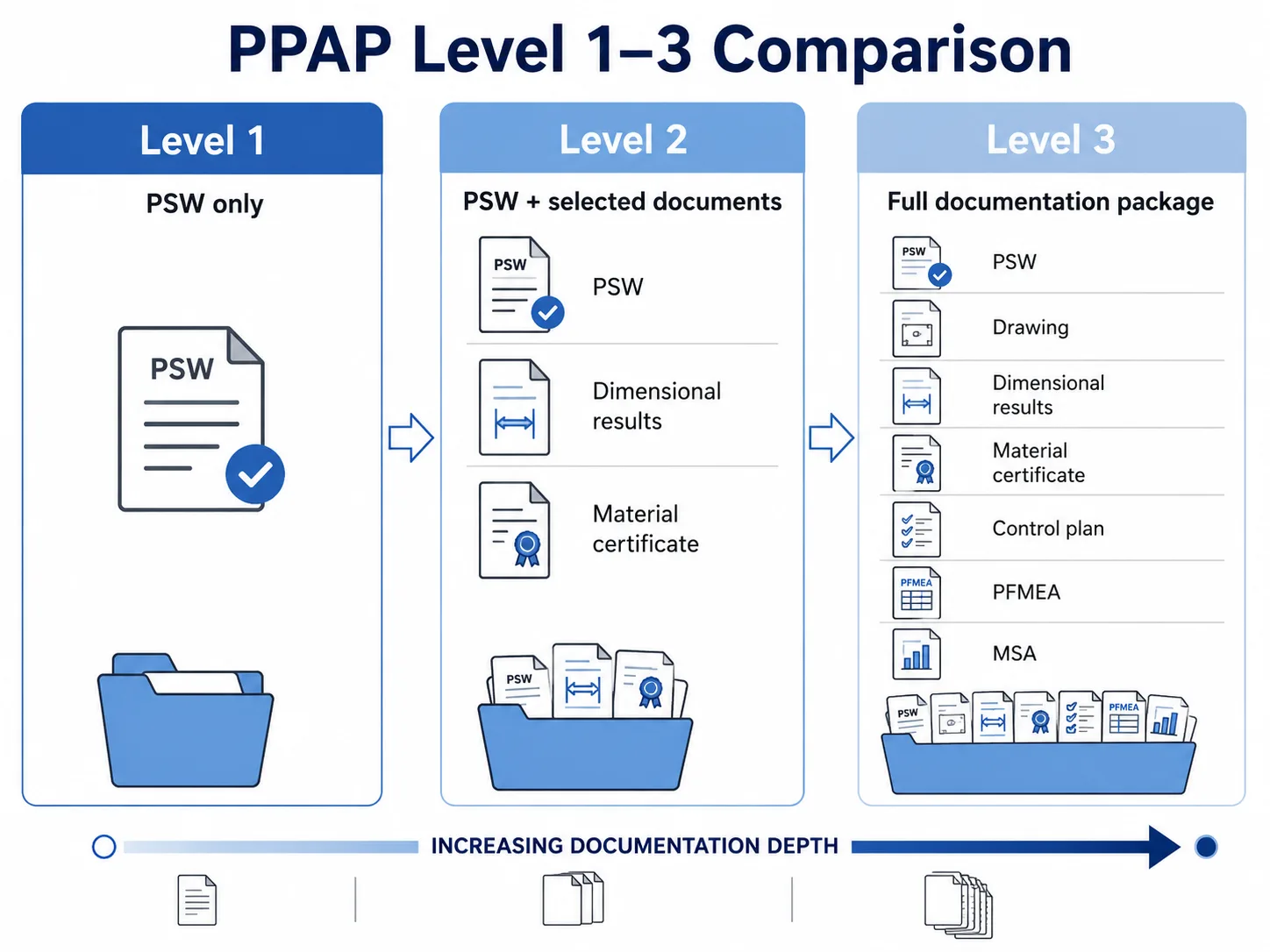
The PPAP level defines how much evidence the supplier submits to the customer. Level 1 is the lightest submission, Level 2 adds selected supporting records, and Level 3 is the most common full submission level for production approval. Customer requirements always take priority, so the final document list should be confirmed in writing before the supplier prepares the package.
| PPAP Level | Typical Submission | How It Applies to Hinge Suppliers | Buyer Risk | Supplier Workload |
|---|---|---|---|---|
| Level 1 | Part Submission Warrant only | May fit low-risk hinges with stable production history and low failure consequence | Higher if supporting evidence is not reviewed | Lowest |
| Level 2 | PSW plus selected supporting documents | Useful for medium-risk hinge projects where the customer wants key evidence without a full package | Moderate; depends on which documents are selected | Moderate |
| Level 3 | PSW plus full supporting documentation package | Recommended for safety-related, automotive, high-volume, structural, or customer-critical hinge applications | Lowest when the package is complete and reviewed properly | Highest |
Level 1 should not be treated as “no quality evidence.” Even when only the PSW is submitted, the supplier should still maintain supporting records internally. Level 2 requires careful agreement because customers may define the selected documents differently. Level 3 is usually the clearest route when the hinge is critical, custom, high-volume, or linked to a customer approval process.
Core PPAP Documents for Hinge Projects
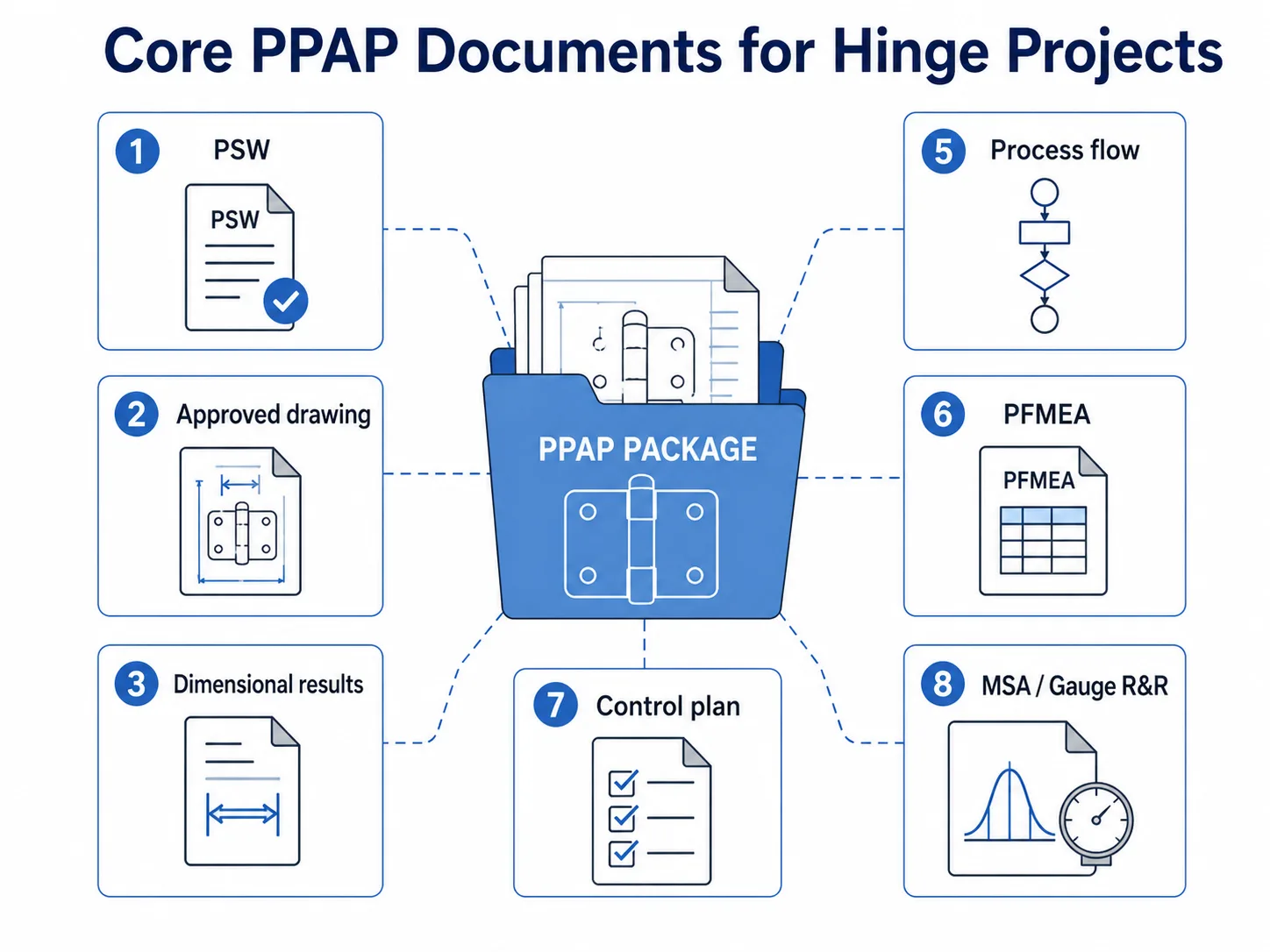
Different customers may request different PPAP elements, but hinge projects commonly require evidence for part design, material, dimensions, process control, measurement system, and functional performance. The following document groups are the ones buyers and hinge suppliers should review first.
Part Submission Warrant
The Part Submission Warrant, or PSW, is the formal summary document that confirms the submitted hinge meets the drawing, specification, and customer approval requirements. For Level 1, this may be the only document submitted to the customer. For Level 2 and Level 3, it acts as the cover document for the supporting package.
For hinge suppliers, the PSW should clearly identify the part number, revision, drawing date, material grade, finish, production site, submission reason, and customer approval status. A vague PSW can create confusion later if the hinge design, finish, or mounting geometry changes.
Design Records and Approved Drawings
Design records define what the hinge must be. This may include 2D drawings, 3D models, material specifications, tolerance requirements, coating or finish details, mounting hole layout, pin diameter, opening angle, torque requirement, load rating, and any customer-specific notes.
For custom hinge programs, drawing control is especially important. If hinge geometry, pin clearance, knuckle length, leaf thickness, hole spacing, or surface finish affects assembly performance, the approved drawing should be treated as the source of truth for PPAP review.
Dimensional Results
Dimensional results confirm whether production samples match the drawing. For hinge parts, important dimensions may include leaf thickness, hole spacing, knuckle alignment, pin diameter, gap between leaves, mounting flatness, opening angle, and overall length.
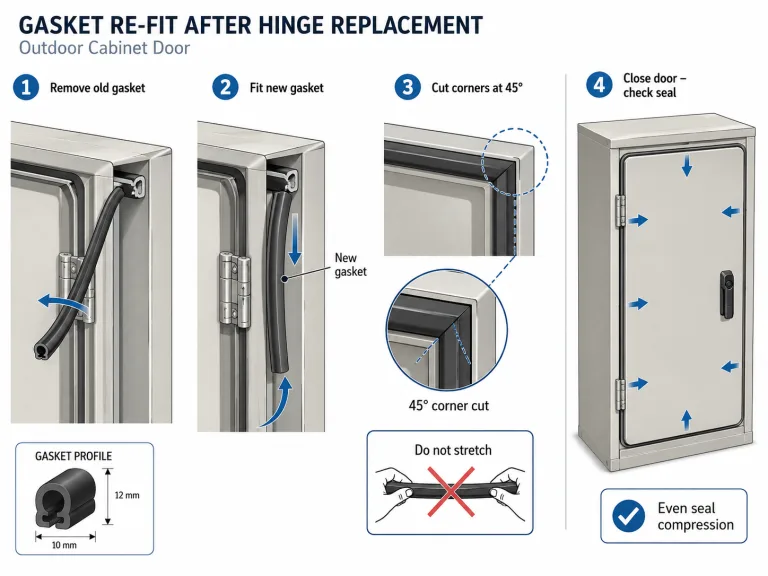
If the hinge is used on an enclosure, access panel, vehicle part, or equipment guard, small dimensional errors can create assembly problems. Door alignment, gasket compression, latch engagement, and service access may all depend on hinge geometry. When hinge dimensions directly affect installation or long-term door alignment, buyers should also review the broader industrial enclosure hinge selection workflow rather than treating the hinge as an isolated component.
Material Certificates and Surface Finish Records
Material certificates confirm that the hinge body, pin, bushing, fasteners, and other critical components use the specified grade. This matters when the hinge is exposed to moisture, salt, washdown chemicals, outdoor weather, or customer-specific corrosion requirements.
Surface finish records may include coating thickness, plating information, passivation records, electropolishing details, or corrosion test requirements. If stainless steel is selected for corrosion resistance, the PPAP package should not rely only on the word “stainless.” In humid, washdown, or salt-exposed applications, buyers should verify the material and finish together with why stainless steel hinges can still corrode in real service conditions.
Process Flow, PFMEA, and Control Plan
The process flow shows how the hinge is manufactured from raw material to finished product. For a hinge supplier, this may include stamping, forming, machining, welding, pin insertion, bushing installation, surface treatment, assembly, inspection, packaging, and shipment.
The PFMEA identifies where the process could fail and what controls are used to reduce risk. For hinge manufacturing, common risks include hole mislocation, pin looseness, knuckle misalignment, burrs, coating damage, poor weld penetration, incorrect material, wrong bushing, or inconsistent torque performance.
The control plan links these risks to inspection points. It should show what is checked, how often it is checked, what equipment is used, and what reaction plan applies if the result is out of specification.
Measurement System and Capability Evidence
Measurement evidence helps confirm that the supplier can inspect the hinge reliably. For critical dimensions, the customer may request MSA or Gauge R&R. This is especially important when small differences in hole spacing, pin clearance, or knuckle alignment affect assembly performance.
Capability studies may be requested for key characteristics that must remain stable in production. For hinge suppliers, these may include mounting hole position, leaf thickness, torque range, pin retention force, bushing fit, or critical interface dimensions.
How to Choose the Right PPAP Level for a Hinge Supplier
The right PPAP level should reflect the hinge’s end use, customer risk, production maturity, and process complexity. A low-risk cabinet hinge does not always need the same package as an automotive hinge, but a customer-critical hinge should not be approved with only a signature if dimensional, material, or process evidence is required.
| Hinge Project Type | Typical Risk Level | Suggested PPAP Direction | Why |
|---|---|---|---|
| Standard cabinet hinge with stable production history | Low | Level 1 or customer-defined Level 2 | Low complexity, but internal records should still be retained |
| Industrial enclosure hinge with corrosion or sealing requirements | Medium | Level 2 | Material, finish, and dimensional evidence may be needed |
| Heavy-duty hinge for structural equipment access | Medium to high | Level 2 or Level 3 | Load, sag, mounting, and cycle performance may affect equipment reliability |
| Automotive or safety-related hinge | High | Level 3 or customer-specific submission | Full traceability and process evidence are usually expected |
| New custom hinge with new tooling | Medium to high | Level 3 if customer approval is required | New tooling increases dimensional and process risk |
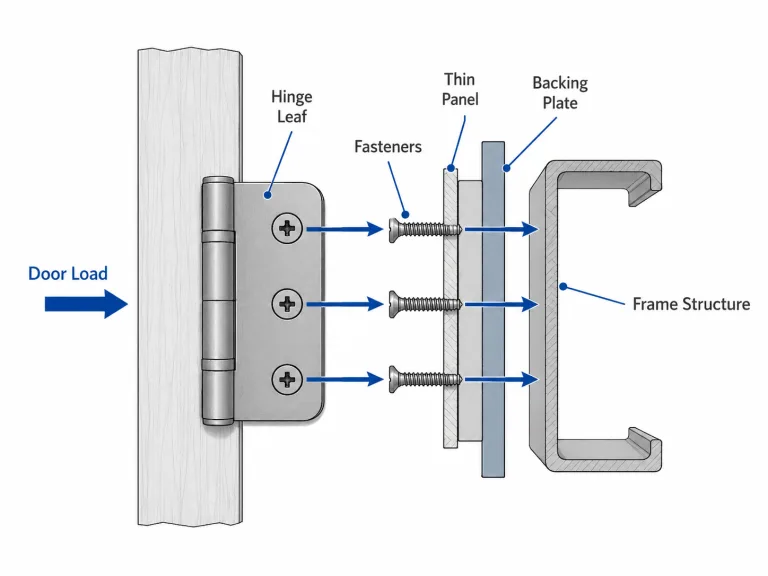
When the hinge is heavy, load-bearing, frequently cycled, or installed on a large access door, PPAP review should not focus only on documents. It should also confirm that the selected hinge can support the real door load. For these applications, a heavy-duty hinge selection process based on door weight should support the PPAP decision before samples are approved.
Level 1 vs Level 2 vs Level 3 Document Comparison
The table below gives a practical comparison for hinge suppliers. It should not replace a customer’s PPAP instruction, but it can help buyers and suppliers agree on the expected submission package before sample approval.
| Document or Evidence | Level 1 | Level 2 | Level 3 |
|---|---|---|---|
| Part Submission Warrant | Submitted | Submitted | Submitted |
| Approved drawing or design record | Retained unless requested | Often submitted | Submitted |
| Dimensional results | Retained unless requested | Often submitted | Submitted |
| Material certificate | Retained unless requested | Often submitted | Submitted |
| Surface finish or coating evidence | Retained unless requested | Customer-specific | Submitted if applicable |
| Process flow diagram | Retained | Customer-specific | Submitted |
| PFMEA | Retained | Customer-specific | Submitted |
| Control plan | Retained | Often submitted | Submitted |
| MSA / Gauge R&R | Retained if required | Customer-specific | Submitted if required |
| Capability studies | Retained if required | Customer-specific | Submitted if required |
| Sample parts | Customer-specific | Customer-specific | Usually submitted or made available |
| Customer-specific requirements | As required | As required | As required |
Common PPAP Mistakes in Hinge Sourcing
1: Treating Level 1 as Enough for Every Simple Hinge
Level 1 may be appropriate for low-risk parts, but it should not be used automatically. If the hinge affects door alignment, operator safety, corrosion resistance, sealing performance, or field service reliability, the buyer may still need supporting evidence even when the part looks simple.
2: Requesting Level 3 for Every Hinge
Level 3 provides a more complete approval package, but it also requires more preparation, review, and document control. For low-risk catalog hinges, a full Level 3 package may add unnecessary work if the customer does not need that level of evidence. The PPAP level should match the hinge’s risk and customer requirement, not a blanket rule.
3: Not Defining Level 2 Documents Clearly
Level 2 is often where confusion starts because it uses selected supporting documents. The customer and supplier should agree on the exact document list before the supplier prepares the package. For hinge projects, common Level 2 documents may include dimensional results, material certificates, control plan, and selected test reports.
4: Reviewing the Paperwork but Not the Hinge Risk
A complete document package does not automatically mean the hinge is suitable for the application. PPAP should be reviewed together with the hinge’s actual function: load, cycles, corrosion exposure, mounting method, tolerance stack-up, and customer assembly conditions.
What Buyers Should Request Before Sample Approval
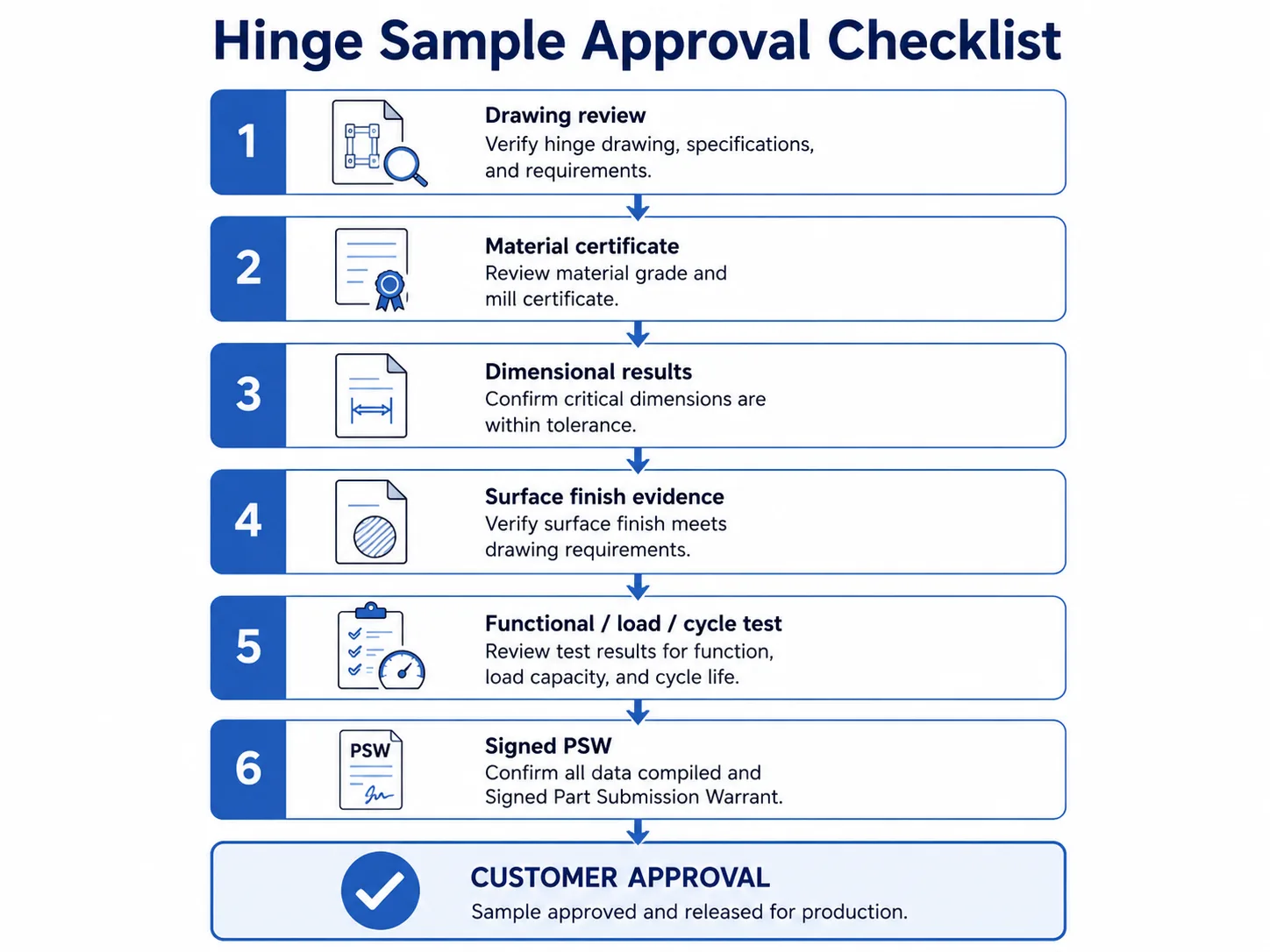
Before approving a hinge sample, buyers should request the document set that matches the project risk. For a low-risk hinge, a PSW and drawing confirmation may be enough. For a customer-critical hinge, the buyer should review dimensional results, material certificates, process flow, control plan, measurement evidence, and any required functional or corrosion test data.
- Approved hinge drawing and revision level
- Material certificate for hinge body, pin, bushing, and key hardware
- Dimensional results for critical mounting and interface dimensions
- Surface finish or coating evidence if corrosion resistance matters
- Process flow diagram for production steps
- PFMEA for key manufacturing risks
- Control plan for production inspection
- MSA or Gauge R&R for critical measurements when required
- Capability evidence for key characteristics when required
- Cycle, load, torque, corrosion, or functional test reports when applicable
- Signed PSW with customer approval status
If the hinge will be used in an enclosure, access panel, machine guard, or other assembly where failure could affect maintenance access or safety, sample approval should include both documentation review and physical fit confirmation.
FAQ
What is the difference between PPAP Level 1 and Level 3 for hinge suppliers?
Level 1 usually submits only the Part Submission Warrant, while Level 3 submits the PSW together with a full supporting documentation package. For hinge suppliers, Level 3 is more appropriate when the hinge is safety-related, automotive, high-volume, custom, or customer-critical.
What documents are usually included in PPAP Level 2 for a hinge supplier?
PPAP Level 2 usually includes the PSW plus selected supporting documents requested by the customer. For hinge projects, common Level 2 documents may include dimensional results, material certificates, control plan, selected test reports, and customer-specific records.
Do all hinge suppliers need PPAP Level 3?
No. Not every hinge project needs Level 3. Low-risk catalog hinges may use Level 1 or Level 2 if the customer agrees. Level 3 is more suitable for automotive, safety-related, high-volume, structural, or newly tooled custom hinge programs.
Can a hinge buyer request extra documents beyond the PPAP level?
Yes. Customer-specific requirements may exceed the basic PPAP level. If corrosion resistance, load capacity, torque, cycle life, or dimensional stability is critical, the buyer can request additional reports even when the formal PPAP level is lower.
How should a buyer choose the right PPAP level for a hinge project?
The buyer should consider hinge function, safety risk, production volume, customer requirement, process maturity, and failure consequence. A low-risk cabinet hinge may use Level 1 or 2, while an automotive or safety-related hinge usually needs Level 3 or a customer-specific package.
Next Steps
If your hinge project requires PPAP documentation, HTAN can help review the drawing, material, dimensional control points, surface finish requirements, and customer approval expectations before sample submission. Share your part drawing, application, target PPAP level, customer-specific requirements, and expected production volume, and our engineering team can help identify which hinge documentation should be prepared before approval.

 English
  한국어
한국어  Русский
  Español
  Italiano
  Deutsch
  Français
  Português