

Salt Spray Test Hours for Hinges: 96h vs 240h vs 500h
If you only have ten seconds: salt spray test hours for hinges are accelerated-corrosion benchmarks under ASTM B117 or ISO 9227, and the three numbers you will see on most datasheets — 96h, 240h, and 500h — correspond to indoor/dry, mild outdoor, and coastal/marine service respectively. They do not convert one-to-one into service years, and a higher number is not always worth the price.
This guide explains what each number actually measures, where the test is reliable, where it overpromises, and how to pick the right rating for your project without overspending or leaving the door open to early failure.
What the Test Actually Measures
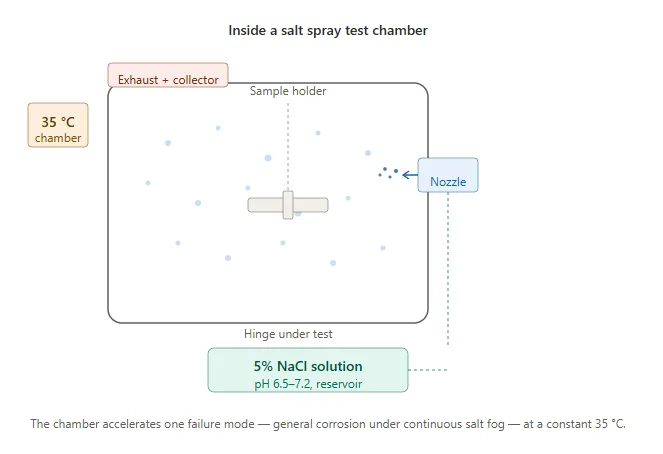
The salt spray test puts a hinge inside a sealed chamber held at 35 °C and continuously sprays it with a 5 % sodium chloride fog at a pH between 6.5 and 7.2. The hours rating is the time the sample lasts before red rust appears on the base metal — not the time until total failure, and not the time until the coating discolours.
Two standards govern the procedure: ASTM B117, dominant in North America, and ISO 9227, dominant in Europe and Asia. Both use the same 5 % salt solution, but ISO 9227 specifies tighter chamber tolerances. A hinge labelled “240h” should always be accompanied by the standard reference — “240h per ASTM B117” or “240h per ISO 9227 NSS” — otherwise the number is uninformative.
One frequent misunderstanding is treating salt spray hours as service hours. They are not. The test isolates one failure mode (general corrosion under continuous salt fog) and accelerates it. It does not simulate UV exposure, wet–dry cycling, mechanical wear, or galvanic coupling. A hinge that passes 500h in the chamber can still fail in two years if the field environment includes any of those four factors.
96h vs 240h vs 500h: What Each Number Predicts
96h — Indoor and Dry-Environment Hinges
A 96h rating typically corresponds to zinc-plated carbon steel or low-grade galvanised steel. The coating is thin (5–8 µm of zinc) and the protection mechanism is sacrificial: the zinc corrodes preferentially to the steel beneath.
This rating is correct for indoor cabinets, dry storage, and equipment that never sees condensation. It is wrong for anything that gets touched by humid air on a daily basis. In practice, a 96h hinge installed outdoors will show white zinc oxide bloom within months and red rust within one to two years. If the project is indoor-only and cost-sensitive, 96h is the rational floor — the longer-term economics of upgrading are covered in the carbon steel vs stainless steel hinge cost analysis, which works through the break-even point in detail.
240h — Mild Outdoor, Coastal-Adjacent, Humid Indoor
A 240h rating is the practical middle ground. It is typically achieved by SS304 stainless steel, by thicker zinc plating (8–12 µm) with an organic topcoat, or by hot-dip galvanising. The coating system is heavier and the failure pathway is slower.
240h is the right rating for outdoor cabinets inland, for humid industrial interiors, and for projects up to a few miles from the coast but not directly on the shoreline. Beyond that distance, salt aerosol concentration drops sharply and 240h tends to hold up well. For projects that sit closer to the shore, the additional gasket and material requirements documented in the NEMA 4X specification for coastal projects usually push the choice up to 500h regardless of the salt spray number alone.
500h — Marine, Chemical, Heavy Industrial
A 500h rating is what you should expect from SS316 stainless steel, electropolished SS316, or multi-layer coating stacks (zinc + e-coat + powder topcoat). The molybdenum content in SS316 specifically resists chloride pitting, which is what makes it the default for saltwater service.
500h is the right rating for offshore platforms, dockside enclosures, marine equipment, chemical plants, and any door that is washed down with chlorinated water. The full specification — including pin material, gasket geometry, and fastener compatibility — is the topic of the marine enclosure hinge specification guide, because 500h alone is not enough if the rest of the assembly introduces a leak path.
Quick-Reference Table: Hours vs Environment vs Material
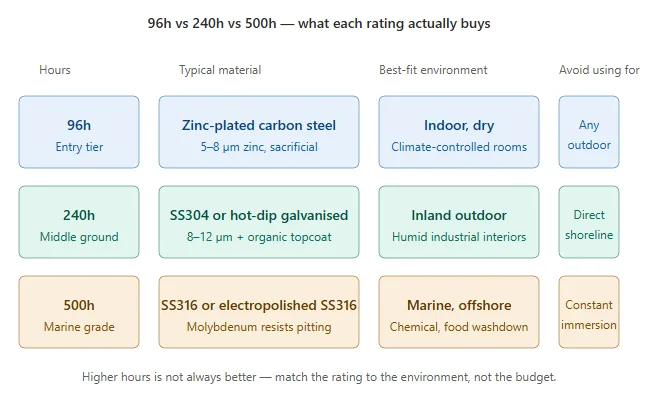
| Rating | Typical Material / Finish | Recommended Environment | Common Mismatch to Avoid |
|---|---|---|---|
| 96h | Zinc-plated carbon steel | Indoor cabinets, dry storage, climate-controlled rooms | Any outdoor or condensing application |
| 240h | SS304, hot-dip galvanised, zinc + organic topcoat | Inland outdoor, humid industrial, coastal-adjacent (> 5 km from shore) | Direct shoreline or chloride washdown |
| 500h | SS316, electropolished SS316, multi-layer coating | Marine, offshore, chemical plant, food washdown | Submersion or constant immersion (use 1000h+ or specialty alloy) |
| > 500h | Super-austenitic (6Mo), Monel, bronze, polymer composite | Continuous seawater immersion, splash zone | Treating as a drop-in upgrade — installation must change too |
Why a Hinge Can Pass the Test and Still Fail in the Field
The most common buyer complaint about salt spray ratings is that a hinge “passed 240h” but rusted in service within a year. There are four recurring reasons, and none of them mean the test report was fraudulent.
First, the test is static while the hinge is dynamic. Opening and closing flexes the coating at the pivot, opening micro-cracks that the chamber test never reaches. Second, the test does not address galvanic corrosion — pairing a 500h stainless hinge with carbon steel screws on a humid wall is a chemistry experiment, not a fastening solution. Third, edge protection and pivot sealing are not standardised, so two hinges with the same rating can have very different real-world performance. Fourth, the test assumes the coating arrived intact; site handling, drilling, or welding damages it before installation. The full set of stainless-specific failure modes is documented in the five causes of stainless steel hinge corrosion.
How to Choose Without Overspending
Step one is to write down the actual service environment in three numbers: distance from any salt source, expected humidity range, and presence or absence of chemical wash. Step two is to map those numbers to the table above, then add one level if the door is mission-critical or if replacement access is restricted. Step three is to verify the test report — not the marketing number.
A credible supplier should be able to produce: the standard reference (ASTM B117 or ISO 9227), the failure criterion used (first red rust, 5 % surface coverage, or coating blister), the number of samples tested, the coating thickness as installed, and the accredited lab’s report header. Anything less than that is a marketing claim, not a test result.
FAQ
Do salt spray hours convert directly to service years?
No. A rough rule of thumb sometimes quoted is “100 chamber hours ≈ 1 year of mild coastal service” for carbon steel under zinc coating, but the relationship breaks down entirely for stainless steel and for environments with UV, wet–dry cycling, or chemical exposure. Treat the hours as a comparison tool between products, not as a service-life prediction.
What is the difference between ASTM B117 and ISO 9227?
Both use a 5 % NaCl fog at 35 °C and report time to red rust. ISO 9227 specifies stricter chamber tolerances (±2 °C on temperature) and is generally considered the more reproducible procedure. Results from the two standards are not numerically interchangeable, so a “240h ASTM B117” hinge is not automatically a “240h ISO 9227” hinge.
Can a 500h hinge be used underwater?
Not reliably. Salt spray simulates a salt-laden atmosphere, not constant immersion. For continuous seawater service, specify super-austenitic stainless (6Mo), Monel, bronze, or non-metallic composite — and confirm with a marine engineering specialist before ordering.
Is cyclic corrosion testing (CCT) better than salt spray?
CCT alternates salt fog with dry and humid phases, which correlates better with outdoor service than continuous salt spray. A 480h CCT result is roughly equivalent to 1000h ASTM B117 in many coating systems. For projects with high UV or rain exposure, ask the supplier whether a CCT report is available in addition to the standard salt spray number.
What should I ask my supplier about a salt spray rating?
Five questions: Which standard (ASTM B117 or ISO 9227)? What was counted as failure? How many samples were tested and what was the spread? What coating thickness was on the test sample? And can you provide the original accredited lab report, not a summary? A supplier who cannot answer all five does not actually own the data.
Next Steps
Salt spray hours are a useful filter, but they are one input among several — material grade, coating system, pivot geometry, and installation discipline matter just as much. If you are scoping a project and want a second opinion on whether 240h is enough or 500h is overkill, send the installation environment and door usage profile to the HTAN engineering team. We will respond with a matching part number and the original lab report behind its rating.



 English
  한국어
한국어  Русский
  Español
  Italiano
  Deutsch
  Français
  Português