

Data Center and Network Cabinets
Hinge Solutions for Data Center Racks and Network Cabinets
Server and network cabinet doors must open within restricted aisles while preserving access to equipment, cable paths, locks, bonding straps, and adjacent racks. Hinge selection depends on the complete rack-door assembly.
HTAN reviews front doors, split rear doors, removable panels, concealed mounting space, opening clearance, and service workflow before recommending a hinge layout.
Leave your contact details and a short rack-door note. You do not need to select the hinge model before contacting us.
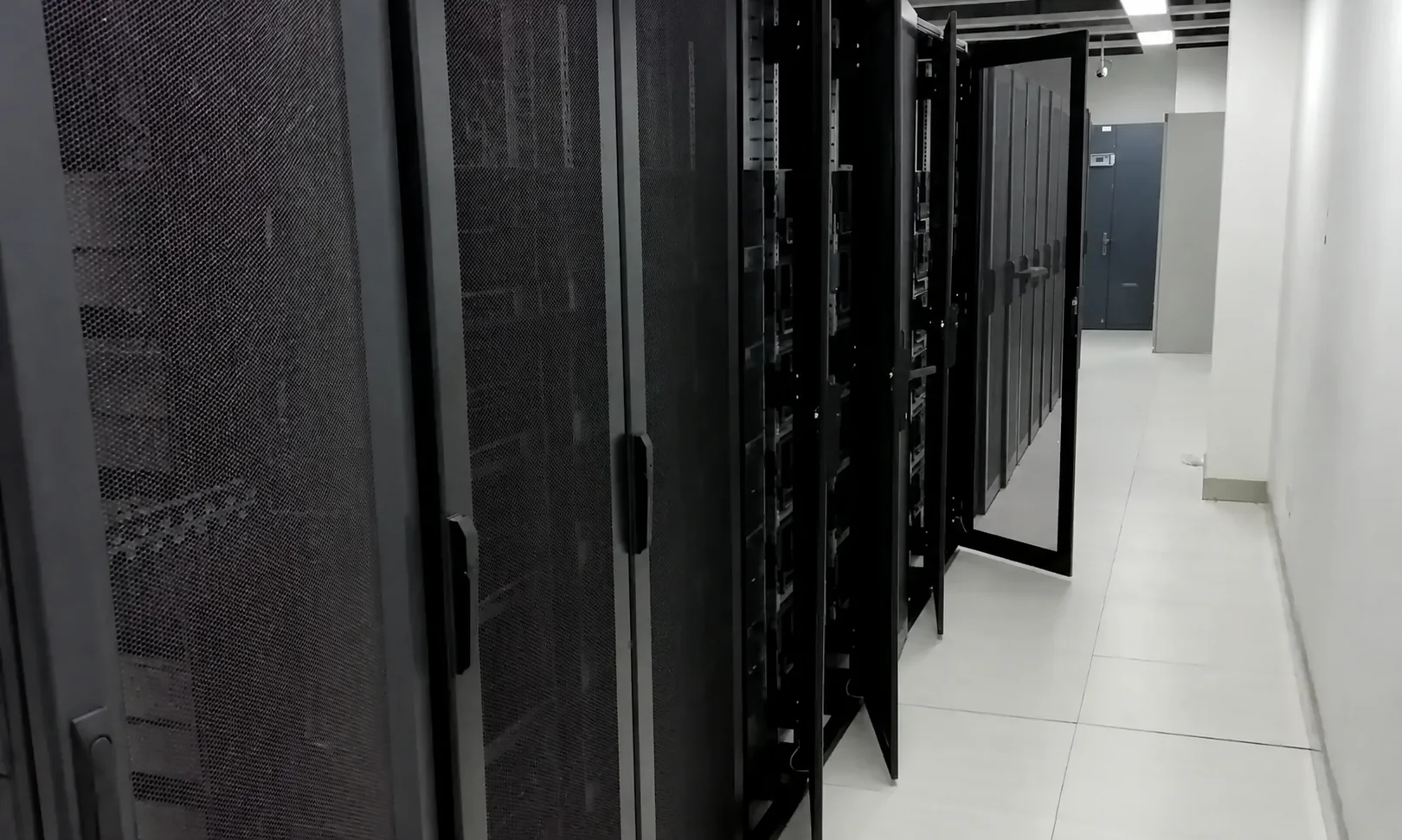
Application Map
Where Hinges Are Used on Data Center Racks
A full-height front door, split rear door, glass network door, and removable panel create different loading, opening, security, and maintenance requirements. Start with the moving component rather than the cabinet category alone.
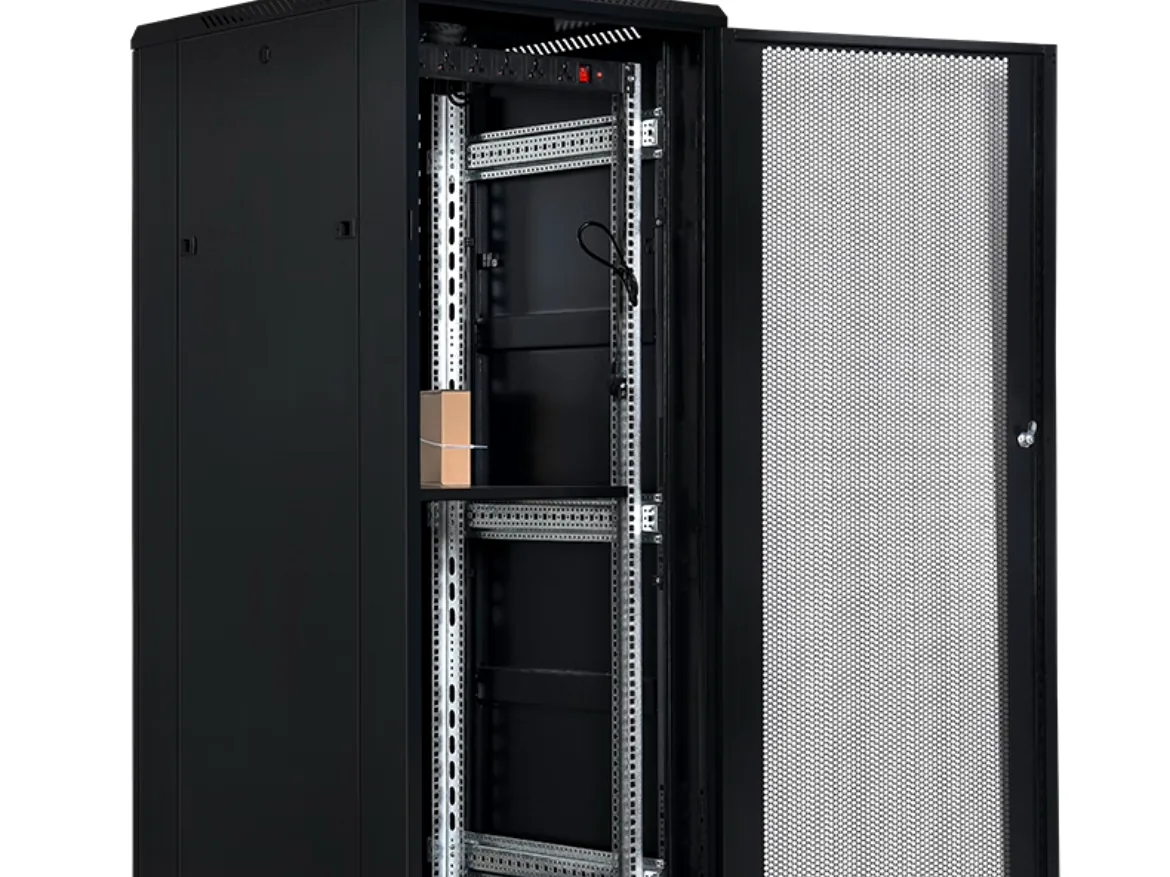
Full-Height Perforated Front Door
Split Rear Door
Glass Network Cabinet Door
Removable Side or Rear Panel
Choose by Rack Door Configuration
Start with the moving door or panel. A rack with a narrow rear door, a glass network door, and a removable cable panel may require different hinge directions and validation steps.
Perforated Front Door
- Primary constraint
- Narrow solid mounting edge beside the perforated zone.
- Typical hinge direction
- Concealed, continuous, pivot, or compact discrete structure.
- Required validation
- Mounting-edge stiffness, fastener spacing, internal rail clearance.
- Review this layout
- Perforated Front Doors
Split Rear Door
- Primary constraint
- Two door leaves, center alignment, cable access.
- Typical hinge direction
- Compact discrete, concealed, pivot, or removable structure.
- Required validation
- Opening sequence, handle clearance, PDU and cable-manager interference.
- Review this layout
- Split Rear Doors
Glass or Solid Network Door
- Primary constraint
- Mounting stress, visible alignment, lock interaction.
- Typical hinge direction
- Concealed, pivot, or supported discrete structure.
- Required validation
- Panel interface, frame stiffness, latch alignment.
- Review this layout
- Security Interface
Removable Service Panel
- Primary constraint
- Removal direction and service access.
- Typical hinge direction
- Lift-off or removable-pin structure.
- Required validation
- Lift clearance, bonding disconnection, reinstallation alignment.
- Review this layout
- Door Reversal
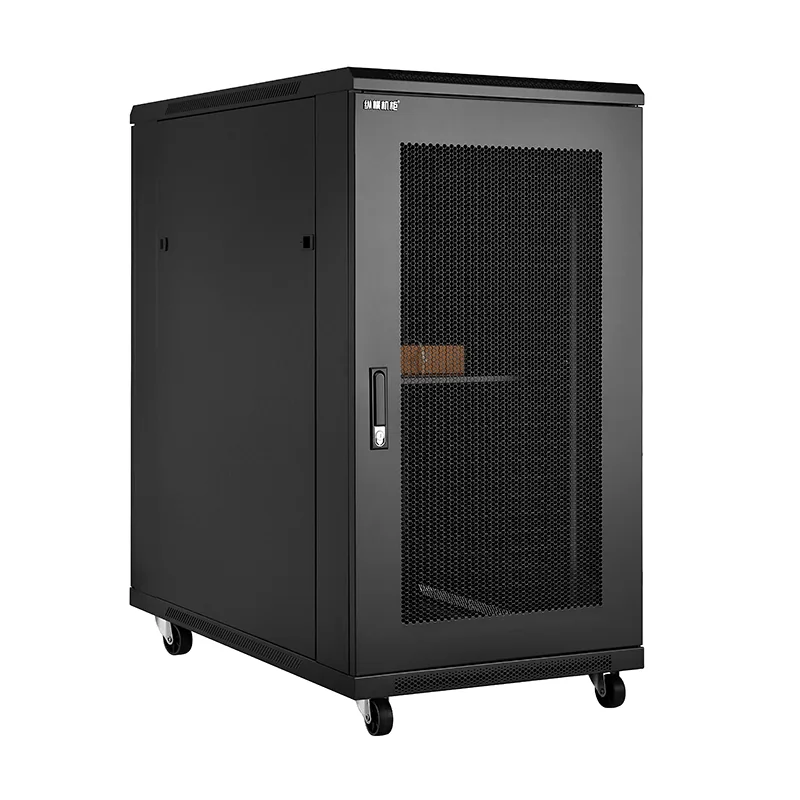
Perforated Front Doors
Perforated rack doors may provide less continuous sheet-metal area near the hinge side than solid doors. Review the hinge leaf, fastener pattern, reinforcement, and frame interface together.
Hinges for perforated server rack doors must fit within the available solid mounting edge without unnecessarily occupying the usable perforated area.
The hinge should not occupy the perforated area or interfere with internal rails, fans, filters, or front-mounted hardware. Door rigidity, narrow mounting edges, latch projection, and removal for service belong in the same review.
Split Rear Doors and Cable Access
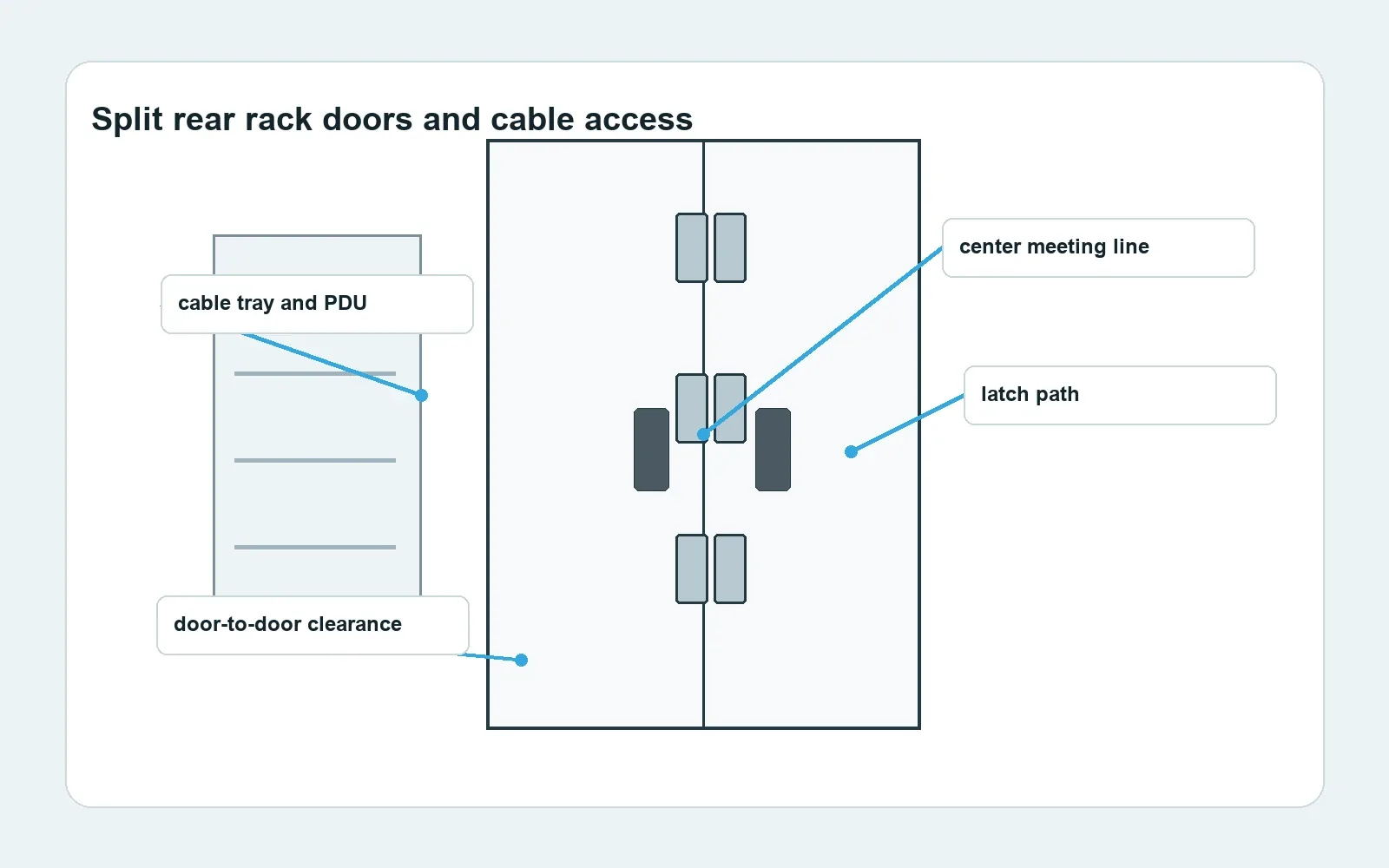
Split rear doors reduce the swing envelope compared with one full-width rear door, but they create two hinge axes, two latch paths, and a center meeting line that must remain aligned. The left and right doors may not share the same clearance problem: one side may pass near a wall, while the other crosses a cable manager, PDU, or rear connector.
Split rear server rack door hinges must be reviewed as two separate hinge axes with a shared center meeting line and independent latch paths.
Review whether both doors must open at the same time, whether one door must open before the other, and whether handles, latches, bonding straps, PDUs, cable managers, or rear connectors enter either door’s rotation envelope.
When removable rear doors are required, confirm the lift direction, vertical removal clearance, bonding-strap disconnection point, door identification, and reinstallation sequence. The hinge arrangement should support technician access without creating a conflict between the two doors or the rear-mounted equipment extraction path.
Check Before Release
Opening sequenceHandle clearancePDU interferenceCable-manager clearanceBonding disconnectionRemoval direction
Aisle Clearance
Aisle Clearance and Door Swing Envelope
Service Task vs Required Door Clearance
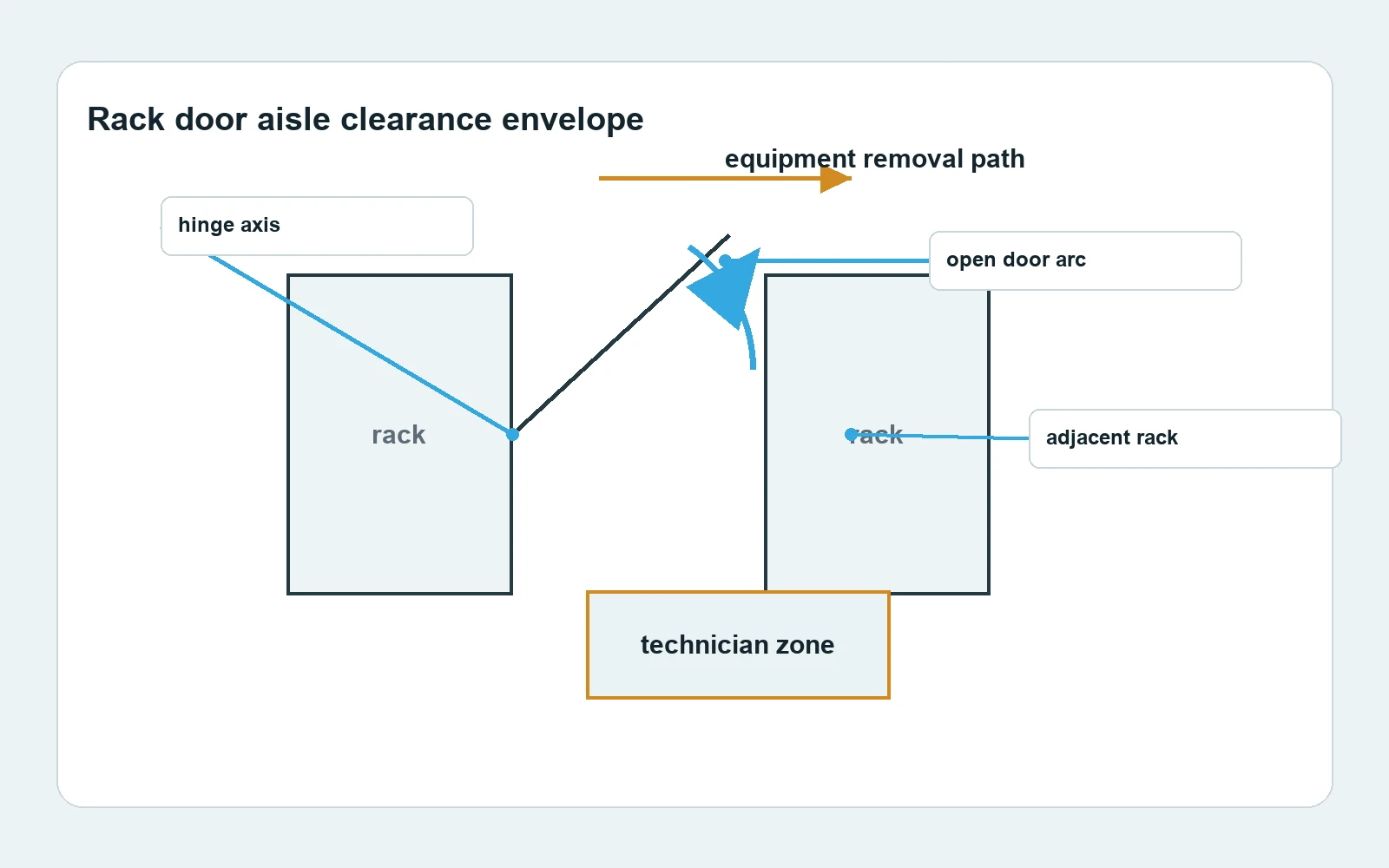
A nominal opening angle does not guarantee usable service access. Real clearance depends on swing radius, handle projection, neighboring racks, walls, technician position, and the equipment-removal path. A 180-degree door may still block access if the handle, hinge leaf, cable path, neighboring rack, or wall enters the working area.
Server rack door aisle clearance should be checked against the technician position and equipment-removal path, not only the nominal opening angle.
| Service Task | Check | Common Conflict |
|---|---|---|
| Routine cable access | Technician hand, tool, and standing space | Handle, wall, or adjacent open door |
| PDU or rear equipment replacement | Rear equipment extraction path | Split door, cable manager, or bonding strap |
| Server installation or removal | Front rail and equipment movement path | Door leaf, handle, or hinge hardware inside the extraction zone |
| Full door removal | Vertical lift and lateral handling space | Overhead tray, wall, neighboring rack, or floor obstruction |
Door Reversal and Removable-Door Layouts
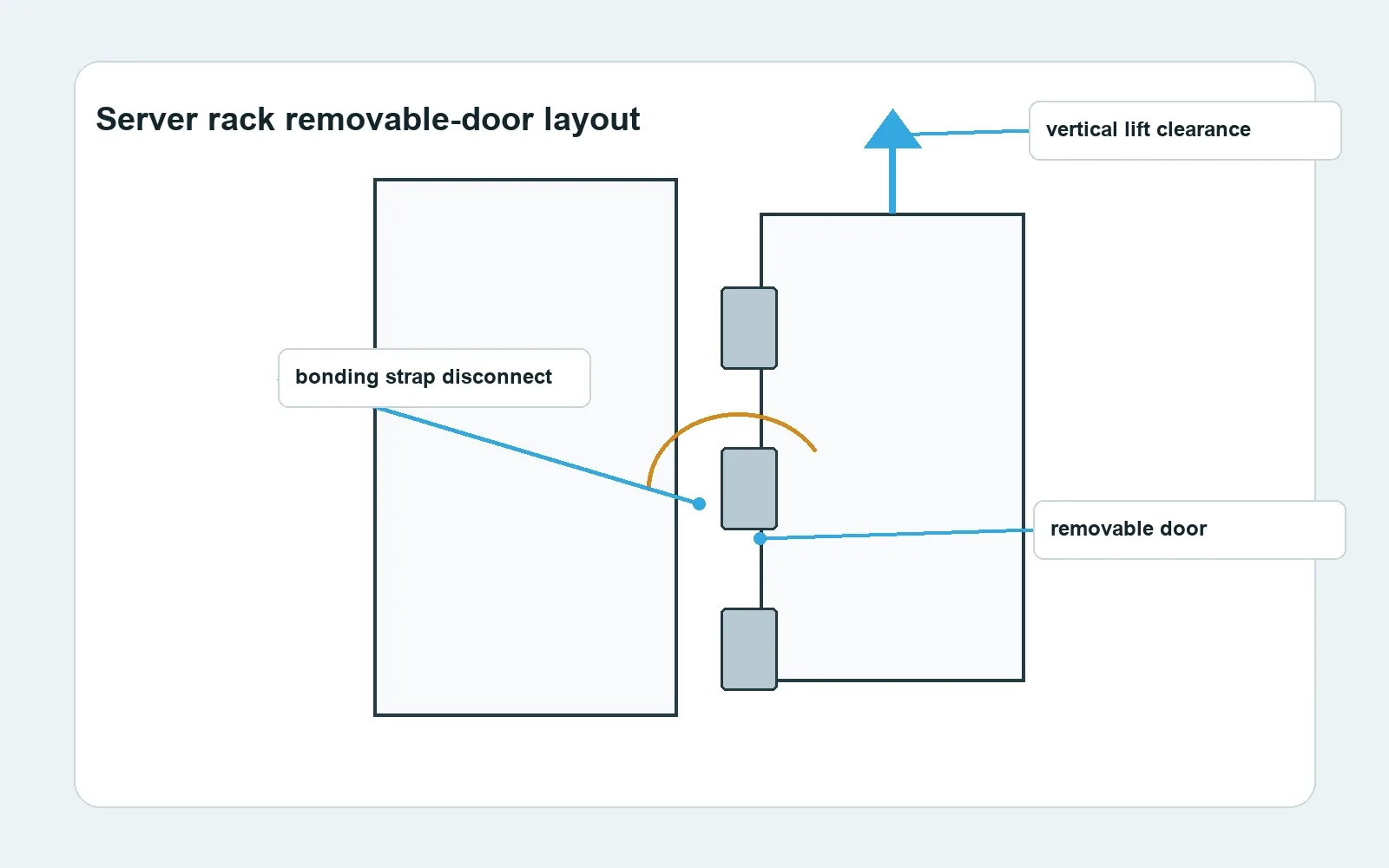
Field door reversal, symmetrical mounting holes, reversible pins, lift-off direction, bonding strap disconnection, and reinstallation alignment should be confirmed before the rack design is locked.
Removable server rack door hinges require sufficient lift clearance, a defined bonding-strap disconnection point, and repeatable reinstallation alignment.
Fixed Door
Suitable for long-term fixed layouts where door removal is not part of routine service.
Reversible Door
Useful when the site layout may require left-hand or right-hand opening after installation.
Removable Door
Useful when installation, transport, or service needs a larger access opening.
The removal method should be selected together with the available lift space, bonding connection, door weight, and reinstallation procedure. For a focused comparison, review lift-off versus fixed enclosure hinges.
Internal Mounting Depth and Equipment Clearance
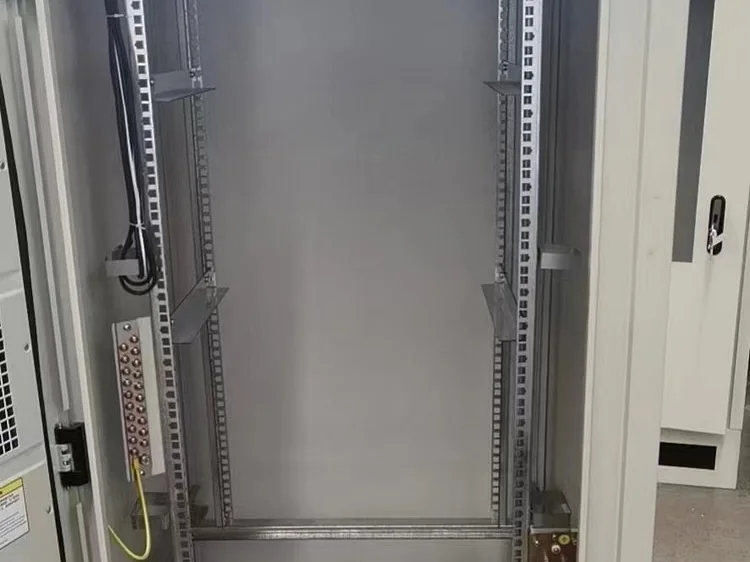
A concealed hinge can reduce external projection, but its internal depth must be checked through the full opening cycle. A layout that appears clear when the door is closed may still interfere with a lock rod, rack rail, cable manager, PDU, fan tray, or rear connector during rotation.
Internal rack hinge clearance must be checked through the complete opening cycle. Network cabinet hinge mounting depth should include the hinge body, fasteners, installation tools, and future service access.
Review hinge leaf depth, hinge knuckle projection, fastener access, tool access, and door removal direction before the hinge type is finalized. A hinge that fits geometrically may still be impractical if mounting screws cannot be installed or serviced after rails and equipment are assembled.
- Lock rod path and latch travel
- Rack rail and fan tray position
- PDU, cable manager, and rear connector clearance
- Tool access for fastener installation
Need a Hinge Layout Review for Your Rack Door?
Send the rack-door configuration, dimensions, opening direction, mounting-edge details, internal clearance, and service-access requirements. HTAN can review the hinge direction, mounting layout, removal method, and sample requirements before you finalize the cabinet design.
A short description and contact details are enough to begin the review.
Rack Door Interfaces: Airflow and Security
Perforated Area and Mechanical Clearance
The hinge layout can protect usable perforated area and prevent mechanical interference, but it does not establish the cabinet’s airflow capacity or thermal performance. Those requirements must be validated on the completed rack assembly.
Keep hinge leaves and reinforcement away from perforated boundaries, fan areas, filters, and equipment intake zones.
Security Interface and Concealed Hardware
Concealed or internally mounted hinges can reduce external projection and limit direct access to hinge hardware, but they do not by themselves create a secure cabinet. Security depends on the complete door, frame, latch, lock, fastener, hinge-retention, and access-control system. Here, the hinge is reviewed for mounting space, lock-rod clearance, opening movement, and rack-door integration.
For a focused review of concealed hinge exposure, hinge-pin access, and network cabinet physical security, see the dedicated network cabinet security guide.
Bonding Straps and Moving Cable Clearance
Do not assume that the hinge itself provides a reliable bonding path. Paint, coatings, grease, wear, and corrosion can change electrical contact. Where bonding is required, use a dedicated and verifiable bonding connection appropriate to the rack design.
Server rack door bonding strap clearance should be checked at closed, intermediate, fully open, and removal positions.
- Identify the hinge rotation envelope.
- Locate the bonding attachment points.
- Check cable and strap slack.
- Confirm door-removal procedure.
- Inspect continuity after reassembly.

Door Alignment in High-Density Rack Rows
In a high-density rack row, small changes in door position can affect latch engagement, handle clearance, neighboring doors, and the appearance of the complete row. Review the hinge axis, mounting-edge stiffness, fastener spacing, frame tolerance, and installed door accessories together.
Continuous hinges distribute attachment along a longer edge, while discrete hinges concentrate the load at specific mounting points. The final choice depends on door structure, reinforcement, serviceability, replacement needs, and manufacturing method.
Continuous and discrete hinge layouts transfer load into the mounting edge differently. Review the Continuous vs. Butt hinge load distribution guide for point loading, linear load distribution, fastener stress, and thin-sheet deformation.
Related Cabinet Applications
This page focuses on indoor server racks and network cabinets where rack-door configuration, aisle clearance, equipment access, and removable-door workflow are the main concerns.
Hinge Families for Server and Network Cabinets
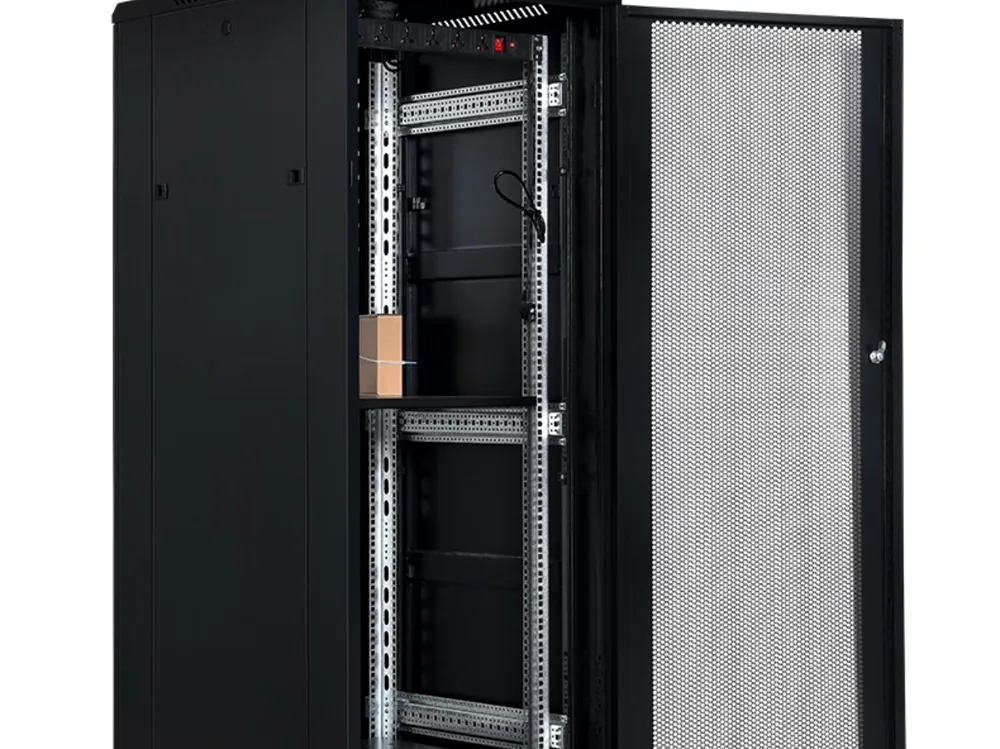
Concealed hinges are one option when external projection and exposed hardware must be reduced. Internal depth, lock-rod clearance, cable path, fastener access, and installation sequence still need review.
Concealed HingesBest fit: low projectionMain limitation: internal depthReview input: rail, lock rod, cable path
Lift-Off HingesBest fit: removable doorsMain limitation: lift clearanceReview input: removal direction, bonding strap
Continuous HingesBest fit: long edge supportMain limitation: replacement methodReview input: door edge stiffness
Heavy-Duty HingesBest fit: reinforced doorsMain limitation: point loadingReview input: frame thickness
Pivot HingesBest fit: defined swing axisMain limitation: support spaceReview input: swing radius
Removable-Pin HingesBest fit: removable panelsMain limitation: pin accessReview input: removal sequence
OEM Review
How HTAN Reviews the Rack Door Assembly
01
Door Configuration Review
Door type, size, material, perforation, glass panel, and split or full-height layout.
02
Swing and Clearance Review
Opening angle, aisle, adjacent rack, handle, equipment removal path, and internal cable path.
03
Mounting Interface Review
Frame width, sheet thickness, reinforcement, fasteners, internal depth, latch, and lock position.
04
Sample Fit and Movement Check
Sample fit, opening movement, alignment, removal and reinstallation, bonding-strap movement, and recorded observations for OEM validation.
What HTAN Can Review
HTAN can review rack door configuration, hinge axis, door load, mounting edge, opening angle, aisle clearance, internal interference, bonding strap path, door removal, sample fit, alignment, and product specification inputs.
HTAN’s review supports hinge selection, mounting-layout review, sample fit, and movement observations. Final rack security, bonding, airflow, thermal performance, seismic performance, certification, and site compliance remain the responsibility of the equipment manufacturer and project team.

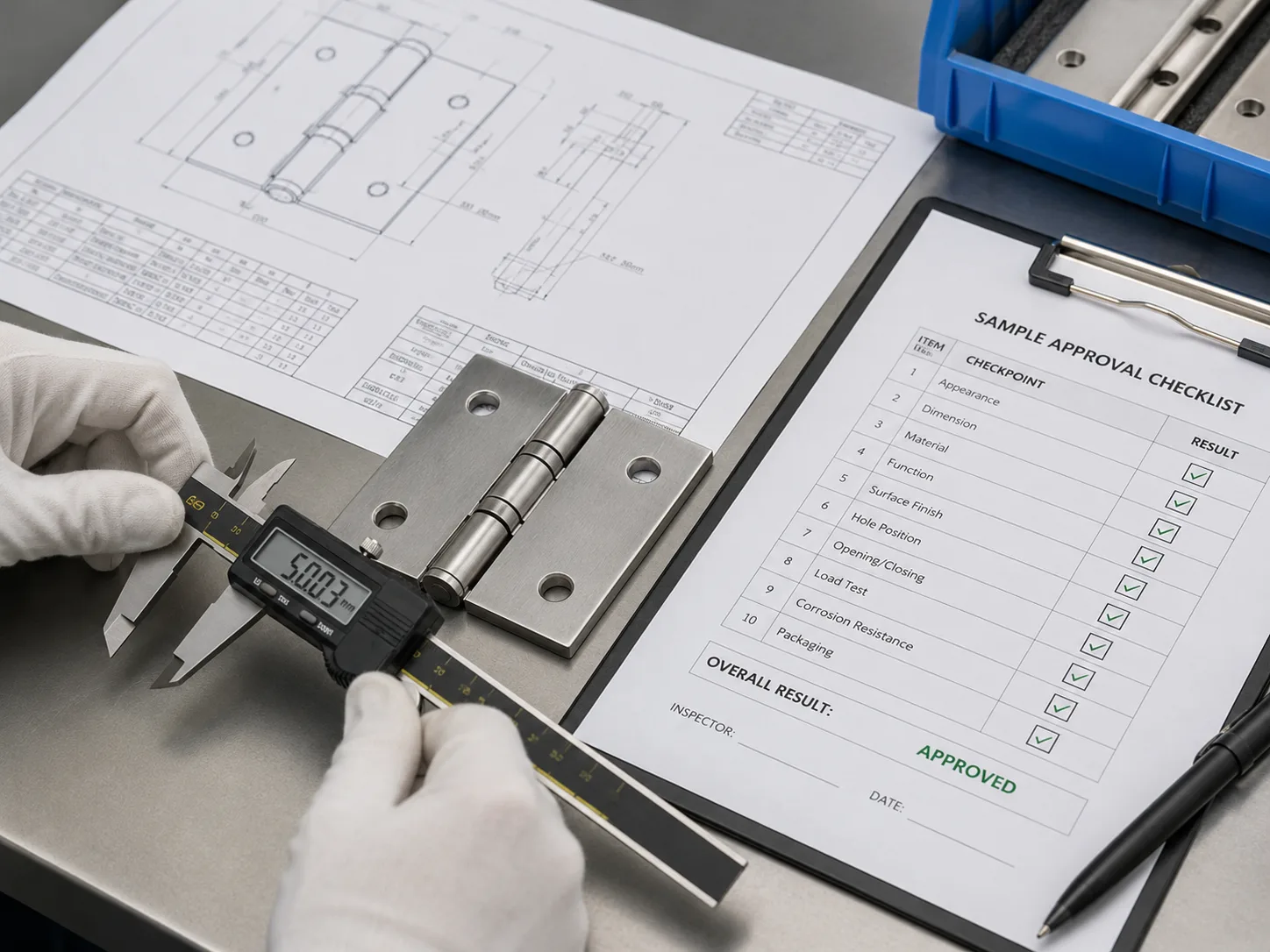
For sealed control cabinets where gasket compression, IP or NEMA requirements, grounding clearance, and outdoor exposure must be reviewed together, use the electrical enclosure door hinge solution.
For outdoor telecom cabinets and remote 5G sites exposed to rain, salt, humidity, corrosion, and long maintenance intervals, use the outdoor telecom cabinet hinge guide.
Validation Boundary
Hinge selection can support door alignment, service access, removable-door layouts, concealed mounting, and moving-cable clearance. It does not by itself prove rack security, airflow capacity, thermal performance, electrical bonding, seismic performance, lifecycle, or regulatory compliance. Final requirements must be validated on the completed server or network cabinet assembly.
Page Navigation
Jump to the rack-door checks most relevant to your design stage.
Compare Rack Door ConfigurationsRFQ
Data Center and Network Cabinet RFQ
Send your contact details and a short note about the rack door, frame, opening direction, service access, or existing hinge reference.
For custom server rack door hinges, send the door type, dimensions, opening direction, mounting-edge details, and required removal method.
Rack Door
- Door type, size, and weight
- Perforated, glass, or solid
- Opening direction and angle
Rack Interface
- Frame material and sheet thickness
- Mounting-edge width
- Rail, latch, wall, and rack clearance
Service and Movement
- Front or rear access
- Door reversal or removal
- Cable tray and bonding strap
Project Information
- Company and contact person
- Annual quantity and sample need
- Timeline, retrofit, or new design
Start With the Rack Door Assembly
You do not need to choose a hinge model before contacting HTAN. Leave your contact details and a short note about the door type, approximate dimensions, opening direction, mounting space, or internal clearance.
- Application-based hinge review
- Sample-fit and mounting layout support
- OEM quantity and customization discussion
Decision FAQ
What hinge types are commonly used on server rack doors?
Rack doors may use concealed, lift-off, discrete, continuous, pivot, or custom hinge structures. The choice depends on door layout, mounting edge, clearance, service task, and manufacturing method.
When should a server rack door be removable?
Use removable doors when installation, transport, equipment replacement, narrow aisle work, or service access needs a larger opening.
Can a server rack hinge be used as the bonding path?
Do not rely on the hinge by default. Use a dedicated, verifiable bonding connection suited to the rack design.
How much opening angle does a rack door need?
Base the angle on the actual maintenance and equipment-removal task. There is no universal value for every rack.
How do you check internal hinge clearance in a network cabinet?
Check the hinge body, leaf, knuckle, fasteners, installation tools, rack rails, lock rods, PDUs, fan trays, and cable managers throughout the complete door-opening cycle.
 English
  한국어
한국어  Русский
  Español
  Italiano
  Deutsch
  Français
  Português