

Telecom Shelter Cabinet Hinges: Material & Sealing Guide
A telecom shelter cabinet can look like a simple outdoor enclosure during a site walk, but the door hardware is doing more work than many buyers expect. The cabinet may sit outdoors for years, be opened repeatedly by field technicians, and still need to maintain door alignment, gasket compression, corrosion resistance, and security after long exposure to weather, vibration, and service cycles.
That is why hinge selection matters. For procurement and engineering teams, the real question is not whether a hinge fits a catalog description. It is whether the hinge can keep the cabinet door serviceable over the full life of the network site.
This guide focuses on practical hinge specification for telecom shelter cabinet hinges used in outdoor network sites and 5G deployments. It covers site exposure, technician access frequency, door weight, gasket sealing, material choice, fastener compatibility, and supplier verification. It is not a general outdoor hinge overview, and it is not only a stainless steel versus coated zinc comparison.
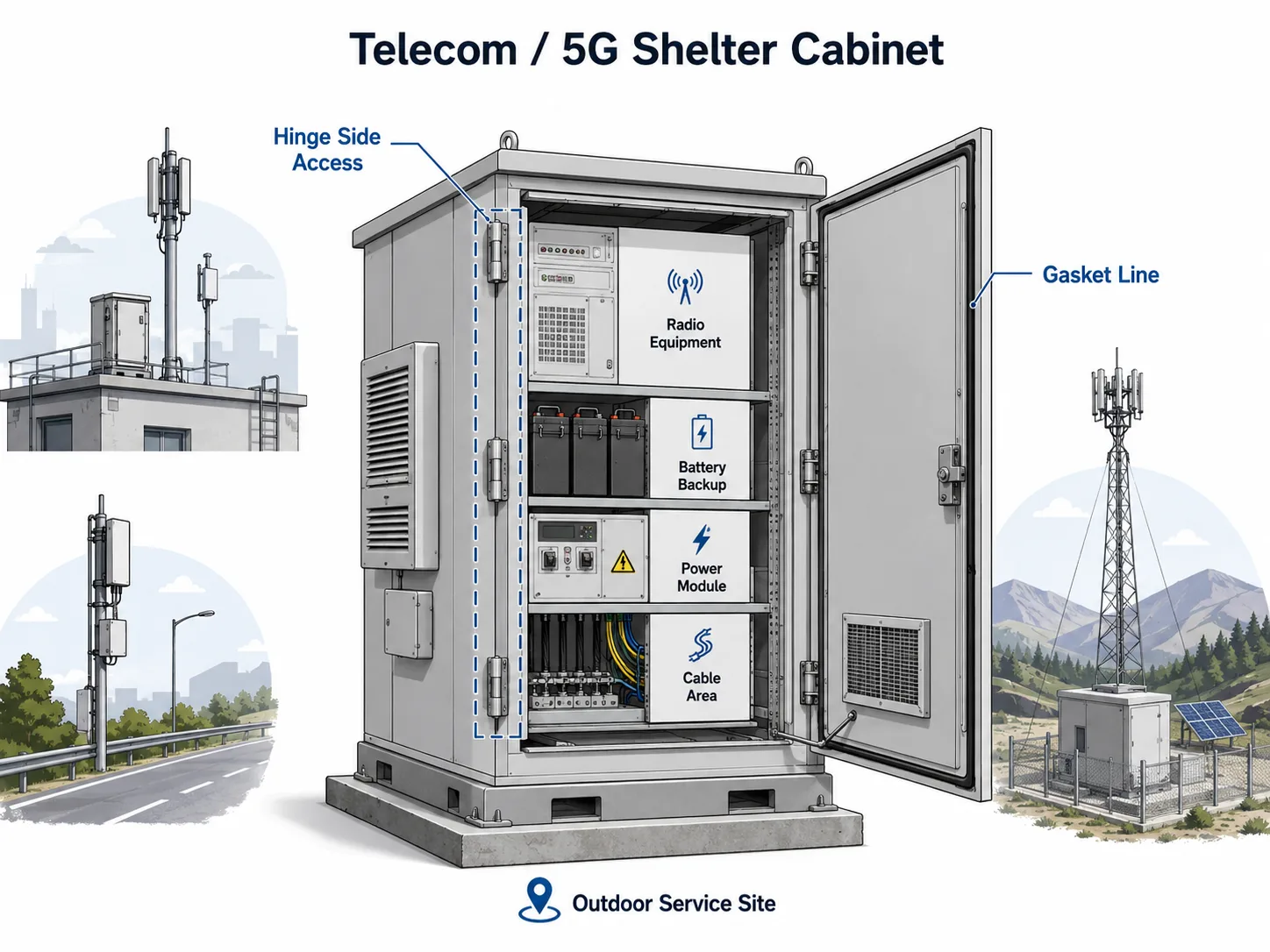
Why Telecom Shelter Cabinet Hinges Need a Separate Review
Telecom and 5G shelter cabinets are part of network infrastructure. A cabinet door failure may not stop the entire network immediately, but it can delay service, expose sensitive equipment, reduce sealing performance, or make field work more difficult during a maintenance window.
Unlike a general equipment cabinet, a telecom shelter cabinet may hold radio equipment, power modules, battery backup systems, fiber or cable connections, environmental controls, and monitoring components. The door must remain stable enough for technicians to access those systems without fighting misalignment, corrosion, or binding hardware.
For procurement teams, the hinge should be reviewed around four practical conditions:
- Outdoor corrosion exposure
- Field service frequency
- Door weight and opening geometry
- Long-term alignment and gasket compression
If those conditions are not defined before sourcing, hinge selection becomes a catalog guess. In telecom and 5G network deployments, that guess can become repeated maintenance cost later.
What Makes Telecom and 5G Cabinets Different from General Outdoor Cabinets
Telecom cabinets often operate in mixed field conditions. Some are installed near roads with vibration and dust. Some are placed on rooftops with wind-driven rain and heat exposure. Others are installed near coastal areas, utility corridors, or remote network sites where maintenance access is limited. The environmental classes encountered in outdoor non-weatherprotected use are described in IEC 60721-3-4, the international classification for stationary use at non-weatherprotected locations, which gives a useful baseline before specifying hardware against any one site.
The hinge must support the technician’s workflow while also surviving the environment. During commissioning, the cabinet may be opened many times. During normal operation, it may stay closed for long intervals. When it is opened again, the hinge still needs to move smoothly, support the door, and allow the latch and gasket to work as intended.
This mixed duty cycle creates a specific hinge challenge: the hinge must handle both repeated service access and long closed-door exposure. A hinge that corrodes, binds, loosens, or allows door sag can affect more than the door. It can affect technician access, gasket compression, latch alignment, and enclosure reliability.
Key Hinge Requirements for Telecom Shelter Cabinets
The best hinge for a telecom cabinet depends on the door system, not only on the hinge material. Before choosing stainless steel, coated zinc, concealed, surface-mounted, heavy-duty, or removable hinge structures, the buyer should define the application requirements.
| Requirement | Why It Matters in Telecom Cabinets | What to Verify |
|---|---|---|
| Door weight and size | Larger doors create leverage and hinge-side stress | Door height, width, thickness, weight, hinge spacing |
| Field access frequency | Frequent opening increases wear and fastener stress | Service interval, technician access pattern, open angle |
| Gasket compression | The hinge affects whether the door seals evenly | Hinge axis, latch force, gasket line, door gap |
| Outdoor corrosion exposure | Moisture, salt air, dust, and condensation can degrade hardware | Material grade, surface finish, fastener compatibility |
| Security requirement | Telecom cabinets may need tamper-resistant hardware | Pin retention, hidden fasteners, hinge placement |
| Vibration and wind load | Roadside and rooftop sites may create loosening or movement | Fastener locking, mounting reinforcement, sample fit |
| Replacement strategy | Remote sites need predictable replacement and documentation | Drawing, part number, material certificate, approved substitute |
This table should be treated as a sourcing checklist. If the supplier cannot confirm these items, the hinge is being treated as a catalog component instead of part of the cabinet door system.
Stainless Steel Hinges: Where They Fit Best
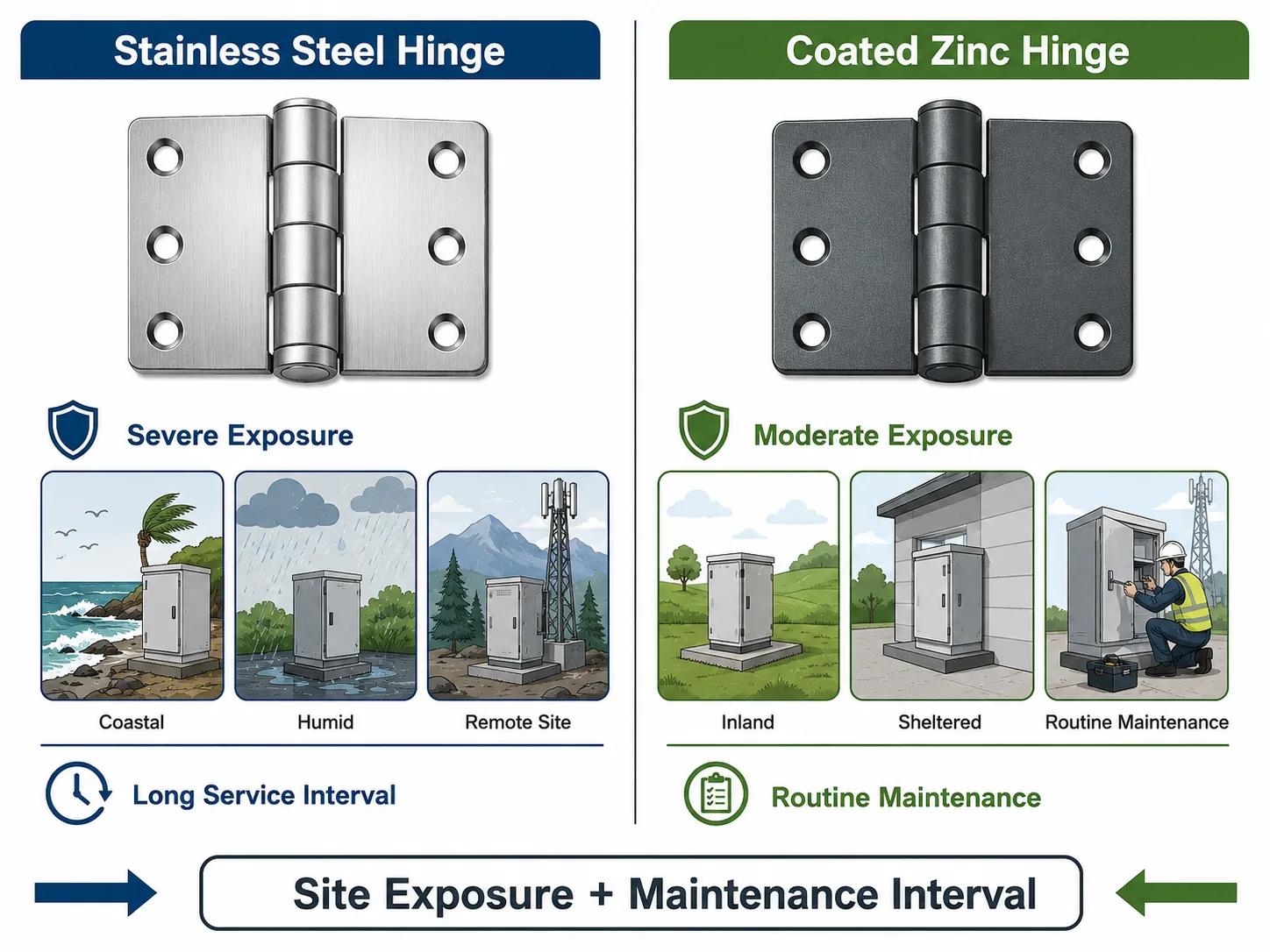
Stainless steel hinges are usually the stronger direction when corrosion resistance and long-term outdoor stability are priorities. This is often the case for telecom cabinets installed in coastal zones, humid regions, high-rainfall areas, rooftops, remote sites, or locations where maintenance visits are infrequent.
The advantage of stainless steel is not only visible rust resistance. A suitable stainless hinge can reduce the risk of early hardware replacement caused by moisture, condensation, and repeated weather cycling. For network infrastructure expected to remain stable for years, that matters.
However, stainless steel is not a universal solution. If the enclosure uses mixed materials, incompatible fasteners, poor drainage, or hidden moisture traps, stainless hardware can still show staining, pitting, or crevice corrosion. If stainless hinges will be installed against coated steel, aluminum, or mixed fasteners, buyers should understand why stainless steel hinges can still corrode before treating material grade as the only specification.
For coastal telecom shelters or roadside cabinets exposed to salt air, material selection should also be reviewed with the project’s protection target and corrosion environment. If the project is tied to coastal exposure or a NEMA 4X expectation, review the NEMA 4X hinge specification for coastal projects before final material approval.
Coated Zinc Hinges: Where They Can Still Be Practical
Coated zinc hinges can still be practical for telecom cabinets when the site environment is moderate and the cabinet is inspected regularly. For inland telecom cabinets, sheltered network sites, or cost-sensitive projects with routine service access, coated zinc may provide an acceptable cost-to-performance balance.
The main benefit is economy. If the environment is not highly corrosive and technicians can identify early coating damage during scheduled maintenance, coated zinc hardware may be sufficient.
The limitation is coating integrity. Once the coating is scratched, worn through, or damaged around the hinge knuckle, fastener area, or mounting face, corrosion can begin faster than with suitable stainless hardware. In telecom applications, this matters because field technicians may repeatedly handle the door, work near the hinge side, or open the cabinet in poor weather.
Coated zinc is not automatically wrong. It is simply more sensitive to exposure level, coating quality, installation damage, and maintenance discipline. For procurement teams, the question is not “Is coated zinc acceptable outdoors?” The better question is: “Is the site exposure moderate enough, and will maintenance happen often enough, to manage coating damage before it becomes a service issue?”
Common Telecom Cabinet Hinge Failure Patterns
The best way to choose hinge material and structure is to understand likely field failures. Telecom shelter hinge problems usually appear in several repeatable patterns.
Pattern 1: Door Sag Over Time
The door no longer sits square in the frame. The latch may require extra force, or the bottom corner may drag during closing. This often points to hinge wear, fastener loosening, mounting face deformation, or hinge-side load mismatch.
If the cabinet door has already shifted or the latch no longer aligns, the broader hinge sag diagnosis and prevention guide can help identify whether the root cause is pin wear, mounting damage, or frame distortion before replacing hinges with the same material.
Pattern 2: Corrosion at the Hinge Interface
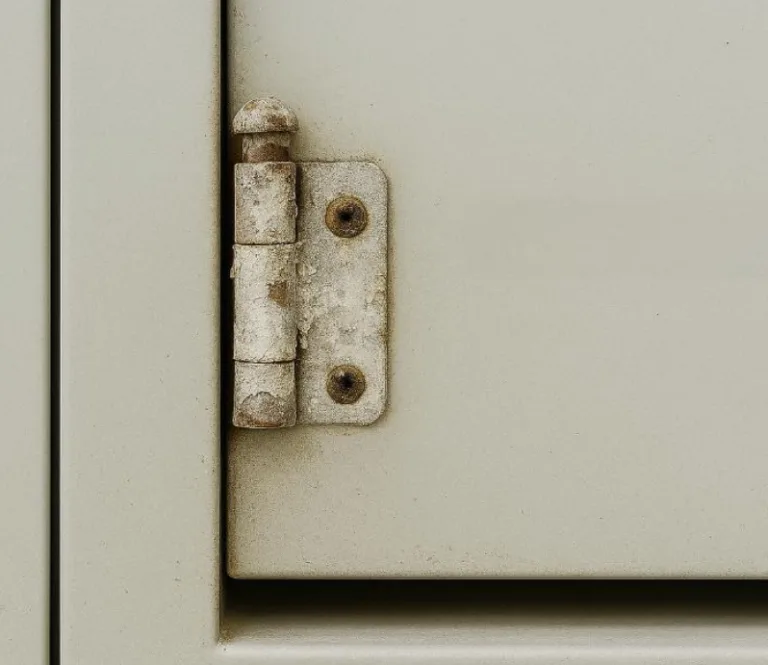
Rust, staining, discoloration, or coating breakdown may appear around the hinge leaf, screws, pin, or contact points. In coated zinc hinges, this often means the protective finish has been compromised. In stainless hinges, it may indicate crevice conditions, mixed-metal contact, trapped moisture, or poor drainage.
This failure pattern should be treated as a system issue. Replacing the hinge without reviewing fasteners, drainage, surface finish, and cabinet material can repeat the same failure.
Pattern 3: Reduced Gasket Compression
If the hinge no longer holds the door in the correct position, the gasket may not compress evenly. That can lead to water ingress, dust intrusion, or reduced cabinet sealing performance.
If hinge selection may affect gasket compression or enclosure protection, the IP-rated enclosure hinge checklist can help verify door alignment, latch force, mounting holes, and sealing continuity.
Pattern 4: Binding After Long Idle Periods — The Telecom-Specific Failure
This pattern is more specific to telecom than to almost any other outdoor cabinet category. A telecom shelter is opened intensively during initial site commissioning, then often stays closed for months or even years between service visits. When a technician returns — sometimes during a fault response, in poor weather, at night, or under time pressure — the hinge has to work the first time.
What goes wrong during that long idle period is usually invisible until the door is opened. Salt aerosol, dust, condensation, insect activity, and seasonal humidity cycling all act on the hinge pin, bushing, and knuckle area while no one is watching. When the door is finally opened, the symptoms can include stiff initial movement, audible binding, gritty rotation, sticking part-way through the swing, or in worst cases a hinge that refuses to move until force is applied — which then risks bending the leaf or stripping fasteners.
This is why telecom hinge specification should consider not only how the hinge performs when new, but how it performs after sitting unopened. Pin material, bushing material, surface finish around the knuckle, and drainage around the hinge area all affect whether the cabinet can still be serviced on demand. For remote shelter sites, rooftop sites, and backup power cabinets where service access must work when needed, this idle-period reliability is often the deciding factor — not catalog load rating.
Pattern 5: Fastener Loosening
The hinge body may look intact, but mounting screws or backing hardware can loosen under vibration, thermal cycling, or repeated door movement. This affects both stainless and coated zinc hinge options. Fastener locking, backing plates, thread engagement, and mounting reinforcement should be part of the hinge specification.
Hinge Specification by Telecom Cabinet Area
Not every door in a telecom shelter cabinet has the same duty cycle. A power compartment, radio equipment access door, battery backup compartment, and cable access panel may require different hinge decisions.
| Cabinet Area | Access Pattern | Main Hinge Requirement | What to Verify |
|---|---|---|---|
| Radio equipment compartment | Medium to high during commissioning and service | Smooth repeated access and stable alignment | Pin wear, opening angle, technician clearance |
| Battery backup compartment | Lower frequency but higher consequence of access failure | Long-term alignment and corrosion resistance | Door weight, gasket line, fastener compatibility |
| Power distribution door | Periodic service access | Reliable opening and latch alignment | Hinge spacing, gasket compression, security |
| Fiber / cable access panel | Controlled access, sometimes limited clearance | Stable door position and cable clearance | Open angle, cable bend clearance, no rebound |
| Environmental control compartment | Filter or fan access may be routine | Repeatable access and easy reassembly | Removal needs, fastener access, gasket recovery |
| Remote shelter main door | Less frequent but critical service access | Weather resistance, security, and field reliability | Material, pin retention, drainage, replacement traceability |
This kind of compartment mapping helps buyers avoid over-specifying every door while still protecting the most critical access points.
Procurement Decision Framework
For buyers, telecom cabinet hinge selection should follow a simple sequence.
1. Define the Site Exposure
Identify whether the site is coastal, humid, inland, rooftop, roadside, desert, industrial, or remote. The same hinge may perform differently depending on salt air, rain exposure, dust, heat, condensation, and service access.
2. Define the Service Frequency
A cabinet opened weekly does not have the same hinge requirement as a remote shelter opened only during faults. Frequent access increases wear and handling damage. Long idle periods increase the importance of corrosion resistance and smooth reopening.
3. Define the Door and Sealing Requirement
Record door size, approximate weight, gasket line, latch position, required opening angle, and any security requirement. The hinge must be selected with the door and latch system, not as a standalone item.
4. Match Hinge Material to Site Risk
Stainless steel is often the safer direction for severe exposure, remote sites, and long service intervals. Coated zinc can remain practical for moderate inland sites with routine maintenance and lower corrosion pressure.
5. Verify the Door System
Confirm installed fit, hinge movement, latch alignment, gasket compression, fastener compatibility, and technician access before approving production or bulk sourcing.
The main mistake is treating the hinge as an isolated hardware purchase. In telecom and 5G shelter cabinets, the hinge affects service access, door alignment, security, and enclosure sealing.
What to Send a Hinge Supplier
To recommend a suitable hinge for telecom and 5G shelter cabinets, the supplier needs more than a photo of the current hinge. Provide the following details before asking for a specification:
- Cabinet type: telecom shelter, 5G equipment cabinet, rooftop cabinet, roadside cabinet, remote network site, or power cabinet
- Door height, width, thickness, and approximate weight
- Door material and frame material
- Current hinge type, hinge count, hinge spacing, and mounting method
- Required opening angle and technician access clearance
- Gasket location and sealing requirement
- Latch position and security requirement
- Site environment: coastal, humid, rooftop, roadside, remote, dusty, industrial, or high-rainfall
- Service frequency and expected idle period between maintenance visits
- Material preference: stainless steel, coated zinc, or project-specific finish
- Fastener compatibility and pin retention requirement
- Required documentation: drawing, material certificate, surface treatment, sample report, or test evidence
This information allows the supplier to recommend a hinge structure and material based on the real operating conditions, not only a catalog category.
Final Recommendation
For telecom and 5G shelter cabinets, hinge selection should begin with the site and door system. Review outdoor exposure, service frequency, door weight, gasket compression, latch alignment, security expectation, fastener compatibility, and replacement traceability before choosing the hinge material or structure.
Stainless steel hinges are usually the safer direction for coastal, humid, remote, or long-service telecom sites where corrosion resistance and stable operation matter more than initial cost. Coated zinc hinges can still be practical for moderate inland sites with routine maintenance and controlled exposure, but the coating condition must be part of the inspection plan.
The best hinge is not chosen by material name alone. It is chosen by how well it supports field access, door alignment, gasket compression, and long-term service reliability in the specific telecom cabinet environment.
FAQ
Are stainless steel hinges always better for telecom shelter cabinets?
No. Stainless steel hinges are often better for severe outdoor exposure, coastal environments, humid sites, and remote cabinets with limited maintenance access. However, site conditions, fastener compatibility, drainage, door structure, and service frequency still matter.
Can coated zinc hinges be used on outdoor telecom cabinets?
Yes. Coated zinc hinges can be suitable for moderate outdoor environments, inland telecom sites, and cabinets with regular maintenance access. The key limitation is that the coating must remain intact and the exposure level must not be too aggressive.
What usually causes telecom cabinet hinge failure first?
Common causes include corrosion at the hinge interface, coating damage, fastener loosening, pin wear, door sag, poor alignment, gasket compression problems caused by hinge-side movement, and binding after long idle periods between service visits.
Why do telecom cabinet hinges sometimes bind when opened after long idle periods?
During long idle periods, salt aerosol, dust, condensation, and humidity cycling can act on the hinge pin, bushing, and knuckle while no one is watching. When the cabinet is finally opened — often during a fault response in poor conditions — the hinge can stick, rotate gritty, or refuse to move without force. Pin material, bushing material, and drainage around the hinge area all affect this idle-period reliability.
What should procurement ask suppliers to provide?
Procurement teams should ask for hinge drawings, material details, surface treatment information, fastener compatibility, installation requirements, sample review guidance, and project-specific verification support.
Need Help Specifying Telecom Shelter Cabinet Hinges?
If your telecom or 5G shelter cabinet depends on stable outdoor service, treat hinge selection as a system decision, not a catalog decision. Share the cabinet drawing, site environment, access frequency, door size, gasket layout, and security requirement so the hinge specification can be matched to real operating conditions — including idle-period reliability for remote sites where the door has to work the first time, every time.

 English
  한국어
한국어  Русский
  Español
  Italiano
  Deutsch
  Français
  Português