

Enclosure Hinge IP Rating Checklist: 12 Specs to Verify
An enclosure hinge IP rating checklist is the fastest way to confirm whether the hinges you are about to specify will actually preserve the cabinet’s IP66, IP67, or NEMA 4X rating in service — instead of becoming the leak path that voids it.
This page is a 12-point verification checklist for buyers, project engineers, and OEM sourcing teams. It does not re-explain what IP66 means or why outdoor cabinets fail. Instead, each item gives you one decision to make, the specification to ask the supplier for, and the deeper engineering factor to verify before approving a hinge sample.
Use it as a copy-paste RFQ checklist or as the acceptance gate before approving a hinge sample.
How to Use This Checklist
Before you start, gather three numbers from your enclosure design: door weight, required IP or NEMA rating, and installation environment. The environment may be indoor, outdoor inland, coastal, marine, washdown, dusty, cold, or hazardous. Every item below should be checked against those three inputs.
Items 1–4 are specification checks. They confirm whether the hinge matches the enclosure rating and environment. Items 5–8 are mechanical checks. They confirm whether the hinge can keep the door aligned under load, cycles, temperature change, and material interaction. Items 9–12 are procurement and installation checks. They confirm whether the supplier can prove the rating and whether the installed hinge still protects the enclosure.
The 12-Point Checklist
Confirm the Hinge Has Its Own Published IP or NEMA Rating
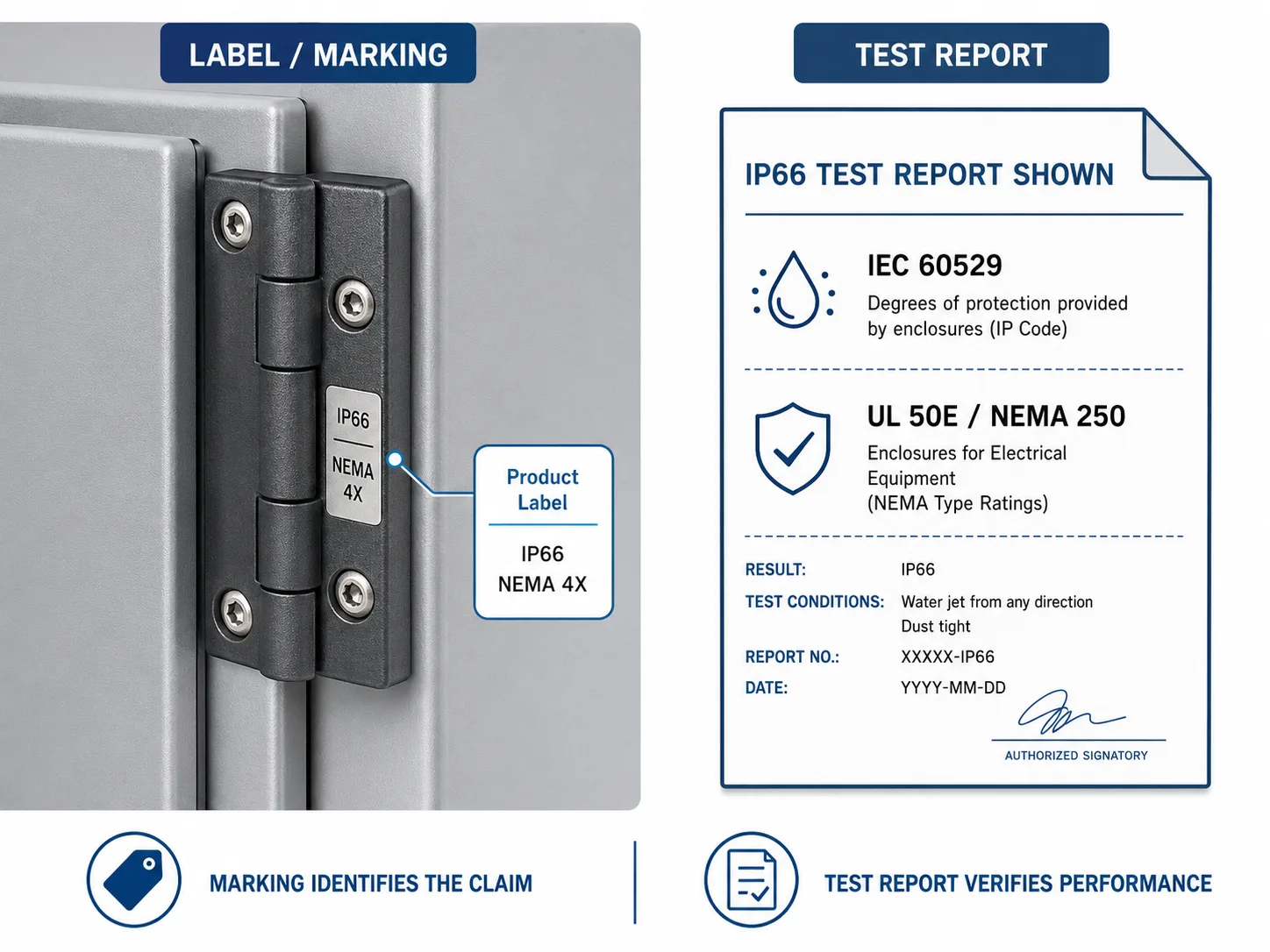
Why it matters: A hinge labeled “IP66 compatible” is not the same as a hinge tested to IP66. The pivot pin, mounting holes, and fastener interfaces can introduce leak paths that the enclosure gasket cannot compensate for.
Ask the supplier for: a test report against IEC 60529 for IP ratings or UL 50E / NEMA 250 for NEMA-rated enclosures, with the hinge tested as installed — not only the enclosure body tested separately.
Reject if: the datasheet only says “suitable for outdoor use,” “weatherproof,” or “water-resistant” without a numeric rating and standard reference. If the enclosure must resist coastal humidity, hose-down cleaning, or salt exposure, the hinge should be checked against NEMA 4X hinge selection requirements before it is approved for the project.
Match Hinge Style to the Sealing Strategy
Why it matters: Continuous, butt, and concealed hinges interact with the gasket differently. Continuous hinges distribute load along the door edge, but the pin area can collect debris. Butt hinges concentrate load at fewer points and may locally over-compress or under-compress the gasket. Concealed hinges can protect the pivot area better when the enclosure design allows the hinge to stay inside or away from the sealing boundary.
Ask the supplier for: a section drawing showing how the hinge sits relative to the gasket line, fasteners, door return, and mounting frame.
When load distribution and door sealing are both part of the design review, compare hinge style with the enclosure’s gasket compression requirement before approving the sample.
Select the Base Material by Corrosion Class
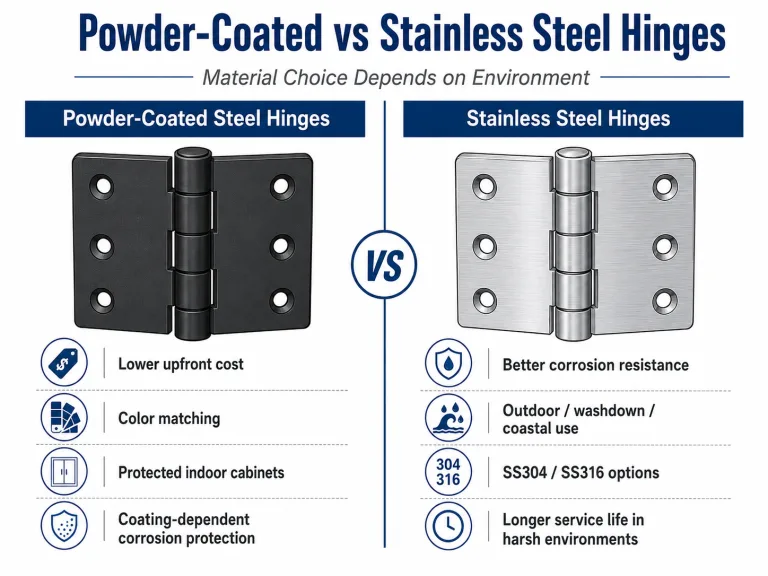
Why it matters: Once the base material rusts, no gasket can preserve the enclosure rating for long. Carbon steel may be acceptable for protected indoor cabinets. SS304 can work for many inland outdoor applications. SS316 is usually safer for coastal, marine, washdown, or chloride-rich environments. Aluminum can reduce weight, but fastener and galvanic compatibility must be checked carefully.
Ask the supplier for: a material certificate showing the actual grade, not just a generic “stainless steel” statement.
When coated steel, carbon steel, SS304, and SS316 are being compared, the real decision is whether the hinge material can meet the corrosion exposure and maintenance life expected from the enclosure.
Verify the Coating or Surface Finish Survives the Service Life
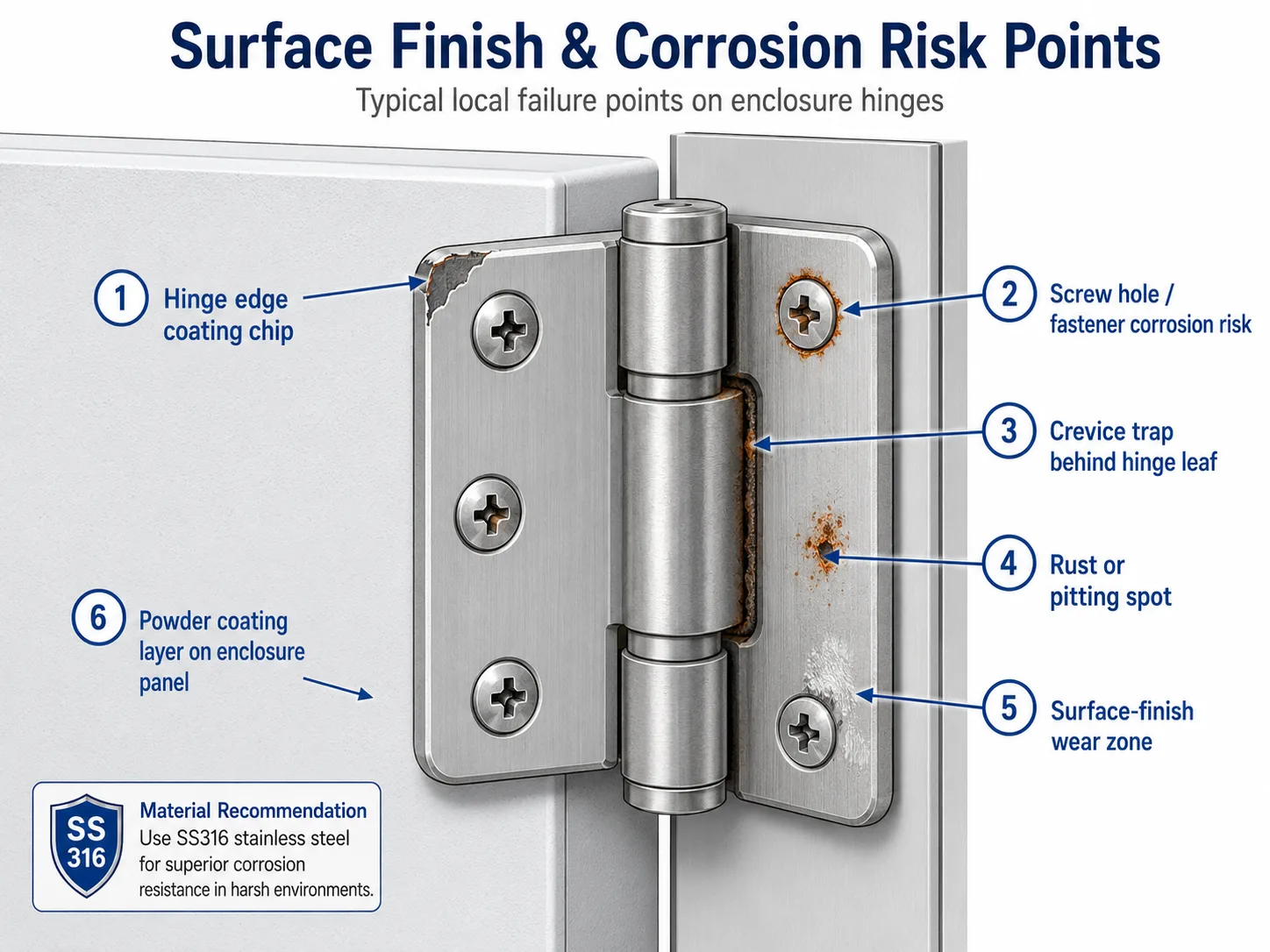
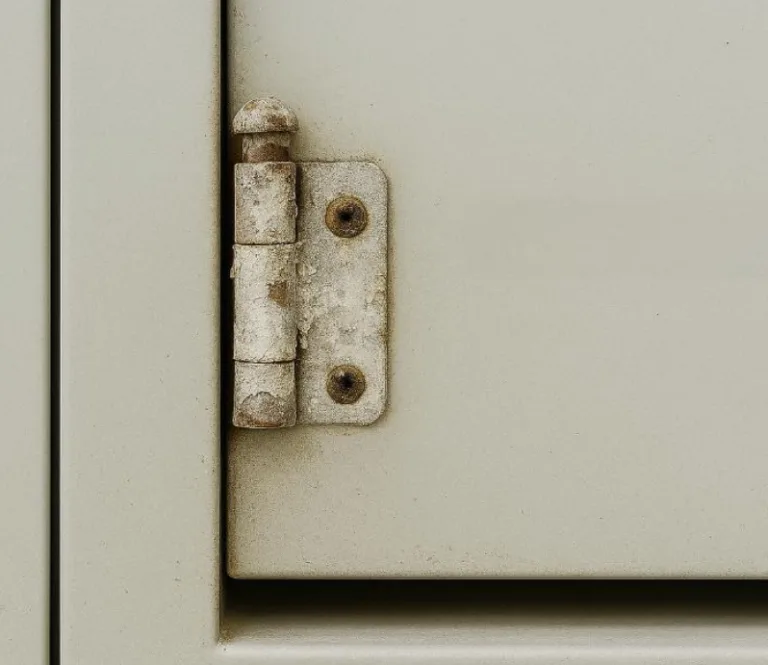
Why it matters: Powder coating can chip at edges, hinge leaves, and mounting holes, exposing the base metal. Zinc plating is generally better suited to protected indoor conditions. SS316 has stronger corrosion resistance, but poor handling, trapped salts, incompatible fasteners, or crevice conditions can still cause staining or pitting.
Ask the supplier for: coating thickness, adhesion test data, salt spray test report, and surface treatment details such as passivation or electropolishing where applicable.
Reject if: the supplier cannot explain how the finish performs at hinge edges, screw holes, and contact points. In humid, washdown, or salt-exposed enclosures, surface finish should be reviewed together with why stainless steel hinges corrode so the project does not rely on material grade alone.
Specify Both Static and Dynamic Load Capacity
Why it matters: Door weight is only the static load. Wind, vibration, transportation shock, repeated opening, and field service can create dynamic loads that flex the hinge and open micro-gaps in the gasket. Once the door shifts, the enclosure may lose sealing pressure even if the hinge does not visibly break.
Ask the supplier for: static load rating per hinge and fatigue load rating at the rated cycle count.
When the enclosure door is heavy, wide, exposed to wind, or opened frequently, hinge selection should start with real door weight and loading conditions. In these cases, a heavy-duty hinge selection process based on door weight is more reliable than choosing only by hinge size, material, or catalog appearance.
Define the Cycle Life Requirement
Why it matters: A hinge that supports the rating on day one may not preserve it after repeated use. Pin wear, bushing wear, fastener loosening, and door sag can reduce gasket compression and create ingress paths over time.
Recommended targets: use lower cycle targets for rarely opened indoor access doors and higher cycle targets for outdoor service cabinets, telecom enclosures, critical infrastructure, or inspection panels opened frequently. Do not apply one cycle target to every enclosure without considering service frequency.
Ask the supplier for: a cycle life report at the rated load. A credible report should identify the test load, number of cycles, hinge orientation, pass/fail criteria, and post-test inspection results.
Check Sag Resistance Over the Design Life
Why it matters: A door that slowly sags may lose gasket compression on the latch side, dropping the effective enclosure rating long before the hinge is considered broken. This is one of the most common silent failure modes in industrial cabinets.
Ask the supplier for: permissible sag or deflection at rated load over the expected service life. If no number is available, request a sample test using the actual door size and mounting pattern.
If the enclosure door is wide, heavy, or frequently opened, sag and alignment should be checked during sample approval because gasket compression depends on door position over time.
Account for Thermal Cycling and Galvanic Pairing
Why it matters: Outdoor enclosures can experience large temperature changes. Different materials expand at different rates, which can loosen bolts, change gasket compression, or increase friction around the hinge pin. Mixed-metal assemblies can also create galvanic corrosion in humid or wet environments.
Ask the supplier for: material compatibility between hinge body, pin, bushing, fasteners, washers, and enclosure frame. Specify isolation washers or sealing washers when mixed metals are unavoidable.
Reject if: the bill of materials lists a stainless hinge with lower-grade pins, zinc-plated fasteners, or incompatible mounting hardware for an outdoor or washdown application.
Apply Environment-Specific Validation
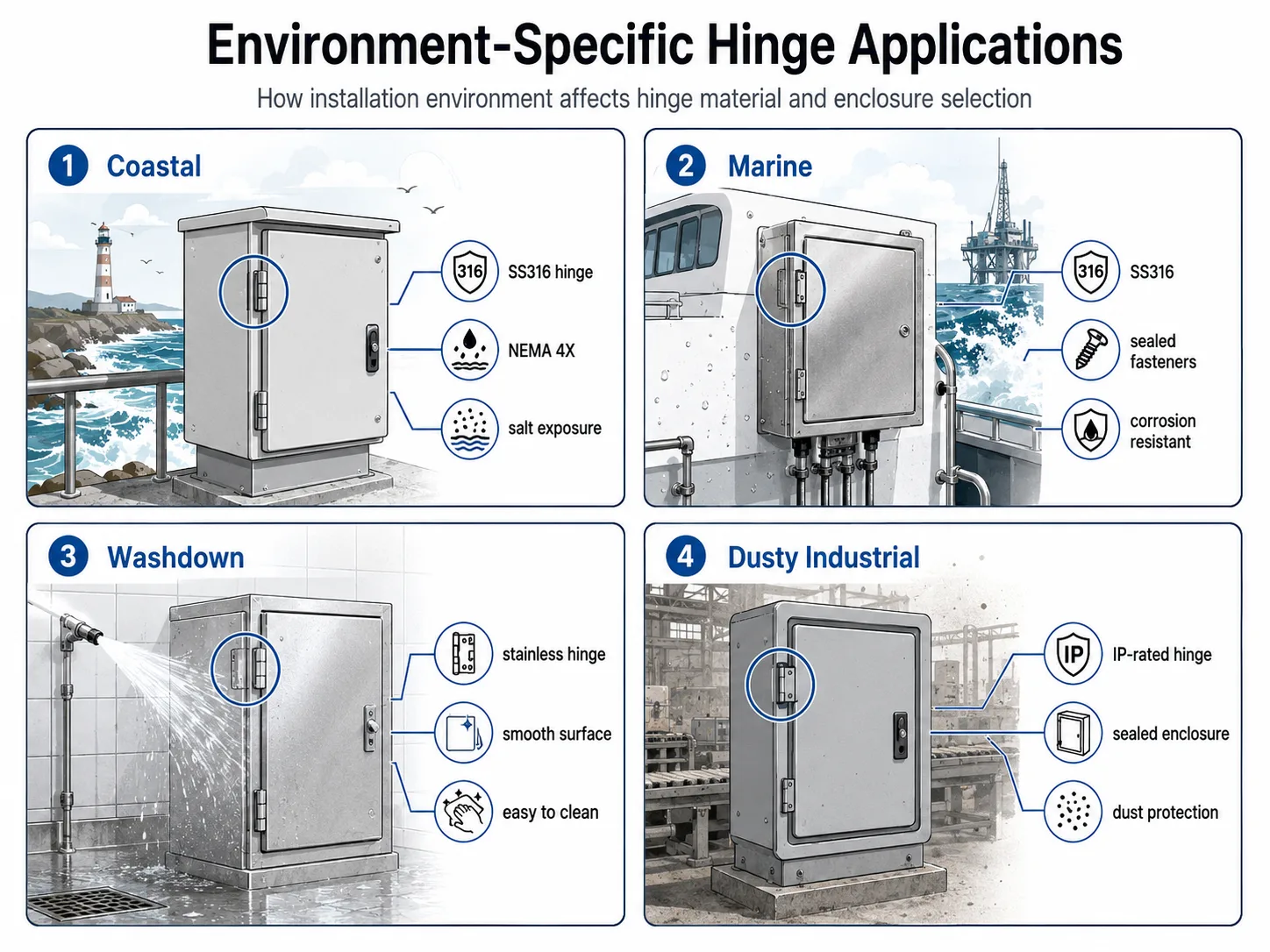
Why it matters: A generic IP66 statement does not cover every installation environment. Coastal sites, electrical control cabinets, outdoor public infrastructure, washdown zones, and dusty industrial areas all create different hinge risks.
Map your environment to the right specification: coastal, offshore, washdown, dusty, and outdoor public infrastructure projects all create different hinge risks. For coastal or salt-exposed sites, review NEMA 4X hinge selection before approving the material and documentation package.
Decide Whether the Door Must Be Removable
Why it matters: Lift-off and removable-pin hinges can make field service faster, but they introduce vertical clearance requirements and different sealing geometry. Fixed-pin hinges usually preserve alignment more consistently, but they can make replacement or inspection slower.
Ask yourself: is door removal part of the maintenance procedure, and does the service team have enough clearance to remove and reinstall the door without damaging the gasket or hinge alignment?
When service access and sealing repeatability are both important, compare removable and fixed hinge structures before finalizing the hinge type.
Demand Supplier Documentation as a Pre-Shipment Gate
Why it matters: A hinge that arrives without documentation cannot be defended in a field warranty dispute. Procurement should treat documentation as part of the deliverable, not as an afterthought.
Minimum document set: material certificate, IP or NEMA test report, corrosion test report if required, cycle life report, dimensional inspection report, and batch traceability number. For higher-stakes projects, request a third-party witness test from a recognized laboratory.
Reject if: the supplier can provide a catalog page but cannot provide test conditions, material grade, cycle data, or traceability for the hinge batch.
Verify the Installation, Not Just the Hinge
Why it matters: The best hinge can still compromise an IP rating if it is mounted on an out-of-flat door frame, torqued unevenly, or paired with the wrong gasket. The hinge specification is necessary, but installation quality determines whether the enclosure remains sealed in service.
On-site checks: verify the door-to-frame gap, fastener torque, gasket compression, hinge-side alignment, latch-side compression, and diagonal door warping when closed.
If hinge selection, material choice, gasket compression, door alignment, and installation method all affect the final enclosure rating, the hinge should be reviewed as part of the full industrial enclosure hinge guide workflow rather than as a standalone hardware item.
Quick-Reference Table by Enclosure Rating
The values below are practical procurement targets, not automatic requirements of the IP code. Final acceptance should follow the project specification, enclosure standard, supplier test report, and the actual installation environment.
| Enclosure Rating | Recommended Material Direction | Suggested Cycle Target | Load Safety Factor | Suggested Corrosion Test Target |
|---|---|---|---|---|
| IP54 indoor cabinet | Carbon steel, zinc-plated, or protected hinge material | 10,000 cycles | 1.2× | Basic indoor corrosion check |
| IP65 outdoor cabinet | SS304 or coated steel, depending on exposure | 20,000 cycles | 1.5× | Moderate outdoor corrosion target |
| IP66 outdoor industrial enclosure | SS304 for inland sites; SS316 for coastal or harsh sites | 50,000 cycles | 2.0× | Higher corrosion-resistance target |
| IP67 / IP68 critical enclosure | SS316 or sealed corrosion-resistant hinge system | 100,000 cycles | 2.5× | Project-specific corrosion and immersion validation |
| NEMA 4X enclosure | SS316 or corrosion-resistant stainless hinge system | 50,000 cycles | 2.0× | Corrosion test target required by project specification |
FAQ
Does a hinge need its own IP rating, or is the enclosure rating enough?
The hinge needs its own IP rating, or at minimum a manufacturer statement showing that the hinge has been tested as part of the enclosure assembly. Enclosure-level IP testing is performed on a complete cabinet, so an unrated hinge should not be assumed to preserve the same rating in other cabinet designs.
Is IP66 always equivalent to NEMA 4X?
No. IP66 covers dust ingress and high-pressure water jets. NEMA 4X also includes corrosion-resistance expectations at the enclosure level. A hinge can support an IP66 enclosure and still be unsuitable for a NEMA 4X coastal project if corrosion resistance is not verified.
Can I retrofit a higher-rated hinge onto an existing enclosure?
Sometimes, but changing hinge hardware can affect the enclosure rating. A retrofit should be reviewed against gasket compression, mounting holes, door alignment, and fastener sealing. For critical applications, the assembly should be re-tested or documented by engineering approval.
How often should installed enclosure hinges be re-checked?
Inspection frequency depends on environment, access frequency, door weight, vibration, and corrosion exposure. Outdoor IP65 and IP66 cabinets should be checked regularly for sag, corrosion, fastener looseness, and gasket compression. Critical IP67 or IP68 applications may require more frequent inspection.
Next Steps
If you are specifying hinges for a new enclosure project and want a second opinion on the material, load, rating, and installation combination, contact the HTAN engineering team with your door weight, target IP or NEMA rating, installation environment, enclosure material, and expected service frequency. We can help match an existing hinge direction or flag where a custom solution may be required.

 English
  한국어
한국어  Русский
  Español
  Italiano
  Deutsch
  Français
  Português