

Hinge Mounting Plates: When Door Frames Need Reinforcement
You can choose the perfect hinge — right load rating, right material, right size — and still watch the door fail within months. When that happens, the hinge is usually not the problem. The problem is what the hinge was bolted to.
A hinge only transfers the door’s load into the frame or panel behind it. If that mounting surface is too thin, too soft, or unsupported, the fasteners pull out, the metal tears, and the door sags no matter how good the hinge is. This is where hinge mounting plates, backing plates, and frame reinforcement become part of the specification.
Summary: When a Hinge Mounting Plate Is Needed
A hinge mounting plate or backing plate is needed when the material behind the hinge cannot safely carry the door load. The warning signs are thin sheet metal, limited fastener engagement, soft substrate, elongated holes, visible panel flex, or a door that sags even though the hinge itself is correctly rated. In those cases, the solution is not simply a stronger hinge. The full load path — door, hinge, fasteners, mounting surface, and frame — must be reinforced as one system.
Quick Answer: Do You Need a Mounting Plate?
You need a hinge mounting plate, backing plate, or reinforcement whenever the material behind the hinge cannot safely carry the pull-out and shear forces created by the door. A plate spreads the load over a larger area and gives fasteners more material to grip, reducing the risk of screw pull-out, hole elongation, panel tear-out, and door sag.
Use Standard Mounting
Use standard hinge mounting when the frame is rigid, the material is thick enough, the fasteners have full engagement, and the door load is low to moderate.
Add a Backing Plate
Add a backing plate when the hinge mounts to thin sheet metal, soft material, composite panels, or any surface where fasteners may pull through.
Use Structural Reinforcement
Use welded reinforcement, structural backing, inserts, or a stronger mounting zone when the door is heavy, wide, frequently used, or exposed to vibration.
What the Warning Signs Mean
| Condition | What It Means | Better Direction |
|---|---|---|
| Thin sheet metal with a heavy or wide door | Fastener holes may elongate or tear | Add backing plate or welded reinforcement |
| Screws only catch one or two threads | Fastener engagement is too weak | Increase engagement with a plate, insert, or thicker structure |
| Soft wood, MDF, plastic, or composite | Threads can strip or crush the material | Use backing plate, insert, or structural member |
| Holes already stretched into ovals | The mounting surface is already overloaded | Repair with reinforcement that reaches sound material |
| Panel flexes when the door moves | The load is not being transferred into the frame | Add structural support behind the hinge |
| Hinge is rated but the door still sags | The substrate may be weaker than the hinge | Review the full load path, not only the hinge rating |
Practical takeaway: if the hinge is strong enough but the mounting surface is not, a stronger hinge will not solve the failure. The weak link has to be reinforced.
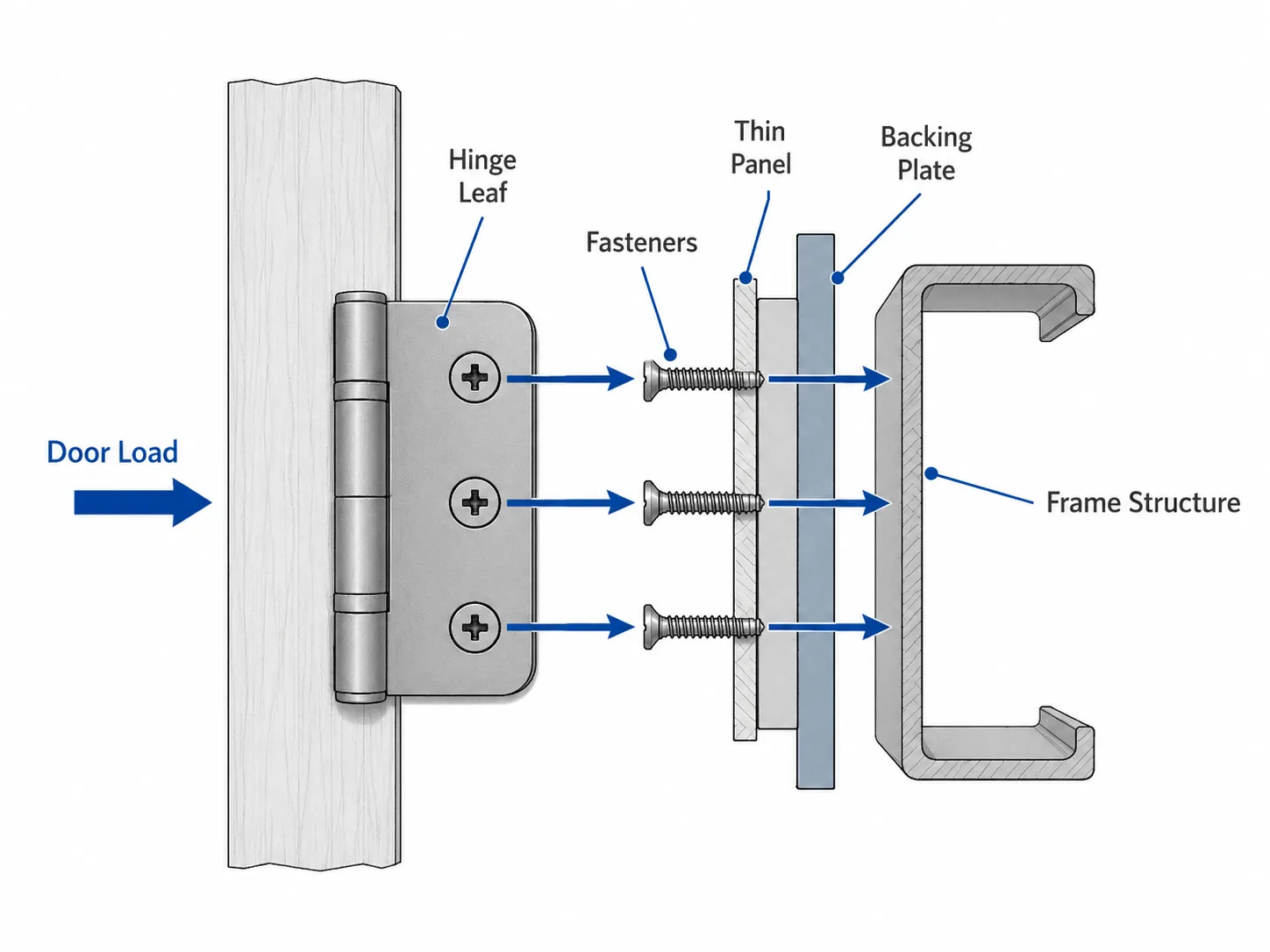
Why the Mounting Surface Fails Before the Hinge
A hinge does not hold a door by itself. It works as a bridge that carries the door’s weight into the frame, panel, or structure behind it. The weakest point in that load path is what fails first. On many industrial doors, equipment covers, and enclosure panels, that weak point is not the hinge body. It is the small area of material around each fastener.
The reason is load concentration. The door weight tries to pull the upper hinge fasteners out of their holes. Door width increases leverage. Repeated opening, closing, vibration, or impact adds movement. On a rigid steel frame, the surrounding material can usually carry that load. On thin sheet metal, soft composite, or unsupported panels, the local material around the screw holes may deform before the hinge reaches its rated limit.
Common Mounting Failure Modes
Fastener Pull-Out
The fastener pulls away from the panel under door load. Typical signs include loose hinges, visible gaps, and door sag.
Hole Elongation
Thin metal stretches around the screw holes. Round holes become oval and the hinge begins to shift.
Panel Tear-Out
The material cracks or tears around the mounting area. The hinge leaf starts lifting from the frame.
Thread Stripping
Screws crush or strip soft material. The screw turns but does not tighten.
Panel Flex
The mounting face bends when the door moves. The door shifts, binds, or loses alignment.
Load Path Break
The hinge is strong enough, but the structure behind it cannot transfer the load safely.
This is why hinge selection and mounting design should be reviewed together. The load you calculate for the hinge is also the load the mounting surface has to survive. If you have already used a heavy-duty hinge selection guide to estimate door load, the next question is whether the frame behind the hinge can actually carry that load.
Signs a Frame or Panel Needs Reinforcement
Some warning signs appear during the design stage. Others show up after installation as early field failures. Either way, they point to the same issue: the hinge mounting surface is not strong enough by itself.
Design-Stage Checks
- Thin sheet metal around the hinge zone
- Limited fastener thread engagement
- Soft or low-density substrate
- Heavy or wide door relative to the panel
- No structural member behind the hinge
Field Failure Signs
- Elongated mounting holes
- Screws that turn but do not tighten
- Visible flex at the hinge area
- Door sag after short service
- Hinge leaf lifting from the frame
For B2B projects, these checks should happen before the first production order. If the mounting surface is marginal, it is cheaper to add a plate during design than to repair torn panels after the product ships.
Reinforcement Options by Failure Risk
There are several ways to reinforce a hinge mount. The right choice depends on the substrate, door load, available space, and whether the joint needs to remain serviceable.
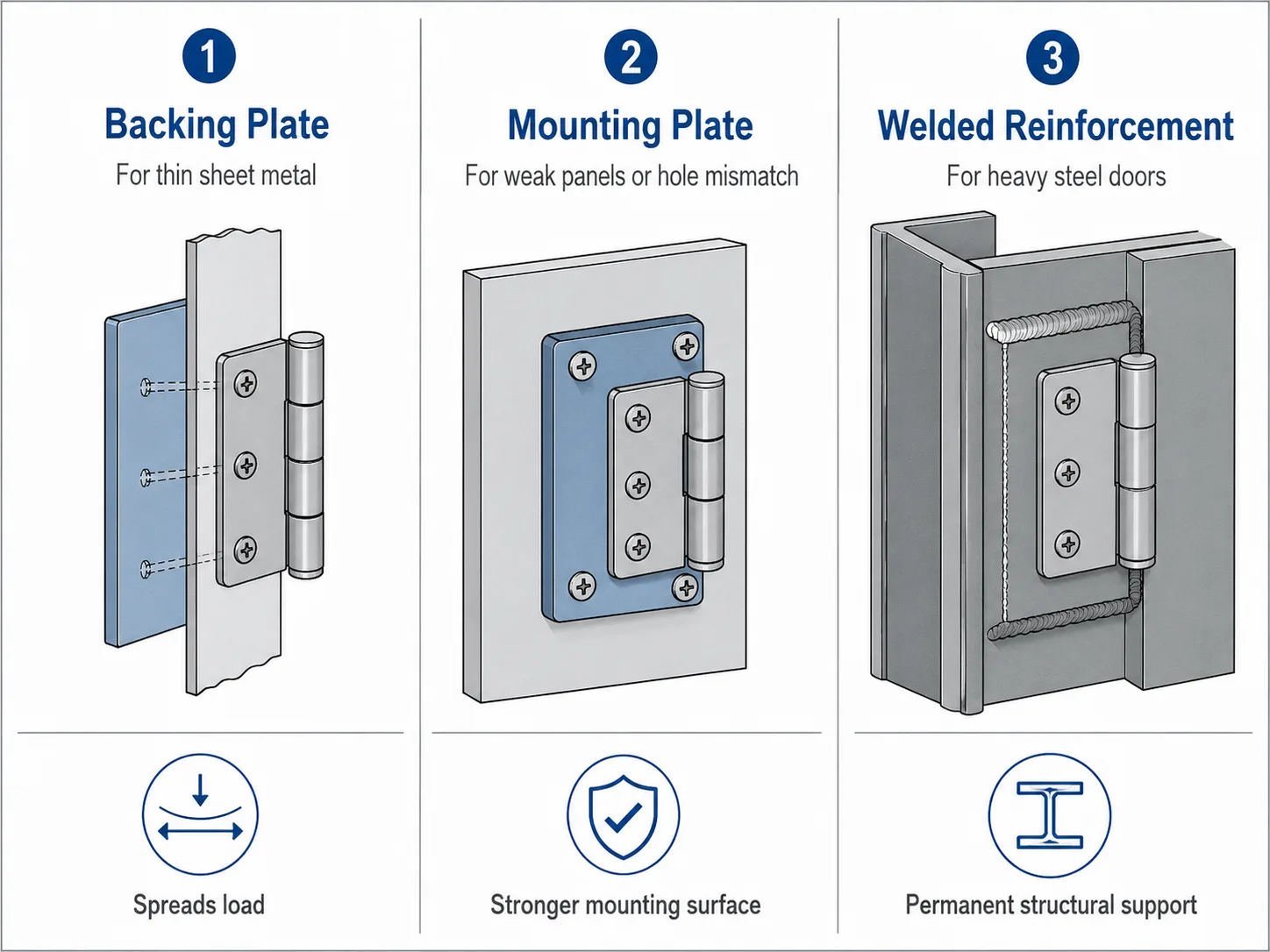
Backing Plate
Sits behind thin material so fasteners clamp through the skin into a stronger plate.
Best for: thin sheet metal, soft panels, composite skins.
Watch out: requires access to the back side of the panel.
Mounting Plate
Provides a thicker surface for the hinge to mount to, then attaches to the structure.
Best for: weak panels or non-matching hinge hole patterns.
Watch out: must be sized and attached correctly.
Welded Reinforcement
Adds a permanent steel plate, gusset, or reinforced frame area behind the hinge.
Best for: heavy steel doors and permanent industrial frames.
Watch out: welding heat and distortion must be controlled.
Threaded Insert
Adds stronger threads in thin aluminum, plastic, or composite panels.
Best for: panels where direct screws strip easily.
Structural Backing
Fasteners reach a stud, rail, tube, or internal frame member behind the skin.
Best for: doors with a real structural member near the hinge line.
The principle is the same in every case: spread the concentrated fastener load over more material and give the fasteners something solid to grip. Whether that solution is bolted, welded, or built into the frame depends on the door structure. The trade-offs between bolted and welded attachment are covered in our guide to weld-on vs bolt-on hinges.
Matching the Fix to the Substrate
The substrate matters because each material fails differently. A good reinforcement plan should match the failure mode of the material, not just the size of the hinge.
| Substrate | Common Failure | Better Fix |
|---|---|---|
| Thin sheet metal | Hole elongation, tear-out, panel flex | Backing plate or welded reinforcement behind the hinge |
| Steel frame | Local bending under heavy door load | Welded plate, gusset, or heavier hinge mounting zone |
| Wood or MDF | Thread stripping, splitting, screw loosening | Structural backing, larger plate, through-bolts, or inserts |
| Thin aluminum | Hole elongation and thread stripping | Backing plate, threaded insert, or thicker mounting pad |
| Plastic or composite | Crushing, cracking, or creep around fasteners | Backing plate, molded insert, load-spreading washer, or internal frame member |
| Insulated or sandwich panel | Skin separation, local crushing, poor fastener grip | Through-bolted plate, internal reinforcement, or structural insert |
Thin sheet metal is the most common case in industrial enclosures and cabinets. A backing plate on the inside face allows the fasteners to clamp the hinge and plate together with the thin skin between them. This spreads the pull-out load across the plate instead of concentrating it at each hole edge.
Wood, MDF, and some composites fail differently. They do not usually tear like thin metal; they crush, strip, or split around the screw threads. In those cases, the goal is to move the fastener load into something stronger, such as an internal frame rail, structural backing, threaded insert, or larger plate.
For aluminum, plastic, and composite panels, material compatibility also matters. The plate, hinge, and fasteners should be chosen so they do not create avoidable galvanic corrosion or long-term loosening in the operating environment.
Specifying a Hinge Mounting Plate
Once reinforcement is needed, the plate itself becomes part of the hinge specification. A plate that is too small, too thin, or poorly attached will not solve the problem. Review these details before ordering or fabricating the part.
Geometry
- Plate size larger than hinge footprint
- Hole pattern matched to hinge
- No interference with gasket or latch
Strength
- Enough thickness to resist bending
- Enough thread depth or clamp length
- Load spread beyond screw holes
Environment
- Material compatible with hinge and fasteners
- Finish matched to exposure
- Corrosion and galvanic risk reviewed
Do not treat the plate as an afterthought. A mounting plate changes the joint thickness, fastener length, hinge position, and sometimes the gasket or latch alignment. These details should be reviewed before production, especially on sealed enclosures, heavy access doors, and OEM equipment panels.
What to Send a Supplier for a Mounting Review
The best time to solve a mounting problem is before the hinge is made, not after the first door tears out on the assembly line. A capable hinge supplier can recommend a backing plate, a different hole pattern, a thicker hinge leaf, or a hinge designed to spread its load — but only if the mounting surface is part of the RFQ.
RFQ Checklist
- Door weight and width
- Substrate material
- Substrate thickness
- Hinge model or hole pattern
- Available mounting area
- Back-side access
- Structural member behind panel
- Indoor or outdoor environment
- Corrosion exposure
- Photos or drawings
With those details, a supplier can review the whole joint instead of quoting the hinge in isolation. This is especially important for thin-panel cabinets, heavy equipment doors, service access panels, and any custom door where the mounting surface is not a rigid frame.
Confirm the Mounting Before Ordering
A hinge, mounting plate, fastener, and frame should be treated as one system. If one part of that system is weaker than the rest, the door will fail at that weak point. Reinforcement is not needed on every project, but it should be reviewed whenever the door is heavy, wide, frequently used, mounted to thin material, or expected to survive vibration or outdoor exposure.
Request a Hinge Mounting Review
If you are working on a thin-panel door, non-standard frame, heavy access cover, or enclosure that has already shown fastener pull-out or door sag, HTAN can help review the hinge and mounting surface together.
Share the door size, door weight, substrate material, substrate thickness, hinge hole pattern, available mounting area, and photos or drawings. Request a hinge mounting review before the mounting surface becomes the weak link.
FAQs
When does a hinge need a mounting plate or backing plate?
A hinge needs a mounting plate or backing plate when the material behind the hinge cannot safely carry the pull-out and shear forces created by the door. Common warning signs include thin sheet metal, soft wood, plastic or composite panels, limited fastener engagement, elongated holes, visible panel flex, and doors that sag even when the hinge itself is correctly rated.
What is the difference between a mounting plate and a backing plate?
A backing plate sits behind thin material so the fasteners clamp through the hinge, panel, and plate, spreading the load over a wider area. A mounting plate is a stronger surface that the hinge mounts to directly, and that plate is then attached to the structure. In some designs, one plate can serve both functions.
How thick does sheet metal need to be to mount a hinge without reinforcement?
There is no single safe thickness because the answer depends on door weight, door width, fastener size, fastener count, thread engagement, and frame design. As a practical warning point, sheet metal around 2 mm or below should be reviewed carefully when the door is heavy, wide, frequently used, or mounted with limited fastener engagement.
Can a mounting plate fix a door that already sags or has stripped holes?
Sometimes. If the surrounding material is still sound, a backing plate or larger mounting plate can restore the joint by spreading load into fresh material. If the panel is torn, badly deformed, or cracked around the hinge area, the reinforcement must bridge beyond the damaged zone into solid structure. The hinge should also be checked because the mounting failure may have overloaded it.
What should I tell a hinge supplier about my mounting surface?
Send the door weight and width, substrate material, substrate thickness, hinge hole pattern, available mounting area, back-side access, whether a structural member sits behind the panel, and photos or drawings of the door and frame. This allows the supplier to recommend the hinge and reinforcement as one system instead of quoting the hinge alone.

 English
  한국어
한국어  Русский
  Español
  Italiano
  Deutsch
  Français
  Português