

Powder-Coated vs Stainless Steel Hinges: Industrial Selection Guide
Choosing between powder-coated steel hinges and stainless steel hinges is not only a cost decision. In industrial applications, the better choice depends on moisture exposure, corrosion risk, washdown frequency, coating damage, fastener compatibility, maintenance access, and expected service life.
Powder-coated steel hinges can work well on protected indoor cabinets, control panels, machine covers, and equipment doors where appearance, color matching, and budget matter. Stainless steel hinges are usually the safer choice for outdoor enclosures, washdown equipment, coastal cabinets, food processing equipment, chemical exposure, and applications where replacement labor is more expensive than the hinge itself.
This guide compares powder-coated steel and stainless steel hinges from an industrial selection perspective. It explains where each material makes sense, how corrosion starts, what buyers should check before approval, and how to avoid choosing a hinge that looks acceptable on day one but fails early in service.
If you are weighing carbon steel against stainless steel more broadly — including galvanised, zinc-plated, and bare-steel finishes — the carbon steel vs stainless steel hinge cost analysis covers the wider material comparison. This guide focuses specifically on powder-coated steel and how its coating failure mode changes the buying decision.
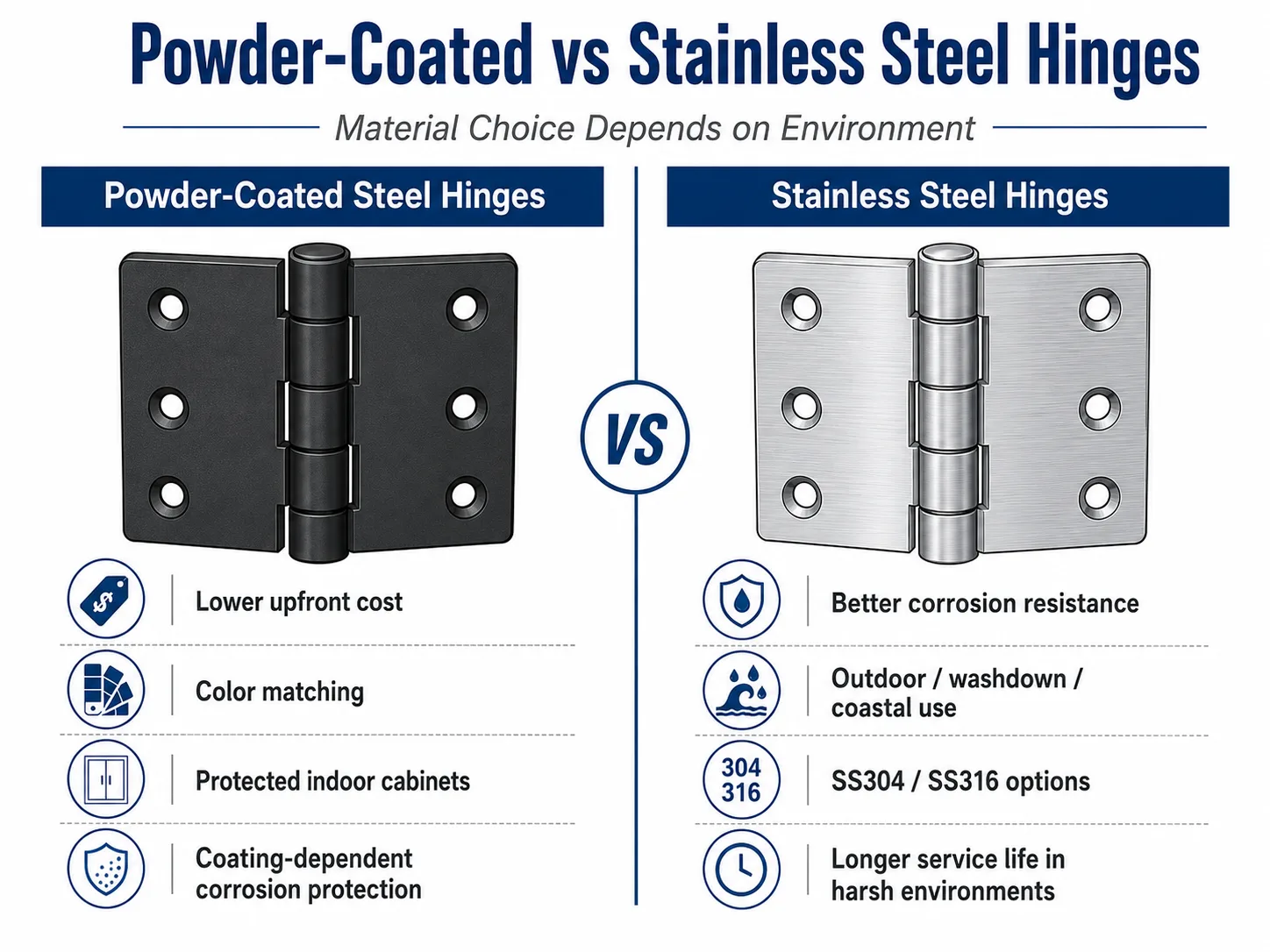
When Powder-Coated Steel Hinges Make Sense
Powder-coated steel hinges use a carbon steel base protected by a cured powder coating. The coating improves appearance, adds a protective barrier, and allows the hinge color to match the enclosure, cabinet, or equipment surface. For many indoor industrial applications, this can be a practical and cost-effective solution.
Powder-coated hinges are most suitable when the hinge is installed in a dry or protected environment, the coating is not likely to be scratched during installation, and the door does not require frequent washdown or chemical cleaning. Typical examples include indoor electrical cabinets, light-duty access panels, control boxes inside a facility, machine covers away from coolant spray, and budget-sensitive equipment doors.
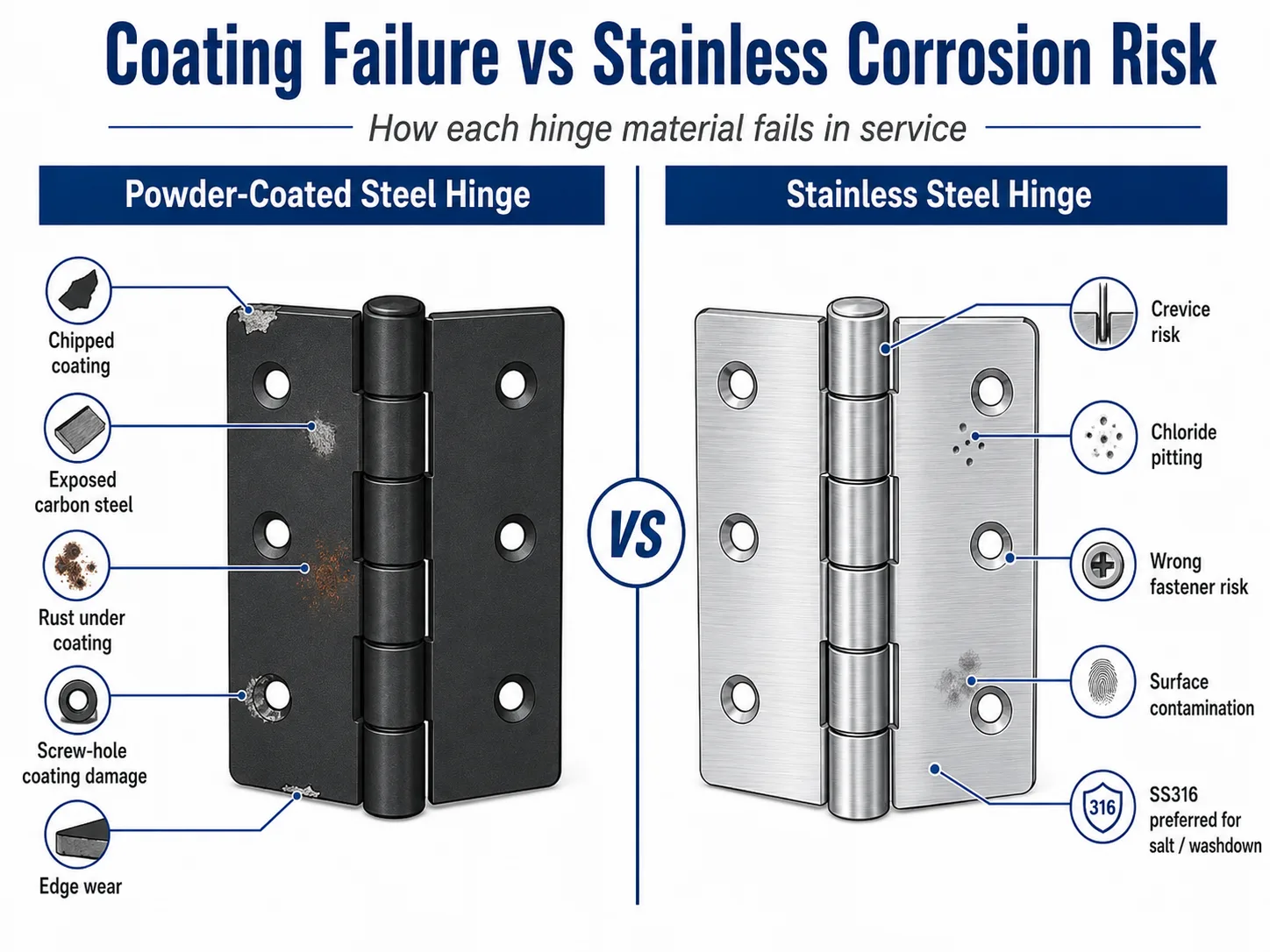
The main limitation is that corrosion protection depends on the coating remaining intact. If the coating chips at the edge, cracks around the screw hole, or wears at the hinge knuckle, moisture can reach the carbon steel underneath. Once that happens, rust can spread under the coating and become difficult to detect until the hinge begins to stain, bind, or loosen.
Best-Fit Applications for Powder-Coated Hinges
- Indoor control cabinets with limited moisture exposure
- Light-duty machine covers in dry production areas
- Equipment panels where color matching is important
- Protected storage cabinets or access panels
- Budget-sensitive applications with planned inspection intervals
For these applications, powder-coated steel can be a reasonable choice if the coating quality is specified clearly and the mounting hardware does not damage the finish during installation.
When Stainless Steel Hinges Are the Safer Choice
Stainless steel hinges use corrosion-resistant alloy material rather than relying only on an external coating. This makes them more reliable in environments where moisture, condensation, salt, chemicals, cleaning agents, or outdoor exposure can attack hinge surfaces and fastener areas.
SS304 stainless steel is often suitable for general indoor and inland outdoor industrial use. SS316 is usually the better choice for coastal sites, washdown equipment, marine cabinets, food processing machinery, chemical exposure, or areas where chloride-rich moisture may be present.
Stainless steel is not automatically maintenance-free. Poor fastener selection, crevice gaps, trapped moisture, surface contamination, or contact with dissimilar metals can still cause staining or pitting. If the project depends on stainless steel for long-term corrosion resistance, buyers should understand why stainless steel hinges can still corrode before assuming the material grade alone solves the problem.
Best-Fit Applications for Stainless Steel Hinges
- Outdoor electrical enclosures and control cabinets
- Coastal or salt-exposed equipment
- Food processing and washdown machinery
- Marine service panels and dockside cabinets
- Chemical processing equipment doors
- High-cycle access panels where early replacement would disrupt maintenance
For these applications, stainless steel usually reduces long-term service risk even when the initial purchase price is higher.
Corrosion Risk: Coating Failure vs Stainless Surface Protection
The biggest difference between powder-coated and stainless steel hinges is how each one resists corrosion. Powder-coated steel depends on a barrier layer. Stainless steel depends on the alloy’s surface behavior. Both can fail, but they fail in different ways, and accelerated tests such as ASTM B117 salt spray testing are the standard way to compare them under controlled conditions.
Powder-coated hinges usually fail first at edges, screw holes, hinge leaves, and contact points. These areas are more likely to be scratched, compressed, or exposed to moisture. If coating damage occurs during installation, the hinge may look acceptable at first but begin rusting later around fasteners or hidden contact surfaces.
Stainless steel hinges usually perform better in wet or corrosive environments, but they still require correct grade selection and clean installation. SS304 can stain or pit in chloride-rich environments, while SS316 gives stronger resistance for salt, washdown, and coastal exposure. In high-corrosion projects, material choice should be reviewed together with fasteners, washers, drainage, and surface finish.
| Corrosion Factor | Powder-Coated Steel Hinges | Stainless Steel Hinges |
|---|---|---|
| Protection method | External coating barrier | Corrosion-resistant alloy surface |
| Main weak point | Chipped coating, scratched edges, screw holes | Crevices, chloride exposure, poor fasteners |
| Indoor dry use | Good fit | Often more than required |
| Outdoor exposure | Depends heavily on coating quality and maintenance | Usually safer, especially with the right grade |
| Coastal or washdown use | High risk if coating is damaged | SS316 usually preferred |
| Repair after surface damage | Touch-up may be needed | Usually less dependent on coating repair |
Cost vs Service Life: What Buyers Should Compare
Powder-coated steel hinges usually have a lower purchase cost. Stainless steel hinges usually cost more upfront. However, industrial hinge selection should not compare only unit price. Buyers should also consider replacement labor, downtime, access difficulty, maintenance frequency, and the cost of a failed door or panel.
On a protected indoor cabinet, powder-coated steel may be the better value because the environment is controlled and replacement is simple. On an outdoor enclosure, washdown machine, or coastal cabinet, stainless steel may be more cost-effective over the life of the equipment because early rust, seized pins, or coating failure can lead to repeated service calls.
If the hinge supports a heavy door or a frequently opened access panel, the material decision should also be combined with load and cycle requirements. For heavier equipment doors, a heavy-duty hinge selection process based on door weight is more reliable than choosing a hinge only by coating or stainless grade.
Buyers Should Compare Total Cost, Not Only Unit Price
- Initial hinge price
- Installation labor
- Fastener and washer requirements
- Inspection and maintenance frequency
- Replacement difficulty
- Downtime risk if the door cannot open or close properly
- Corrosion impact on gasket compression, latch alignment, or service access
The best material choice is the one that matches the operating environment and service expectation, not the one with the lowest purchase price.
Application Selection Table
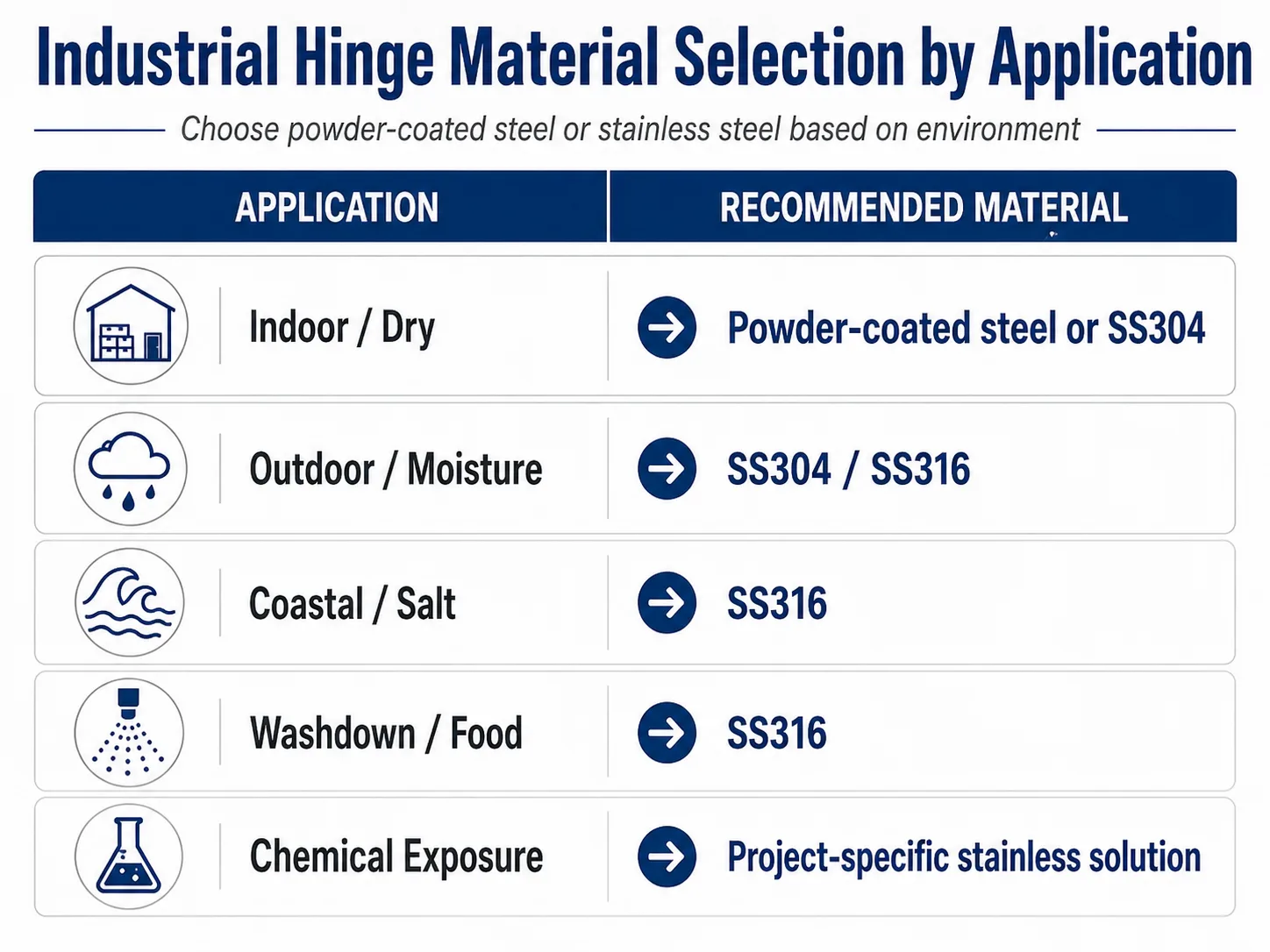
The table below gives a practical starting point for industrial buyers. Final selection should still consider door weight, hinge count, fastener compatibility, operating temperature, and maintenance conditions.
| Application | Recommended Direction | Why |
|---|---|---|
| Indoor electrical cabinet | Powder-coated steel or SS304 | Powder coating can work if the cabinet is protected from moisture |
| Outdoor industrial enclosure | SS304 or SS316 depending on exposure | Outdoor moisture increases rust risk around damaged coating |
| Coastal control cabinet | SS316 | Salt-laden air increases pitting and coating failure risk |
| Food processing equipment | SS316 with cleanable geometry | Washdown chemicals and hygiene requirements favor stainless construction |
| Machine cover in a dry workshop | Powder-coated steel | Good balance of appearance, cost, and indoor durability |
| Chemical or washdown enclosure | SS316 or project-specific stainless solution | Cleaning agents and trapped moisture can attack coatings and fasteners |
| Temporary or low-risk equipment panel | Powder-coated steel | Lower initial cost may be acceptable if failure consequence is low |
| Long-life OEM equipment door | Stainless steel if corrosion or access reliability matters | Replacement labor and downtime may outweigh initial cost savings |
For outdoor cabinets exposed to salt, hose-down cleaning, or corrosion-prone conditions, hinge material should be reviewed together with enclosure protection requirements. In these cases, NEMA 4X hinge selection is a better decision framework than simply asking whether powder coating or stainless steel looks better on the datasheet.
Common Mistakes When Comparing Powder-Coated and Stainless Hinges
Mistake 1: Assuming Powder Coating Is Rust-Proof
Powder coating can improve corrosion resistance, but it does not make carbon steel rust-proof. Once the coating is damaged, the base metal can corrode. This is especially important around screw holes, hinge edges, and moving contact points.
Mistake 2: Assuming All Stainless Steel Is Marine Grade
Not all stainless steel hinges perform the same way. SS304 and SS316 are not interchangeable in chloride-rich environments. If the hinge is used near saltwater, in washdown zones, or in chemical processing, the stainless grade should be specified clearly.
Mistake 3: Ignoring Fastener Compatibility
The hinge material is only one part of the corrosion system. Screws, washers, mounting plates, and the enclosure frame must also be compatible. Poor fastener selection can cause rust staining, galvanic corrosion, or loosening even when the hinge body is correctly specified.
Mistake 4: Looking Only at Purchase Price
Powder-coated steel may be cheaper at purchase, but if the hinge is difficult to replace or installed in a harsh environment, early failure can cost more than the original price difference. Buyers should compare total service cost, not only unit cost.
Final Recommendation
For protected indoor cabinets and dry equipment panels, powder-coated steel hinges can be a practical choice when color matching, cost, and moderate durability are the main priorities. For outdoor enclosures, washdown equipment, coastal cabinets, food processing machinery, or long-life OEM projects, stainless steel hinges are usually the safer choice.
As a simple rule: use powder-coated steel where the environment is controlled and coating damage is unlikely. Use SS304 for general stainless requirements in less aggressive environments. Use SS316 when salt, washdown chemicals, coastal air, or long-term corrosion resistance is part of the specification.
If the hinge is used on food processing or washdown equipment, material selection should also support cleanability and maintenance access. In those environments, food processing equipment hinge selection should consider stainless grade, surface geometry, fastener control, and cleaning procedure together.
FAQ
Are powder-coated steel hinges rust-proof?
No. Powder-coated steel hinges depend on the coating as a protective barrier. If the coating chips, scratches, or cracks around edges and screw holes, the steel underneath can rust.
Are stainless steel hinges always better than powder-coated hinges?
Not always. Stainless steel is usually better for wet, outdoor, coastal, or washdown environments. Powder-coated steel can still be a practical choice for protected indoor cabinets where color matching and lower cost matter.
Should I use SS304 or SS316 stainless steel hinges?
SS304 can work for many general indoor or inland outdoor applications. SS316 is usually preferred for coastal, marine, washdown, chemical, or chloride-rich environments where corrosion resistance is more demanding.
Can powder-coated hinges be used outdoors?
They can be used outdoors only when the exposure is mild and the coating is protected from damage. For frequent rain, salt exposure, washdown, or harsh industrial environments, stainless steel is usually safer.
What should buyers check before choosing between powder-coated and stainless hinges?
Buyers should check moisture exposure, corrosion risk, door weight, replacement difficulty, fastener compatibility, coating damage risk, washdown frequency, and expected service life before choosing the hinge material.
Need Help Choosing Hinge Material?
If your project requires hinges for outdoor cabinets, washdown equipment, industrial enclosures, coastal installations, or long-life OEM doors, HTAN can help review the application conditions before selection. Share your enclosure material, door size, exposure level, cleaning method, fastener preference, and service life expectation, and our engineering team can help recommend a powder-coated steel, SS304, or SS316 hinge direction.

 English
  한국어
한국어  Русский
  Español
  Italiano
  Deutsch
  Français
  Português