

10–20kg Heavy-Duty Torque Hinge Guide | No-Math Lookup Table
This page helps engineers quickly size heavy-duty torque hinges for 10–20kg industrial lids and access panels without doing full manual calculations. It is most useful for service doors, HMI covers, industrial control cabinets, and similar top-opening panels where smooth motion, one-hand usability, and safe free-stop positioning all matter.
For broader product categories and enclosure applications, see our heavy-duty hinges guide.
At the 10kg to 20kg (22–44 lbs) load class, a lid is no longer just a structural panel. It becomes a key part of the human-machine interface. Users expect motion that feels controlled, stable, and safe — not a lid that drops under gravity or fights back with excessive force.
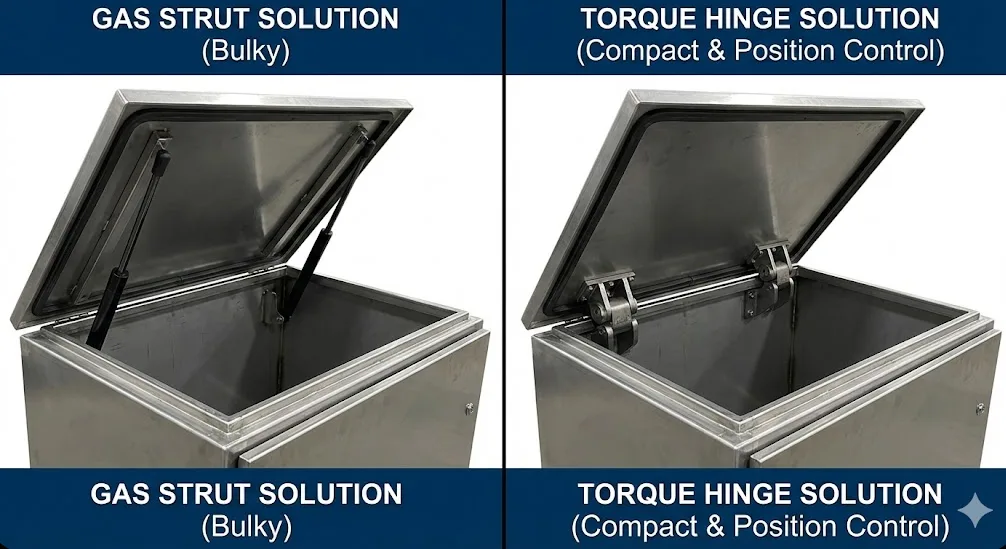
The common engineering trap at this load range is simple: teams either scale up standard hinges and end up with lids that slam shut, or they add bulky gas struts and lose internal space, clean packaging, and true infinite positioning.
- Safety risk: A 20kg lid falling freely under gravity can create severe pinch or crush hazards.
- Operational failure: Oversized torque makes the lid difficult to lift with one hand.
- Component damage: Poor control allows impact loads to reach sensitive internal electronics.
To help design teams bypass unnecessary calculation work, we built this No-Math Lookup Table. It is based on standard engineering assumptions, practical safety margins, and real industrial use logic. In under 30 seconds, it gives you a realistic starting torque target for most 10–20kg lids.
The Core Asset: 10–20kg Lid Torque Lookup Table
This lookup table is designed for fast preliminary sizing.
This table assumes:
- top-opening lid or access panel
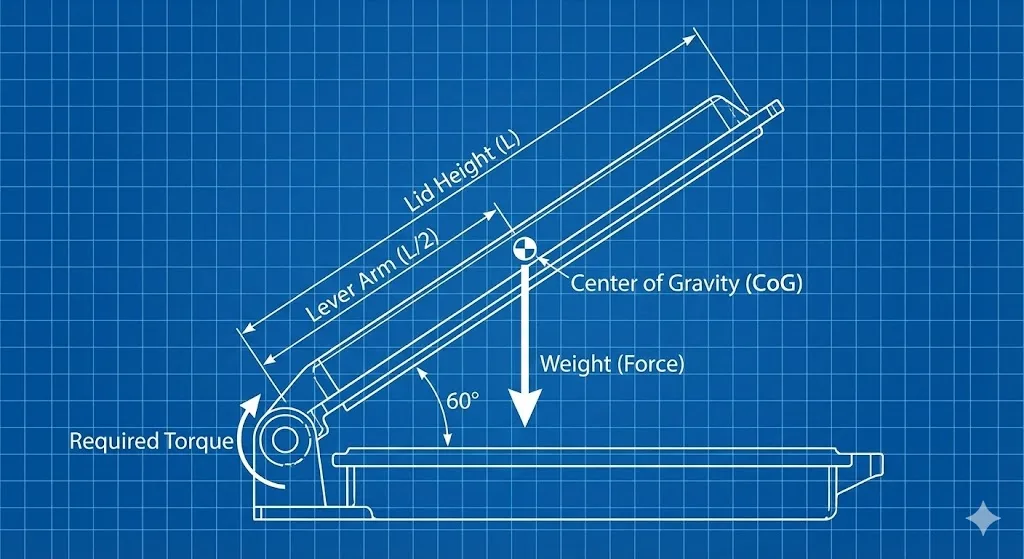
- center of gravity at 50% of lid length
- standard two-hinge layout
- 20% safety factor included
- normal industrial manual operation
Engineering logic: T = m × g × (L/2) × 1.2
How to use it: Find your lid height in the left column, then match it to the lid weight in the top row. The intersecting value is the recommended total system torque.
Heavy-Duty Torque Hinge Selection Matrix
| Lid Height (mm) \ Weight (kg) | 10 kg | 12 kg | 15 kg | 18 kg | 20 kg |
| 300 mm (CoG 0.15m) | 18 N·m | 22 N·m | 27 N·m | 32 N·m | 36 N·m |
| 400 mm (CoG 0.20m) | 24 N·m | 29 N·m | 36 N·m | 43 N·m | 48 N·m |
| 500 mm (CoG 0.25m) | 30 N·m | 36 N·m | 45 N·m | 53 N·m | 60 N·m |
| 600 mm (CoG 0.30m) | 36 N·m | 43 N·m | 53 N·m | 64 N·m | 72 N·m |
| 800 mm (CoG 0.40m) | 48 N·m | 57 N·m | 71 N·m | 85 N·m | 96 N·m |
Example: If your lid weighs 15kg and is 500mm long, the lookup table gives a recommended total torque of 45 N·m. In practice, that usually means two hinges rated at 22.5 N·m each, installed symmetrically.
Quick per-hinge reference for a two-hinge layout:
| Total Torque | Two-Hinge Setup | Per Hinge |
|---|---|---|
| 36 N·m | 2 hinges | 18 N·m each |
| 45 N·m | 2 hinges | 22.5 N·m each |
| 60 N·m | 2 hinges | 30 N·m each |
| 72 N·m | 2 hinges | 36 N·m each |
Why Add a 20% Safety Factor?
A common question is: if the theoretical torque is lower, why specify more? The answer is that real industrial lids do not operate under perfect static conditions.
- Torque decay: All friction-based hinges lose some output over time as internal surfaces wear.
- Dynamic loading: Operators rarely move a lid at perfect slow speed. Inertia creates overshoot and release instability.
- Thermal variation: Internal damping grease changes behavior with temperature, which can raise or lower resistance.
That is why the 20% rule is not padding. It is a practical reliability margin. If long-term torque fade is a major concern, review why torque hinges lose strength and how to prevent it.
Two Real-World 10–20kg Use Cases
Case 1: EV Charger Service Door
An outdoor EV charger service door weighs 12kg and has a lid height of 400mm. The lookup table gives a recommended total torque of 29 N·m.
- Practical setup: two 15 N·m hinges
- Why not use the exact minimum: outdoor environments often introduce corrosion, temperature variation, and seal drag
- Engineering note: for EV charger enclosure projects, corrosion resistance and repeatable holding force are just as important as nominal torque sizing
If your project is in EV charging infrastructure, connect this recommendation to your EVSE enclosure hinge page or related EV charger application page here.
Case 2: Control Cabinet or HMI Lid
A control cabinet or HMI service lid weighs 18kg and has a lid height of 600mm. The lookup table gives a recommended total torque of 64 N·m.
- Practical setup: two 32 N·m hinges
- User experience issue: if one-hand opening still feels too heavy, review asymmetric torque or assisted motion strategies
- Engineering note: this is a common range where torque hinges outperform oversized standard hinges but may still need evaluation against gas-assist concepts
Advanced Strategies for 10–20kg Loads
In this specific weight class, choosing “the biggest hinge available” is rarely the best answer. Good design balances holding performance, user effort, and internal packaging.
Solution A: Asymmetric Torque
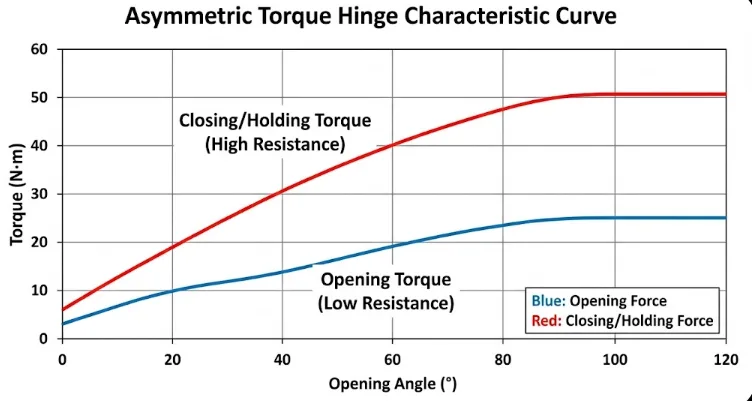
If a 20kg lid uses equal resistance in both directions, the user may struggle to open it comfortably. In these cases, asymmetric torque is often the better engineering choice.
- Opening direction: lower resistance to reduce user effort
- Closing direction: higher resistance to oppose gravity and maintain free-stop control
Solution B: Dual-Hinge Configuration
For lids wider than 600mm, a single large hinge is usually a poor idea. It concentrates stress in one area, increases mounting risk, and can distort motion quality.
The preferred fix is a dual-hinge layout. If the required total torque is 50 N·m, two 25 N·m hinges are usually better than one 50 N·m hinge because the load is distributed more evenly and the lid rotates more smoothly.
For a broader comparison between compact torque-based control and assist systems, see torque hinges vs gas springs vs springs.
When This Lookup Table Is Not Enough
This lookup table covers most standard 10–20kg lid applications, but it is not a substitute for full engineering analysis in every situation.
- Shifted center of gravity: If the lid carries a monitor, fan, handle, or internal mounted component, the real lever arm may be much larger than assumed.
- Negative or over-travel angles: If the lid must hold below horizontal or beyond a high opening angle, the gravity moment changes and the lookup values may no longer apply.
- High-vibration mobile equipment: Static holding force alone may not resist real vibration loads in vehicles or moving equipment.
- Very wide lids or off-center loads: Large panel width can create torsion and uneven hinge loading that the simple table does not capture.
If your project falls into one of these categories, use a more detailed calculation route instead of relying on the quick lookup alone. For deeper sizing logic and more complete formulas, see our torque hinge selection guide.
Frequently Asked Questions (FAQ)
Q1: How many torque hinges should I install on a 15kg lid?
Recommendation: two.
Besides sharing the mechanical load, dual mounting reduces lid twist during motion and helps the friction system wear more evenly. In most industrial 10–20kg lids, two hinges are the standard baseline.
Q2: Why not use a standard hinge with a gas strut?
Standard hinges with gas struts often provide lift assistance or soft-close behavior, but they do not always deliver true position control at intermediate angles. Gas struts also occupy more internal volume and introduce seal-life considerations. Torque hinges are more compact and better suited to free-stop behavior in many enclosure designs.
Q3: What material should I choose for outdoor cabinets?
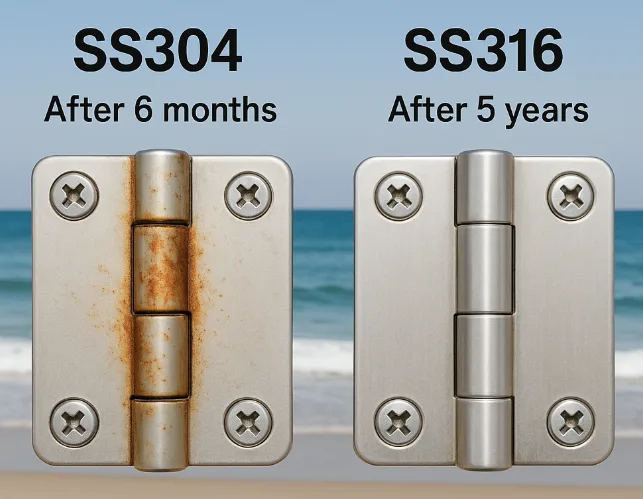
Standard zinc-plated carbon steel is usually not enough for outdoor industrial environments. For long-term reliability, use stainless steel or a properly protected hardened-steel construction with corrosion-resistant finishing and wide-temperature grease.
Q4: Can a 20kg lid use only one heavy-duty torque hinge?
Technically, sometimes yes. In practice, usually no. For lids wider than about 600mm, a single hinge creates poor load distribution, higher localized stress, and less stable motion. A two-hinge layout generally delivers better alignment, smoother operation, and longer service life.
Conclusion
Selecting the right heavy-duty torque hinge for a 10–20kg lid is not just a sizing exercise. It is a safety, usability, and reliability decision.
Used correctly, the lookup table on this page can eliminate unnecessary guesswork and give your team a fast, practical starting point. Used blindly, without checking CoG shift, angle extremes, or vibration, it can still lead to incorrect selection.
The safest workflow is:
- Use the lookup table for fast first-pass sizing
- Confirm whether your project fits the standard assumptions
- Upgrade to detailed calculation or hybrid strategy if needed
If you are unsure whether your lid fits the quick-lookup assumptions, contact our engineering team for project-specific support.


 English
  한국어
한국어  Русский
  Español
  Italiano
  Deutsch
  Français
  Português