

Tool-Free Lift-Off Hinges: 3-A vs EHEDG Sanitation Guide
In food, dairy, beverage, and sanitary equipment, a hinge can become a cleaning problem when operators cannot easily access the area behind the door or panel. A fixed hinge may look acceptable during installation, but daily sanitation can expose hidden risks: trapped residue, difficult wipe-down areas, corrosion around the pin, skipped cleaning steps, and longer equipment downtime.
Tool-free lift-off hinges for daily sanitation are used when doors, covers, or access panels must be removed quickly for cleaning without loose tools. The goal is not only faster removal. The goal is to make the sanitation task repeatable, inspectable, and realistic for operators working under daily cleaning schedules.
This guide focuses on one specific decision: when a sanitary equipment project should use a tool-free lift-off hinge, and how 3-A or EHEDG expectations may affect hinge selection, documentation, cleanability review, and supplier approval. It does not replace the broader hygienic equipment design process or a full certification review.
Daily sanitation is only one part of sanitary equipment hardware selection. If the project also involves washdown exposure, cleaning residue, lubricant control, and production access across the whole machine, the broader food processing equipment hinge selection should be reviewed before final approval. If the equipment is installed inside an ISO-classified cleanroom rather than a food production line, the cleanroom cabinet hinge guide covers the tool-free access requirements for controlled-environment cabinets, which follow a different cleanability logic than daily food-equipment sanitation.
Why Daily Sanitation Changes the Hinge Decision
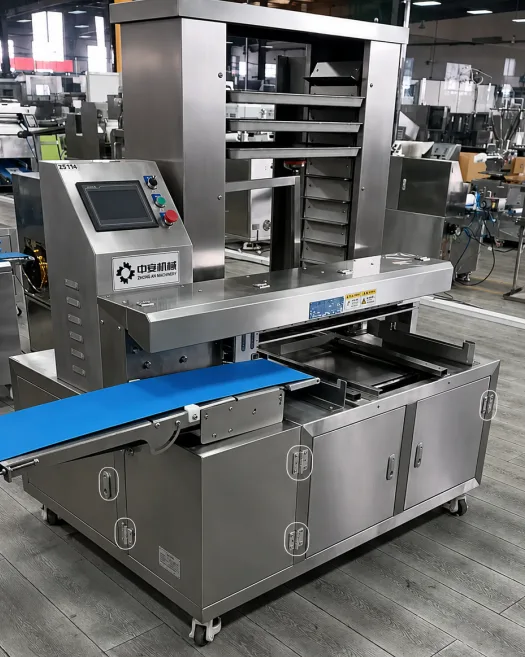
A hinge used on a dry equipment cabinet does not face the same duty as a hinge used on a door that must be removed, cleaned, inspected, and reinstalled every day. In sanitary equipment, the hinge must support both mechanical performance and sanitation workflow.
When the hinge is hard to remove, requires a tool, traps residue behind the mounting leaf, or becomes difficult to reinstall, operators may spend more time cleaning or skip the removal step altogether. That turns a small hardware decision into a sanitation risk.
For OEM engineers and plant teams, the first question should not be “Is this hinge removable?” The better question is: “Can the sanitation team remove, clean, inspect, and reinstall this hinge consistently without damaging the door, losing parts, or extending downtime?”
The Failure Chain: Fixed Hinge → Hidden Residue → Cleaning Delay
The failure chain usually starts with access. A fixed hinge or poorly designed removable hinge can create a hidden area behind the door, around the pin, or between the hinge leaf and the panel. If operators cannot reach that area easily, residue and moisture can remain after cleaning.
The problem can then move through the equipment workflow:
- Hinge area is difficult to access during daily sanitation.
- Operators spend extra time cleaning or skip full removal.
- Residue, moisture, or cleaning chemical remains around the hinge area.
- Corrosion, staining, wear, or hard-to-inspect gaps appear over time.
- Cleaning time increases, inspection confidence drops, and maintenance work becomes more frequent.
A tool-free lift-off hinge can reduce this risk only when the design is truly easy to remove, easy to clean, and easy to reinstall. If removal requires force, creates loose parts, or changes door alignment after reassembly, the hinge may create a different maintenance problem.
Where 3-A and EHEDG Affect Hinge Selection
3-A and EHEDG are often used as hygienic design references or certification expectations in sanitary equipment projects. The exact requirement depends on the equipment type, customer specification, market, certification scope, and whether the hinge is part of a product-contact or non-product-contact area. The hygienic design fundamentals behind both frameworks — drainability, cleanable geometry, and avoidance of dead spaces — are described in the publicly referenced EHEDG hygienic design principles (Guideline 8), which is a useful baseline before reviewing any specific hinge.
For hinge selection, the practical difference is not just “US vs Europe.” Buyers should focus on what the project must prove: hygienic design, cleanability, inspectability, documentation, and operator access. A hinge that looks sanitary on a drawing may still fail the user’s daily cleaning process if it is difficult to remove or creates hidden residue points.
| Selection Question | 3-A-Oriented Review | EHEDG-Oriented Review |
|---|---|---|
| Is the hinge easy to clean? | Review hygienic design details, exposed gaps, mounting surfaces, and documentation expectations | Review cleanability, residue retention risk, and test or validation expectations when required |
| Can the door be removed without tools? | Confirm tool-free removal supports the sanitation procedure and does not create loose parts | Confirm removal and reassembly can be repeated without hidden contamination risk |
| Is the material suitable for wet cleaning? | Verify stainless grade, surface finish, and compatibility with the equipment environment | Verify material, finish, and cleanable geometry against the cleaning method |
| What documents should the supplier provide? | Material evidence, drawing details, finish description, and project-specific compliance documents | Cleanability evidence, design review, material evidence, and project-specific documentation |
| What should the buyer avoid? | Hidden threads, hard-to-clean recesses, unclear material claims, and tool-dependent removal | Dead spots, inaccessible hinge zones, rough surfaces, and unverified cleaning access |
The safest approach is to ask the customer or certifying body what evidence is required for the specific equipment. Do not assume that a generic “hygienic hinge” label is enough for a sanitary equipment project.
What OEM Buyers Should Verify Before Approval
Tool-free lift-off hinge approval should focus on the real cleaning workflow. A hinge that removes easily during a sales demonstration may still fail in production if it binds after installation, traps residue behind the mounting plate, or requires careful alignment that operators cannot repeat every day.
| Approval Item | What to Check | Why It Matters |
|---|---|---|
| Tool-free removal | Can the door or panel be removed without loose tools? | Supports daily sanitation and reduces skipped cleaning steps |
| Reinstallation repeatability | Does the door return to the same alignment after removal? | Prevents latch problems, seal gaps, and operator frustration |
| Cleanable hinge geometry | Are pin areas, mounting leaves, and gaps easy to wipe and inspect? | Reduces residue retention and hidden cleaning risks |
| Material and finish | Is the hinge material suitable for wet, chemical, or washdown conditions? | Prevents corrosion, staining, and premature wear |
| Loose parts control | Can pins, washers, or small parts fall into the process area? | Reduces foreign material and maintenance risks |
| Operator handling | Can sanitation staff remove and reinstall the hinge safely and consistently? | Ensures the design works in daily practice, not only in engineering review |
| Supplier documentation | Can the supplier provide drawing, material, finish, and compliance evidence? | Supports customer approval, audit readiness, and purchasing control |
If the project only needs a general removable-door mechanism, the standard lift-off hinge selection process may be enough. If the door is removed as part of a validated or daily sanitation process, the hinge must also be reviewed for cleaning access, residue control, material compatibility, and operator repeatability.
Daily Sanitation Application Matrix
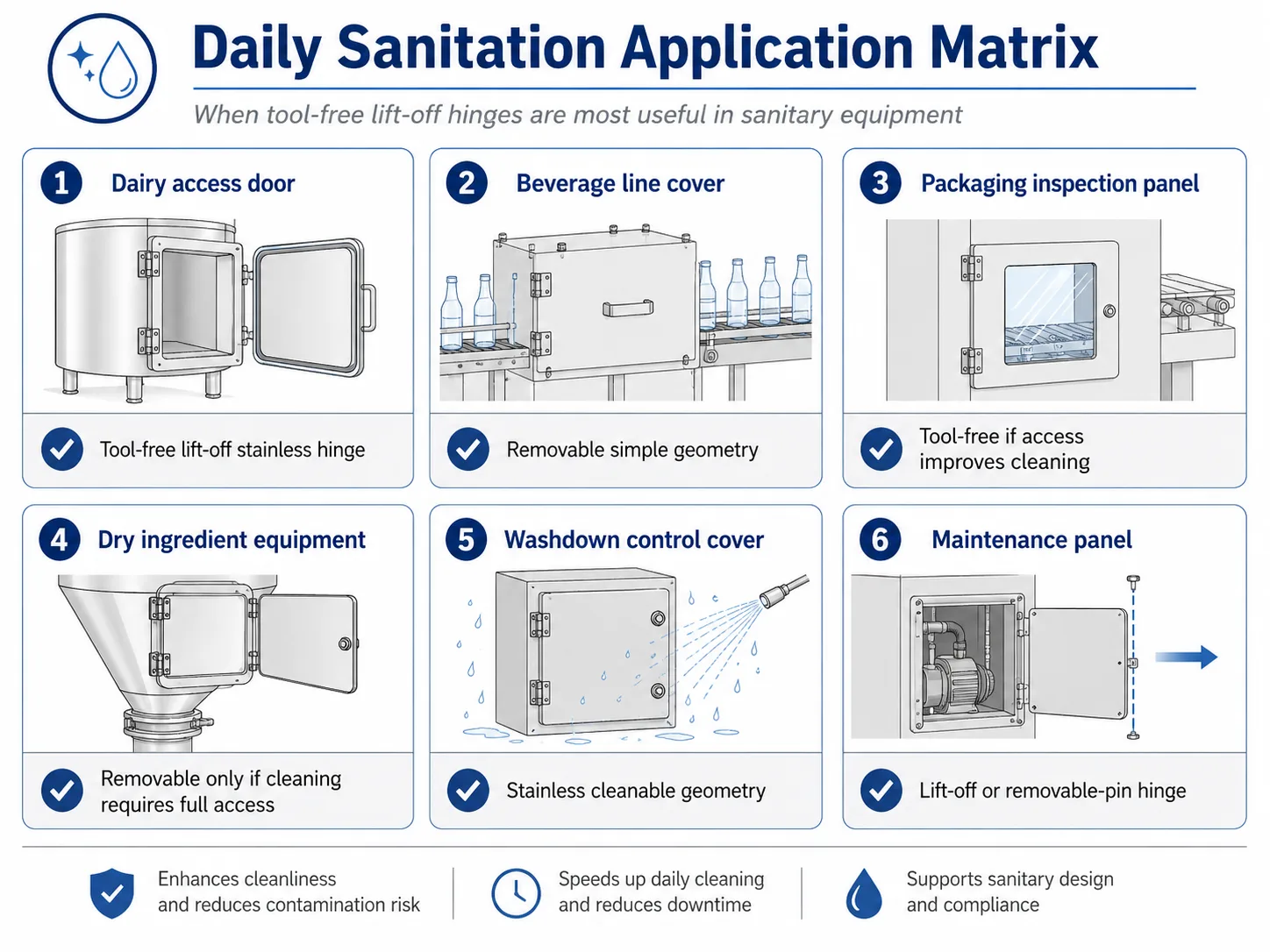
The table below helps separate applications where tool-free lift-off hinges are strongly useful from those where a fixed or semi-removable hinge may still be acceptable.
| Application | Sanitation Need | Recommended Hinge Direction | What to Confirm |
|---|---|---|---|
| Dairy equipment access door | Frequent cleaning around wet product zones | Tool-free lift-off stainless hinge | Material grade, cleanable gaps, removal procedure |
| Beverage line guard or cover | Fast access for wipe-down and inspection | Lift-off or removable hinge with simple geometry | No hidden residue area behind the hinge leaf |
| Packaging line inspection panel | Daily visual inspection, lower washdown exposure | Tool-free hinge if removal improves access | Door alignment after repeated removal |
| Powder or dry ingredient equipment | Dust removal and residue inspection | Removable hinge only if cleaning procedure requires full access | Dust traps, hinge clearance, easy wipe-down |
| Washdown-adjacent control cover | Moisture exposure and cleaning splash | Stainless hinge with cleanable geometry | Drainage, material compatibility, fastener selection |
| Tooling or maintenance panel | Periodic removal, not daily sanitation | Lift-off hinge or removable-pin hinge depending on service needs | Safe handling, clearance, and reinstallation repeatability |
Food, dairy, beverage, and pharmaceutical applications may all require cleanable hardware, but the compliance context is not the same. If the project is primarily a pharmaceutical or cleanroom cabinet application, pharmaceutical equipment cabinet hinge selection should be reviewed separately because disinfectant exposure, audit language, and cabinet cleanability expectations may differ from food equipment sanitation.
Common Mistakes When Choosing Tool-Free Lift-Off Hinges
Mistake 1: Assuming Removable Means Sanitary
A hinge can be removable but still difficult to clean. If the hinge leaves, pin area, mounting holes, or stop surfaces create hidden residue zones, tool-free removal alone does not solve the sanitation problem.
Mistake 2: Ignoring Operator Behavior
If the door is heavy, awkward, or hard to reinstall, sanitation teams may avoid removing it every day. A hygienic design must work for the people who perform the cleaning task, not only for the engineer who selected the hinge.
Mistake 3: Using Unclear Material Claims
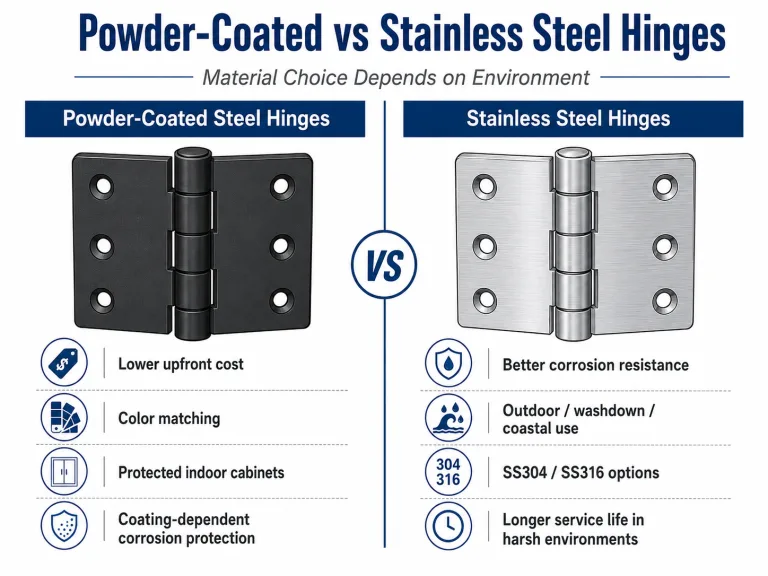
“Stainless steel” is not enough as a purchasing specification. Buyers should confirm the stainless grade, surface finish, fastener compatibility, and expected cleaning environment before approving the hinge sample.
In wet or chemical-cleaning environments, stainless steel hinges should still be reviewed for crevices, trapped moisture, and fastener compatibility. Buyers should understand why stainless steel hinges can still corrode before assuming stainless material alone is enough for daily sanitation.
Mistake 4: Overlooking Reinstallation Alignment
After a door is lifted off for cleaning, it must return to the correct position. Poor reinstallation repeatability can create latch problems, rubbing, seal gaps, or operator frustration during every sanitation cycle.
Mistake 5: Treating 3-A or EHEDG as a Simple Label
A label or claim is not enough by itself. Buyers should confirm the certification scope, equipment context, documentation, material, surface finish, and whether the hinge design supports the actual sanitation procedure used on site.
What to Send a Hinge Supplier Before Selection
To recommend the right tool-free lift-off hinge, the supplier needs to understand both the equipment design and the sanitation procedure. A simple request for “hygienic lift-off hinge” is usually not enough.
- Equipment type: dairy, beverage, packaging, washdown, dry ingredient, or sanitary access panel
- Door or cover size, weight, and removal frequency
- Cleaning method: wipe-down, washdown, manual removal, or validated cleaning procedure
- Cleaning chemicals or sanitation environment, if known
- Required market or customer expectation: 3-A, EHEDG, internal hygiene standard, or buyer-specific specification
- Required stainless grade and surface finish, if already specified
- Whether the hinge area is product-contact, splash-zone, or non-product-contact
- Need for loose-parts control during removal
- Required documentation: drawing, material certificate, finish description, or cleanability evidence
- Installation constraints, clearance, and reinstallation alignment requirements
Providing these details helps the supplier recommend a hinge that supports the actual sanitation task instead of offering a generic removable hinge that may not meet the equipment’s cleaning needs.
Final Recommendation
Use tool-free lift-off hinges when daily sanitation requires fast, repeatable access behind doors, covers, or panels. The hinge should be easy to remove, easy to clean, easy to inspect, and easy to reinstall without changing door alignment or creating loose-parts risk.
For 3-A or EHEDG-related projects, do not rely on generic claims. Confirm the project’s actual requirement, certification scope, documentation expectations, material grade, surface finish, and cleaning workflow. The best hinge is not simply the most sanitary-looking design. It is the design that sanitation teams can use correctly every day while still supporting equipment reliability and customer approval.
FAQ
Are tool-free lift-off hinges required for daily sanitation?
They are not automatically required for every sanitary equipment design, but they can be useful when doors or panels must be removed frequently for cleaning, inspection, or residue control. The requirement depends on the equipment design, cleaning procedure, customer specification, and compliance expectations.
What is the main advantage of tool-free lift-off hinges in food equipment?
The main advantage is repeatable access for cleaning. A tool-free lift-off hinge can help operators remove a door or panel without tools, clean behind the hinge area, inspect residue-prone zones, and reinstall the door more efficiently.
Can one hinge meet both 3-A and EHEDG expectations?
It may be possible, but it depends on the design, certification scope, material, surface finish, cleanability evidence, and customer requirement. Buyers should confirm the specific project requirement instead of assuming one generic hygienic hinge covers both.
What should buyers check before approving a hygienic lift-off hinge?
Buyers should check tool-free removal, cleanable geometry, reinstallation alignment, stainless grade, surface finish, loose-parts control, corrosion resistance, supplier documentation, and whether the design supports the actual sanitation procedure.
Are stainless steel lift-off hinges always hygienic?
No. Stainless steel helps with corrosion resistance and cleanability, but the hinge can still create hygiene risks if it has hidden crevices, rough surfaces, trapped moisture, incompatible fasteners, or a design that operators cannot remove and reinstall consistently.
Need Help Selecting Tool-Free Lift-Off Hinges for Daily Sanitation?
If your project involves food equipment, dairy equipment, beverage lines, sanitary access panels, or daily cleaning procedures, HTAN can help review the door design, cleaning workflow, stainless material, surface finish, removal method, and documentation needs before hinge selection. Share your equipment type, cleaning method, door size, sanitation frequency, market requirements, and preferred hinge structure, and our engineering team can help recommend a tool-free lift-off hinge direction for your application.

 English
  한국어
한국어  Русский
  Español
  Italiano
  Deutsch
  Français
  Português