

Cleanroom Cabinet Hinges: Stainless Steel & Tool-Free Access
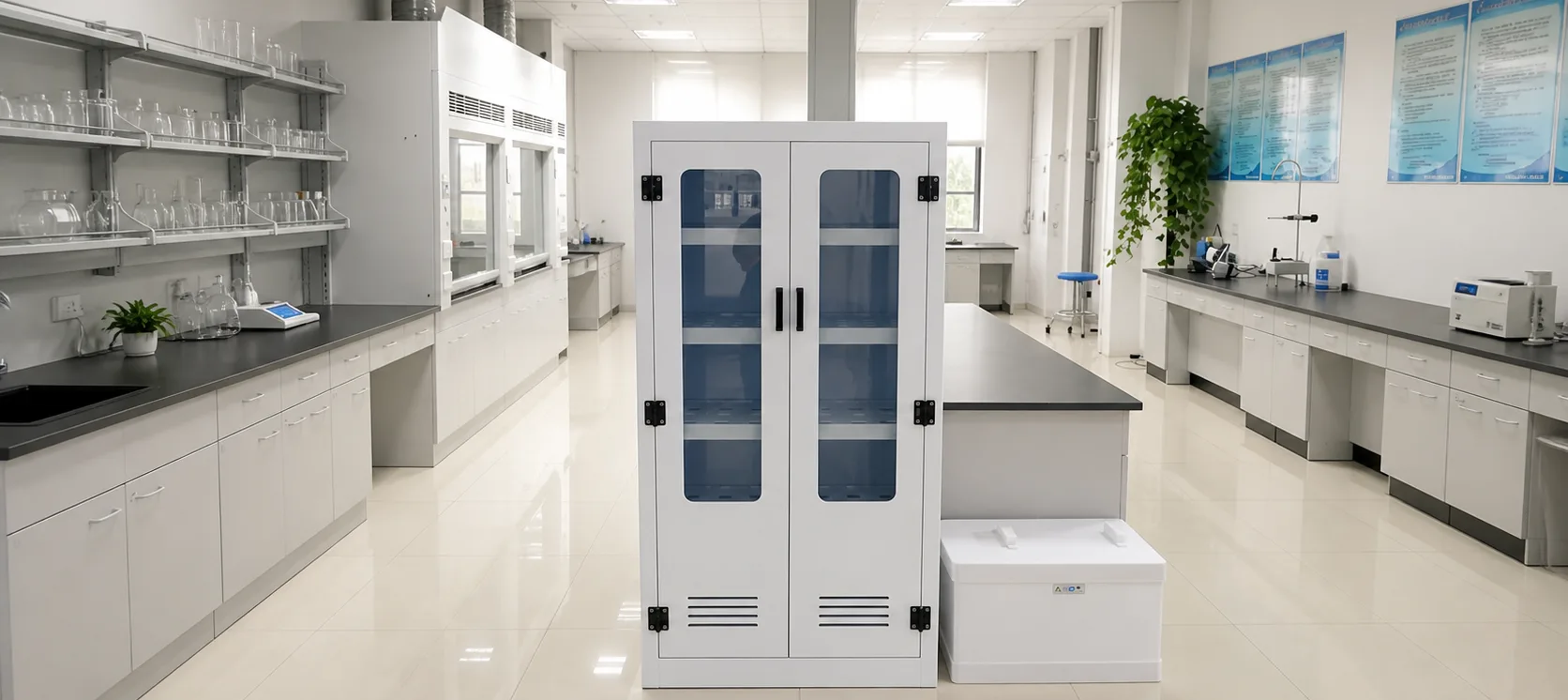
Cleanroom cabinet hinges should be selected for more than basic door movement. In pharmaceutical cleanrooms, medical equipment rooms, laboratory storage areas, electronics manufacturing zones, and controlled assembly environments, the hinge can affect cleanability, particle control, corrosion resistance, maintenance access, and long-term contamination risk.
A hinge with exposed crevices, loose fasteners, rough surfaces, or poor corrosion resistance can become a hidden contamination point. Even when the cabinet door works mechanically, the hinge area may still collect residue, trap cleaning agents, shed particles, or make maintenance procedures slower than necessary.
This guide explains how to evaluate cleanroom cabinet hinges based on four practical requirements: smooth cleanable surfaces, stainless steel material selection, tool-free or captive-access design, and contamination control. For projects where cabinet hinges must be evaluated together with locks, handles, seals, and enclosure structure, the broader enclosure hardware decision should be reviewed as one system.
Why Cleanroom Cabinet Hinges Need a Different Design Approach
Cleanroom cabinets are different from ordinary industrial storage cabinets. Their hardware is exposed to cleaning routines, disinfectants, controlled airflow, glove contact, inspection procedures, and sometimes strict documentation requirements. A hinge that is acceptable in a general workshop may not be suitable for a cabinet inside a controlled environment.
The most important question is not only whether the hinge can support the door. Engineers and maintenance teams should also ask whether the hinge can be cleaned effectively, whether it creates particle traps, whether the material resists repeated cleaning, and whether the door can be opened or serviced without increasing contamination risk.
For this reason, cleanroom cabinet hinge selection should be reviewed together with the cabinet surface finish, cleaning procedure, access frequency, stainless steel grade, fastener design, and the surrounding controlled environment.
Cleanable Surface Design and Contamination Control
Smooth Surfaces and Reduced Crevices
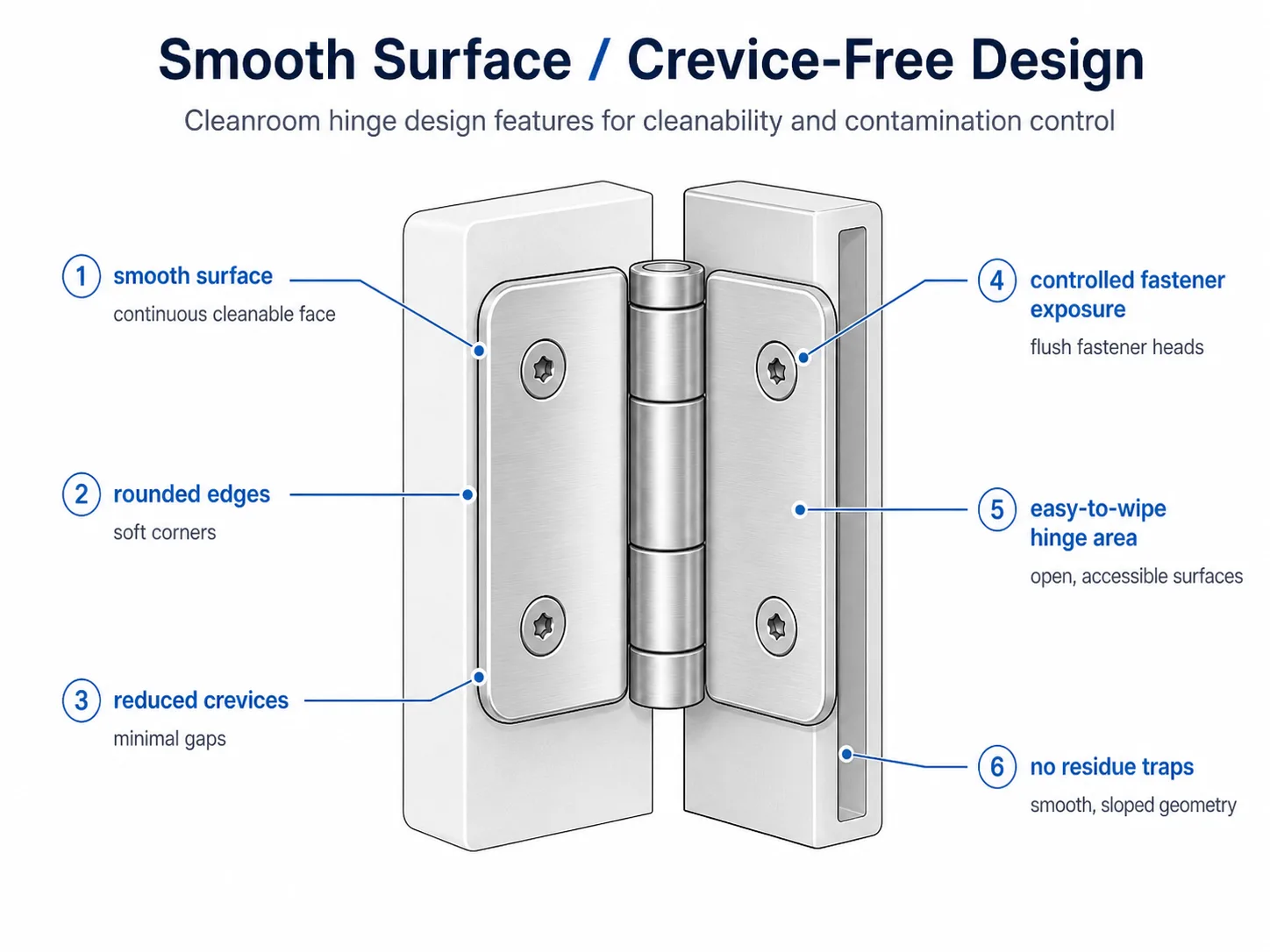
The hinge area should be easy to wipe, inspect, and keep free of residue. Smooth surfaces, rounded edges, minimal gaps, and controlled fastener exposure can reduce the number of places where dust, particles, disinfectant residue, or biological contamination may collect.
In cleanroom cabinet design, small details matter. A hinge knuckle with exposed gaps, a rough stamped edge, or a screw head that traps residue may create more cleaning difficulty than the hinge body itself. When the cabinet is used in pharmaceutical, medical, laboratory, or electronics environments, the hinge should support the cleaning process instead of becoming a maintenance burden.
If the cabinet door needs to be opened or serviced for cleaning or inspection, the hinge design should be evaluated as part of the full cleaning procedure, not only as a general convenience feature.
Particle, Dust, and Residue Control
Cleanroom hinge selection should consider how the hinge behaves during repeated opening, cleaning, and inspection. Poorly finished surfaces, loose hardware, dry rubbing points, or worn components may contribute to particle generation over time. The goal is to reduce avoidable particle sources and make the hinge area easier to inspect.
For cleanroom cabinets, the best design is usually the one that limits exposed friction points, avoids unnecessary cavities, keeps fasteners controlled, and allows maintenance teams to verify cleanliness visually. A compact hinge may look cleaner from the outside, but it still needs to be checked for hidden gaps or cleaning blind spots.
Why Exposed Threads and Loose Fasteners Create Cleaning Risks
Exposed threads, removable screws, and loose washers can increase cleaning risk because they create small areas where residue may collect. In controlled environments, captive fasteners or tool-free release designs may reduce loose hardware during maintenance, but they still need to be designed so that latch points, release buttons, and hinge interfaces remain cleanable.
Tool-free access is valuable only when it supports a controlled cleaning or maintenance process. If the release mechanism adds hidden cavities or difficult-to-wipe surfaces, it may create a new contamination concern. The design should balance access speed with cleanability, inspection, and repeatable use.
Stainless Steel Material Selection for Cleanroom Cabinets
When 304 Stainless Steel May Be Enough
304 stainless steel may be suitable for cleanroom cabinets used in lower-corrosion environments, dry controlled spaces, or applications with mild cleaning agents. It can provide a clean appearance, reasonable corrosion resistance, and good mechanical strength for many indoor cabinet doors.
However, the final choice should not be based on stainless steel grade alone. Cleaning chemistry, exposure frequency, humidity, door weight, fasteners, and surrounding frame material all affect long-term performance. A 304 stainless hinge used with incompatible screws or harsh disinfectants may still develop staining or surface damage over time.
In projects where coated steel is being compared with stainless steel, the final decision should not stop at material cost. The real question is whether stainless steel material choices are needed to support cleaning, corrosion resistance, and long-term maintenance expectations.
When 316L Stainless Steel Is Safer
316L stainless steel is usually safer when the cabinet is exposed to stronger disinfectants, chloride-containing cleaners, high humidity, frequent wipe-down procedures, or more demanding hygiene requirements. The lower carbon content and molybdenum addition help improve corrosion resistance in more aggressive environments.
For cleanroom hinges, corrosion is not only a visual problem. Surface staining, pitting, or roughness can create cleaning difficulty and increase contamination risk. If the hinge is used near disinfectant residues, wet cleaning routines, or sensitive medical and pharmaceutical equipment, 316L is often the more conservative choice.
When the hinge must tolerate severe disinfectant exposure or chloride-rich cleaning conditions, the material decision should account for why stainless hardware can still corrode even inside controlled environments.
Surface Finish, Electropolishing, and Cleaning Resistance
Surface finish is just as important as stainless steel grade. A smoother hinge surface is easier to clean and less likely to hold residue. Electropolishing can help reduce microscopic surface roughness and improve cleanability, especially in hygiene-sensitive cabinet designs.
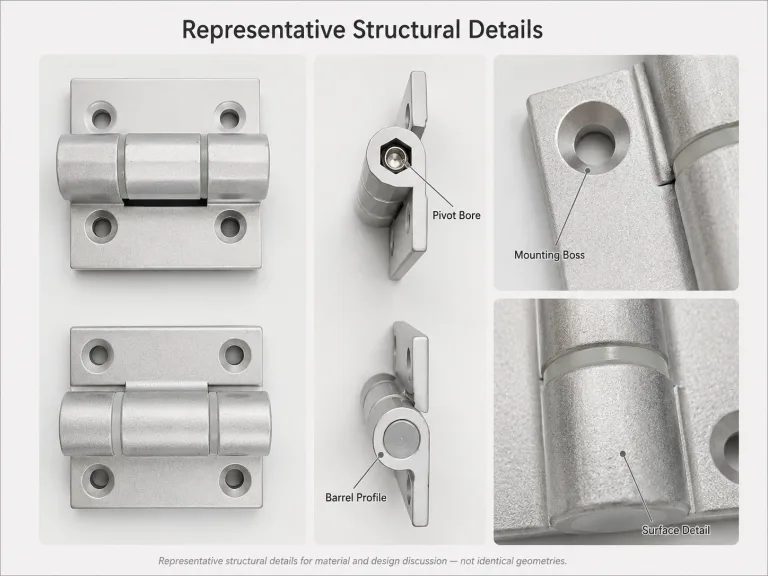
When reviewing hinge samples, inspect edges, screw recesses, knuckles, release features, and hidden contact areas. A hinge may be made from stainless steel but still have rough edges, trapped polishing compound, or crevices that are difficult to clean. For cleanroom cabinet hinges, finish quality and geometry should be evaluated together.
Tool-Free Access Without Increasing Contamination Risk
When Tool-Free Hinges Make Sense
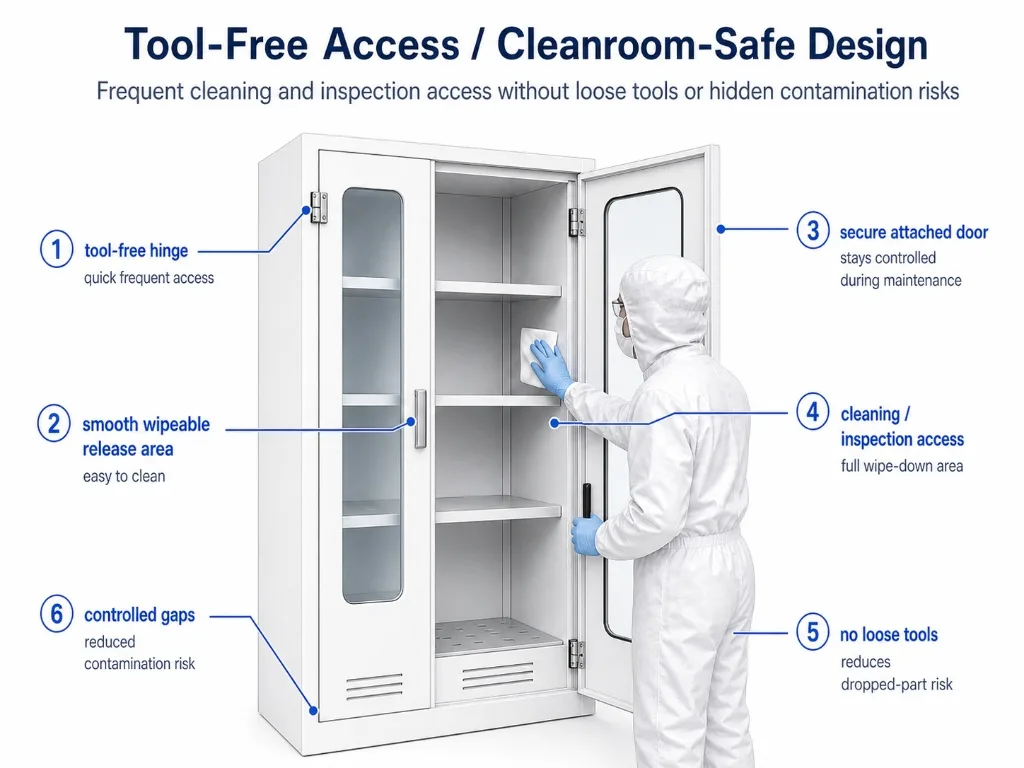
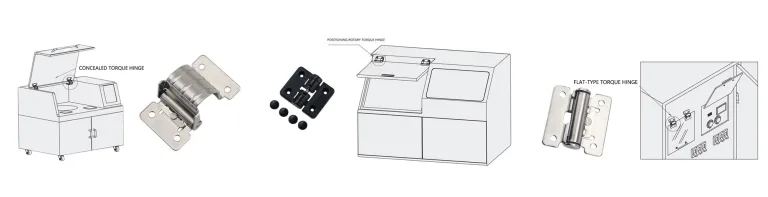
Tool-free hinges can be useful when cabinet doors or panels must be opened frequently for cleaning, inspection, filter replacement, equipment access, or process changeover. Reducing the need for loose tools can help simplify maintenance and lower the chance of misplaced fasteners inside a controlled area.
However, tool-free does not automatically mean cleanroom-safe. The release mechanism must be smooth, secure, easy to wipe, and resistant to the cleaning agents used in the facility. If a tool-free mechanism creates hidden gaps or uncontrolled wear points, it may create the same contamination risks it was meant to reduce.
Captive Fasteners and Controlled Access
Captive fasteners are useful in cleanroom cabinets because they reduce loose parts during maintenance. A screw, pin, or latch that remains attached to the door or hinge assembly is easier to control than a removable fastener that can be dropped, misplaced, or contaminate the work area.
If cabinet panels must be opened repeatedly for cleaning access, the hinge should support repeatable use without shifting the door position. A design that changes alignment after each cleaning cycle can create uneven gaps, additional inspection work, or new residue traps around the hinge area.
When deciding between a fixed door, a wide-opening door, or a controlled access mechanism, compare cleaning access with alignment repeatability. In some cabinet designs, cleaning access without full door removal may be more reliable than frequent hinge separation.
When Fixed Hinges May Be Safer
A fixed hinge may be safer when the cabinet door does not need to be removed, when alignment must remain stable, or when the cleaning procedure is performed with the door attached. Fixed hinges can reduce reassembly variation and may be easier to validate in repeated maintenance procedures.
For cleanroom cabinets, the best access design is not always the fastest one. The best design is the one that allows cleaning, inspection, and maintenance to be performed consistently without creating loose hardware, uncontrolled gaps, or repeated alignment problems.
Cleanroom Cabinet Hinge Selection Table
| Cleanroom Requirement | Recommended Hinge Direction | Why It Fits | Key Risk to Check |
|---|---|---|---|
| Frequent cabinet cleaning | Smooth stainless steel hinge with minimal crevices | Reduces residue traps and supports wipe-down procedures | Hidden gaps, rough edges, and difficult-to-clean fastener areas |
| High disinfectant exposure | 316L stainless steel hinge with compatible fasteners | Improves resistance to aggressive cleaning chemicals | Pitting, staining, and incompatible screw materials |
| Frequent panel access | Tool-free or captive-access hinge design | Reduces loose tools and loose fasteners during maintenance | Release mechanism crevices and poor alignment repeatability |
| Stable door alignment required | Fixed hinge or controlled access hinge system | Maintains consistent door position after repeated cleaning | Door shift, uneven gaps, and repeatability issues |
| Medical or pharmaceutical cabinet use | Stainless steel hinge with cleanable geometry | Supports hygiene-sensitive access and cleaning procedures | Surface roughness, residue accumulation, and cleaning validation gaps |
| Electronics cleanroom cabinets | Low-particle hinge with controlled wear points | Reduces avoidable particle sources around storage or access doors | Wear debris, unsealed friction points, and exposed hardware |
Common Design Mistakes in Cleanroom Cabinet Hinges
Choosing Hinges Only by Stainless Steel Grade
Stainless steel grade matters, but it is not the only factor. A 316L hinge with poor geometry, exposed crevices, or incompatible fasteners may still be difficult to clean. A cleanroom cabinet hinge should be evaluated by material, surface finish, geometry, fastener design, and maintenance procedure together.
Ignoring Crevices Around the Hinge Area
The hinge area often contains small gaps that are easy to overlook during design. Knuckles, pins, washers, latch points, screw recesses, and frame interfaces should all be checked for cleaning accessibility. If the area cannot be inspected or wiped properly, it can become a recurring contamination concern.
Using Removable Hinges Without a Cleaning Procedure
Removable or tool-free access features can improve cleaning efficiency, but they must be supported by a clear cleaning and reassembly procedure. Maintenance teams should know how the door is opened, how fasteners are controlled, and how alignment is checked after service.
Overlooking Disinfectant Compatibility
Cleaning agents can affect hinges differently depending on stainless steel grade, surface finish, fastener material, and exposure frequency. If the cabinet is exposed to strong disinfectants, hydrogen peroxide vapor, chloride-containing cleaners, or repeated wet cleaning, material compatibility should be reviewed before production.
Assuming Tool-Free Always Means Better
Tool-free access can reduce service time, but it is not automatically the best choice for every cleanroom cabinet. If the mechanism adds crevices, wears quickly, or makes cleaning harder, a fixed stainless steel hinge may be more reliable. The hinge should be selected for cleanability and repeatability, not only for speed.
Inspection and Cleaning Recommendations
Cleanroom cabinet hinges should be included in cleaning and inspection routines. The inspection should focus on surface condition, fastener control, residue buildup, smooth movement, corrosion signs, and whether the hinge area remains easy to clean after repeated use.
- Check whether the hinge area can be wiped without hidden residue traps.
- Inspect hinge pins, knuckles, release mechanisms, and fasteners for wear or staining.
- Confirm that tool-free or captive components remain secure after repeated cleaning.
- Check whether the door returns to the same position after opening or repeated service.
- Look for rough edges, scratches, pitting, or surface damage that may hold residue.
- Verify that cleaning agents are compatible with the hinge material and fasteners.
- Document any hinge replacement or maintenance action when required by the facility procedure.
For high-cleaning-frequency areas, the hinge should be reviewed more often. Small surface damage or fastener loosening can become more important in cleanroom cabinets than in ordinary industrial cabinets because the contamination risk is tied directly to surface condition and cleaning repeatability.
Conclusion
Cleanroom cabinet hinges should be selected as part of the contamination-control strategy, not only as door hardware. The hinge must support smooth operation, resist cleaning chemicals, reduce residue traps, control loose fasteners, and allow maintenance access without creating new cleaning risks.
The best hinge choice depends on four questions:
- Can the hinge area be cleaned and inspected easily?
- Does the stainless steel grade match the cleaning chemistry?
- Does tool-free access improve maintenance without adding contamination points?
- Will the door return to the same position after repeated opening or service?
When these questions are answered together, cleanroom cabinet hinges can support both mechanical reliability and contamination control. A well-selected hinge helps the cabinet remain serviceable, cleanable, and suitable for controlled environments throughout its working life.
Need Help Selecting Cleanroom Cabinet Hinges?
If your cleanroom cabinet requires stainless steel hinges, tool-free access, controlled fasteners, or a smoother cleanable design, HTAN can help review the application conditions before selection. Share your cabinet size, door weight, cleaning method, stainless steel grade requirement, and access frequency, and our engineering team can help recommend a hinge direction that supports cleanability, corrosion resistance, and maintenance efficiency.
For OEM cabinet projects, custom hinge options can also be evaluated based on mounting space, surface finish, access needs, and cleaning procedure requirements.
FAQ
What makes a cabinet hinge suitable for cleanroom use?
A cleanroom cabinet hinge should have smooth cleanable surfaces, corrosion-resistant material, controlled fasteners, minimal crevices, and a design that does not create unnecessary particle or residue traps during cleaning and maintenance.
Is 304 or 316L stainless steel better for cleanroom cabinet hinges?
304 stainless steel may be enough for mild indoor environments, but 316L stainless steel is usually safer when the hinge is exposed to stronger disinfectants, chloride-containing cleaners, high humidity, or frequent wet cleaning.
Are tool-free hinges always better for cleanroom cabinets?
Not always. Tool-free hinges can improve maintenance access and reduce loose tools, but the mechanism must remain smooth, cleanable, secure, and resistant to cleaning agents. If it adds hidden crevices, a fixed hinge may be safer.
Why do crevices around hinges matter in cleanrooms?
Crevices can trap dust, residue, cleaning agents, or biological contamination. If the hinge area cannot be wiped or inspected easily, it can become a recurring contamination point even when the cabinet door works mechanically.
How often should cleanroom cabinet hinges be inspected?
Inspection frequency depends on cleaning frequency, disinfectant exposure, access frequency, and facility procedures. Hinges in high-cleaning-frequency areas should be checked more often for residue buildup, surface damage, fastener looseness, corrosion, and smooth operation.


 English
  한국어
한국어  Русский
  Español
  Italiano
  Deutsch
  Français
  Português