

Cable-Hole Torque Hinges: When Wire-Through Makes Sense
In many OEM assemblies, the hardest part of a hinged joint is not holding the panel in position — it is getting the wires across the joint without them snagging, chafing, or breaking after a few thousand open-close cycles. When a lid carries a touchscreen, a camera, a sensor, or any powered component, those cables have to cross the rotating axis somehow. A cable-hole torque hinge solves both problems at once: it holds the panel at the angle you set, and it routes the wiring straight through the center of the hinge. This guide explains when a wire-through design actually makes sense, how to specify hole size and torque, and where these hinges fit best.
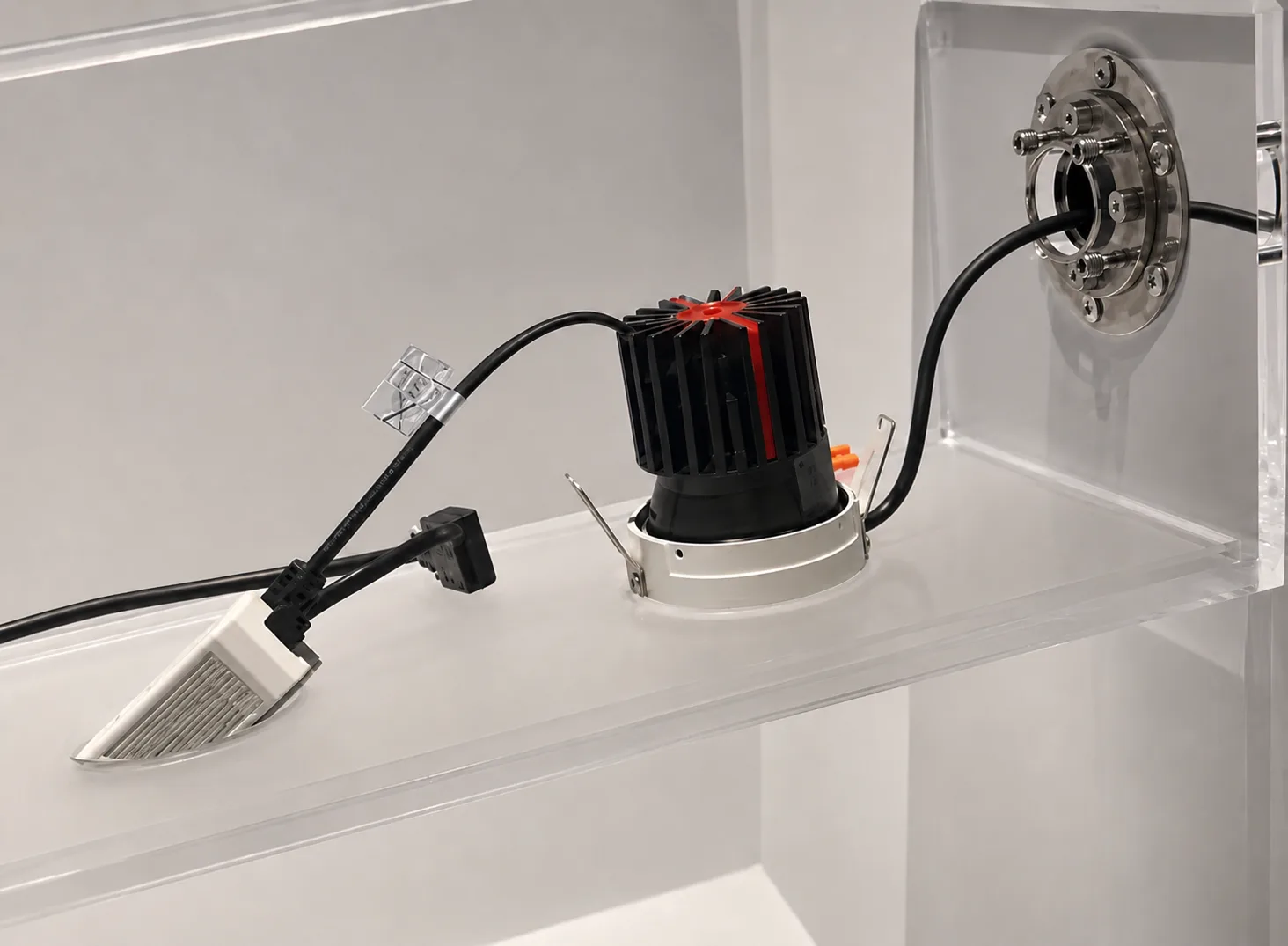
What a Cable-Hole Torque Hinge Is
A cable-hole torque hinge — also called a hollow-shaft, wire-through, or hollow torque hinge — is a positioning hinge with a hole running down the center of its rotation axis. It does two jobs in one part. Like any torque hinge, it uses controlled internal friction to hold a lid, display, or arm at a chosen angle without spring-back. Unlike a solid hinge, its hollow shaft lets a cable harness pass through the pivot, so the wiring rotates with the joint instead of being draped around the outside of it.
That second job is the whole point. On a powered lid or a rotating arm, the cable has to get from the fixed base to the moving part. Run it around the outside and it flexes, rubs, and eventually fails at the bend point. Run it through the center of the hinge and the cable sees far less movement, because the rotation axis is the one place on the joint where travel is smallest. The hinge becomes both the mechanical pivot and the cable conduit.
If you are still deciding whether a torque hinge is the right category at all — versus a plain friction hinge, a gas spring, or a stay arm — start with our torque hinge selection guide. This article assumes you already need controlled positioning and are weighing whether the wire-through version is worth it.
When Does a Wire-Through Hinge Make Sense?
A cable-hole torque hinge makes sense when a powered component is mounted on the moving panel and its cabling must cross the hinge axis. It is the right choice when external cable routing would be exposed, when repeated motion would fatigue a cable run outside the joint, when the design needs to look clean with no visible wiring, or when you want to cut part count by removing drag chains, spiral wrap, and external cable guides. It is usually the wrong choice when nothing on the moving panel needs power or signal, when the cable bundle is too large for any practical hole diameter, or when the panel is so heavy that a hollow shaft cannot provide the required torque and structural strength at once.
| Situation | Use a Cable-Hole Torque Hinge? |
|---|---|
| Powered display or touchscreen on the moving panel | Yes |
| Camera, sensor, or light head needs hidden wiring | Yes |
| An external cable loop would flex, snag, or fatigue | Yes |
| No wiring crosses the hinge axis | No — use a solid hinge |
| Cable bundle is too large for the bore | Usually no |
| Heavy panel needs maximum shaft strength | Review a solid hinge or larger body |
When Wire-Through Routing Makes Engineering Sense
The decision is not about the hinge in isolation. It is about whether internal routing solves a real problem in your assembly. These are the situations where it usually pays off.
A Powered Component Sits on the Moving Panel
The clearest case is a lid or arm that carries something electrical: a touchscreen, an HMI panel, a camera, a light head, a sensor, or a small display. The component needs power and signal from the fixed side of the product, and the cable has to survive every open-close cycle for the life of the equipment. Routing it through the hinge axis is the most direct way to protect it.
The Cable Would Otherwise Flex at a Bend Point
A cable routed around the outside of a hinge is forced to bend every time the panel moves. That repeated bending is a classic fatigue failure: the conductor or its insulation cracks at the flex point long before anything else on the product wears out. Inside the hinge, the cable is close to the rotation axis, so it twists gently rather than bending sharply. For high-cycle equipment, that difference is the difference between a cable that lasts and one that becomes a warranty claim.
Appearance and Cleanability Matter
On medical, laboratory, and premium industrial equipment, exposed wiring reads as low quality and creates places where dust and contaminants collect. A wire-through hinge hides the cable completely, leaving a clean exterior with no loops or external guides to wipe around. In hygiene-sensitive equipment, fewer external crevices is a genuine advantage, not just a cosmetic one.
You Want to Cut Part Count
Without internal routing, engineers usually add drag chains, spiral wrap, cable clips, or external guides to manage the wiring across a joint. Each of those is another part to source, install, and document. A hollow torque hinge collapses the mechanical pivot and the cable path into one component, which simplifies the bill of materials and the assembly line. For OEM products built in volume, that consolidation can matter as much as the cable protection itself.
When a Solid Torque Hinge Is the Better Call
Wire-through is not automatically better. A hollow shaft removes material from the center of the hinge, and that has consequences. There are clear cases where a solid torque hinge is the smarter choice.
- Nothing on the panel needs wiring. If the moving part is a plain cover or guard with no powered component, a cable hole adds cost and a stress concentration for no benefit.
- The cable bundle is too large. If the harness is thick, shielded, or includes connectors that cannot be threaded, no practical hole diameter will fit it. In that case, external routing with proper strain relief may be unavoidable.
- The load is very heavy. A hollow shaft has less material than a solid one of the same diameter. For a heavy panel that needs high torque and high structural strength, a solid shaft, a larger hinge, or a multi-hinge layout may be required to carry the load safely.
- The connector must stay attached. If the cable ends in a bulky connector that cannot be removed during assembly, threading it through a narrow bore may not be feasible.
A practical rule is simple: specify a cable hole when something needs to pass through it, and skip it when nothing does.
| Decision Factor | Cable-Hole Torque Hinge | Solid Torque Hinge |
|---|---|---|
| Cable routing | Routes the cable through the hinge axis | Requires external routing |
| Appearance | Cleaner, with hidden wiring | May need a cable loop or guide |
| Shaft strength | Bore reduces the cross-section | Stronger for the same body size |
| Best use | Powered panels, HMIs, sensors, arms | Plain lids, guards, heavy covers |
| Main risk | Bore too small or cable pinching | External cable fatigue at the bend |
How to Specify the Hole Size
Hole diameter is the parameter buyers get wrong most often. The hole has to fit not just the bare cable, but the full bundle plus a margin for movement, and sometimes a protective sleeve. Depending on the hinge series, cable-hole torque hinges may be available in compact bores for a single thin signal cable, mid-size bores for typical power-and-signal bundles, or larger bores for thicker harnesses or multiple cables — common bore sizes run from roughly 4.5 mm up through 8 mm, 12 mm, and beyond. Always confirm the exact bore against the supplier drawing before sampling, since available sizes vary by model.
To size the hole correctly, work through these points:
| Factor | What to Check |
|---|---|
| Bundle diameter | Measure the full harness, not a single conductor, including any shielding or jacket |
| Connectors | Confirm whether connectors must pass through, or can be terminated after threading |
| Protective sleeve | Add space if the cable needs a sleeve or conduit through the bore |
| Movement margin | Leave clearance so the cable can twist freely without pinching against the bore wall |
| Minimum bend radius | Make sure the cable’s rated bend radius is respected where it enters and exits the bore |
| Future cables | Allow for added signal lines if the product may gain features later |
| Sealing | Decide how the bore will be sealed if the environment is dusty or wet |
A bore that is too tight pinches the cable and reintroduces the very wear problem you were trying to solve. A bore that is slightly generous lets the cable move freely and tolerates a future design change. When in doubt, size up — but tell your supplier the bundle diameter and connector situation so they can confirm the hinge can still deliver the torque you need at that bore.
Balancing Hole Size Against Torque and Strength
Here is the engineering trade-off at the heart of every wire-through hinge: the bore and the torque mechanism share the same shaft. A larger hole leaves less material for the friction elements and less cross-section to carry load. That does not mean you cannot have both a generous bore and strong holding torque — it means the two have to be specified together, not in isolation.
In practice, smaller cable-hole hinges tend to live in the lighter torque ranges suited to electronics, control panels, and compact displays, while larger-bodied hollow hinges can offer higher torque for heavier covers. The point is to give your supplier both numbers at once — the bundle diameter you need to pass through, and the holding torque the panel requires — so the hinge can be matched to both. Specifying a hole size without a torque target, or a torque without a bore, is how projects end up with a hinge that fits the cable but cannot hold the lid, or holds the lid but cannot fit the cable.
If you are unsure what holding torque the panel needs in the first place, our torque calculation case studies walk through how panel weight and center-of-gravity distance translate into a torque figure. Settle the torque requirement first, then layer the bore requirement on top.
Material and Environment
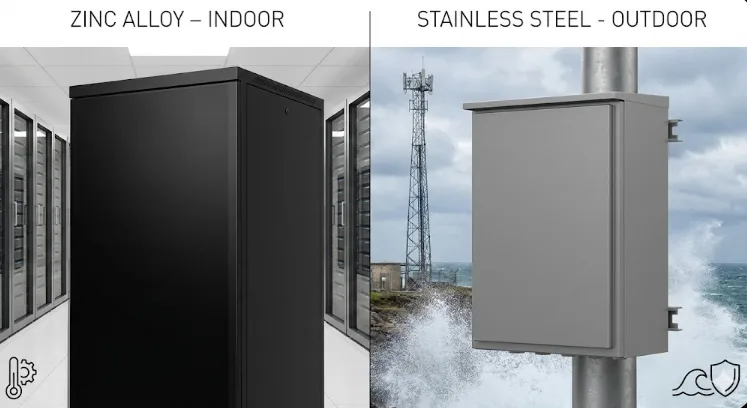
Cable-hole torque hinges come in the same material families as solid torque hinges, and the same environmental logic applies. Stainless steel is the choice for washdown, humid, marine, or hygiene-sensitive equipment where corrosion resistance matters. Iron or steel with a plated finish is common for cost-sensitive indoor electronics and control panels. The right pick depends on where the product lives, not on the fact that it has a cable hole.
One extra consideration is specific to wire-through designs: the bore itself can be an entry path for dust or moisture if it is left open at both ends. In dirty or wet environments, plan how the cable entry will be sealed or protected, so the hole that carries your wiring does not also carry contamination into the equipment.
Typical Applications
Cable-hole torque hinges show up wherever a powered part moves on a hinged joint. Common examples include:
- Control panels and HMIs where the operator interface tilts or folds and its wiring must cross the pivot.
- Equipment lids with touchscreens or cameras, where the display rides on the moving cover and needs a protected cable path.
- Robot and automation joints that carry signal and power across a rotating axis in a confined space.
- Medical and laboratory arms where a clean exterior, smooth motion, and hidden wiring all matter at once.
- Light heads and instrument mounts that reposition frequently and must keep their cabling protected through every adjustment.
What links all of these is the same pattern: controlled positioning plus a cable that has to survive the motion. Wherever both are true, the wire-through design earns its place.
Common Mistakes to Avoid
- Sizing the hole to the cable, not the bundle. Measure the full harness with its jacket and any sleeve, plus movement margin — not a single conductor.
- Specifying a bore without a torque target. The hole and the friction mechanism share the shaft. Give both numbers so the hinge can be matched to both.
- Forgetting the connectors. Confirm early whether connectors must pass through the bore or can be terminated after the cable is threaded.
- Leaving the bore open in a dirty environment. Plan cable-entry sealing so the wire path does not become a contamination path.
- Choosing wire-through when nothing needs wiring. If the panel has no powered component, a solid hinge is simpler, stronger, and cheaper.
What to Send When Requesting a Sample
A wire-through hinge has one extra dimension to communicate beyond a normal torque hinge: the cable. To get a useful recommendation quickly, send your supplier both the mechanical and the cabling data together.
| Information | Why It Matters |
|---|---|
| Panel weight and center of gravity | Defines the holding torque required |
| Opening angle and hold positions | Defines the motion range and free-stop need |
| Cable bundle diameter | Defines the minimum bore size |
| Connector type and size | Determines whether connectors pass through the bore |
| Number of hinges | Affects how total torque is shared |
| Material and environment | Guides grade, finish, and bore sealing |
| Mounting surface and direction | Affects fastener strategy and orientation |
| Sample and future order quantity | Supports OEM sampling and pricing |
Before committing to bulk production, validate the hinge on a representative prototype with the real cable in place. Our torque hinge sample testing checklist covers how to confirm holding, user force, and durability on the actual assembly — for a wire-through hinge, run that check with the cable threaded so you can confirm the bundle moves freely through the full opening range.
Frequently Asked Questions
What is a cable-hole torque hinge?
A cable-hole torque hinge is a positioning hinge with a hollow shaft, so a cable can pass straight through the center of the rotation axis. It holds a panel at a chosen angle through controlled internal friction while also routing wiring across the joint, protecting the cable from the bending and chafing that external routing causes.
When should I use a wire-through hinge instead of a solid one?
Use a wire-through hinge when a powered component on the moving panel needs its cable routed across the hinge axis, when external routing would flex and fatigue the cable, when a clean hidden-wiring appearance matters, or when you want to remove drag chains and external guides to cut part count. Use a solid hinge when nothing on the panel needs wiring, when the cable bundle is too large for a practical bore, or when a very heavy load needs the full strength of a solid shaft.
How do I choose the right cable hole size?
Measure the full cable bundle, including jacket, shielding, and any protective sleeve, then add clearance so the cable can twist freely without pinching. Confirm whether connectors must pass through the bore, and leave margin for any cables a future design revision might add. Tell your supplier both the bundle diameter and the holding torque you need, since the bore and the friction mechanism share the same shaft.
Does a cable hole reduce the hinge’s holding torque?
A hollow shaft has less material than a solid one of the same diameter, so the bore and the torque mechanism compete for the same cross-section. It does not prevent strong holding torque, but the two must be specified together. Provide both the required bore and the required torque so the hinge body can be sized to deliver both.
What applications use cable-hole torque hinges most?
They are common wherever a powered part moves on a hinged joint: control panels and HMIs, equipment lids carrying touchscreens or cameras, robot and automation joints, medical and laboratory arms, and adjustable light heads or instrument mounts. The shared requirement is controlled positioning plus a cable that must survive repeated motion.
Specifying a Cable-Hole Torque Hinge
A cable-hole torque hinge is the right answer to a specific problem: a powered panel that has to hold its position and carry its wiring across the same joint. When that describes your product, routing the cable through the hinge protects it, cleans up the exterior, and removes the external guides you would otherwise have to add. When it does not, a solid torque hinge is simpler and stronger. The key is to specify the bore and the torque together, size the hole to the full bundle, and validate the design with the real cable on a representative prototype.
If you have a powered lid, arm, or panel that needs both positioning and internal cable routing, HTAN can help match the bore size, torque range, material, and mounting to your application. Browse our torque hinge range or contact HTAN with your panel weight, opening angle, and cable bundle details for a recommendation.




 English
  한국어
한국어  Русский
  Español
  Italiano
  Deutsch
  Français
  Português