

How to Select Cold Storage Hinges for Load, Gasket Compression and Low-Temperature Service
Door Load, Offset, Gasket Compression, Condensation & Low-Temperature Movement
Cold storage hinges do more than carry an insulated door. They establish the pivot axis that controls door position, gasket approach, closing behavior, and the long-term relationship between the door and frame. When the hinge system develops play, moves on its fasteners, freezes, corrodes, or uses the wrong offset, the visible problem may appear first as a seal gap, frost line, rising opening force, or a door that no longer closes consistently.
This guide explains how to select cold storage hinges for fixed cold rooms, walk-in freezers, and refrigerated warehouse doors. The selection sequence starts with the complete door geometry, then checks seal pressure, condensation, hinge mechanism, materials, failure symptoms, and validation. Product selection should begin only after those conditions are defined.
Scope boundary: This page covers fixed cold-room and freezer-door selection. A refrigerated truck door adds body flex, road vibration, dynamic shock, and transport fastener risks; use the separate guide to refrigerated truck door hinges when the door is mounted on a moving vehicle.
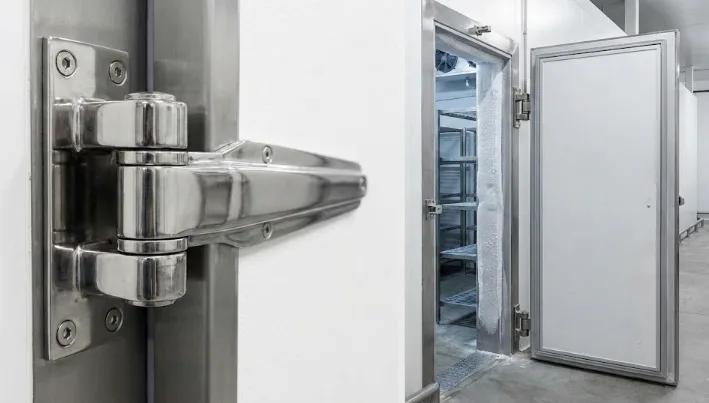
The hinge must be selected as part of the insulated door, gasket, latch, frame, and operating environment.
Quick Answer: Start With Door Geometry and Seal Behavior
A supplier cannot select a cold room hinge from door weight alone. The starting specification must describe the load, the door-to-frame relationship, the seal, and the low-temperature operating condition.
| Selection Input | What to Define | Why the Hinge Depends on It | Next Engineering Action |
|---|---|---|---|
| Door load | Mass, width, height, thickness, center of gravity, attached hardware | Determines vertical load and the moment transferred into the hinge line | Weigh or calculate the complete moving door |
| Door geometry | Flush or overlay construction, offset, hinge spacing, frame and door mounting surfaces | Controls pivot location, clearance, fastener loading, and seal approach | Issue a section drawing through the hinge and gasket |
| Seal behavior | Gasket profile, compression target, latch position, hinge-side gap, floor sweep | The hinge positions the door but does not independently define the sealing force | Confirm the acceptable installed compression with the door and gasket design |
| Operating function | Fixed pivot, rising/cam-lift action, adjustment, assisted closing, removable door | Each mechanism changes door motion, service access, and seal contact | Write the required door behavior before choosing a hinge type |
| Cold and moisture exposure | Minimum temperature, warm-side condition, door-open duration, condensation, frost, cleaning | Affects friction, icing, corrosion, lubricant behavior, and material selection | Define the actual temperature and moisture cycle |
| Duty and service | Expected cycles, impacts, inspection access, replaceable wear parts, maintenance method | Changes wear rate, fastener retention, and field replacement needs | Match the validation plan to the real door duty |
After these inputs are defined, review the available cold storage hinges by mechanism, material, mounting pattern, and documented operating limits. A catalog image is not enough to confirm fit or life.
Calculate What the Door Loads Into the Hinge Line
An insulated door applies both vertical load and an overturning moment to the hinge system. A useful first relationship is:
M = W × d
where W is the complete door weight and d is the horizontal distance from the hinge axis to the door center of gravity. Increasing door width, moving equipment toward the latch side, or adding glass, handles, heater hardware, and protective plates can increase the moment even when the nominal door weight changes only slightly.
The required hinge system cannot be determined from this moment alone. The reaction at each hinge also depends on hinge spacing, number of hinges, door and frame stiffness, fastener pattern, backing structure, offset geometry, impact loading, and the supplier’s stated rating method. Two hinges with the same appearance may have ratings based on different test fixtures and different mounting assumptions.
Do Not Use a Universal Hinge Count or Safety Factor
A wide or high-cycle door may benefit from an additional hinge, but there is no universal width at which a third hinge becomes mandatory. Likewise, one fixed safety factor cannot represent every warehouse door, personnel door, freezer, or processing room. The design margin should reflect the supplier’s rating basis, the complete door moment, impact and misuse conditions, mounting stiffness, temperature, cycle requirement, and the consequences of losing alignment.
Ask the supplier to state the approved door mass, center-of-gravity limit, hinge quantity and spacing, mounting substrate, fastener condition, test temperature, and cycle or static test method. Without those conditions, “maximum load” is not a complete engineering rating.
Design Cold Storage Hinges Around Gasket Compression
The cold-room door must remain in the correct position relative to the gasket and frame. The hinge establishes the pivot axis and supports alignment; the latch or closing mechanism brings the door into its final closed position; the gasket profile and material determine how compression develops and recovers. Treating “seal pressure” as a hinge-only value leads to incomplete specifications.
How Hinge Geometry Changes the Seal
- Incorrect offset: the door may bind before the gasket reaches the frame, or it may close with an excessive air gap.
- Hinge-axis position: the axis controls how the hinge-side edge approaches and wipes across the gasket during closing.
- Door sag: wear, fastener movement, or frame deformation can reduce compression at one corner while overcompressing another.
- Cam or rising action: the mechanism may lift the door during opening and lower it during closure, but the rise, handing, floor clearance, and gasket behavior must match the complete door.
- Latch relationship: the latch may create most of the final pull-in force, so hinge and latch geometry must be checked together.
A cold door can appear closed while the hinge-side gasket is barely contacting the frame. Conversely, excessive compression can increase closing force, accelerate gasket wear, and make the door difficult to release. The acceptable compression is determined by the selected gasket profile, hardness, temperature behavior, recovery, and door construction—not by a universal percentage.
Separate the tasks: This page explains how hinge geometry affects gasket contact. Detailed EPDM, silicone, neoprene, hardness, compression set, and compound selection belong in the guide to hinge gasket material selection.
Measure Seal Contact on the Complete Door
Before release, check the gap and contact around the complete perimeter at ambient and cold conditions. A temporary contact-indicating method, measured door gaps, closing-force measurements, or another project-approved inspection can reveal weak contact near the upper latch corner, overcompression near the lower hinge, or a frame that changes shape during cold soak. The method and acceptance limits must be defined by the door-system owner.
Control Condensation, Frost, and Low-Temperature Friction
Whenever a cold door separates a low-temperature room from warmer, more humid air, the door system can develop condensation on cold surfaces. Repeated opening increases moisture entry. Air leakage at the gasket can continue feeding humid air toward the cold frame after the door closes. If moisture reaches a hinge pin, bushing, fastener pocket, or frame joint and freezes, the door may become hard to move or may stop short of its intended closed position.
| Moisture or Cold Mechanism | What the Operator May Notice | What to Inspect | Engineering Response |
|---|---|---|---|
| Condensation on the hinge or frame | Water staining, corrosion, residue, or intermittent stiffness | Warm-air path, cold bridges, drainage, fastener pockets, surface condition | Reduce leakage and water traps; confirm material and finish exposure |
| Moisture freezing around the pivot | High breakaway force or a door that stops before full closure | Ice location, pin and bushing clearance, frame frost pattern | Address the moisture source, drainage, heating, or anti-frost detail at system level |
| Lubricant viscosity rising in the cold | Movement is acceptable warm but heavy after cold soak | Approved lubricant, minimum temperature, quantity, contamination, bearing design | Use supplier-supported low-temperature lubrication or a validated self-lubricating interface |
| Gasket stiffening or losing recovery | Closing effort rises or the seal gap changes at low temperature | Gasket grade, compression, profile, temperature range, hinge-side movement | Review gasket and hinge geometry together on the complete door |
| Thermal contraction changing alignment | Door contacts the frame or latch only when cold | Door panel, frame, fastener, hinge, and latch movement through temperature | Include thermal movement and tolerance in the section drawing and validation |
Frame heaters, anti-frost systems, thermal breaks, drainage paths, and air-management details are door-system controls rather than automatic hinge features. The hinge must remain compatible with them, but it cannot compensate for continuous warm-air leakage or trapped water elsewhere in the assembly.
Do not add a generic grease during installation or maintenance without checking the hinge design. A lubricant that is suitable for one pin-and-bushing system may increase drag, collect residue, or damage another. For self-lubricating bearing interfaces, additional grease may be prohibited. The approved lubricant, quantity, reapplication method, and minimum operating temperature should come from the hinge or bearing supplier.
Choose the Hinge Mechanism by Door Behavior
Cold storage hinge selection should begin with what the door must do during opening, closing, adjustment, and service. Similar-looking hinges can create very different motion.
| Hinge Direction | Use It When | Main Benefit | Main Engineering Check |
|---|---|---|---|
| Fixed heavy-duty hinge | The door needs a stable pivot and the latch provides the closing pull-in | Simple load path and predictable geometry | Load rating, hinge-line stiffness, offset, alignment, and fastener support |
| Rising or cam-lift hinge | The door should lift clear of a floor sweep or gasket during opening and return downward during closure | Can reduce drag and support gravity-assisted closing | Rise curve, handing, floor clearance, door weight, closing speed, and final gasket compression |
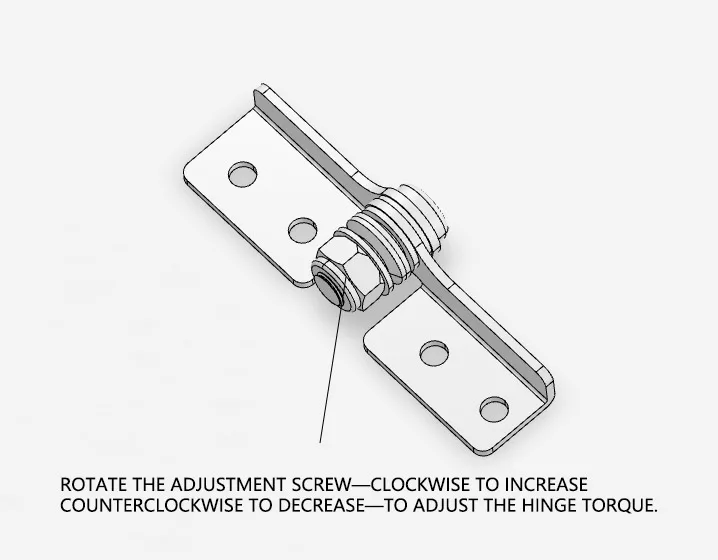
| Adjustable hinge | The installation requires field correction of door height, lateral position, or gasket contact | Allows alignment to be restored without redrilling the complete door | Adjustment range, locking method, access, structural stiffness, and post-adjustment retention |
| Spring-assisted hinge | A smaller door or personnel door needs a positive return action | Adds closing bias | Spring output at low temperature, fatigue, replaceability, rebound, and latch interaction |
| Lift-off or removable hinge | The complete door must be removed for service and the sealing system can tolerate the removable architecture | Faster door removal on suitable designs | Retention, lifting clearance, handing, reinstallation alignment, and gasket repeatability |
A rising hinge and a lift-off hinge are not automatically the same mechanism. A rising hinge changes vertical door position through its opening path; a lift-off hinge permits separation when aligned to a removal position. Some products may combine functions, but the drawing must confirm the actual motion rather than relying on a category name.
For heavy insulated doors, avoid selecting a spring-assisted or adjustable mechanism only from its visible size. Confirm the structural load rating separately from the closing or adjustment function. The internal spring, cam, or adjustment screw does not automatically increase the capacity of the leaves, pin, fasteners, or door frame.
Match Materials and Bearing Interfaces to the Exposure
“Stainless steel” is not a complete cold-storage specification. The material direction must reflect minimum temperature, water and condensation exposure, cleaning chemistry, chloride contact, fastener material, surface finish, bearing construction, and whether residue can remain around the hinge.
| Material or Interface Direction | Where It May Fit | What It Does Not Prove | What to Request |
|---|---|---|---|
| Austenitic stainless hinge construction | General cold rooms, wet areas, and projects needing good corrosion resistance | The grade name alone does not prove the hinge load, temperature range, finish quality, or resistance to the actual cleaner | Material certificate, finish, weld and fastener details, exposure compatibility |
| Higher-chromium/nickel/molybdenum stainless direction such as 316-family grades | Chloride-rich, coastal, brine, or aggressive washdown exposure | It does not eliminate crevice corrosion, mixed-metal attack, residue retention, or poor cleaning geometry | Exact grade, surface condition, cleaning chemical compatibility, fastener match |
| Coated steel or protected zinc-alloy construction | Dry or lower-risk refrigerated zones where the supplier has suitable low-temperature and corrosion evidence | Ambient corrosion appearance does not prove long-term performance under condensation or damaged coatings | Coating system, substrate, low-temperature data, corrosion test conditions and acceptance |
| Engineered polymer bushings or self-lubricating interfaces | Selected bearing positions where moisture resistance and reduced lubrication are useful | The bushing material does not carry the complete door load by itself or prove wear life at the actual pressure and temperature | Load, temperature, wear, chemical, and mating-surface data |
| Replaceable pin, bushing, or wear components | High-cycle doors or facilities that prioritize field serviceability | Replaceability does not correct weak mounting structure or incorrect door geometry | Replacement procedure, spare part numbers, retention method, service clearance |
Food and beverage facilities add cleaning and residue conditions that may be more demanding than ordinary refrigerated storage. When sanitation zones, open product, aggressive washdown, or cleanable geometry are the primary task, use the dedicated food processing hinge selection guide rather than expanding this page into a complete hygiene standard.
Diagnose Cold Storage Hinge Problems by the First Visible Symptom
A cold-room door problem should be traced through the complete load and sealing system. Replacing the hinge without measuring the door, frame, gasket, latch, and mounting surfaces can hide the cause temporarily while preserving the same failure condition.
| First Visible Symptom | Possible Hinge or Door Cause | What to Measure or Inspect | Corrective Direction |
|---|---|---|---|
| Upper latch-side seal gap | Door sag, hinge play, loose fasteners, weak backing, frame movement | Door diagonals, hinge-axis position, pin play, fastener movement, frame flatness | Restore structure and alignment before increasing latch force |
| Hinge-side gasket is crushed while latch side leaks | Incorrect offset, axis too close to the seal line, door twist, uneven adjustment | Section geometry, gasket contact, door plane, hinge and latch positions | Correct pivot and door geometry; do not use latch force to hide the mismatch |
| Door moves freely warm but becomes hard after cold soak | Frozen moisture, unsuitable lubricant, reduced bearing clearance, gasket stiffening | Ice location, breakaway force, approved lubricant, pin/bushing condition, gasket behavior | Separate moisture, lubrication, clearance, and gasket causes before replacing parts |
| Door closes warm but stops short when cold | Thermal contraction, frost, cam geometry, latch shift, gasket force increase | Cold gap, contact points, latch alignment, frame movement, cam position | Validate the complete closing path at operating temperature |
| Rust staining starts around screws or joints | Mixed materials, damaged finish, trapped cleaner, crevice, unsuitable fastener | Fastener grade, coating damage, drainage, cleaner residue, surface contact | Correct the material system and moisture trap, not only the visible stain |
| Door loses alignment again after adjustment | Adjustment lock not retained, fasteners moving, backing too flexible, wear continues | Witness marks, torque retention, slot movement, support deformation, pin play | Restore load-path stability before repeating adjustment |
| Self-closing action becomes weak or aggressive | Spring fatigue, changing friction, wrong cam rise, door mass change, temperature effect | Door mass, closing angle, spring/cam condition, friction, latch and gasket force | Revalidate the complete motion rather than adjusting one component in isolation |
Validate the Complete Cold Room Door Before Release
A hinge sample can pass a bench inspection and still fail after installation because the real door adds offset, gasket force, latch pull-in, frame flexibility, temperature change, condensation, and operating misuse. The validation plan should therefore test a representative door assembly rather than an unloaded hinge whenever the project risk justifies it.
- Record the released geometry. Confirm door mass, center of gravity, hinge quantity and spacing, offset, mounting surfaces, fasteners, backing, gasket, latch, floor sweep, and opening stop.
- Check ambient assembly behavior. Measure gaps, door level, opening force, closing force, interference, hinge play, and seal contact before cold exposure.
- Cold-soak the representative assembly. Use the project minimum temperature and enough time for the door, frame, hinge, gasket, and latch to reach the intended condition.
- Repeat the motion and seal checks cold. Record breakaway force, movement, self-closing behavior where applicable, final closure, latch engagement, and perimeter gasket contact.
- Expose the assembly to the expected moisture mechanism. Where condensation or washdown is relevant, reproduce the defined exposure rather than assuming a dry cold test represents service.
- Run the required door cycles. The cycle count, speed, dwell, impact, temperature, and maintenance condition should represent the project or a documented supplier method.
- Inspect the structure after testing. Look for fastener movement, elongated holes, backing deformation, hinge play, surface damage, corrosion, residue traps, gasket wear, and changing alignment.
The acceptance criteria must be agreed before the test. Typical project outputs include allowable opening force, maximum drift, permitted hinge play, door-gap limits, seal-contact requirement, self-closing range, fastener movement limit, corrosion acceptance, and replaceable-part condition. Do not replace these project limits with an unrelated catalog cycle number.
Retrofit Without Losing Offset or Seal Geometry
A replacement hinge must preserve more than the bolt-hole pattern. A hinge with matching holes can still move the pivot axis, alter the door offset, change the rising action, reverse the handing, increase the closed gap, or shift the door relative to the latch and gasket.
| Retrofit Item | Why It Matters | Next Engineering Action |
|---|---|---|
| Hole pattern and mounting centers | Controls whether the replacement can use the existing reinforced locations | Measure the door and frame separately; do not rely on a model name |
| Closed-door offset | Determines the door position relative to the frame and gasket | Compare section drawings through the closed hinge |
| Pivot-axis location | Changes sweep clearance and hinge-side gasket motion | Overlay the old and new axes in the door section |
| Handing and opening direction | Cam, rising, spring, and removable actions may be directional | Confirm left/right hand and viewing convention on the drawing |
| Rise or cam path | Changes floor-sweep clearance, closing speed, and final door height | Request the rise-versus-angle or mechanism drawing |
| Fasteners and backing | A different plate or slot pattern can concentrate load in weak skin material | Review thread engagement, backing plate, insulation, and edge distance |
| Latch and gasket relationship | A small axis or offset change can prevent even compression | Recheck latch engagement and complete perimeter contact |
| Service parts and removal clearance | The replacement may require different pin access or door-lifting space | Confirm the actual maintenance sequence before release |
Confirm These Inputs Before Requesting Cold Storage Hinges
- Door assembly: width, height, thickness, total mass, center of gravity, attached handles, heaters, glass, protection plates, and other moving hardware.
- Mounting geometry: door and frame sections, closed offset, hinge-axis target, hinge spacing, skin thickness, backing, fasteners, and available edge distance.
- Seal system: gasket profile, target installed contact or compression, latch position, floor sweep, allowable gap, and required closing behavior.
- Operating function: fixed pivot, rising/cam-lift, adjustable, spring-assisted, removable, self-closing, opening angle, stop, and handing.
- Temperature condition: minimum and maximum operating temperature, storage temperature, warm-side condition, cold-soak duration, and expected temperature cycling.
- Moisture exposure: condensation, frost, washdown, cleaning chemicals, brine, chloride, residue, drainage, and frame-heating details.
- Duty cycle: expected opening frequency, operating speed, impact or misuse condition, dwell, maintenance access, and consequences of seal loss.
- Required evidence: material documentation, drawing, load-rating basis, temperature data, cycle method, lubricant or bushing data, corrosion evidence, and replacement-part information.
- Sample validation: opening force, closing force, alignment, seal contact, frost behavior, self-closing action, fastener movement, wear, and cold-condition performance.
The initial recommendation remains preliminary until the complete door geometry and supplier data are reviewed. Sample approval requires representative assembly testing, and production approval requires evidence that the released hinge, fasteners, backing, door, gasket, latch, and assembly method reproduce the accepted result. For a project review, send HTAN the door section, mass and center of gravity, offset, hinge spacing, gasket details, operating temperature, moisture exposure, required motion, and existing hole pattern.
FAQs
How do I choose the right cold storage hinges?
Start with the complete door mass, center of gravity, width, hinge spacing, offset, mounting structure, gasket and latch geometry, operating function, minimum temperature, condensation or washdown exposure, and expected duty. Then compare hinge mechanisms and supplier ratings under matching conditions. Door weight alone is not enough.
Does a heavier or wider cold room door always need more hinges?
Not automatically. Hinge quantity depends on door moment, hinge spacing, frame and door stiffness, mounting structure, fasteners, offset, duty, impact conditions, and the supplier’s rating basis. A third hinge may improve stability on some doors, but no universal width or weight rule replaces the actual door geometry and validated hinge data.
Why does a freezer door hinge become hard to open when cold?
Possible causes include moisture freezing around the pivot, lubricant viscosity increasing, bearing clearance changing, gasket stiffness increasing, frame or door contraction, misalignment, or a latch and cam path that changes at low temperature. Inspect the ice location and measure the complete door behavior before replacing the hinge.
How do cold storage hinges affect gasket compression?
The hinge establishes the pivot axis and maintains door position relative to the frame. Its offset, alignment, wear, adjustment, and cam or rising motion affect how the hinge-side edge approaches the gasket. Final sealing also depends on the latch, gasket profile, material, compression recovery, door stiffness, and frame geometry.
Should cold room door hinges use 304 or 316 stainless steel?
The choice depends on the actual exposure. A 304-family stainless direction may be suitable for many general cold-room conditions, while 316-family grades are often considered where chloride, brine, coastal air, or aggressive washdown increases corrosion risk. Confirm the exact grade, finish, fasteners, cleaning chemistry, crevice geometry, and supporting test evidence.





 English
  한국어
한국어  Русский
  Español
  Italiano
  Deutsch
  Français
  Português