

Weld-On Hinges for Mobile Equipment: Selection & Risk Guide
Weld-on hinges for mobile equipment are used when service doors, tool compartments, access panels, trailer doors, and equipment guards must stay aligned under vibration, road shock, repeated opening, and field service conditions. Unlike bolt-on hinges, weld-on hinges become part of the steel structure, which can reduce loosening risk when the door and frame are designed for welding.
However, weld-on hinges are not automatically the right choice for every vehicle door. They are strong and permanent, but they also reduce adjustability, require welding access, and depend heavily on the quality of the parent metal, hinge material, weld preparation, and post-weld protection. A poorly selected or poorly installed weld-on hinge can create the same problems it was meant to solve: door sag, binding, corrosion around the weld area, or difficult field repair.
This guide explains when weld-on hinges make sense for service trucks, utility trailers, construction equipment, mobile generator enclosures, and other mobile equipment. It focuses on hinge selection, application risk, and specification decisions — not welding procedure qualification. Final welding details should always follow the equipment builder’s drawings, material requirements, qualified welding procedure, and applicable shop safety rules.
If you are comparing weld-on and bolt-on hinges in general industrial applications (machine enclosures, fixed cabinets, equipment doors), the broader weld-on vs bolt-on hinge decision guide covers the universal trade-offs. This page focuses specifically on how mobile equipment — road vibration, twisting frames, field service access, and corrosion exposure — changes those trade-offs.
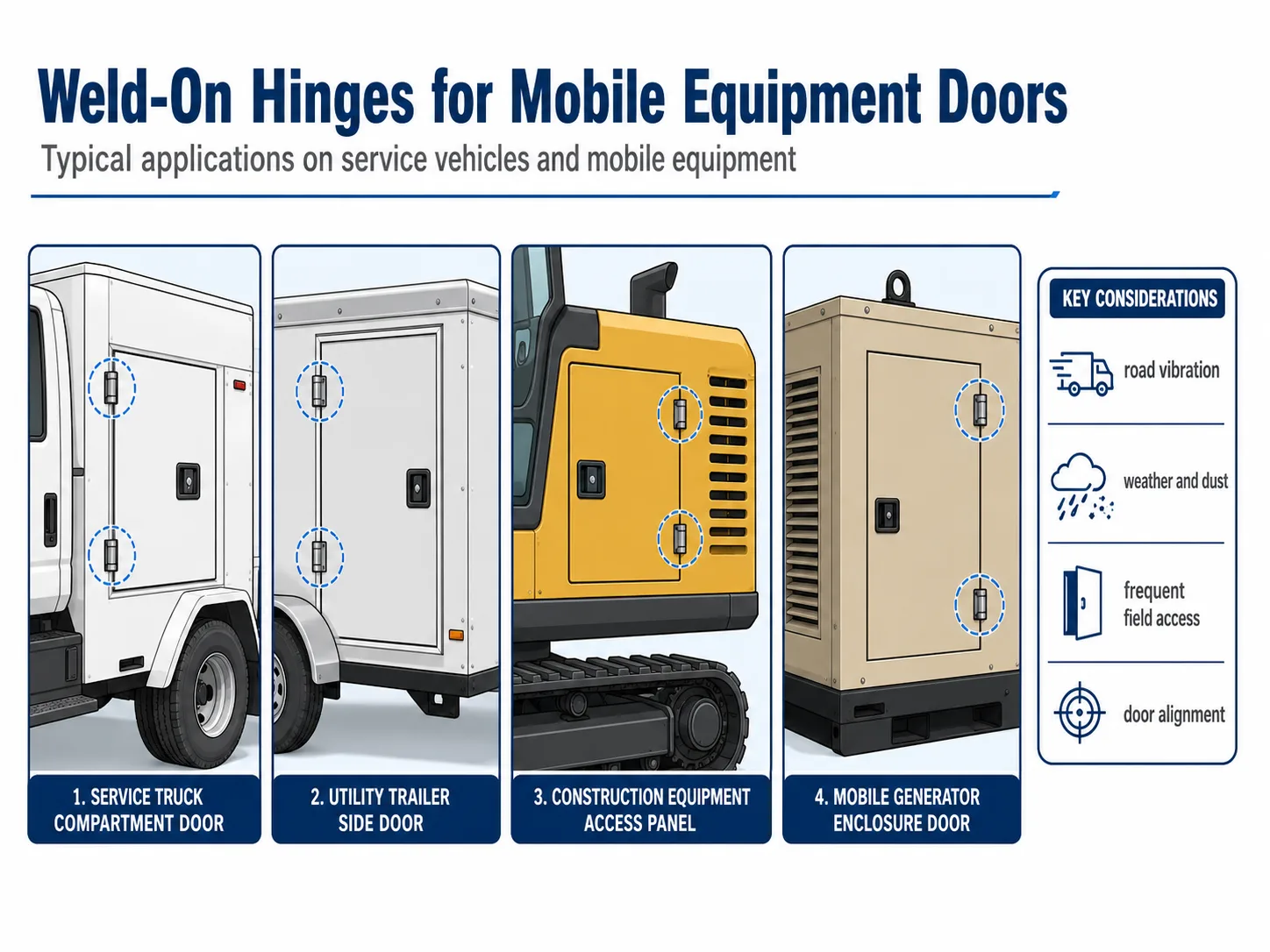
Why Mobile Equipment Doors Need Different Hinge Decisions
A stationary cabinet door and a service truck compartment door may look similar, but they do not experience the same duty cycle. Mobile equipment doors are exposed to road vibration, impact, twisting frames, uneven terrain, dust, water spray, salt, and frequent field access. The hinge must do more than carry the door weight; it must keep the door aligned while the vehicle body moves around it.
Common hinge problems on mobile equipment include loose fasteners, elongated mounting holes, cracked weld areas, seized pins, corrosion around the hinge leaf, and door misalignment that prevents the latch or gasket from sealing correctly. These problems often appear first on tool compartments, side access doors, tailgate panels, storage boxes, battery enclosures, mobile generator covers, and trailer service doors.
For mobile equipment builders and fleet maintenance teams, the right question is not simply “Is a weld-on hinge stronger?” The better question is whether the door structure, frame material, access frequency, corrosion exposure, and future maintenance plan support a permanent welded hinge solution.
When Weld-On Hinges Are the Right Choice
Weld-on hinges are usually a strong choice when the door or panel is mounted to a steel frame, the application sees constant vibration, and the hinge does not need frequent repositioning or removal. They are especially useful when mechanical fasteners may loosen over time or when the mounting surface is thick enough to support a sound welded joint.
Typical mobile equipment applications include service truck compartment doors, utility trailer side doors, heavy toolboxes, construction equipment access panels, dump body side doors, mobile generator enclosures, and steel service body panels. In these applications, hinge alignment and vibration resistance often matter more than easy removal.
If the project is already using welded steel construction, weld-on hinges can simplify the structure by eliminating bolt holes and fastener stacks at the hinge leaf. For many heavy-duty steel doors, this provides a cleaner load path from the door into the frame.
- Steel service bodies where door alignment must survive vibration
- Tool compartments that are opened frequently in field service
- Construction equipment panels exposed to shock and dust
- Mobile generator or compressor enclosures with heavy access doors
- Trailer doors where bolt loosening has been a recurring maintenance issue
For general weld-on hinge types, pin styles, and product-level options, the broader weld-on hinges guide can be used as a product reference. This page focuses specifically on mobile equipment and service vehicle applications.
When Bolt-On or Removable Hinges May Be Better
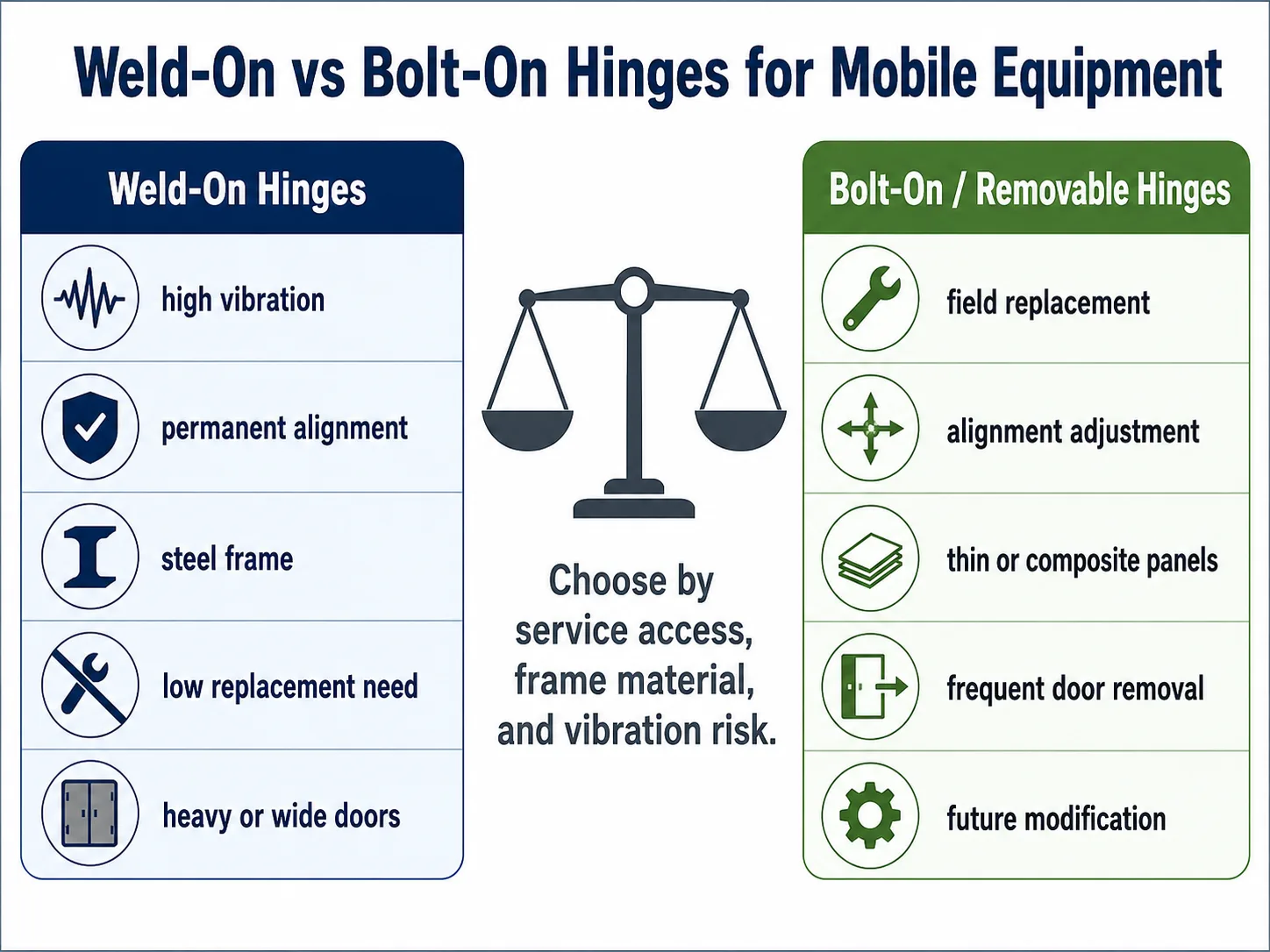
Weld-on hinges are permanent. That is an advantage when the door must resist vibration, but it becomes a limitation when the door may need future adjustment, replacement, or fast field removal. In those cases, bolt-on, removable-pin, or lift-off hinge designs may be more practical.
Weld-on hinges may not be the best choice when the door is made from aluminum, composite, fiberglass, plastic, or very thin sheet metal without a suitable reinforcement structure. Welding can also be difficult if the hinge area is close to wiring, insulation, fuel systems, sealed compartments, or finished surfaces that cannot tolerate heat.
When future panel replacement is likely, a bolted hinge mounted to a welded reinforcement plate can offer a useful compromise: the structure remains strong, but the hinge itself can be removed without cutting welds. This hybrid approach is often better for prototype builds, frequently modified vehicles, or service panels that must be replaced quickly in the field.
- Use bolt-on hinges when field replacement is more important than permanent attachment.
- Use removable-pin hinges when the door must come off for inspection or service.
- Use weld-on hinges when vibration resistance and permanent alignment are the main priorities.
- Use reinforcement plates when the panel material cannot safely support a welded hinge directly.
Key Selection Factors for Service Vehicle Hinges
Before choosing a weld-on hinge, define the door and service conditions. A hinge that works on a small tool compartment may not be suitable for a large side access door or a tailgate panel. The hinge should be selected as part of the door system, not as a separate hardware item.
Door Weight, Width, and Center of Gravity
The hinge must support the door weight and the moment created by the door width and center of gravity. A wide door creates more leverage on the hinge side than a narrow door of the same weight. For heavy or wide mobile equipment doors, hinge selection should start with the real door weight, hinge spacing, and center-of-gravity location.
When a service truck compartment door, generator enclosure panel, or trailer access door is wide, heavy, or opened frequently, a heavy-duty hinge selection process based on door weight should be completed before deciding whether the hinge should be weld-on, bolt-on, or removable.
Vibration and Shock Exposure
Mobile equipment experiences vibration that stationary enclosures do not. Repeated shock can loosen bolts, enlarge holes, wear bushings, and shift door alignment. Weld-on hinges can help reduce fastener loosening because there are no hinge-leaf bolts at the welded interface, but the weld joint and surrounding structure must still be strong enough for the application.
Welding Access and Frame Material
The best weld-on hinge design can still fail if the installer cannot access the joint correctly or if the door frame is not suitable for welding. Buyers should confirm base material, thickness, coating condition, reinforcement needs, and whether the hinge area can be safely welded without damaging nearby components.
Service Access and Future Replacement
A permanent welded hinge is harder to replace than a bolted hinge. If the vehicle body is expected to be modified, repaired, or reconfigured, the hinge strategy should include future access. For panels that must be removed regularly, a removable-pin or bolt-on solution may reduce maintenance time even if the welded option is stronger.
Material Selection for Mobile Equipment
Material selection should match the vehicle body, environment, coating process, and corrosion risk. Most mobile equipment weld-on hinges are selected from carbon steel or stainless steel, depending on whether the main priority is strength, weldability, corrosion resistance, or long-term appearance.
Carbon Steel Weld-On Hinges
Carbon steel weld-on hinges are commonly used on painted steel service bodies, trailers, construction equipment, and utility vehicles. They can be a practical choice when the surrounding structure is also steel and the hinge will be protected after welding with primer, paint, powder coating, or another approved finish.
The main risk is corrosion at the weld area or exposed hinge surfaces if post-weld protection is incomplete. Buyers should specify how the welded area will be cleaned, coated, sealed, or inspected after installation.
Stainless Steel Weld-On Hinges
Stainless steel weld-on hinges are better suited for coastal service vehicles, washdown equipment, emergency service bodies, marine-adjacent vehicles, and mobile equipment exposed to road salt, moisture, or cleaning chemicals. SS304 may be suitable for general corrosion resistance, while SS316 is usually preferred when chloride exposure or salt spray is part of the environment.
Stainless steel still requires correct installation and compatible surrounding materials. Crevices, contamination, trapped moisture, and dissimilar metal contact can still create corrosion problems. For salt-exposed vehicles or washdown service bodies, buyers should review why stainless steel hinges can still corrode before assuming stainless grade alone is enough.
Coating and Post-Weld Protection
For steel mobile equipment, the hinge and weld area should be protected after welding. Bare welds and heat-affected areas can corrode faster than the surrounding coated surface if they are not cleaned and finished correctly. The finish system should match the vehicle body’s corrosion expectation and maintenance schedule.
Installation Risks Buyers Should Specify Around
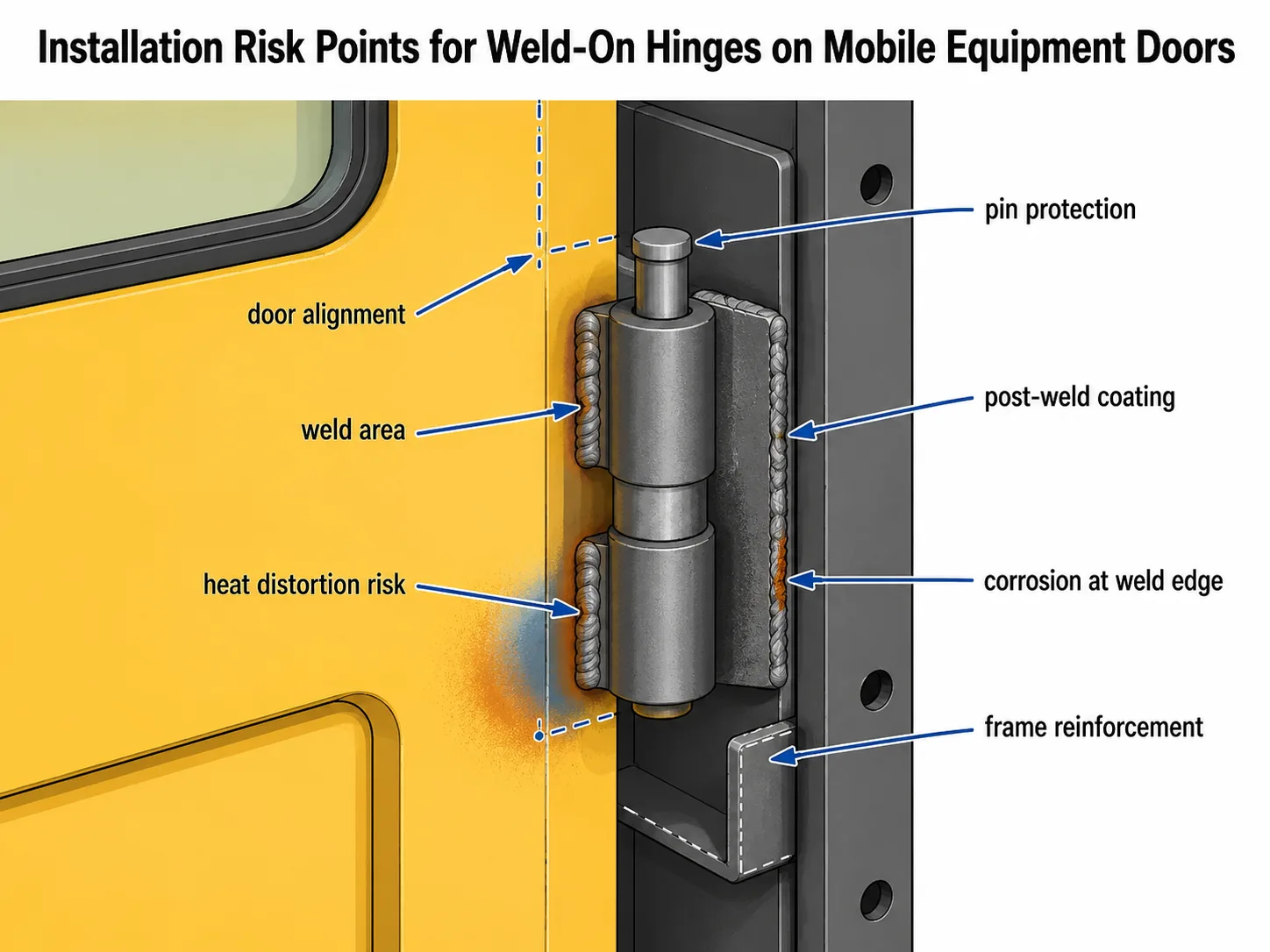
This guide does not replace a welding procedure specification. Welding parameters depend on material, thickness, joint design, equipment, filler metal, shop process, and qualification requirements. However, buyers and equipment builders should still specify the installation risks that affect hinge performance.
Distortion and Door Alignment
Heat distortion can shift hinge alignment and cause the door to bind, sag, or fail to latch correctly. Mobile equipment doors often need repeatable closure because the latch, gasket, or lock depends on consistent hinge-side alignment. The drawing or work instruction should define how alignment will be held and verified after welding.
Weld Quality and Load Path
A weld-on hinge transfers load into the parent metal. If the parent metal is too thin, poorly supported, contaminated, or poorly prepared, the hinge may not perform as intended. For load-bearing structural welds on service body frames, the fabrication should follow a qualified procedure aligned with AWS D1.1 Structural Welding Code — Steel, and buyers should confirm whether reinforcement plates, backing structure, or larger hinge leaves are needed for the door design.
Pin Protection and Serviceability
Hinge pin condition affects long-term operation. Dust, road debris, water, and corrosion can increase friction and make the door harder to open. Grease fittings, bushings, sealed pins, or removable pins may be needed depending on the service environment and maintenance plan.
Corrosion at the Welded Area
The welded area should not be treated as finished just because the hinge is attached. Cleaning, surface preparation, coating repair, and inspection should be part of the installation plan. This is especially important for service vehicles exposed to salt, rain, mud, or washdown cleaning.
Selection Table by Mobile Equipment Type
The table below gives a practical starting point for mobile equipment hinge selection. Final specification should still be based on door weight, door width, frame material, welding access, corrosion exposure, and the equipment builder’s design requirements.
| Mobile Equipment Type | Typical Door or Panel | Recommended Hinge Direction | Main Selection Concern |
|---|---|---|---|
| Service truck body | Tool compartment door | Carbon steel or stainless weld-on hinge | Vibration resistance and door alignment |
| Utility trailer | Side access door or rear panel | Weld-on or bolt-on depending on replacement needs | Frame material and future service access |
| Construction equipment | Engine or maintenance access panel | Heavy-duty weld-on hinge with serviceable pin design | Shock, dust, and repeated inspection access |
| Mobile generator enclosure | Large service door | Weld-on hinge or reinforced bolted hinge | Door weight, vibration, and gasket alignment |
| Dump body or heavy service body | Heavy side door or tailgate-related panel | Heavy-duty weld-on hinge system | Load path and structural reinforcement |
| Coastal service vehicle | External access compartments | SS316 weld-on hinge where compatible | Salt exposure and post-weld corrosion protection |
| Prototype or frequently modified vehicle | Removable or adjustable panel | Bolted hinge or hybrid welded backing plate | Future adjustment and replacement |
Common Mistakes When Specifying Weld-On Hinges
Mistake 1: Choosing Weld-On Only Because It Is “Stronger”
Weld-on hinges can be strong, but strength is not the only requirement. If the door must be adjusted, removed, replaced, or serviced quickly, a bolted or removable design may be more practical. The correct hinge attachment method depends on the complete door system.
Mistake 2: Ignoring Door Width and Leverage
A wide door can overload a hinge even if the door is not extremely heavy. Door width, center of gravity, hinge spacing, and latch location all affect how the hinge performs on mobile equipment.
Mistake 3: Welding Before Confirming Alignment
Once a hinge is welded, correcting alignment may require grinding and rework. Door fit, latch engagement, gasket compression, and clearance should be confirmed before final welding approval.
Mistake 4: Not Protecting the Weld Area After Installation
Corrosion often starts around exposed welds, damaged coatings, and unsealed edges. Post-weld cleaning and corrosion protection should be specified as part of the hinge installation, not left as an afterthought.
Mistake 5: Using the Same Hinge for Every Vehicle Door
Standardization can reduce inventory, but every vehicle door does not carry the same load or service risk. A small toolbox door, a generator service panel, and a heavy equipment access door may need different hinge sizes, pin designs, and materials.
When a Hybrid Mounting Approach Makes Sense
For mobile equipment, the weld-on versus bolt-on decision is rarely binary. A common middle ground is a welded backing plate combined with a bolted hinge: the welded plate gives the door a stronger load path into the body structure, and the bolted hinge can still be removed for field replacement without grinding out a weld. This works well for prototype builds, frequently modified service vehicles, and panels that must be replaced quickly while the equipment is in service.
The broader trade-off matrix between weld-on and bolt-on attachment — alignment adjustability, frame material compatibility, replacement effort — applies across all hinge applications, not just mobile equipment. For real-world failure patterns observed across weld-on installations of all types, the five common issues with weld-on hinges covers the recurring service problems and how to prevent them.
What to Send a Hinge Supplier Before Selection
To recommend the right weld-on hinge, a supplier needs more than a photo of the door. Provide the application conditions so the hinge can be matched to load, vibration, corrosion exposure, and service requirements.
- Vehicle or equipment type
- Door or panel weight
- Door width, height, and thickness
- Frame material and thickness
- Expected opening frequency
- Vibration or shock exposure
- Indoor, outdoor, coastal, washdown, or chemical exposure
- Need for removable pin, grease fitting, bushing, or sealed pin
- Whether the door may need future replacement
- Surface finish or post-weld coating requirement
For mobile equipment doors that must remain aligned under vibration, hinge selection should be reviewed together with the structure, latch, gasket, and maintenance plan. Treating the hinge as a small hardware part instead of a load-bearing access component is the most common reason for early service problems.
FAQ
Are weld-on hinges better than bolt-on hinges for service trucks?
Weld-on hinges are often better when the door is mounted to a steel structure and must resist vibration over long service life. Bolt-on hinges may be better when field replacement, adjustment, or removable panels are more important.
Can weld-on hinges be used on aluminum or composite service body panels?
Only if the structure is designed for it. Weld-on hinges require compatible weldable material and proper reinforcement. For aluminum or composite panels, a bolted hinge, reinforcement plate, or hybrid mounting design may be more practical.
What material is best for weld-on hinges on mobile equipment?
Carbon steel is common for painted steel service bodies and construction equipment. Stainless steel is preferred when corrosion exposure, coastal air, washdown cleaning, or road salt is part of the environment. The final choice should match the door frame, welding process, and finish system.
What are the main risks when installing weld-on hinges?
The main risks are heat distortion, poor alignment, weak welds, pin contamination, and corrosion at the weld area. The installation should follow the equipment builder’s drawing, qualified welding procedure, and post-weld protection requirements.
When should I avoid weld-on hinges for mobile equipment doors?
Avoid weld-on hinges when the panel material is not suitable for welding, when future door replacement is likely, when alignment must remain adjustable, or when welding access could damage nearby systems. In those cases, bolt-on, removable-pin, or hybrid mounting may be better.
Need Help Selecting Weld-On Hinges for Mobile Equipment?
If your project involves service trucks, trailers, construction equipment, mobile generator enclosures, or other mobile equipment doors, HTAN can help review the door weight, frame material, vibration exposure, corrosion environment, and service access requirements before selection. Share your door size, material, application environment, opening frequency, and preferred mounting method, and our engineering team can recommend a weld-on hinge direction or identify when a bolt-on or hybrid mounting approach may be safer.




 English
  한국어
한국어  Русский
  Español
  Italiano
  Deutsch
  Français
  Português