

Industrial Concealed Hinges: Types & Design Guide
In harsh industrial environments, a protruding hinge is not only an aesthetic flaw but also a potential safety hazard and failure point. The core definition of an industrial-grade concealed hinge lies in this principle: when the door is closed, all hinge components—leaves, pins, and fasteners—are hidden, forming a flush interface between the door and frame.
In million-dollar industrial equipment design, hinges are far from insignificant accessories. They directly influence door-closing reliability, enclosure protection ratings (IP/NEMA), long-term maintenance costs, and even a product’s perceived market value. Yet the choice between concealed and surface-mounted hinges remains poorly understood at the specification stage — leading to seal failures, unnecessary rework, and security vulnerabilities that could have been avoided entirely.
This guide systematically covers structural classifications, concealed vs. traditional performance comparisons, TCO financial analysis, materials science, torque calculations, and compliance with international standards (IP, NEMA, ATEX) — everything an engineer needs to make and defend this decision in a design review.
For a broader overview of concealed hinges used in industrial enclosures, security panels, and sealed access doors, see our complete concealed hinge guide.
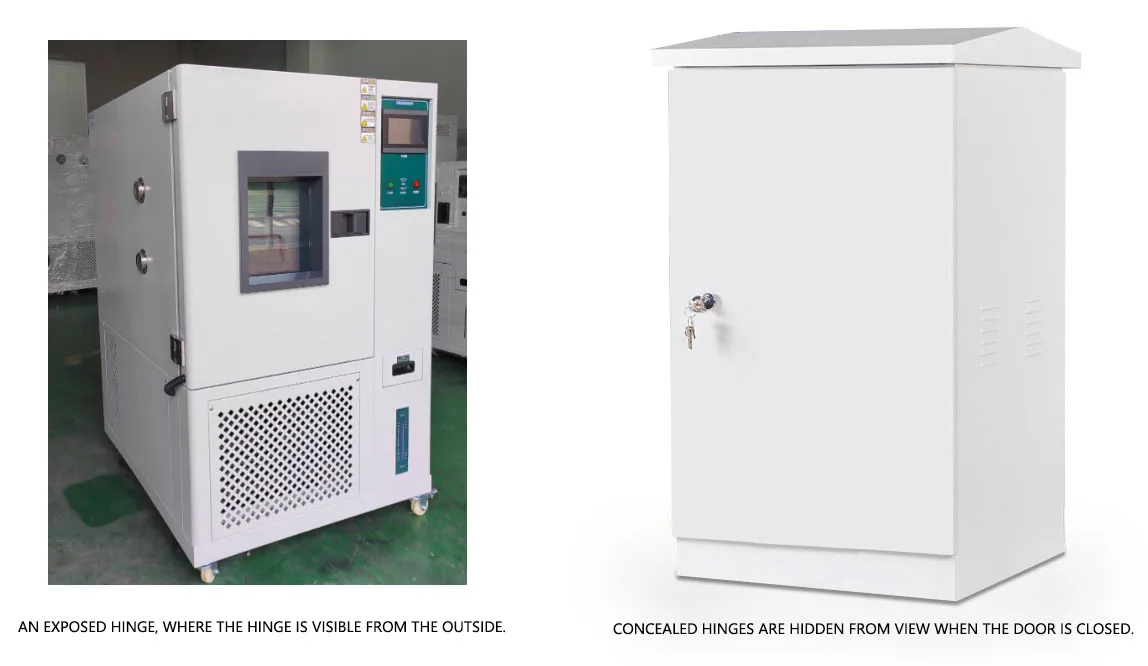
Definitions: Concealed vs. Surface-Mounted Hinges
Industrial Concealed Hinge
Definition: Mounted inside the door and frame, completely hidden when the door is closed. Uses multi-link or internal-shaft mechanisms, typically made from 304/316 stainless steel or high-strength zinc alloy. Designed to handle combined axial and radial loads; requires tight manufacturing and assembly tolerances.
Typical types: Multi-joint concealed hinges, mortise-mount hinges, internal surface-mount hinges, removable concealed hinges, 3D-adjustable hinges.
Field case: In a rail-transit inspection panel project, switching to 316 stainless concealed hinges improved the overall IP rating from IP54 to IP66 and reduced door vibration displacement by 18%.
Surface-Mounted (Exposed) Hinge
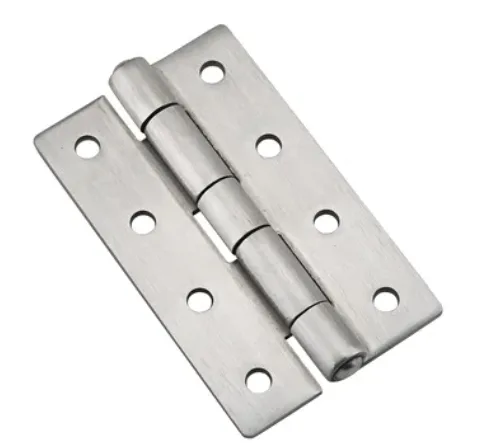
Definition: Installed on the outer surface of the door or frame, visible both when open and closed. Simple design with few components; easy to manufacture and replace. Suitable for welding, bolting, or riveting.
Typical types: Butt hinges, flag hinges, heavy-duty strap hinges, welded continuous (piano) hinges, heavy-duty bearing hinges.
Core Advantages Concealed Hinges Bring to Industrial Manufacturing
Security and Tamper Resistance
Concealed hinges provide dual-layer protection that surface-mounted designs cannot match:
Asset security: The hinge pin and mounting screws are completely enclosed within the door and frame. From the outside, there are no accessible points — no pry gaps, no removable pins — for forced entry. In public facilities like outdoor telecom cabinets or ATMs, an attacker needs only a screwdriver or cutting tool to defeat a surface-mounted hinge. According to EN 1627 burglar-resistance standards, the inaccessible concealed design significantly increases forced-entry time. This makes concealed hinges critical for protecting ATMs, data center servers, and critical infrastructure control panels.
Operational safety: OSHA 1910.212 requires machine guards to eliminate pinch or snag hazards caused by protruding parts. Traditional exposed hinges are a classic snag hazard, likely to catch on operators’ clothing or PPE. Concealed hinges eliminate these protrusions entirely, reducing the risk of tripping or entanglement.
Superior Environmental Sealing
This is the most dominant technical advantage of concealed hinges in industrial applications — it directly determines whether an electrical enclosure can achieve environmental protection certification.
Traditional exposed hinges must penetrate or interrupt the gasket seal, creating inevitable leakage points. Concealed hinges, mounted inside the gasket boundary, allow the gasket to form a complete closed loop around the door frame, ensuring uniform face sealing. Many industrial concealed hinges also include 3D adjustment (X/Y/Z axes), enabling installers to ensure consistent gasket compression around the entire perimeter (30–50% compression recommended) — critical for passing IEC 60529 (IP65/IP66) or NEMA 250 Type 4 water-tightness tests.
IP vs. NEMA Rating Comparison for Industrial Hinge Selection
| Protection Rating | IP Definition (IEC 60529) | NEMA Definition (NEMA 250) | Key Hinge Design Points |
|---|---|---|---|
| IP65 | 6: Dust-tight; 5: Low-pressure water jets | ≈ NEMA 3 | Continuous gasket sealing required |
| IP67 | 6: Dust-tight; 7: Temporary immersion | ≈ NEMA 6 | Hinge must be inside gasket loop |
| NEMA 4 | ≈ IP66 | Rain, snow, high-pressure water | Must withstand freezing stress |
| NEMA 4X | ≈ IP66 | Adds corrosion resistance | Use SUS304 / SUS316 |
| NEMA 6P | ≈ IP68 | Prolonged immersion | Must endure continuous water pressure |
| NEMA 12 | ≈ IP54 | Indoor dust & drip protection | Zinc alloy or steel recommended |
Space Efficiency and Hygienic Design
Space efficiency: Concealed hinges eliminate external protrusions, allowing enclosures to be placed side by side with zero clearance, maximizing layout density. In high-density data centers where cabinets are ganged into continuous walls, surface-mounted hinges create gaps between units and disrupt the layout. Concealed hinges enable true zero-clearance installation.
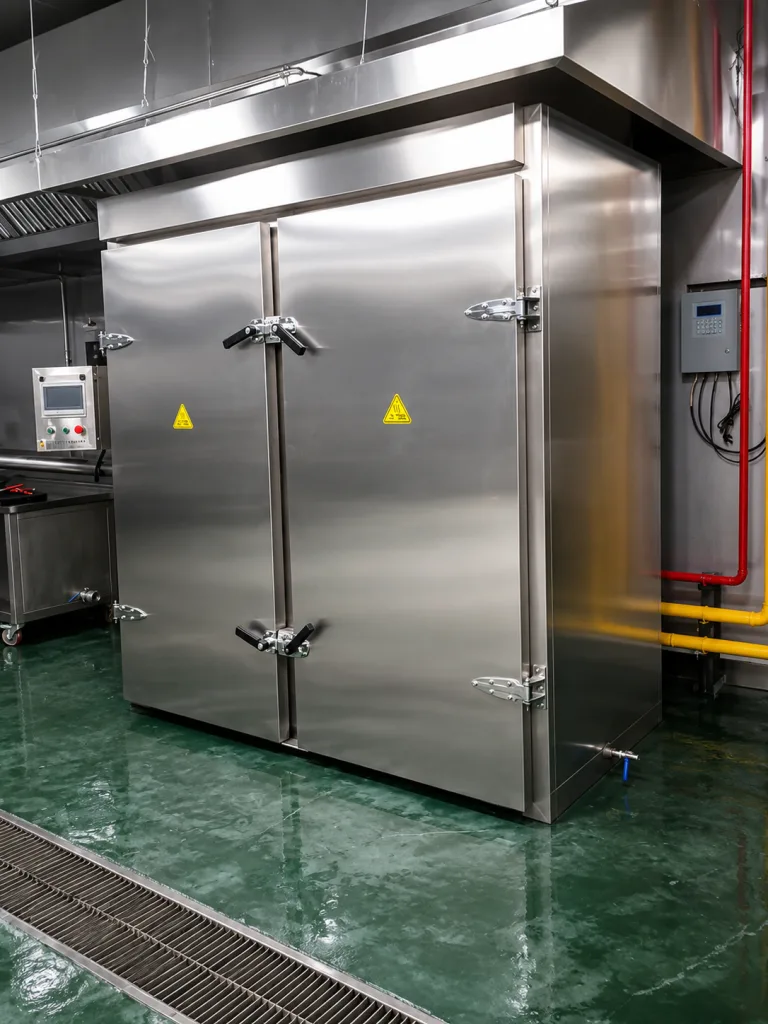
Hygienic design: In food and pharmaceutical industries, exposed hinges trap contaminants in complex geometric crevices. Concealed hinges provide smooth, flush surfaces that can be high-pressure washed, meeting strict hygienic design requirements. Certification is required to verify full cleanability.
Enhanced Durability and Structural Integrity
Hinge bodies are protected within the door and frame, shielded from physical impacts, corrosion, and environmental wear. Surface-mounted hinges are directly exposed to rain, salt spray, and dust, requiring more frequent maintenance and replacement. Mortise-mounted concealed hinges distribute loads internally, improving rigidity, load capacity, and anti-sag performance.
Concealed vs. Traditional Hinges: Key Performance Comparison
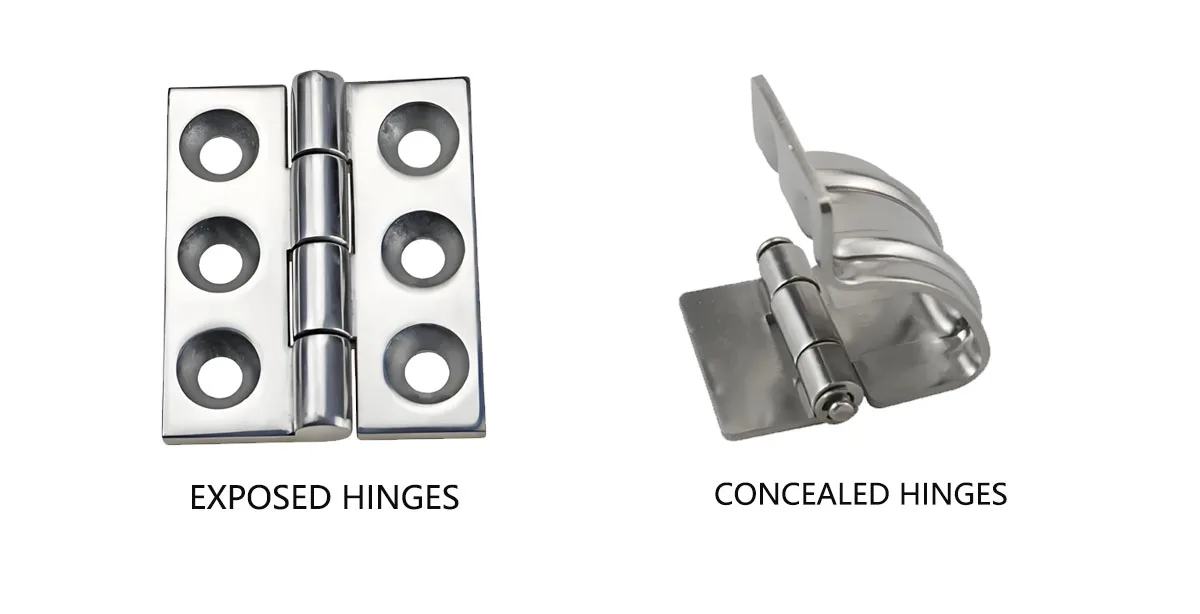
| Characteristic | Industrial Concealed Hinge | Industrial Traditional (Exposed) Hinge |
|---|---|---|
| Safety / Tamper Resistance | ★★★★★ | ★★★ |
| Load Capacity | ★★★★ | ★★★★★ |
| IP Protection / Sealing | ★★★★★ | ★★★ |
| Appearance / Concealment | ★★★★★ | ★★★ |
| Installation Complexity | High (precision machining required) | Low (welding/bolting) |
| Maintenance Convenience | Low (hard to access) | High (easy to replace) |
| Corrosion Risk | Low (protected inside enclosure) | High (directly exposed) |
When traditional hinges win: Welded or continuous hinges with pin-and-bearing structures withstand extremely high static and dynamic loads, making them ideal for heavy machinery, warehouse doors, and mining vehicles where load-bearing, maintenance ease, and cost are the top priorities. See our complete weld-on vs. bolt-on hinge guide for heavy-duty applications.
TCO Analysis: Why Concealed Hinges Are Often the Economical Choice
Many decision-makers fall into a specific trap: they only compare the unit price difference on the BOM. They ignore the massive risks hidden behind the lower price tag. TCO includes not only purchase price, but also installation effort, maintenance cost, downtime risk, and lifecycle value.
Initial Procurement Cost
Surface-mounted hinges are usually cheaper — the price difference can range from 30% to 200% depending on material. However, to compensate for surface-mounted deficiencies such as security and sealing, you may need to purchase additional security screws, protective covers, or anti-tamper hardware. Once these accessories are included, the price gap narrows significantly.
Installation and Assembly Efficiency
Surface-mounted hinges require drilling holes in door and frame surfaces, adding processing steps and risking scratches to anti-corrosion coating — leading to manual touch-up work. Many modern industrial concealed hinges use quick-install technology that allows assembly-line workers to complete installation in seconds without tools, significantly reducing labor costs despite requiring more upfront CAD clearance calculation.
Maintenance and Replacement Costs
Surface-mounted hinges on outdoor equipment require periodic rust removal or replacement. Every on-site maintenance trip incurs travel and downtime cost. Concealed hinges, protected by the enclosure’s sealing system, often match the service life of the enclosure itself and require far less intervention.
Brand Value and Pricing Power
This is a soft cost that is consistently underestimated. Equipment using concealed hinges looks cleaner and carries a modern industrial aesthetic. If you are selling precision medical or industrial instruments at a $50,000+ price point, cheap protruding butt hinges directly damage the customer’s perception of overall quality. The premium pricing power enabled by concealed design often far exceeds the cost of the hinge itself.
| Cost Category | Concealed Hinge | Surface-Mounted Hinge |
|---|---|---|
| Purchase Cost | High | Low |
| Installation Cost | Low–Medium (quick-install) / High (mortise CNC) | Medium (drilling, coating touch-up) |
| Maintenance Cost | Low (protected, rarely replaced) | High (exposed, periodic rust/replacement) |
| Security Add-ons | None needed | Often required (padlocks, security screws) |
| Brand Value Impact | Positive (premium perception) | Neutral to negative |
| 10-Year TCO | Lower in most industrial contexts | Higher than unit price suggests |
Field insight: In high-security environments requiring IP/NEMA compliance, concealed hinges offer greater lifecycle value. In high-load or high-frequency applications where maintenance access is easy, traditional hinges deliver superior cost-performance.
Core Classifications of Industrial Concealed Hinges
Multi-Link Heavy-Duty Concealed Hinges
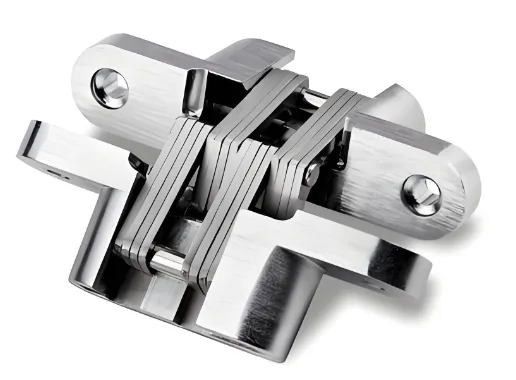
- Structure: Multiple precision links and pins forming a complex mechanism.
- Motion: Translation then rotation; verify motion path using manufacturer CAD files.
- Applications: 180° doors, thick panels, data center cabinets requiring full door opening in narrow aisles.
- Pros/Cons: High load capacity and opening angle; higher cost; requires precision installation.
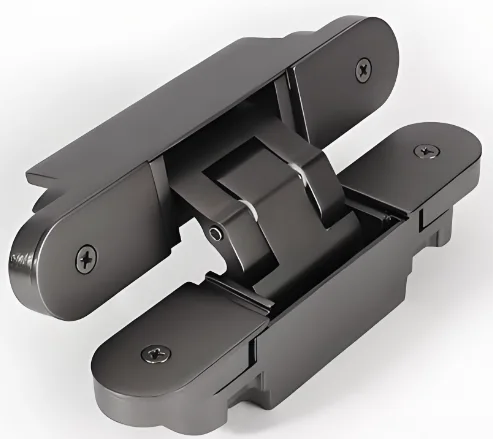
Mortise-Mount Concealed Hinges
- Structure: Fully embedded into recesses machined into door and frame.
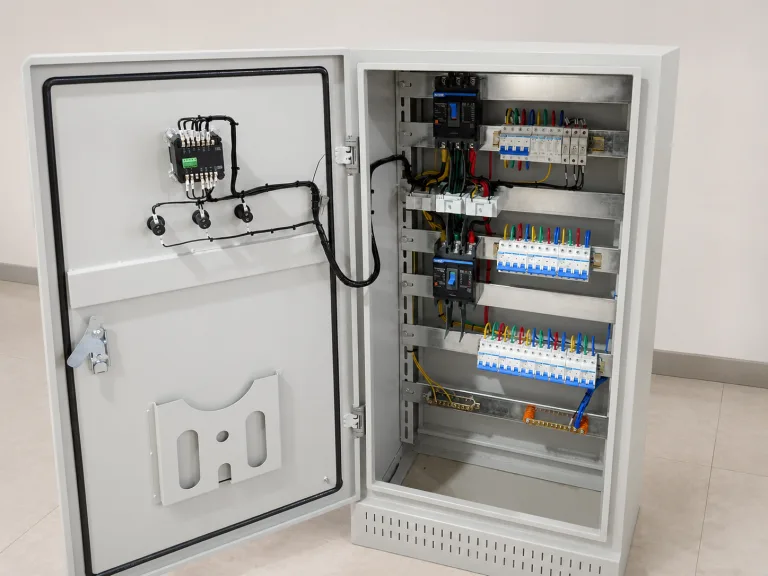
- Applications: Most common type for medium to heavy-duty enclosures; electrical control cabinets.
- Pros/Cons: Excellent structural stability and load distribution; requires precise CNC machining.
Internal Surface-Mount Concealed Hinges
- Structure: Mounted on interior surfaces of door and frame without requiring machined recesses.
- Applications: Thin sheet-metal enclosures (1.5–2.5 mm wall thickness).
- Pros/Cons: Easy installation; limited load-bearing capacity compared to mortise designs.
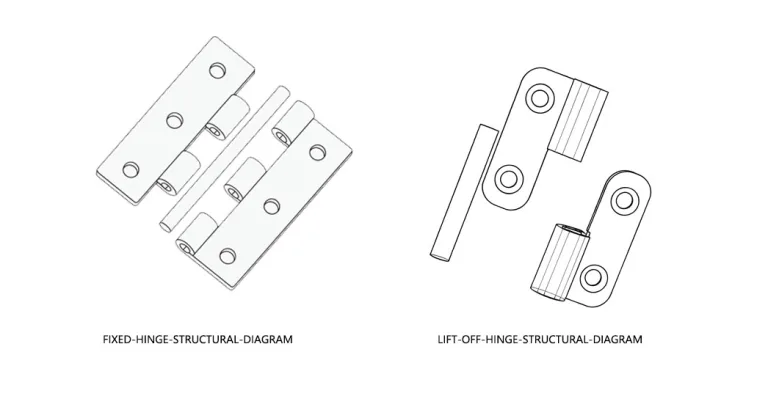
Removable Concealed Hinges
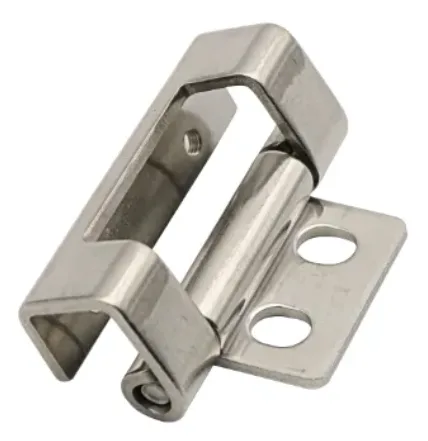
- Structure: Two-part flag design; door panel lifts off the hinge at a specific angle.
- Applications: Server cabinets, medical device panels, and any application requiring frequent complete door removal. See our lift-off hinge complete guide for detailed selection guidance.
- Pros/Cons: Improves serviceability and reduces MTTR; slightly lower tamper resistance than fixed designs.
3D Adjustable Concealed Hinges
- Feature: Fine-tuning on X, Y, Z axes (±2 mm typical) after installation.
- Importance: Critical for maintaining consistent gasket compression and IP/NEMA ratings in large assemblies where manufacturing tolerances accumulate. Without 3D adjustment, achieving IP66 on large enclosure doors is extremely difficult.
Typical Industrial Application Scenarios
| Application | Core Challenge | Recommended Hinge Type |
|---|---|---|
| Electrical control cabinets (NEMA/IP) | Environmental sealing (IP65/IP67), tamper resistance | Mortise or surface-mount concealed; 3D adjustment; SUS316 for NEMA 4X |
| Heavy machinery guards | Heavy doors, vibration, OSHA compliance | Multi-link concealed; anti-loosening fasteners; detent function |
| Data center server cabinets | Secure access, airflow management, narrow aisles | 180° multi-link or removable concealed hinges |
| Outdoor infrastructure (EV charging, 5G, traffic) | Anti-vandalism, NEMA 4X, salt spray | Concealed hinges in 316L SS; NEMA 4X rated |
| Food / pharmaceutical equipment | Cleanability, hygienic design | 316 SS concealed hinges with hygienic surface design |
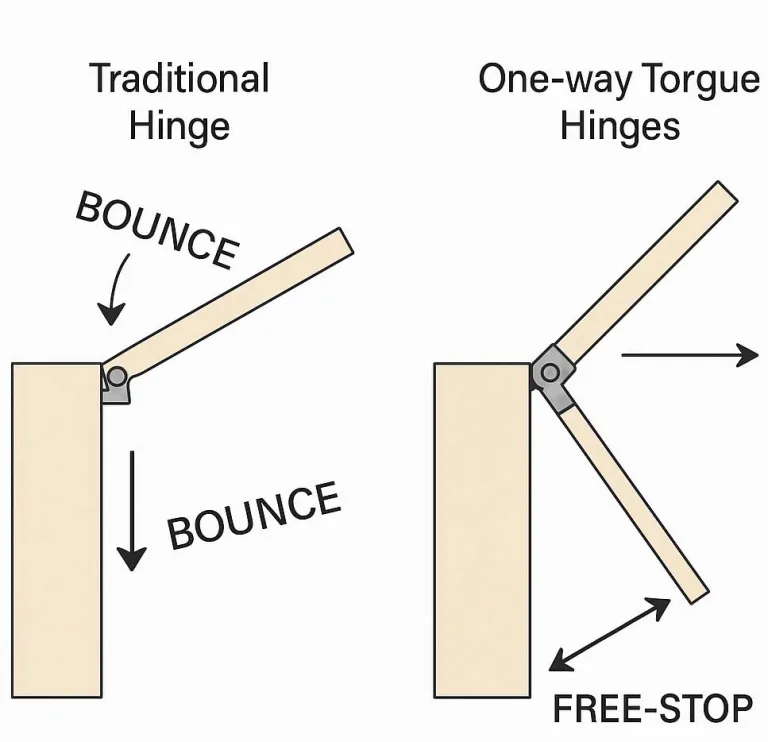
| Special vehicles (RVs, construction) | Continuous vibration, temperature cycling | EN 61373 compliant; aluminum or SS; consider torque-type support where vibration control is needed |
| ATEX / explosive environments | Spark prevention, zone compliance | Certified concealed hinge designs for hazardous environments |
Decision Matrix: When to Choose Which Solution
| Requirement / Scenario | Surface-Mounted | Concealed | Better Choice |
| Load capacity >200 kg | ✓ Welded/continuous | Requires multi-link heavy-duty | Surface (simple cases) |
| IP65 / IP66 / IP67 certification required | Risk of leakage at gasket | ✓ Continuous gasket loop | Concealed |
| Anti-tamper / high security | Exposed pins — vulnerable | ✓ No external attack points | Concealed |
| Zero-clearance cabinet ganging | Creates gaps between units | ✓ Flush installation | Concealed |
| Hygienic / cleanroom environments | Crevice contamination risk | ✓ Flush, washable surface | Concealed |
| Lowest initial unit cost | ✓ Cheaper per piece | Higher unit cost | Surface |
| Field maintenance without shutdown | ✓ Easy access and replace | Difficult to access | Surface |
| Premium product perception | Industrial/rough appearance | ✓ Clean, modern aesthetic | Concealed |
| 10-year TCO in outdoor/industrial use | Higher (maintenance, rust) | ✓ Lower (protected lifespan) | Concealed |
Ultimate Selection Guide: Load, Motion, Material, Installation
Step 1 — Accurately Calculate Load Requirements
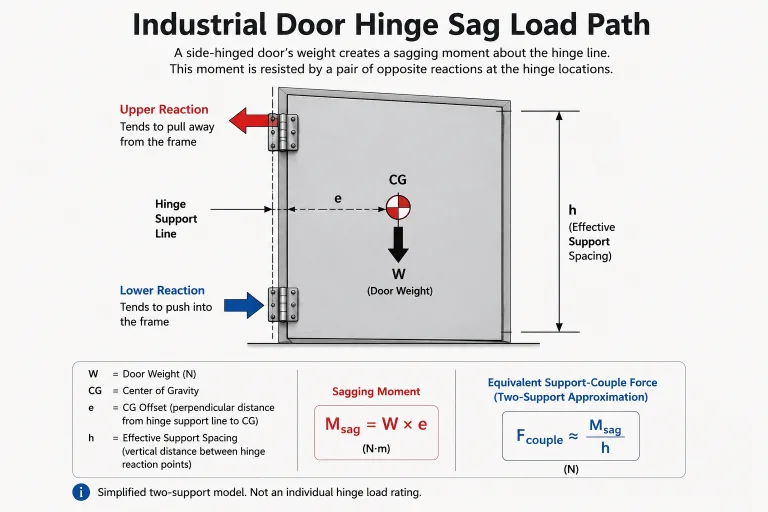
A common mistake is selecting hinges solely by door weight. The correct calculation uses torque:
Torque formula: M = F × D
- M = Torque (N·m)
- F = Door weight converted to force: F (N) = Mass (kg) × 9.8 m/s²
- D = Lever arm = Door width / 2 (m)
Example: 40 kg door, 1.0 m wide → F = 40 × 9.8 = 392 N → D = 0.5 m → M = 392 × 0.5 = 196 N·m
Distribute the total torque across the number of hinges used, then apply a safety factor of ≥ 1.5×. Verify that each hinge’s rated thrust and radial load exceed the calculated values. For a comprehensive calculation framework, see our torque hinge calculation and selection guide.
Step 2 — Determine Motion Path and Opening Angle
| Opening Angle | Application | Note |
|---|---|---|
| 90° | Standard small access panels | Basic clearance only |
| 120° | Most industrial cabinets | Best balance of access and space |
| 180° | Data centers, heavy access doors | Maximum opening; check aisle clearance |
For multi-link concealed hinges, the center of rotation is a virtual point defined by the mechanism — incorrect modeling leads to collision between door and frame during opening. Always verify using the manufacturer’s CAD motion files before finalizing installation dimensions. Engineering warning: forcing a hinge beyond its design angle limit causes permanent damage.
Step 3 — Match Materials to Environment and Standards
| Material | Standard | Core Properties | Typical Application |
|---|---|---|---|
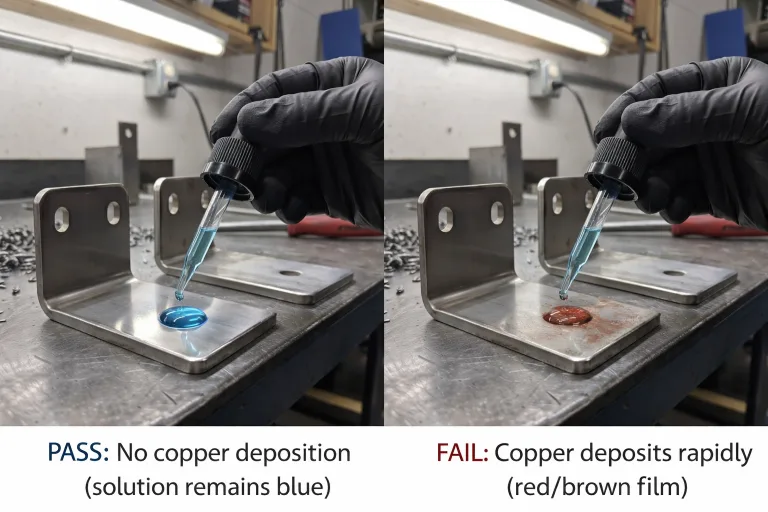
| 316/316L Stainless Steel | ASTM A240 / EN 1.4401 | Superior corrosion resistance; 1,000+ hr salt spray | NEMA 4X, marine, medical, coastal |
| 304 Stainless Steel | ASTM A240 / EN 1.4301 | Good corrosion resistance | Food processing, humid, outdoor |
| Zinc Alloy (Zamak) | ASTM B86 | Cost-effective, complex shapes via casting | NEMA 1/12 indoor, general commercial |
| Carbon Steel (coated) | Steel + protective finish | High strength; requires coating | Dry indoor machinery, low-cost projects |
For a deep-dive comparison of zinc die-cast vs. stainless steel concealed hinges including failure mode analysis and procurement guidance, see our zinc vs. stainless steel concealed hinge sourcing guide.
Step 4 — Choose Installation Method
- Mortise (CNC machined): Best for permanent installations and heavy-duty assemblies. Maximum structural integrity; requires precision machining capability.
- Screw-mounted (surface internal): Best for modular designs, adjustable enclosures, or applications where easy maintenance and serviceability are required. Use 3D-adjustable designs to compensate for assembly tolerances.
For large assemblies, always select 3D-adjustable hinges to correct misalignment and ensure uniform gasket compression. Tighten fasteners to specified torque using a torque wrench; apply thread-locking compound or lock washers to prevent vibration-induced loosening.
Selection Self-Checklist for Design Reviews
Use this checklist during DFMEA to ensure hinge selection is integrated into risk management early:
- Is security or load capacity the top priority for this application?
- Does the application require a specific IP or NEMA rating? If IP65 or above, concealed is often the better direction.
- Does product appearance affect perceived market value or command a price premium?
- Does your manufacturing process support CNC machining for mortise installation?
- What is the expected maintenance frequency? Will technicians need to access the hinge for service?
- Which is more critical: long-term downtime cost or initial purchase cost?
- Have you verified the 10-year TCO, not just the BOM unit price?
Common Troubleshooting
Q: The door is sagging — what should I do?
- Recalculate required torque using M = (m × g) × (D / 2) and verify the hinge’s rated load is sufficient.
- If the load exceeds the hinge’s capacity, upgrade to a higher-rated model.
- If load is within spec, check fastener tightness and substrate integrity. For a complete diagnosis framework see our hinge sag diagnosis and prevention guide.
Q: Why is my IP rating failing after installation?
- Verify gasket compression: Check that the gasket is compressed evenly and sufficiently around the entire perimeter.
- Adjust alignment: On 3D-adjustable hinges, use the depth adjustment to ensure the door seals flush against the frame.
- Inspect gasket integrity: Check for breaks, tears, or gaps at seams that would compromise the seal.
Q: Since the hinge is hidden inside, can I use carbon steel instead of stainless?
Not always. Although the internal environment is better protected, condensation can still occur inside cabinets — especially in equipment that cycles between heated and cooled states. For general indoor applications, zinc-plated carbon steel or zinc alloy may be acceptable. For coastal, high-humidity, or chemical environments, even internal concealed hinges should use 304 or 316 stainless steel to prevent long-term corrosion and seizure.
Q: Is the load capacity of concealed hinges really lower than surface hinges?
Not necessarily. While surface hinges are structurally simpler and bulkier for the same volume, modern industrial-grade concealed hinges using high-strength steel and optimized link structures can support very substantial panel weights. Always check the radial and axial load data in the product datasheet and maintain a practical safety factor.
Q: Concealed hinges occupy internal cabinet space — what if equipment doesn’t fit?
This is a valid concern. During the CAD design phase, import the 3D model provided by the hinge manufacturer to simulate the full motion path. For extremely space-constrained cabinets, choose offset concealed hinge designs or flat-structure link hinges to minimize internal intrusion.
Conclusion
Concealed and traditional hinges are not a matter of absolute superiority — the optimal choice depends on application requirements, engineering constraints, and lifecycle cost weighting.
- When safety, IP/NEMA protection, appearance, and long-term TCO are priorities → choose concealed hinges.
- When maximum load-bearing, easy field maintenance, and lowest initial cost matter most → choose traditional surface-mounted hinges.
We recommend conducting a comprehensive TCO evaluation and running the self-checklist above during the design-in phase — not after seal failures or vandalism issues surface in production. For custom specifications or engineering consultation on concealed hinge selection for your enclosure project, contact the HTAN engineering team directly.

 English
  한국어
한국어  Русский
  Español
  Italiano
  Deutsch
  Français
  Português