

Best Hinges for Electrical Panels: Selection Guide
Choosing a hinge for an electrical panel is not the same as choosing one for a general cabinet. The door on a distribution board, control panel, or outdoor power enclosure has to do more than swing open — it has to keep a gasket sealed against dust and water, sometimes carry a bonded ground path, resist tampering, survive vibration, and still let a technician get inside fast when something needs service. Pick the wrong hinge and the failure shows up where the consequences are most expensive: a broken seal that lets moisture reach live components, a sagging door that fails an IP test, or a panel that becomes difficult and time-consuming to service. This guide walks through what actually matters when selecting electrical panel hinges, and which hinge type fits which situation.
Quick Answer: What Hinge Is Best for an Electrical Panel?
For most electrical panels, the best hinge is the one that matches the enclosure’s protection rating and service needs. Concealed hinges suit sealed, tamper-sensitive enclosures that must hold an IP or NEMA rating. Weld-on or heavy external hinges suit large, heavy steel cabinets where strength and security come first. Lift-off hinges suit panels that need frequent door removal for wiring or maintenance. In every case, the hinge must be sized to the real door weight, made from a material that survives the installation environment, and chosen so it does not break the gasket seal that protects the components inside.
Those are the headline matches. The rest of this guide explains the decision factors behind them, because the right answer depends on how your panel is sealed, secured, grounded, and serviced.
| Panel Priority | Better Hinge Direction |
|---|---|
| IP / NEMA sealing | Concealed hinge or a sealed hinge layout |
| Tamper resistance | Concealed or weld-on hinge |
| Heavy steel door | Weld-on or heavy-duty external hinge |
| Frequent door removal | Lift-off hinge |
| Tall door needing load distribution | Continuous (piano) hinge |
| Outdoor / coastal exposure | 304 or 316 stainless, depending on exposure |
| Door bonding required | Add a grounding strap; do not rely on the hinge alone |
Why Electrical Panels Are a Special Case
A general equipment door may tolerate a hinge that is mechanically adequate. An electrical enclosure cannot, because the hinge is tied to outcomes that go well beyond holding the door. Four of these matter more than anything else.
- The seal depends on the hinge. If the hinge lets the door sag even slightly, gasket compression becomes uneven and the enclosure can drop below its rated IP or NEMA protection — letting in the dust and moisture that damage live components.
- Safety and security are at stake. Panels protect energized parts and high-value equipment. Exposed pins or removable hardware can become a tamper or intrusion point, which is why many electrical enclosures favor concealed or tamper-resistant designs.
- Grounding continuity can run through the door. On many panels the door itself must be bonded to the enclosure ground. The hinge and its hardware are part of how that continuity is maintained, so the connection cannot be an afterthought.
- Service access is constant. Electricians open these doors to wire, inspect, and troubleshoot. A hinge that holds the door at a usable angle, or lets it be removed entirely, directly affects how safely and quickly that work gets done.
Every selection factor below traces back to one of these four pressures. Keep them in mind and the choice becomes much clearer.
Sealing: Protecting the IP / NEMA Rating
For any sealed electrical enclosure, the hinge and the gasket work as a system. A rated enclosure earns its IP or NEMA number only if the gasket stays evenly compressed all the way around the door — and that depends on the door staying square to the frame for the life of the product.
This is where hinge choice becomes a sealing decision. A concealed hinge mounted inside the gasket boundary helps preserve an uninterrupted gasket path around the door, while an external hinge that penetrates or interrupts the seal line introduces a potential leak point that has to be managed. Where large doors or thermal cycling can shift alignment over time, a hinge with built-in adjustment helps keep gasket compression correct without a full re-fit. That said, the hinge is only one part of the equation: the final IP or NEMA rating depends on the complete enclosure design — gasket compression, latch force, mounting holes, and the tested assembly as a whole — not on the hinge alone.
The failure chain is worth stating plainly: a hinge that allows sag leads to uneven gasket compression, which breaks the seal, which lets moisture and dust reach the components — turning a small hardware choice into a protection-rating failure. For the deeper relationship between hinge type, sealing, and protection ratings across enclosure styles, see our guide to industrial enclosure hinges.
Security and Tamper Resistance
Electrical panels guard energized equipment, and in many settings they sit in public, outdoor, or shared-access locations. That makes the hinge a security component, not just a mechanical one.
An exposed hinge with an accessible pin can, in the wrong location, become a way to defeat the door without touching the lock. Concealed hinges remove that exposure entirely: with the pin and fasteners hidden inside the closed door, there is no external pry point or removable pin to attack, which is why they are common on outdoor power cabinets and other tamper-sensitive panels. Weld-on hinges take a different route to the same goal — a permanent welded connection with no bolts to loosen or remove, giving maximum strength and pry resistance on heavy steel cabinets. The trade-off is that a welded hinge cannot be adjusted or removed later, so it suits permanent installations rather than panels you expect to re-fit.
If security and a hidden, flush appearance are the priority, our industrial concealed hinge guide covers the tamper-resistant designs in more depth.
Grounding and Electrical Continuity
This factor is unique to electrical work and easy to overlook. On many panels, the door carries mounted components or simply needs to be bonded to the enclosure ground for safety. The question becomes: is the ground path carried by a dedicated bonding strap, or is it expected to run through the hinge?
The safe, standard practice is not to rely on a hinge as the primary ground path. A hinge has a pivoting interface with finishes, coatings, lubricant, and wear that can all raise or vary the resistance across the joint over time — none of which you want in a safety-critical bond. The common approach is a dedicated grounding strap or jumper between the door and the body, with the hinge providing the mechanical connection and the strap providing the reliable electrical one. When you specify the hinge, confirm with your panel’s electrical requirements how door bonding is handled, and leave room for a bonding strap if one is required.
Service Access and Maintenance
Electrical panels are opened far more often than most equipment doors — for wiring changes, inspections, thermal scans, and troubleshooting. How the hinge handles that routine access affects both technician safety and downtime.
Two needs come up repeatedly. First, the door often has to stay open at a usable angle so a technician can work with both hands inside the panel — a wider opening angle, or a hinge that holds position, makes that safer. Second, on panels that are serviced heavily or need the door fully out of the way for backplane access, the ability to remove the door entirely is a real advantage. Lift-off hinges let a technician take the door off without tools and reinstall it in seconds, which speeds up maintenance and reduces the risk of a heavy door getting in the way during live work. For panels where removability is a priority, our complete guide to lift-off hinges explains where that design fits and where it does not.
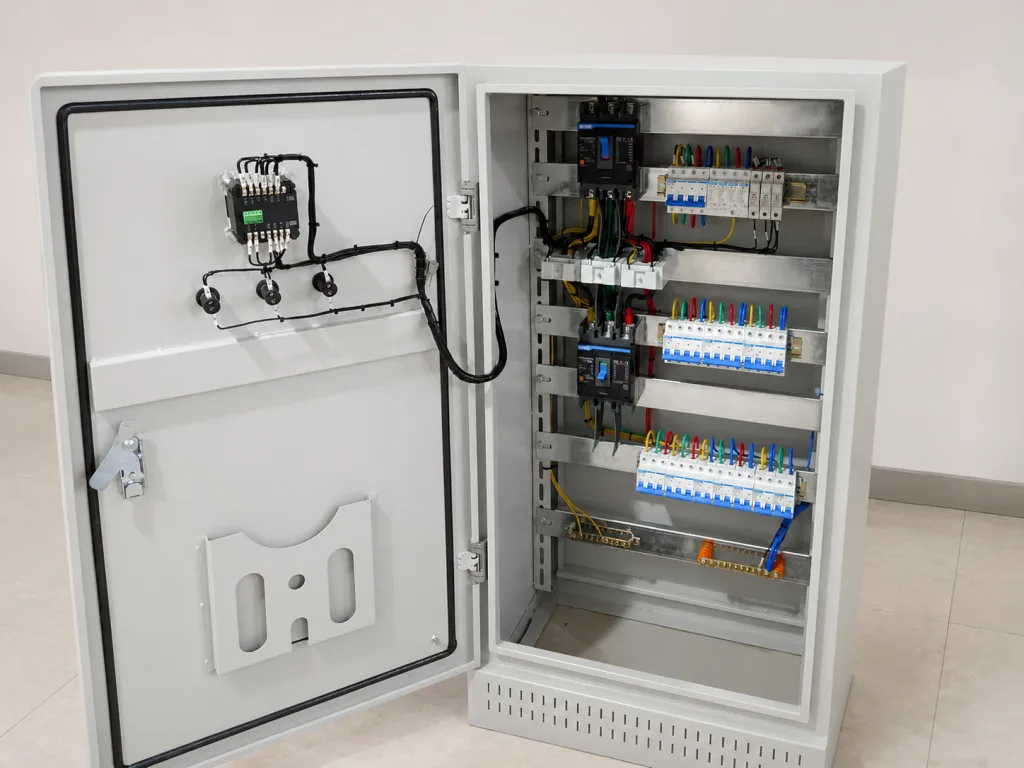
The caution here: removability and tamper resistance pull in opposite directions. A door that lifts off easily for service is also easier to remove without authorization, so on security-sensitive panels a lift-off design may need additional latching or locking to balance the two.
In our own electrical-cabinet work, this is one of the most requested features: the lift-off hinges we supply for distribution and control cabinets (such as our XG02-022-2 series) use a standard M5 screw-mount pattern so the door can be lifted off and re-hung in seconds without tools. This particular series is a zinc alloy design with a black finish, which suits cost-sensitive indoor panels well; for corrosion-prone, washdown, or outdoor installations, a stainless steel hinge is the safer material choice. Matching the material to the environment matters as much here as it does anywhere else on the enclosure.
Load, Vibration, and Door Size
Electrical panel doors are often heavier than they look. A steel door loaded with a mounted display, controls, or backplane components, plus a gasket that adds closing resistance, can place real demand on the hinges — and that demand grows with door width, because a wide door creates a larger moment around the hinge line even at the same weight.
-
- Size to the full assembled door, including mounted components and gasket load, not the bare panel.
-
- Account for door width, since a wide door multiplies the leverage on the hinges even when the weight is moderate.
-
- Use enough hinges. Tall or heavy doors need more than two hinge points to distribute load and keep the door square so the gasket seals evenly.
-
- Plan for vibration. In equipment that vibrates, fasteners can loosen over time; welded or continuous designs resist this better, and thread-locking helps on bolted hinges.
For large, heavy steel cabinets where strength and permanence are the priority, weld-on hardware is a common answer; you can see typical heavy-duty configurations in our weld-on hinge range.
Material Selection by Environment
Where the panel lives decides the hinge material, and the stakes are higher than appearance — a corroded hinge that seizes or fails can break the seal that keeps an electrical enclosure safe.
| Environment | Suggested Material | Why |
|---|---|---|
| Indoor, dry, controlled | Zinc-plated or powder-coated steel | Cost-effective where corrosion risk is low |
| General outdoor / humid | 304 stainless steel | Good corrosion resistance for non-coastal outdoor use |
| Coastal, marine, chemical | 316 stainless steel | Molybdenum resists chloride pitting that defeats 304 |
| Washdown or food-adjacent | 304 or 316 stainless steel | Cleanable and corrosion-resistant under frequent washing |
For outdoor power cabinets in coastal or chemical settings, 316 stainless is usually worth the premium: the cost of a corroded hinge that compromises the enclosure seal — and the components behind it — far exceeds the material saving of a lower grade. Final material selection should still be confirmed against the project environment, exposure duration, cleaning method, and the customer’s enclosure specification.
Matching Hinge Type to Panel Type
Pulling the factors together, here is how the common hinge types line up with electrical panel needs.
| Hinge Type | Best For | Watch Out For |
|---|---|---|
| Concealed hinge | Sealed, tamper-sensitive panels needing IP/NEMA and a flush look | Requires precise machining; higher cost |
| External (surface) hinge | General indoor panels, wide service angles, easy replacement | Exposed pin can be a tamper/seal concern |
| Weld-on hinge | Heavy steel cabinets where strength and permanence lead | Cannot adjust or remove after welding |
| Lift-off hinge | Panels needing frequent full door removal for service | Easier unauthorized removal; may need extra locking |
| Continuous (piano) hinge | Tall doors and heavy monitors needing distributed support | Heavier and less suited to frequent removal |
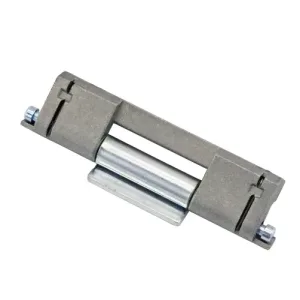
Most real selections come down to a trade-off between sealing and security on one side, and service access on the other. Decide which of the four pressures — seal, security, grounding, service — dominates your panel, and the hinge type usually follows.
Common Mistakes to Avoid
-
- Treating the hinge as separate from the seal. On a rated enclosure, hinge sag is a sealing failure waiting to happen. Specify the hinge and gasket as one system.
-
- Relying on the hinge as the ground path. Use a dedicated bonding strap for door grounding; do not assume the hinge provides reliable continuity.
-
- Sizing by bare door weight. Include mounted components, gasket load, and door width in the calculation, and use enough hinge points.
-
- Ignoring tamper exposure. In public or outdoor locations, an accessible pin can defeat the door; choose concealed or tamper-resistant designs where security matters.
-
- Under-specifying the material. A hinge that corrodes in a coastal or washdown setting can seize and break the enclosure seal. Match the grade to the environment.
Frequently Asked Questions
What type of hinge is best for an electrical panel?
It depends on the panel’s priorities. Concealed hinges are best for sealed, tamper-sensitive enclosures that must hold an IP or NEMA rating. Weld-on hinges suit heavy steel cabinets where strength and permanence lead. Lift-off hinges suit panels needing frequent door removal for service. In all cases the hinge must be sized to the full door weight, made from a material suited to the environment, and chosen so it keeps the gasket sealed.
How does the hinge affect an enclosure’s IP or NEMA rating?
The rating depends on even gasket compression all around the door, and that depends on the door staying square to the frame. A hinge that sags causes uneven compression and can drop the enclosure below its rated protection. Concealed hinges mounted inside the gasket boundary help preserve an uninterrupted gasket path, but the final rating depends on the complete tested enclosure, not the hinge alone.
Should the hinge be used as the door’s ground connection?
No. A hinge has finishes, lubricant, and wear at the pivot that can make its resistance vary over time, which is not acceptable for a safety-critical bond. Use a dedicated grounding strap or jumper between the door and the enclosure body, with the hinge providing the mechanical connection and the strap the reliable electrical one.
What hinge material should I use for an outdoor electrical cabinet?
For general outdoor use, 304 stainless steel offers good corrosion resistance. For coastal, marine, or chemical environments where chlorides are present, 316 stainless steel is the safer choice because its molybdenum content resists pitting. The cost of a corroded hinge that breaks the enclosure seal far outweighs the material premium.
Are concealed hinges more secure for electrical panels?
Yes, in tamper-sensitive locations. Concealed hinges hide the pin and fasteners inside the closed door, so there is no external pry point or removable pin to attack. This makes them common on outdoor power cabinets and panels in public or shared-access areas. Weld-on hinges also offer high security through a permanent connection with no removable hardware.
Specifying the Right Electrical Panel Hinge
The best hinge for an electrical panel is the one that protects the seal, suits the security level, allows proper grounding, and supports the way the panel is serviced — all while carrying the real door load in its actual environment. Start from how the panel is sealed and secured, confirm how the door is grounded, decide how often it needs to be opened or removed, then match the hinge type and material to those answers. Get that sequence right and the hinge stops being a weak point and becomes part of what keeps the enclosure safe and reliable.
If you are specifying hinges for a distribution board, control cabinet, or outdoor power enclosure, HTAN can help match the type, material, sealing, and mounting to your panel. Share the door size and weight, protection rating, environment, and security needs, and our team can recommend a suitable configuration. Contact HTAN to start a selection review.


 English
  한국어
한국어  Русский
  Español
  Italiano
  Deutsch
  Français
  Português