

Long Outdoor Cabinet Door Sag: When Continuous Hinges Help
A long outdoor cabinet door may look acceptable after installation, but the problem often appears later. The latch corner begins to drop. The door needs to be lifted before closing. The gasket no longer seats evenly along the frame. After rain, dust, or condensation, technicians may find water tracks near the lower frame or corrosion around the hinge side.
At first, the problem may look like a gasket issue or a latch adjustment issue. In many cases, the root cause is actually door sag. For long outdoor cabinet doors, sag is more than a cosmetic problem. It can affect sealing, corrosion protection, field maintenance, technician safety, and the enclosure’s ability to maintain its intended protection level.
This article explains when continuous hinges can help reduce long outdoor cabinet door sag, when they are not enough, and what OEM design teams, enclosure specifiers, and maintenance buyers should confirm before approving a hinge change.
This is not a general continuous hinges vs butt hinges comparison. It is a problem-focused guide for long outdoor cabinet doors where sag affects gasket compression, latch alignment, and long-term service reliability.
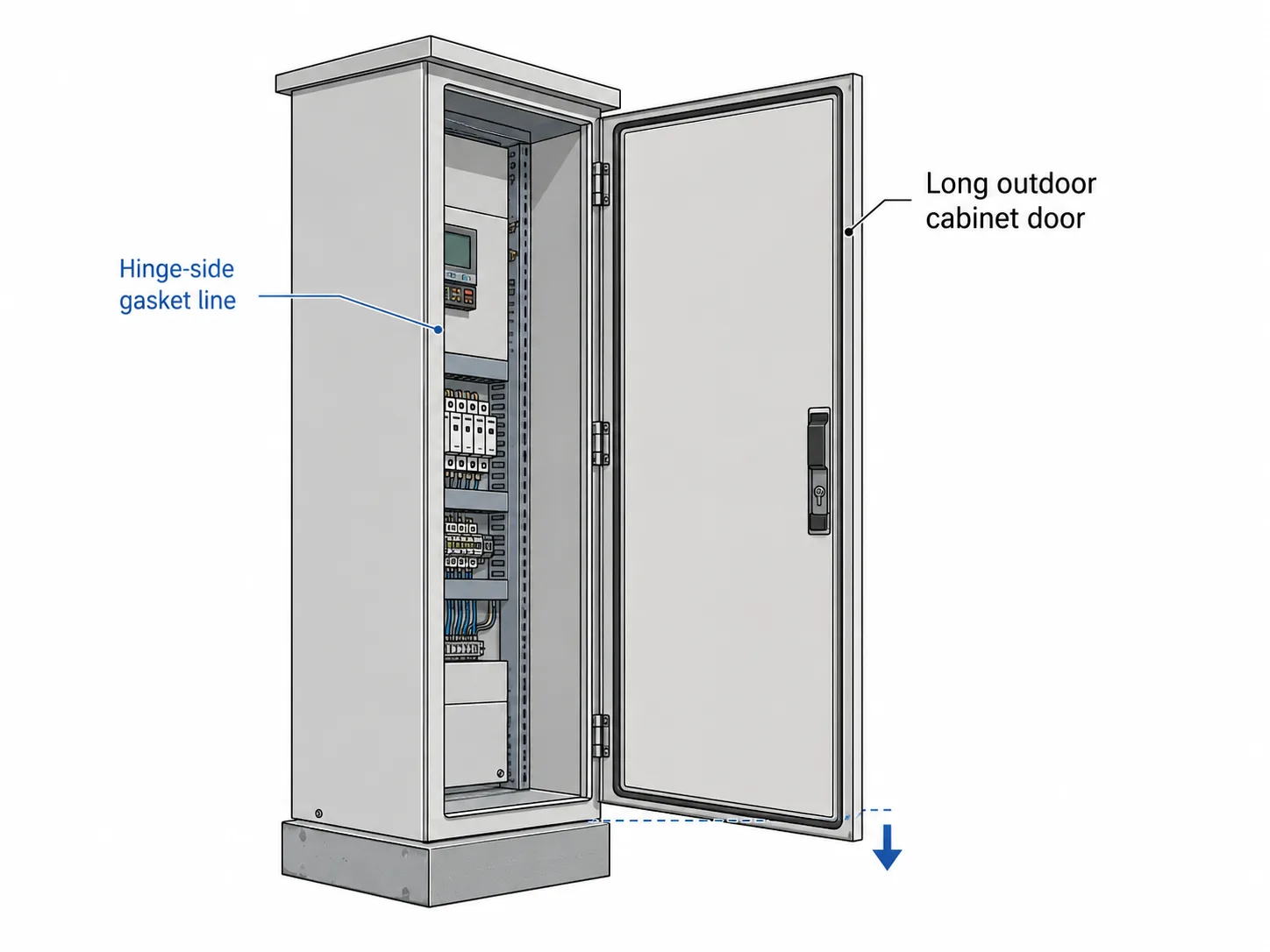
Why Long Outdoor Cabinet Doors Sag
Long cabinet doors create more leverage than short access panels. Even when the door weight looks manageable on paper, the combination of door height, door width, gasket compression, wind load, vibration, and repeated service access can create hinge-side movement over time.
The problem is usually not caused by one single factor. Sag often develops from a chain of small issues:
- The hinge line carries the door weight at limited support points.
- Pin wear or knuckle clearance increases after repeated opening.
- Fasteners loosen or the mounting holes begin to elongate.
- The door skin or frame flexes under cyclic loading.
- The latch-side corner drops slightly.
- The gasket no longer compresses evenly along the perimeter.
- Water, dust, or humid air enters through the weakened seal area.
Once the door begins to drop, gasket replacement alone may not solve the problem. The new gasket may compress correctly for a short time, but if the hinge line continues to move, the seal gap can return.
For projects still deciding between point-loaded butt hinges and a full-length hinge layout, the continuous hinges vs butt hinges load distribution guide should be reviewed before finalizing the hinge type. This page assumes that decision is leaning toward a continuous hinge and focuses on whether it will actually fix the sag.
Failure Chain: From Hinge Load to Field Failure
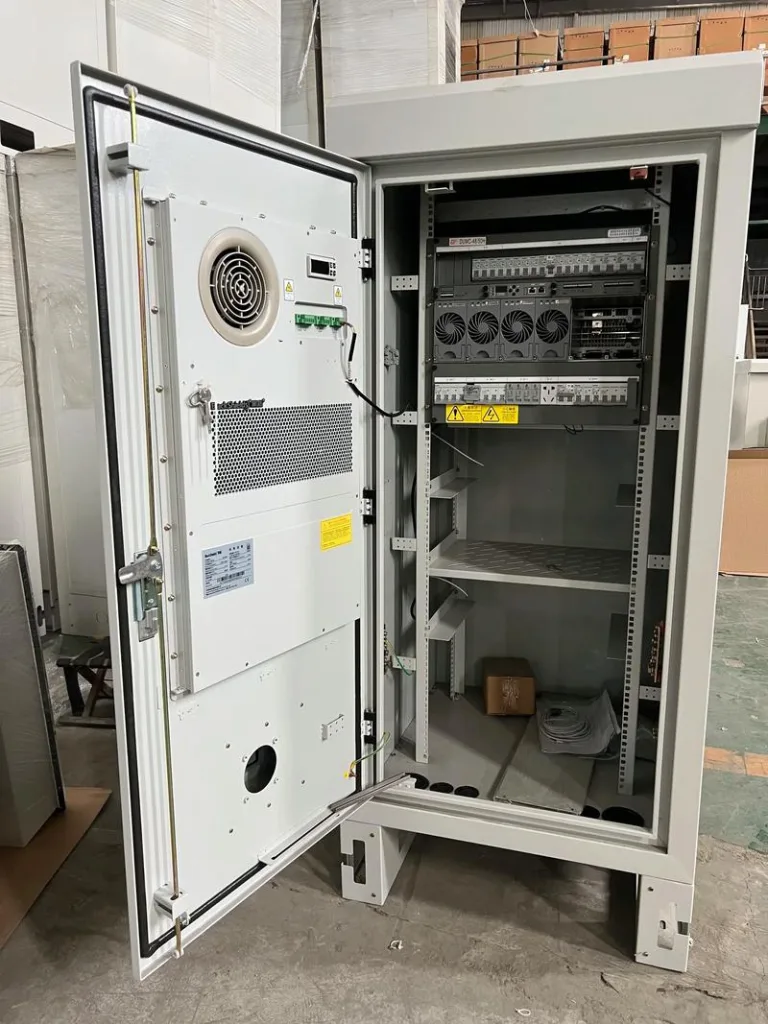
Long outdoor cabinet doors are common in telecom cabinets, power distribution enclosures, EV charging equipment, rail signaling cabinets, water treatment controls, industrial HVAC cabinets, and roadside utility enclosures. These doors may be exposed to thermal cycling, direct sun, wind, rain, traffic vibration, and repeated field service.
When the hinge support is concentrated at two or three discrete hinge points, load and movement can concentrate at the hinge pin and knuckle interface, the hinge mounting screws, the door-side hinge leaf attachment area, the frame-side mounting surface, the latch-side gasket gap, and the lower corner of the door.
As movement develops, the latch side may no longer return to the same position. The door can still close, but the gasket compression becomes uneven. This is where field problems begin. The enclosure may show moisture tracks, rust, dust ingress, latch misalignment, or repeated complaints that the door is “hard to close.”
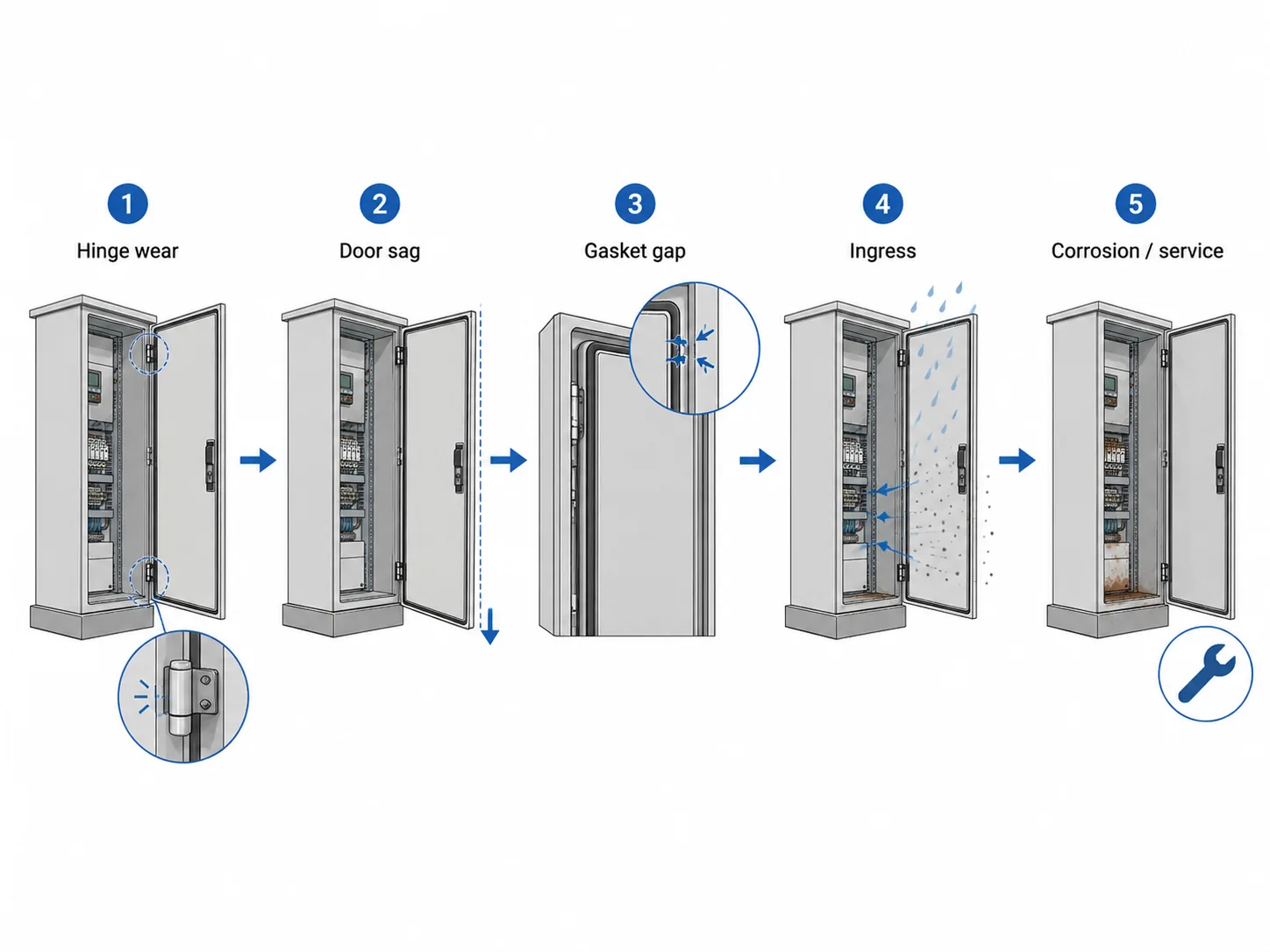
The business consequences are practical:
- Extra service visits for adjustment or hinge replacement
- Recurring gasket replacement without solving the root cause
- Increased corrosion risk inside the enclosure
- Reduced confidence in IP or NEMA protection performance
- Door handling risk in windy outdoor conditions
- Shorter service life for hinge pins, fasteners, and latches
When sag has already changed the gasket line or protection target, the IP-rated enclosure hinge checklist can help verify door alignment, latch force, mounting holes, and hinge-side sealing before approval.
When Continuous Hinges Help Reduce Door Sag
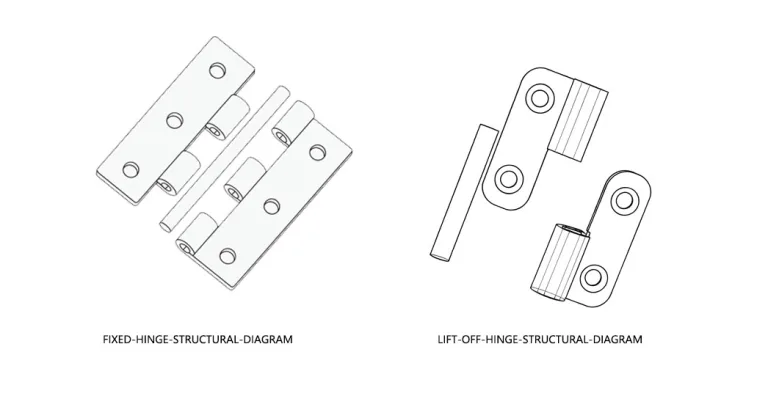
A continuous hinge, often called a piano hinge, supports the door along most or all of the hinge edge. Instead of carrying the door at a few separate points, it spreads the load across a longer mounting line. This can help reduce sag when the main problem is point loading along a long door edge.
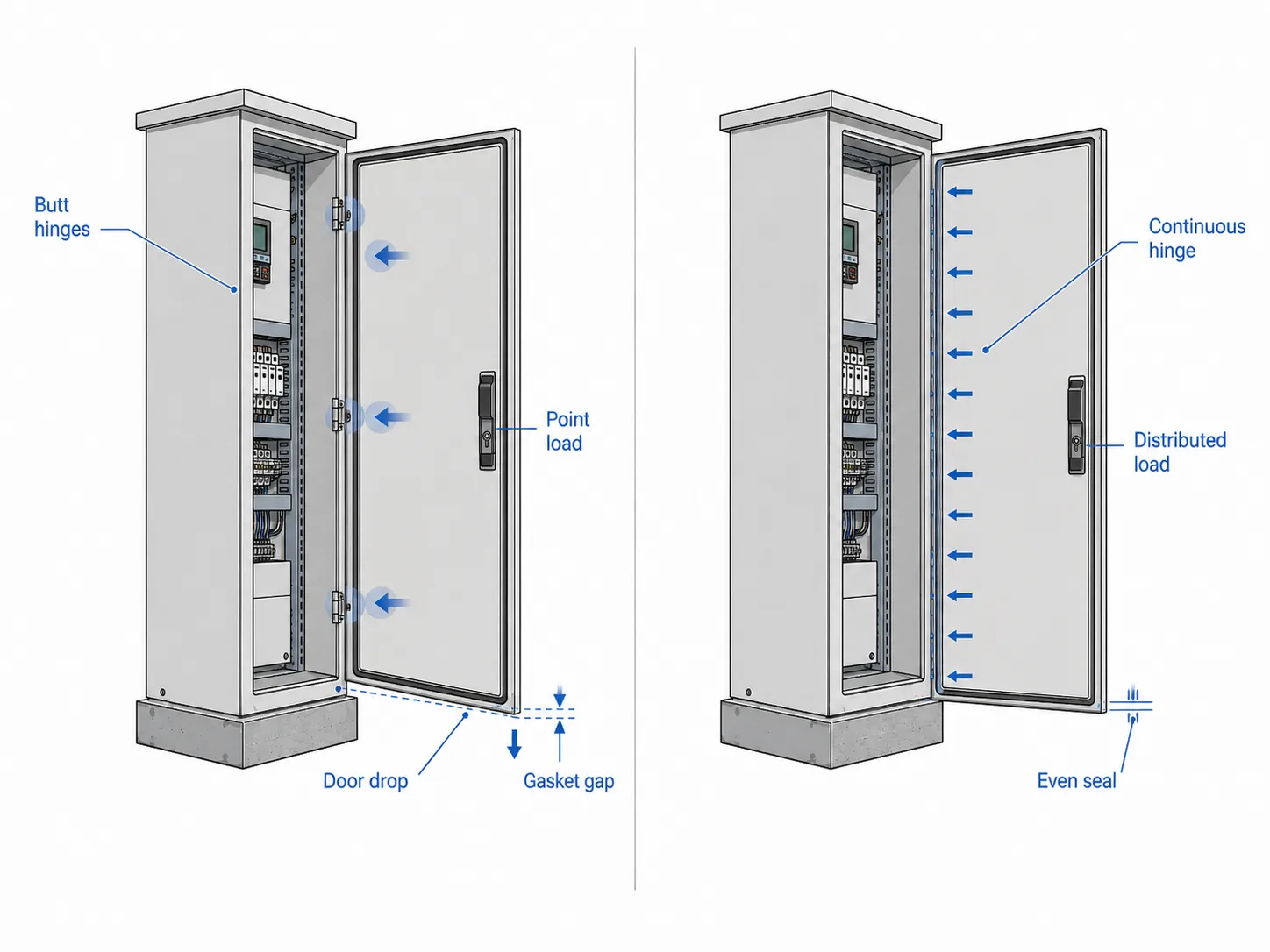
Continuous hinges are most useful when:
- The door is tall or wide enough that point-loaded hinges create visible movement.
- The door uses a perimeter gasket that requires stable compression.
- The cabinet is outdoors and must maintain alignment through thermal cycling.
- The latch side has started to drop after repeated service access.
- The current hinge pins, barrels, or mounting screws show wear.
- The hinge-side frame has enough straight mounting surface for a full-length hinge.
- The door and frame are stiff enough to benefit from distributed support.
The main benefit is not simply “more hinge.” The value comes from a more stable hinge-side load path. When the hinge line remains straighter, the latch side is less likely to drop, and the gasket has a better chance of compressing evenly.
Where Continuous Hinges Do Not Solve the Problem
A continuous hinge does not fix every sagging door. It can only support the door properly if the surrounding structure is stable enough.
A continuous hinge may not solve the problem when:
- The door panel is too flexible.
- The frame is twisted or out of square.
- The hinge mounting surface is uneven.
- The door lacks stiffening channels or formed return edges.
- The gasket seat is already damaged.
- The fastener substrate is too thin or weakened by corrosion.
- The cabinet still allows water to collect around the hinge line.
- The hinge material and fasteners are incompatible with the outdoor environment.
If the door skin bends or the frame bows, a continuous hinge may simply follow that deformation. In that case, the repair must address door reinforcement, frame flatness, or mounting strength before hinge replacement. This is why continuous hinges should be treated as part of a sag-control system, not as a standalone cure.
Decision Logic: When to Evaluate a Continuous Hinge
Use the table below as a screening tool. Final approval should still follow the cabinet drawing, hinge supplier data, door weight, and project requirements.
| Door Condition | Sag Risk | Continuous Hinge Direction | What to Verify |
|---|---|---|---|
| Short or light access door with low gasket load | Low | Butt hinges may be sufficient | Hinge spacing and fastener grip |
| Long door with visible latch-side drop | Medium to high | Continuous hinge should be evaluated | Door stiffness, frame flatness, gasket line |
| Tall gasketed outdoor door | Medium to high | Continuous hinge often helps stabilize the seal plane | Gasket compression, latch force, hinge mounting surface |
| Door with repeated hinge pin or screw wear | High | Continuous hinge or revised hinge layout should be reviewed | Pin wear, mounting holes, substrate strength |
| Door panel bends when opened | High, but not hinge-only | Continuous hinge alone is not enough | Door reinforcement and formed edges |
| Frame is out of square | High, structural issue | Correct frame before hinge approval | Frame geometry and installation condition |
| Coastal or corrosive outdoor site | Material-dependent | Continuous hinge may help load distribution, but material review is required | Hinge material, pin, fasteners, isolation layer |
This table helps separate two different questions: is the door sag caused by point-loaded hinge support, and is the door or frame structure strong enough for a continuous hinge to help? Both must be answered before changing hinge type.
Material and Structure Checks for Outdoor Use
Continuous hinge performance depends on more than hinge length. Material, pin design, leaf thickness, fastener spacing, and mounting surface all affect long-term sag resistance. The corrosivity of the installation site can be classified using ISO 9223, the international classification for atmospheric corrosivity, which helps decide how aggressively the hinge material and fasteners must be specified for the location.
Before approval, check the hinge leaf material, pin material, leaf thickness, knuckle design, fastener spacing, fastener material, door and frame material, isolation layer between dissimilar metals, surface coating or passivation, drainage around the hinge line, and replacement availability.
Outdoor cabinet doors often combine stainless steel, aluminum, galvanized steel, powder-coated steel, and mixed fasteners. If these materials are not isolated correctly, corrosion can loosen the mounting interface and bring back sag even when the hinge itself looks strong. When hinge material, frame material, and fasteners are mixed in wet outdoor conditions, buyers should understand why stainless steel hinges can still corrode before assuming material grade alone prevents loosening.
Common Mistakes That Undercut Sag Control
Mistake 1: Replacing Hinge Type Without Checking Door Stiffness
If the door panel flexes, a continuous hinge may not keep the seal line straight. Door reinforcement, formed returns, or stiffener channels may be needed before the hinge change works.
Mistake 2: Treating the Continuous Hinge as a Load Rating Shortcut
A long hinge does not automatically mean enough capacity. The supplier still needs door weight, width, opening frequency, material, fastener method, and service environment before recommending a hinge.
Mistake 3: Ignoring Fastener Pull-Out Strength
A continuous hinge distributes load, but every fastener still needs adequate grip. Thin sheet metal, damaged holes, poor inserts, or corrosion around fasteners can reduce clamp load and allow the door to shift.
Mistake 4: Mixing Materials Without Isolation
Aluminum, stainless steel, galvanized steel, and carbon steel can create compatibility problems in wet outdoor conditions. Isolation tape, washers, sealing layers, or material changes may be required.
Mistake 5: Replacing the Gasket Before Correcting Door Sag
A new gasket will not solve the problem if the door no longer sits square. If the hinge line moves, the gasket can lose compression again. If the hinge line stays straight but gasket recovery is still uneven, the issue may belong in hinge gasket material selection rather than hinge layout.
Inspection Checks Before Approving a Continuous Hinge
Before changing to a continuous hinge, the maintenance or engineering team should document the current door condition. Check the following:
- Is the latch-side corner visibly lower than the frame reference?
- Does the door need to be lifted before latching?
- Are hinge pins, knuckles, or barrels worn?
- Are hinge screws loose or are mounting holes elongated?
- Is the door panel flexible when opened?
- Is the frame square and flat?
- Does the gasket show uneven compression?
- Is corrosion visible around hinge screws or mounting points?
- Does the door carry mounted components that increase load?
- Does wind, vibration, or frequent service access affect the door?
This inspection helps determine whether the issue is mainly hinge layout, door structure, frame condition, gasket condition, or corrosion.
What to Send a Supplier for Review
When requesting continuous hinge recommendations, do not rely only on a part number or product photo. Send enough information for a real application review:
- Door height, width, thickness, and material
- Approximate door weight, including mounted hardware or panels
- Frame material and thickness at the hinge mounting face
- Current hinge type, hinge count, and spacing
- Current failure mode: sag, hinge pin wear, gasket leak, fastener loosening, or door bending
- Photos of hinge side, latch side, gasket line, and door frame
- Required opening angle
- Gasket profile and required compression behavior
- Target IP or NEMA protection requirement
- Outdoor environment: inland, coastal, roadside, industrial, washdown, or high humidity
- Service frequency and expected maintenance interval
- Preferred fastener type or existing mounting method
- Required documentation: drawing, material certificate, sample report, or test evidence
This information allows the supplier to recommend hinge length, leaf thickness, pin design, material grade, fastener spacing, and whether a standard or engineered continuous hinge is appropriate.
Final Recommendation
For long outdoor cabinet doors, continuous hinges should be evaluated when door sag affects latch alignment, gasket compression, or enclosure reliability. Their main advantage is load distribution along the hinge edge, which can reduce point loading and help maintain a more stable seal plane.
However, a continuous hinge is not a complete solution by itself. Door stiffness, frame flatness, mounting strength, fastener design, material compatibility, and gasket behavior must all be reviewed together. If the door panel bends, the frame is distorted, or the mounting surface is weak, the door can still sag regardless of hinge type.
The safest decision is to treat the hinge as part of the door system. Review the door geometry, support path, gasket line, latch behavior, material stack-up, and site exposure before approving the hinge change.
FAQ
Do continuous hinges always prevent cabinet door sag?
No. Continuous hinges can reduce sag caused by point loading, but they cannot correct a flexible door panel, twisted frame, weak mounting substrate, or damaged gasket seat.
When should I consider a continuous hinge for an outdoor cabinet door?
Consider a continuous hinge when a long or gasketed outdoor cabinet door shows latch-side drop, repeated hinge wear, uneven gasket compression, or fastener movement along the hinge side.
Can a continuous hinge improve gasket sealing?
A continuous hinge can help keep the hinge-side gap more stable, which may support more even gasket compression. Final sealing still depends on frame flatness, latch force, gasket design, and installation accuracy.
Are butt hinges still acceptable on outdoor cabinet doors?
Yes. Butt hinges can work on shorter, lighter, or less demanding cabinet doors when hinge spacing, fasteners, door stiffness, and gasket requirements are appropriate.
What information should I send before asking for a continuous hinge recommendation?
Send door size, door weight, frame material, current hinge layout, gasket profile, opening angle, environment, failure photos, and required protection target. This allows the supplier to review the full door system instead of only matching a hinge part number.
Need Help Reviewing Long Outdoor Cabinet Door Sag?
If your outdoor cabinet door shows latch-side drop, uneven gasket compression, hinge pin wear, loose fasteners, or recurring water ingress after gasket replacement, HTAN can help review whether a continuous hinge, revised fastener pattern, or door reinforcement is the better direction. Share your door dimensions, estimated weight, hinge photos, frame material, gasket layout, site environment, and target protection requirement. Our engineering team can help recommend a hinge direction for your application.


 English
  한국어
한국어  Русский
  Español
  Italiano
  Deutsch
  Français
  Português