

Stainless Steel vs Aluminum Hinges for Washdown Equipment
When engineers compare stainless steel vs aluminum hinges for washdown equipment, the decision is not a contest between a “corrosion-proof” metal and a “lightweight” one. A stainless leaf can resist general staining yet fail around a wet crevice. An anodized aluminum leaf can look intact after routine rinsing yet corrode at a machined bore, worn pivot, or stainless fastener interface. Both outcomes are controlled by the installed system and the cleaning process, not the alloy name alone.
The useful decision is narrower: define the actual washdown cycle, identify where the hinge retains liquid or loses surface protection, then compare complete hinge assemblies under that same exposure. Stainless steel is often the more conservative development direction when finish abrasion is unavoidable or the documented cleaner is unsuitable for the proposed aluminum finish. Aluminum remains viable when mass matters, the exposure is compatible, and the finish, geometry, fasteners, and validation are engineered together.
For dry, outdoor, cold-storage, medical, or other equipment contexts that do not share this washdown process, return to the industrial hinge solutions by application instead of carrying this material decision into a different environment.
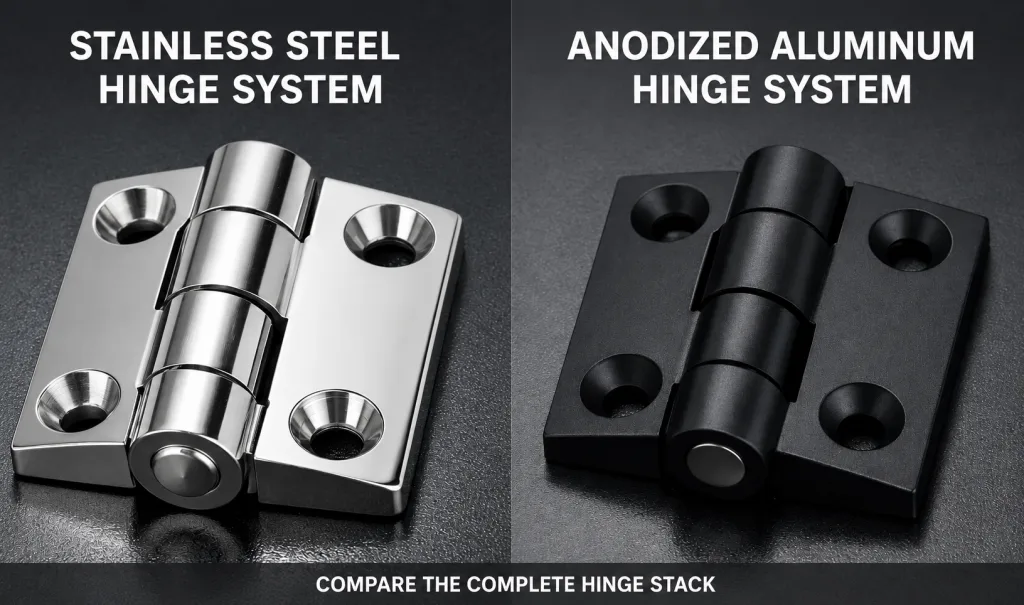
Start With the Washdown Recipe, Not the Metal
“Washdown” can mean an occasional low-pressure water rinse or a repeated hot-cleaning cycle with detergent, disinfectant, dwell time, mechanical brushing, and a final rinse. Those are not equivalent material exposures. A material decision made from the word wet or from an enclosure rating alone is incomplete.
Record the process at the hinge location, not only the cleaning specification for the machine as a whole. The hinge may sit below a spray path, beside a chemical foamer, behind a shield that dries slowly, or next to a hot process surface. It may receive concentrated runoff even when it is not directly sprayed.
| Washdown input | Why it changes the hinge decision | What to record |
|---|---|---|
| Cleaner or disinfectant | Water compatibility does not establish compatibility with acids, alkalis, oxidizers, chlorides, surfactants, or blended products. | Commercial product name, current technical data sheet, and safety data sheet |
| Use concentration | A diluted product and a concentrate leak can create different attack mechanisms. | Normal concentration plus credible dosing or mixing upset |
| Temperature and contact time | Higher temperature or longer wet contact can change the rate of coating attack and localized corrosion. | Liquid temperature at the hinge and maximum dwell before rinse |
| Pressure and impingement | Spray can drive liquid into knuckles, bearing gaps, mounting interfaces, and damaged coating edges. | Nozzle distance, direction, pressure range, and shielding |
| Frequency | Daily cycling can prevent full drying even when each individual wash is mild. | Cycles per shift or week and planned service life |
| Rinse and dry condition | Cleaner left in a crevice may concentrate as water evaporates. | Rinse-water quality, drainage path, air-dry time, and any heated drying |
| Soil and carryover | Salt, process residue, and cleaner deposits can create a different local environment from the fresh solution. | Expected residues and where runoff accumulates |
Decision boundary: If the cleaner, concentration, temperature, rinse condition, or frequency is unknown, the material choice is still preliminary. Mark the missing field To Be Confirmed (TBC) rather than converting a generic corrosion claim into a drawing requirement.
The Hinge Is a Stack of Materials
A hinge described as “stainless” or “aluminum” may refer only to the leaves. The pin, knuckle, bushings, thrust washers, fasteners, spacers, spring elements, lubrication, threadlocker, and mounting structure can all respond differently to the same washdown.
This distinction matters because corrosion frequently starts at an interface rather than on the broad exposed face. Water enters the annular space around a pin, the joint beneath a washer, the gap between a leaf and the frame, or the freshly cut surface of an anodized hole. The visible leaf may still look acceptable while joint friction, fastener preload, door alignment, or coating adhesion is changing.
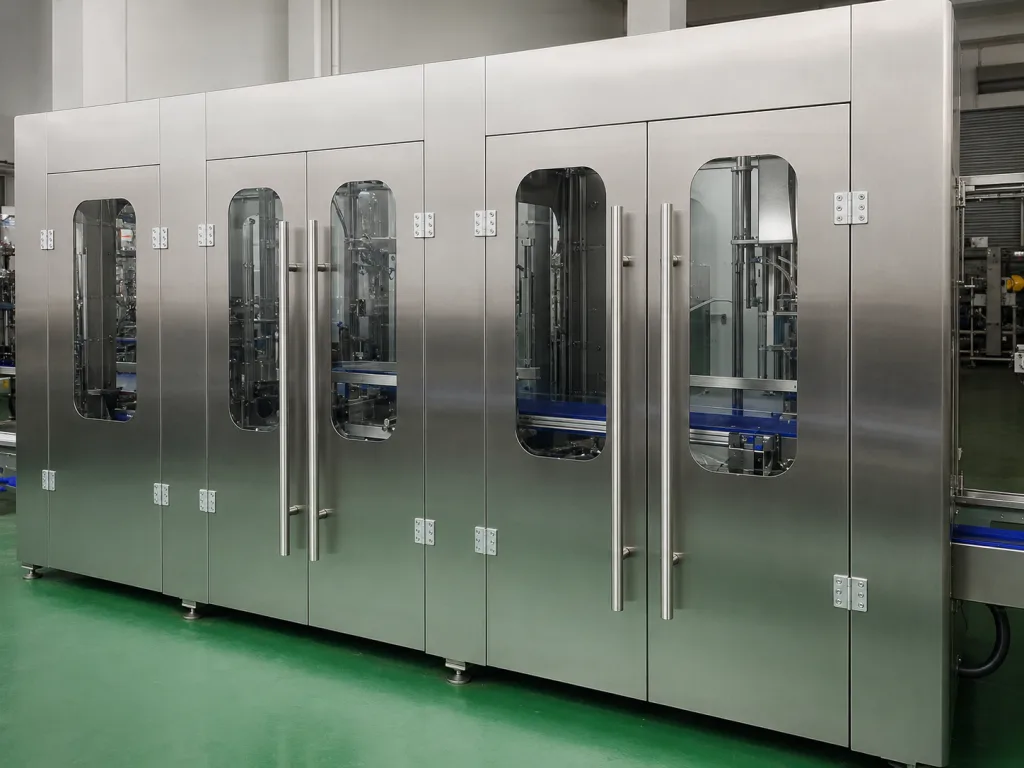
The visible hinge leaves are only part of the installed system. Pins, fasteners, mounting interfaces, door seams, and surrounding equipment materials must be reviewed under the same cleaning exposure.
| Assembly location | Stainless-system concern | Aluminum-system concern | Drawing or sample question |
|---|---|---|---|
| Leaf and knuckle | Grade, surface contamination, crevice condition, weld cleanup | Alloy/temper, finish type, coating continuity, forming damage | Are base material and post-fabrication finish identified? |
| Pin and bearing interface | Galling, retained cleaner, lubricant compatibility | Coating wear, local aluminum exposure, dissimilar pin material | What runs against what after cycling? |
| Mounting holes | Crevice beneath head or washer; contamination from tools | Bare cut edge, coating crush, stainless-fastener galvanic couple | Are bores finished after machining, and is isolation required? |
| Leaf-to-frame joint | Stagnant water or incompatible surrounding metal | Wet contact with stainless or coated steel; hidden coating damage | Can the interface drain and be inspected? |
| Lubricant or polymer parts | Chemical washout, swelling, embrittlement, residue retention | Same risk; a sound metal finish does not protect incompatible nonmetal parts | Has the complete material stack been exposed to the cleaner? |
For supplier comparison, request a bill of materials or a controlled material declaration for the tested sample. A leaf certificate alone does not identify the installed corrosion system.
The pin, bushing, and lubricant can overrule the leaf choice
The pivot converts a static material question into a moving-interface problem. Spray can remove or dilute lubricant, carry particles into the bearing gap, and repeatedly wet fresh wear tracks. If friction rises, the operator may feel binding before broad corrosion is visible. If the bearing opens up, door play can increase while the leaves still look acceptable.
In an aluminum design, wear through an anodized bore can expose base material at the same location where a dissimilar pin and retained liquid meet. In a stainless design, an unsuitable sliding pair or loss of lubrication can increase scoring or adhesive wear. A polymer bushing can interrupt metal contact, but only if its cleaner resistance, swelling, compression, temperature, and wear behavior are compatible with the project. These are not reasons to favor one leaf material automatically; they are reasons to specify and test the actual pivot stack.
Baseline and post-exposure measurements should therefore include the function the hinge must retain: opening force or torque where applicable, free play, axial movement, audible or tactile roughness, and evidence of lubricant migration or washout. The acceptance limits must come from the equipment requirement and the approved sample—not from a generic material table.
Where Stainless Steel Earns Its Margin
Stainless steel provides corrosion resistance through a passive surface film rather than a separately applied barrier coating. That gives it an important practical advantage on a hinge: normal forming, small scratches, and exposed edges do not automatically reveal a completely different base material. This is valuable where pivot movement, tool contact, repeated handling, or abrasive cleaning makes perfect finish preservation unrealistic.
It is still not corrosion-proof. Chloride-bearing products, acidic residues, high temperature, long contact time, incomplete rinsing, surface contamination, and oxygen-starved crevices can overwhelm the local passive condition. World Stainless guidance for wet industrial installations identifies chloride content as a crucial factor in pitting and crevice corrosion and emphasizes appropriate grade selection and drainage. The implication for a hinge is direct: the hidden washer and knuckle gaps deserve more attention than the broad exposed face.
304 and 316 are directions, not automatic approvals
A 316-family stainless direction generally offers more margin than 304-family material against chloride-driven localized corrosion because of its alloying content. That does not establish compatibility with every sanitizer, concentration, temperature, fabrication route, or crevice. The requested grade, product form, finish, weld condition, fasteners, and post-fabrication cleaning must match the sample that is validated.
When an installed stainless hinge already shows staining, pitting, or rust at specific points, the task changes from material selection to root-cause diagnosis. Use the separate guide on why stainless steel hinges still corrode rather than assuming that an upgrade in grade will correct contamination, trapped chemistry, or incompatible hardware.
Do not approve “stainless steel” as a complete specification. At minimum, the drawing or purchase specification needs the grade/family, material condition where relevant, exposed finish, pin and fastener materials, and any required post-fabrication treatment. Exact values remain project-specific until the supplier and OEM agree on them.
Aluminum Depends on an Intact, Specified Finish
Aluminum can reduce hinge mass and can be extruded or machined into sections that place material where stiffness is needed. Its natural oxide provides some protection, and anodizing can create a harder, more corrosion-resistant surface. Those benefits make aluminum a legitimate engineering option for controlled washdown—not a substitute that should be approved from density alone.
The finish must be treated as a functional requirement. “Anodized” does not define the process type, thickness class, sealing, appearance limits, rack/contact marks, masked areas, or post-machining condition. The Aluminum Anodizers Council notes that cleaner concentration, exposure time, temperature, and prompt rinsing influence the result, and it cautions against harsh acidic or alkaline cleaners. For equipment hinges, the most revealing locations are often edges, holes, fastener seats, formed regions, and the knuckle where movement can polish or fracture the surface.
The drawing sequence changes the result
A hole machined after anodizing exposes a different surface from a hole machined before the final finish. A countersunk screw may crush the coating locally. Pressing a hard pin through a coated bore may damage the entry edge. Forming prefinished stock can create microcracks. None of these details is visible in a material dropdown labeled “aluminum.”
Aluminum is a stronger candidate when the wash chemistry is documented as compatible, the finish can remain continuous at exposed and machined areas, standing liquid is avoided, and the complete assembly passes the actual cleaning cycle. If aggressive chemicals, unavoidable abrasion, uncontrolled maintenance tools, or persistent wet crevices are credible, the amount of process control needed to protect aluminum may outweigh its mass benefit.
Equal Envelope Does Not Mean Equal Structure
A material comparison becomes misleading when two hinges are forced into the same leaf thickness, knuckle size, pin diameter, and fastener pattern. Stainless and aluminum designs may need different cross-sections to deliver comparable stiffness, bearing stress, thread engagement, deformation resistance, and cycle performance.
Lower material density can reduce mass, but the installed saving depends on geometry. A thicker aluminum leaf, longer bearing length, reinforced mounting area, larger pin, or additional fastener can consume part of the theoretical advantage. Conversely, copying a thin stainless geometry in aluminum can increase leaf flex, hole elongation, knuckle deformation, or door movement even when the static load looks modest.
Engineering conflict: Suppose an OEM requires the aluminum hinge to fit the stainless hinge’s exact envelope. The aluminum sample may meet an initial hand-operated check but need a stainless pin and stainless fasteners for wear and assembly. The resulting mixed-metal joints become the wettest points in the system, while the fixed envelope prevents adding section thickness or isolation space. The correct response is not to declare either material superior; it is to resolve the envelope, stiffness, wear, and galvanic requirements together before sample approval.
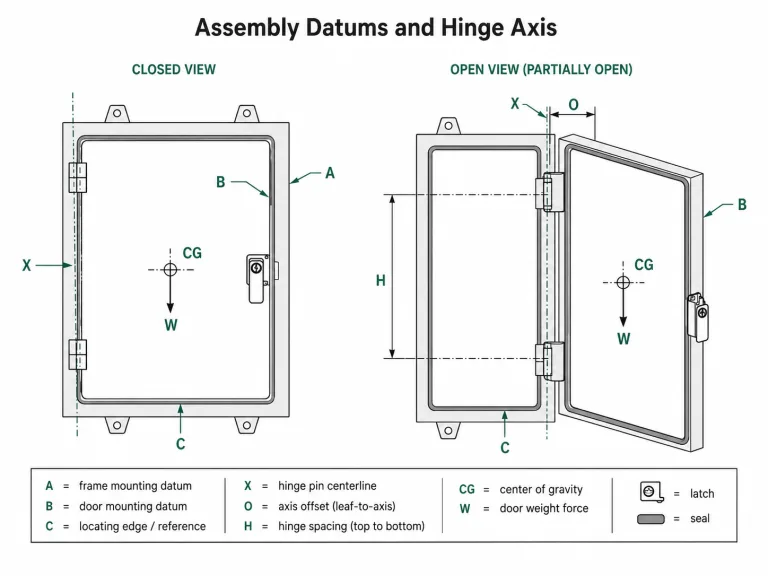
Structural approval should therefore use the real door or cover mass, center-of-gravity distance, hinge spacing, opening range, stops, dynamic loads, gasket or latch reaction, expected cycles, and mounting substrate. This article does not calculate the required hinge size because those inputs are equipment-specific. The comparison is valid only after each candidate has a credible geometry for the same mechanical duty.
Mixed Metals Move the Risk to the Fasteners
Direct contact alone does not establish galvanic corrosion. The metals must be electrically connected and bridged by an electrically conductive liquid. In washdown equipment, retained cleaner or rinse water can provide that path. A common arrangement places a stainless fastener or pin against an aluminum leaf or frame; the stainless component may remain visually unchanged while attack concentrates in exposed aluminum around a hole, beneath a washer, or beside damaged finish.
Severity also depends on the liquid chemistry, time wet, potential difference, and exposed area ratio. World Stainless fabrication guidance explains that galvanic attack on the more active metal increases as the exposed area of the more noble metal grows relative to it. A small bare aluminum defect connected to a larger stainless surface is therefore less favorable than the material names alone suggest.
Electrical isolation can reduce direct metal-to-metal contact, but an insulating washer by itself is not a complete design. The screw shank, thread, countersink, pin, spacer, or damaged coating may still bridge the materials. Isolation parts also need chemical, temperature, compression-set, and wear compatibility with the washdown process.
- Map every metal pair across the leaf, pin, bearing, fastener, washer, frame, and door.
- Show where water can connect those metals after assembly.
- Define sleeves, washers, sealants, coatings, or compatible fastener choices as controlled parts—not installer preferences.
- Inspect the isolated interface after mechanical cycling; movement can cut through coatings or shift a washer.
- Keep drainage open. A sealed-looking joint that admits liquid but cannot release it can be worse than an inspectable gap.
Drainage Can Reverse a Material Decision
A well-drained, inspectable aluminum assembly may perform more predictably than a nominally higher-resistance stainless assembly that traps concentrated cleaner. Material selection cannot compensate for a horizontal pocket, blind mounting gap, upward-facing knuckle, absorbent gasket edge, or unsealed overlap that remains wet between shifts.
At the hinge zone, check the equipment in its installed orientation and through its full opening range. A door that drains when closed may direct water into the knuckle when open for cleaning. A hinge cover may block direct spray yet retain foam behind it. A removable panel may expose sharp or unfinished edges during sanitation. These are geometry questions, not alloy properties.
For food-contact or hygienic processing equipment, the design task extends beyond this material comparison into residue control, exposed threads, cleanability, sanitation access, and plant-specific requirements. Assign that work to the food processing hinge washdown guide; do not treat a pass in this comparison as hygienic-design approval.
Test the Cleaner Cycle the Hinge Will Actually See
Material certificates and coating records establish what was supplied. They do not prove that the assembled hinge will remain functional after repeated exposure to the project cleaner. A useful validation sequence couples environmental exposure with mechanical operation so that new wear surfaces, coating damage, and liquid paths develop as they will in service.
- Freeze the comparison. Identify the stainless and aluminum sample configurations, including leaf, pin, fasteners, bushings, lubricant, finish, mounting substrate, and assembly process.
- Measure a baseline. Record opening force or torque where relevant, free play, door position, visual condition, coating condition, and agreed critical dimensions. Use project-specific acceptance limits.
- Apply mechanical cycles. Operate the hinge through the real angle and load. Include stops, latches, gaskets, and production fasteners when they affect the load path.
- Run the defined washdown. Use the approved cleaner at its specified concentration, temperature, contact time, spray direction, rinse, and drying condition. Add a separately agreed upset only when it represents a credible event.
- Repeat in a realistic order. Alternate operation and cleaning rather than exposing an untouched cosmetic coupon only. The sequence should create the same wear and wet interfaces that the installed hinge will experience.
- Inspect function and location-specific damage. Check broad surfaces, edges, bores, knuckles, fastener seats, frame interfaces, isolation parts, lubricant condition, binding, free play, and door alignment.
- Document the decision. Tie observations to sample identity and test revision. Do not convert an uncalibrated visual impression into a universal pass/fail claim.
ASTM B117 is supporting evidence, not a washdown simulation
ASTM B117 defines the apparatus, procedure, and conditions for a salt-spray environment. Its scope does not prescribe the product’s test specimen, exposure duration, or interpretation of results. A B117 report can support coating-process control or a project specification when the specimen, duration, preparation, and acceptance criteria are agreed. It does not, by itself, demonstrate resistance to a proprietary alkaline cleaner, sanitizer cycling, spray impingement, lubricant washout, mechanical wear, or trapped residue.
If salt fog is relevant to the project, keep it as one evidence stream and require the report to identify the tested sample and revision. Then run a separate project washdown sequence on the complete hinge. The two tests answer different questions.
A broader fit, function, documentation, and production check can be handled with the hinge sample approval checklist. This page retains the narrower responsibility of comparing the two washdown material systems.
Stainless Steel vs Aluminum Hinges: Choose With Evidence
The final comparison should be made after both candidates have credible geometry and after the washdown inputs are recorded. “Preferred” in the table below means the more defensible development direction—not automatic approval for production.
| Project condition | Preferred direction | Reason | Evidence still required |
|---|---|---|---|
| Frequent washdown; finish abrasion or maintenance-tool contact is difficult to prevent | Stainless steel | Corrosion resistance is not dependent on maintaining a separate barrier coating over every exposed edge. | Exact grade, finish, cleaner compatibility, crevice review, fasteners, and complete-assembly cycle test |
| Chloride-bearing chemistry, elevated temperature, prolonged wet crevices, or incomplete rinsing is credible | Stainless steel, with grade TBC | A higher-resistance stainless direction may provide more margin, while trapped chemistry can still defeat the assembly. | Cleaner data, concentration, temperature, contact time, rinse condition, grade review, and test acceptance criteria |
| Mass reduction materially affects the equipment and wash chemistry is controlled and compatible | Engineered aluminum system | Lower density can reduce assembly mass when geometry, finish, and hardware are optimized together. | Alloy/temper, structural geometry, finish specification, post-machining protection, complete weight comparison, and wash-cycle test |
| Anodized aluminum can remain intact, drained, and isolated from stainless hardware | Aluminum remains viable | Controlled finish and interfaces can make aluminum practical in a documented compatible washdown process. | Coating continuity at bores/edges, seal quality, isolation design, wear cycling, cleaner compatibility, and inspection limits |
| Stainless pin or fasteners must contact aluminum in a persistently wet joint | Redesign interface before choosing | Galvanic and crevice conditions may dominate the base-metal comparison. | Wet-path map, exposed area ratio, isolation stack, surrounding frame material, mechanical durability, and assembled exposure test |
| Cleaner chemistry, dwell time, rinse, or drying is unknown | TBC—no production material approval | The environmental requirement has not been defined well enough to compare materials. | Approved washdown recipe and credible upset conditions |
| Washdown is not actually required or another equipment environment controls the decision | Reopen the application requirements | The stainless-versus-aluminum pair may not solve the real task. | Use the site’s application structure to reclassify the exposure before selecting material |
Put the Washdown Decision on the Drawing
The decision is not controlled until procurement, production, and quality teams can reproduce the validated assembly. Transfer only requirements that have been agreed and can be verified.
- Hinge leaf material family and exact grade/alloy when approved
- Material condition or temper where it affects forming or structural performance
- Finish type and controlled finish attributes; use TBC for values not yet established
- Whether holes, countersinks, threads, and cut edges are finished before or after machining
- Pin, bushing, washer, fastener, lubricant, sealant, and isolation materials
- Mounting-frame material and the required isolation or sealing stack
- Drainage orientation and any prohibited water-trapping geometry
- Cleaner reference, concentration range, temperature, contact time, rinse, frequency, and credible upset
- Mechanical and washdown validation method, sample revision, and project-specific acceptance criteria
- Supplier evidence to return with samples and production lots
Do not copy a test duration, coating value, or acceptance limit from a generic article into the drawing. Those values should come from the OEM’s service requirement, the finish supplier’s controlled process, applicable customer requirements, and validation data for the actual assembly.
Send the Hinge and Washdown Conditions Together
For a material review, provide the door or cover drawing, load and hinge spacing, mounting-frame material, target hinge envelope, cleaner product and concentration, wash temperature, frequency, rinse/dry condition, required service cycles, and any preferred stainless or aluminum finish. HTAN can then review which available hinge constructions match the stated conditions and identify fields that still need project confirmation before a sample is ordered.
Submit the washdown hinge applicationQuestions Engineers Ask Before Sample Approval
Is stainless steel always better than aluminum for washdown hinges?
No. Stainless steel is often the more conservative direction when finish abrasion is unavoidable or the documented wash chemistry suits the selected stainless grade better than the proposed aluminum finish. Aluminum can be appropriate when mass matters, its alloy and finish are compatible, mixed-metal joints are controlled, and the complete hinge passes the actual washdown cycle.
Can anodized aluminum hinges be used on washdown equipment?
Yes, under a defined and compatible washdown process. Approval should identify the aluminum alloy and condition, anodizing specification, sealing, machined-edge treatment, pin and fastener materials, drainage, and acceptance criteria. Test the assembled hinge after mechanical cycling because wear at bores, knuckles, and fastener seats can expose areas that a cosmetic coupon does not represent.
Should washdown hinges use 304 or 316 stainless steel?
The answer depends on cleaner chemistry, chloride content, temperature, dwell time, rinse quality, crevices, finish, and surrounding hardware. A 316-family direction generally provides more localized-corrosion margin than 304-family material in chloride-bearing exposure, but neither grade is automatically approved. Confirm the exact grade and complete assembly with project-specific evidence.
Does an ASTM B117 salt-spray result prove washdown resistance?
No. ASTM B117 defines a controlled salt-fog practice, but it does not select the specimen, exposure duration, or result interpretation for a specific hinge. It also does not reproduce a proprietary cleaner, rinse and dry sequence, spray impingement, lubricant washout, or mechanical wear. Use it as supporting evidence and run a separate complete-hinge washdown test.
How can galvanic corrosion be reduced when stainless fasteners meet an aluminum hinge?
Galvanic corrosion requires an electrical connection plus a conductive liquid. Map that wet path and exposed area ratio, then control it with compatible fasteners, insulating sleeves or washers, protected hole edges, drainage, and sealants where appropriate. A washer alone may not isolate the screw shank, thread, countersink, or pin; validate the assembled joint after mechanical and washdown cycling.
For stainless steel vs aluminum hinges, a defensible choice must be tied to a defined washdown recipe, a controlled complete assembly, and acceptance evidence from the real load and cleaning sequence. If any of those three elements is missing, keep the material decision preliminary.


 English
  한국어
한국어  Русский
  Español
  Italiano
  Deutsch
  Français
  Português